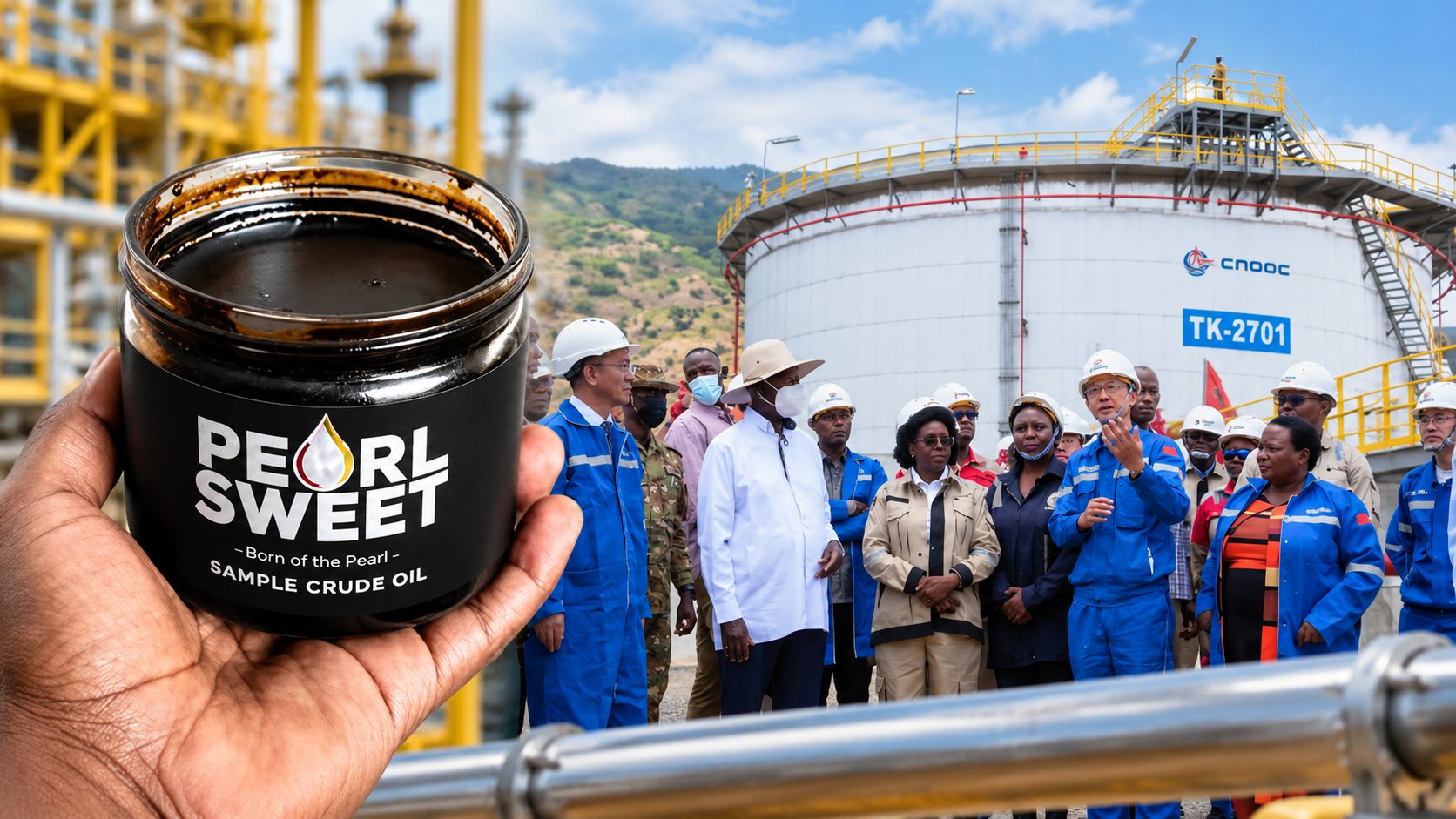
Uganda Pearl Sweet Oil Signals a Powerful New Era
Uganda Pearl Sweet oil is moving from a naming ceremony to the centre of Uganda’s long-awaited entry into commercial crude production, with planned output of about 230,000 barrels per day potentially making the country East Africa’s biggest oil producer.
Uganda has officially named its future crude blend Pearl Sweet, giving a distinct commercial identity to petroleum produced from the Lake Albert region as the country moves toward its first commercial oil production.
President Yoweri Museveni unveiled the name on September 2 at the Kingfisher Development Area in Kikuube District, western Uganda. The choice combines Uganda’s longstanding identity as the “Pearl of Africa” with the relatively low sulphur content of its crude, which places it in the category of “sweet” crude. (The Observer Media Ltd)
But the significance of Uganda Pearl Sweet oil extends well beyond the branding exercise. The name comes as Uganda approaches the culmination of an oil journey that began with commercial discoveries in the Albertine Graben two decades ago.
The country now has two major upstream developments — TotalEnergies-operated Tilenga and China National Offshore Oil Corporation’s Kingfisher — moving toward production, alongside the infrastructure required to transport the crude to international markets.
Together, the projects are designed to reach a peak production rate of approximately 230,000 barrels per day. Tilenga is expected to account for about 190,000 barrels per day and Kingfisher about 40,000 barrels per day. (Reuters)
If that capacity is reached, Uganda would have the potential to overtake South Sudan as East Africa’s largest crude oil producer.
That makes Pearl Sweet more than a new name in the African crude portfolio. It is the commercial identity attached to Uganda’s attempt to establish itself as a significant petroleum producer.
Uganda Pearl Sweet oil marks the end of a long wait
Uganda’s petroleum story has been unusually long for a country that discovered commercially viable quantities of crude roughly two decades ago.
Commercial discoveries in the Albertine Graben were announced in 2006, setting expectations that petroleum could eventually become an important source of government revenue and economic development.
Yet the transition from discovery to production has taken years.
Infrastructure requirements, investment decisions, regulatory processes and disputes surrounding the development and export arrangements all contributed to delays. The projects are now entering a fundamentally different phase: moving from plans and construction toward actual production.
Recent progress at Kingfisher illustrates how close that transition has become.
Uganda’s Energy and Mineral Development Ministry has said the Kingfisher project is about 80% complete, while first-oil readiness has reached 98%, with commissioning tests underway. Its central processing facility has reached mechanical completion and is designed to handle up to 40,000 barrels of crude per day. (Uganda Broadcasting Corporation)
The timing gives the naming of Uganda Pearl Sweet oil a particular significance.
Uganda is no longer simply trying to establish whether it has commercially viable petroleum. It is preparing the product, infrastructure and market arrangements needed to put that petroleum into international trade.
What makes Pearl Sweet different?
The word “Pearl” is a reference to Uganda’s widely used description as the Pearl of Africa, while “Sweet” has a technical meaning within the petroleum industry.
Sweet crude contains relatively little sulphur compared with sour crude. Uganda’s crude has been reported to have a sulphur content of about 0.16%, placing it comfortably within the low-sulphur category. (Monitor)
Low sulphur can be commercially attractive because crude with less sulphur generally requires less processing to remove sulphur compounds during refining.
But Uganda’s crude has another important characteristic: it is waxy.
That matters because the crude can solidify at normal temperatures. The solution is continuous heating during transportation, which is one reason the country’s export infrastructure has been designed around a heated pipeline. (Monitor)
The characteristics of the crude therefore have implications beyond the name.
The blend’s quality will matter to refiners and traders, while its waxy nature creates specific transportation requirements. Uganda’s challenge is consequently not merely to produce crude but to move it reliably from the Lake Albert fields to an international export terminal.
Uganda oil production could change East Africa’s ranking
The most consequential part of Uganda’s petroleum story may be the scale of its planned production.
Tilenga is designed for peak production of approximately 190,000 barrels per day, while Kingfisher is expected to contribute about 40,000 barrels per day.
Combined, that gives Uganda a planned peak capacity of around 230,000 barrels per day. (World Oil)
The significance becomes clearer when Uganda is compared with its regional competitors.
South Sudan has historically been East Africa’s leading crude producer. Uganda’s planned production capacity could change that ranking once its own projects reach their intended levels.
That does not mean Uganda will immediately produce 230,000 barrels per day when commercial production begins. Production is expected to build toward its planned peak rather than reach maximum capacity instantly.
Nevertheless, the target gives Uganda a potentially important position in the regional petroleum market.
It also changes the country’s economic profile.
For years, Uganda has been primarily an importer of petroleum products despite possessing substantial crude resources. The development of domestic production introduces the possibility of combining upstream oil production with refining, energy generation, infrastructure development and exports.
That is the broader transformation behind the Uganda Pearl Sweet oil story.
From Lake Albert to Tanzania
Uganda’s geography creates one of the biggest challenges in its oil strategy.
The country is landlocked.
Producing crude is therefore only one part of the equation. Uganda must transport the petroleum to a seaport before it can reach international buyers.
The principal export route is the 1,443-kilometre East African Crude Oil Pipeline, or EACOP, connecting the oil-producing region in western Uganda with Tanzania’s Tanga port. (Africanews)
The pipeline has been designed to transport Uganda’s waxy crude under heated conditions.
As of September 1, EACOP reported that the project had reached 92.7% overall completion, putting the export infrastructure into the final stage alongside the upstream developments. The company also reported that more than 12,000 people had been directly employed across the project, including more than 4,000 Ugandans. (EACOP)
The pipeline is therefore central to the economics of Uganda’s oil development.
Without an efficient export route, Uganda’s crude production would have limited access to international markets. EACOP provides the physical connection between the Lake Albert fields and the Tanzanian coast.
The arrangement also makes Tanzania an important participant in Uganda’s petroleum story.
Uganda’s oil will cross an international border before reaching the export terminal, making the project both an energy development and a major piece of regional infrastructure.
The export opportunity is only part of Uganda’s plan
Uganda’s government has repeatedly argued that petroleum should not simply become another source of crude exports.
President Museveni has presented oil development as part of a wider strategy involving domestic refining, industrialisation and energy security.
The government plans a 60,000-barrel-per-day refinery at Kabaale, although the project remains at the pre-final-investment-decision stage following an implementation agreement with Alpha MBM International LLC-FZ. (The Observer Media Ltd)
The argument for domestic refining is straightforward: Uganda currently imports petroleum products, while crude produced within the country could provide a domestic feedstock for refining.
Museveni has also argued that refining domestically could reduce some of the transportation and transit costs associated with importing finished petroleum products.
The government’s strategy therefore has two connected components.
Uganda wants to export crude through EACOP while also developing the capacity to refine some petroleum domestically.
That creates a potentially more diversified petroleum economy than one based exclusively on crude exports.
Uganda wants to extract value beyond crude
Another part of the strategy involves natural gas associated with oil production.
Ugandan authorities have said associated gas from Kingfisher will not be routinely flared. Instead, the government plans to use the gas for electricity generation and process additional gas into liquefied petroleum gas for cooking. (SoftPower News)
Museveni has cited a potential electricity-generation capacity of about 80 megawatts from associated gas at Kingfisher.
The objective is to extract more economic value from the petroleum resource rather than treating crude oil as the only commercially useful product.
This approach reflects a broader policy question facing many African oil producers: whether petroleum wealth should primarily finance government spending and exports, or whether it should be used as a foundation for industrial development.
Uganda’s stated ambition is the latter.
The government has pointed to infrastructure, electricity, industrial activity, skills development and other productive assets as areas where petroleum wealth could have a lasting impact.
Pearl Sweet enters an established African crude market
Uganda is not entering an African oil market without precedent.
Several African producers already market their crude under distinctive grades that are familiar to international traders and refiners.
Nigeria, for example, has export grades including Bonny Light, Qua Iboe, Forcados and Bonga, while Angola markets grades such as Girassol and Dalia.
Other African crude grades include Chad’s Doba and Equatorial Guinea’s Zafiro.
Pearl Sweet will therefore join an established system in which crude characteristics, origin and commercial identity are important to buyers.
The naming of Pearl Sweet crude gives Uganda a recognisable label for its future export product.
Ugandan authorities have described the exercise as part of preparing the crude for international marketing and engagement with potential buyers. (Monitor)
The country has also moved toward establishing commercial arrangements around the crude’s marketing, with Vitol’s Bahrain subsidiary appointed to lead international marketing, according to The EastAfrican. (The EastAfrican)
That development illustrates the distinction between producing oil and successfully participating in the global oil trade.
Production requires wells and processing facilities. International sales additionally require transportation, storage, marketing, trading relationships and buyers capable of handling the specific characteristics of the crude.
The environmental cost remains part of the story
Uganda’s oil ambitions have not gone unchallenged.
The country’s petroleum developments and EACOP have faced sustained opposition from environmental groups and other campaigners.
One concern is the location of oil infrastructure near environmentally sensitive areas, including Murchison Falls National Park.
Another is the route of the pipeline, which passes through areas containing forests, wildlife habitats and communities.
Environmental campaigners have argued that the development threatens sensitive ecosystems and conflicts with wider climate objectives. Uganda and its project partners have defended the development, arguing that the country has the right to use its natural resources for economic development while implementing environmental safeguards. (AP News)
The debate is unlikely to disappear when production begins.
Instead, first oil could intensify scrutiny over whether environmental protections promised during the development phase are being implemented effectively.
That will become particularly important as Uganda moves from construction and preparation into an operating petroleum industry.
The economic test begins after first oil
The arrival of commercial production will represent a major milestone, but it will not by itself determine whether Uganda’s petroleum strategy succeeds.
The more difficult test will be what happens to the revenues and economic opportunities generated by the industry.
Uganda’s government has said petroleum wealth should be invested in durable national assets rather than excessive consumption. Museveni has specifically pointed to infrastructure, power generation, railways and other productive investments. (SoftPower News)
That ambition reflects a problem experienced by numerous resource-rich countries.
Oil can generate large revenues without necessarily producing broad improvements in living standards if the proceeds are poorly managed, concentrated in a narrow part of the economy or consumed without building productive capacity.
Uganda is therefore entering a period in which transparency, public accountability and revenue management will become increasingly important.
The country’s Constitution places petroleum resources under government stewardship on behalf of the people, while its petroleum legislation includes provisions concerning sustainable development, environmental protection, national content, transparency and accountability. (The Observer Media Ltd)
The practical implementation of those principles will matter as much as the volume of crude produced.
What Uganda’s oil debut means for Africa
Uganda’s entry into commercial oil production is also significant beyond its borders.
For East Africa, it could introduce a new major crude producer and strengthen the economic relationship between Uganda and Tanzania.
For African energy markets, it adds another export grade at a time when producers are seeking ways to maintain investment in petroleum while also responding to the global energy transition.
For Uganda itself, petroleum offers the possibility of reducing some dependence on imported refined products while creating new revenue and industrial opportunities.
But the size of the opportunity should not be overstated.
A planned peak output of 230,000 barrels per day would make Uganda an important regional producer, but it would remain modest compared with the world’s largest oil-producing countries.
The country’s success will therefore depend less on whether Uganda becomes a global oil giant and more on whether it can use a finite resource to build economic capacity that survives beyond the oil era.
Nigeria can see a familiar lesson in Uganda’s oil ambitions
For Nigeria, one of Africa’s established petroleum producers, Uganda’s experience offers an interesting comparison.
Nigeria has decades of experience producing crude and marketing internationally recognised grades such as Bonny Light. Uganda is approaching the same international market from a very different starting point.
But there is a shared policy challenge: how to turn petroleum production into broader economic value.
Uganda’s emphasis on refining, associated-gas utilisation, infrastructure and local participation reflects an understanding that crude production alone does not automatically create diversified economic growth.
Nigeria’s own experience demonstrates the importance of looking beyond production volumes toward refining capacity, energy security, infrastructure, local industrial participation and effective management of petroleum revenues.
Uganda’s advantage is that it enters the industry with the experiences of established producers available as examples — both positive and negative.
Its ability to learn from those experiences could ultimately matter more than the name attached to its crude.
Pearl Sweet is a beginning, not the destination
The unveiling of Uganda Pearl Sweet oil provides a memorable identity for a resource that has been central to the country’s economic ambitions for two decades.
But the name itself does not produce a single barrel.
The wells, processing facilities, pipeline, export terminal, refinery plans and regulatory systems must all work together before Uganda can fully realise the potential attached to its petroleum resources.
The immediate milestone is first commercial production.
The larger milestone will be what Uganda does with the revenues, skills, infrastructure and industrial capacity that follow.
With Kingfisher approaching first-oil readiness, EACOP reporting more than 90% completion and Tilenga forming the larger part of the planned production system, Uganda is moving closer to the point where its oil ambitions will be measured by results rather than projections. (EACOP)
For East Africa, the arrival of a new crude producer could alter the region’s petroleum hierarchy.
For Uganda, it could represent the beginning of a new economic chapter.
And for the wider African oil industry, Pearl Sweet will soon become more than a carefully chosen name: it will be a crude grade that must compete for buyers, infrastructure and market relevance.
The real measure of Uganda’s oil era will ultimately be whether the wealth beneath Lake Albert can be converted into lasting value above ground.
Recommended Coverage
Uganda is not the only African country seeking to turn its oil resources into greater economic value. See how Nigeria is repositioning its own petroleum sector and attracting new investment.
Investment in Energy, AI and Supply Chains to Boost Nigeria
Oil production alone does not guarantee economic transformation. Explore how energy investment can connect natural resources with wider growth, technology and supply-chain opportunities.
Africa Economic Resilience: AfDB 2026 Report Shows Growth, Stability
Uganda’s oil ambitions come at a time when African economies are seeking stronger and more sustainable growth. Read more about the broader economic trends shaping the continent.
About the Author