
Police have arrested a new suspect and announced the exoneration of the landlord previously under suspicion. But questions remain over the alleged struggle, the crime scene, the midnight phone call, the dog, the missing exhibits, the proposed autopsy, the original investigative team and the evidence linking the new suspect to Vivian Chilaka’s death.
The murder investigation into 23-year-old Vivian Chilaka, the nursing student whose death shocked Alor in Anambra State on June 14, has taken a dramatic turn.
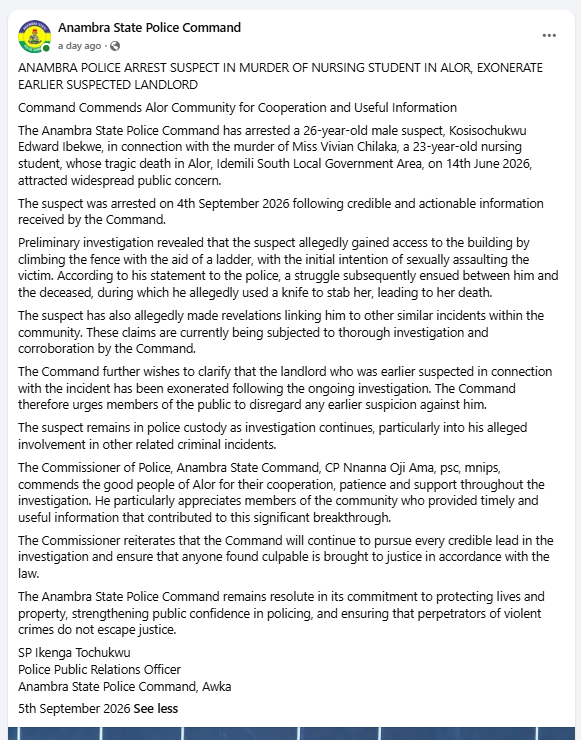
Nearly three months after Vivian was found dead, the Anambra State Police Command announced the arrest of a new suspect — 26-year-old Kosisochukwu Edward Ibekwe, and said the landlord who had previously been under suspicion had been exonerated.
According to the police statement issued on September 5, Ibekwe was arrested on September 4 following what the Command described as “credible and actionable information.”
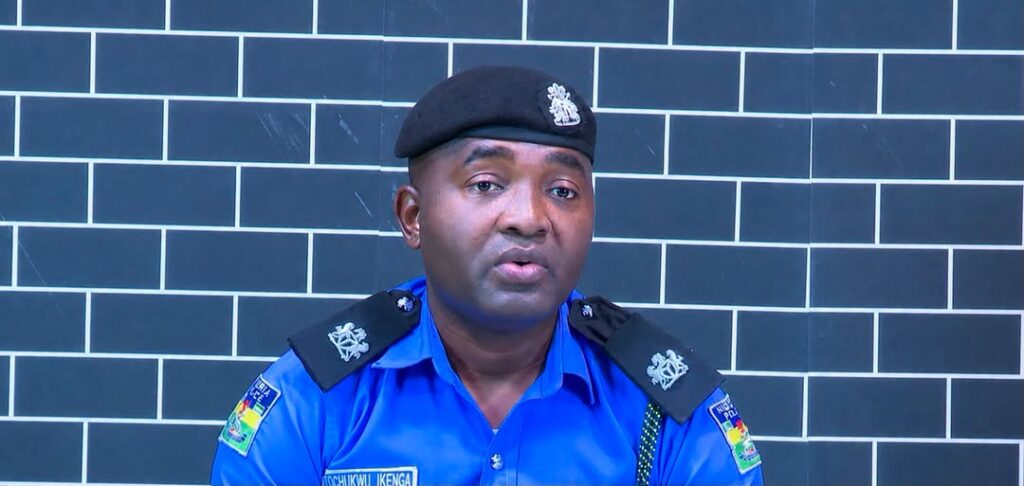
Anambra State Police Command, Awka – SP Ikenga Tochukwu
Police said preliminary investigations indicated that the suspect allegedly gained access to the building by scaling a fence with the aid of a ladder.
The Command further said the suspect allegedly told investigators that his initial intention was to sexually assault Vivian, but that a struggle allegedly followed, during which he allegedly stabbed her with a knife.
Police also said the suspect made revelations allegedly linking him to other similar incidents in the community, although those claims remain subject to investigation and corroboration.
The landlord, meanwhile, was declared exonerated.
For the police, this represents a major breakthrough.
For Vivian’s family, however, the announcement does not necessarily close every question surrounding the case.
In a private conversation with DSG HERALD NEWS, Chiamaka, counsel to the family, raised a series of concerns about the investigation and the evidentiary basis for some of the conclusions now being made public.
Her account introduces questions concerning what investigators found at the original crime scene, the alleged struggle inside Vivian’s room, blood evidence, the compound’s dog, an alleged midnight telephone call to the landlord, physical exhibits, the proposed autopsy, the original investigative team and the circumstances surrounding the landlord’s eventual exoneration.
The police have also not publicly released a comprehensive forensic account answering all of them.
That leaves the case at an important point.
The police have a suspect. But what exactly does the evidence establish?
The breakthrough — and the first question
The arrest of Ibekwe is significant.
But an arrest is not a conviction.
Police allegations are part of an investigation and must ultimately be tested through due process and, where charges are filed, before a court.
That makes the evidentiary foundation of the police account critical.
The Command says the arrest followed “credible and actionable information.”
- But what was that information?
- Was it information from a witness?
- A confession?
- Telephone records?
- Digital evidence?
- Forensic evidence?
- An informant?
- Recovered property?
- Or a combination of investigative leads?
The police statement does not publicly spell that out.
And that leads to the first cluster of questions surrounding the case.
What exactly did investigators find that morning?
According to counsel, the presence of the school chaplain at the scene early that morning may have been crucial.
Her concern is that without his early arrival, important evidence might potentially have been lost.
That raises a fundamental crime-scene question:
- What exactly did investigators find when they arrived?
- Was the scene photographed and documented before anything was moved?
- Was Vivian’s position recorded?
- Were blood stains photographed?
- Were samples collected?
- Were fingerprints and other trace evidence recovered?
- Were the locations of objects within the room documented?
These questions matter because the physical condition of a homicide scene can help investigators reconstruct what happened.
Counsel has specifically questioned the reported appearance of Vivian and the condition of her room.
She argues that the position in which Vivian was found did not, in her view, immediately appear consistent with an attack and that the room was not significantly disorganised.
That does not by itself disprove the police account.
A physical struggle does not necessarily result in a visibly chaotic room.
But if police say a struggle occurred, investigators should be able to explain what evidence supports that conclusion.
Where did the struggle happen?
Police say the suspect allegedly told investigators that a struggle occurred before Vivian was stabbed.
- But where exactly did that struggle happen?
- Inside her room?
- At the doorway?
- Somewhere else in the building?
- Were there marks indicating resistance?
- Were objects displaced?
- Were there injuries consistent with defensive action?
- Was there blood-transfer evidence?
- Were fingerprints or DNA recovered?
The public has not been given those details.
And without them, the phrase “a struggle ensued” remains principally an allegation attributed to the suspect’s account rather than a fully explained forensic reconstruction.
Who cleaned the blood?
Counsel has also raised a question that could be crucial if answered with evidence:
Who cleaned the blood, and when?
If substantial bleeding occurred, the location and pattern of blood evidence could potentially assist investigators in reconstructing the sequence of events.
- Was blood found only where Vivian was discovered?
- Was it found elsewhere?
- Were samples collected before cleaning?
- Were they analysed?
- Were the results compared against Vivian’s DNA?
Counsel has also referred to alleged blood stains around the landlord’s staircase and sitting room.
DSG HERALD NEWS cannot independently verify that those blood stains existed, nor whose blood they may have been.
But if such evidence was documented, it should form part of the investigative record.
And if it was not documented or did not exist, police can equally clarify that.
That is the value of evidence.
It moves a case away from competing narratives and towards demonstrable facts.
The strange question of the dog
Then there is the dog.
If the police theory is that an outsider entered the compound by scaling a fence, another obvious investigative question arises:
- Where was the compound dog?
- Was the dog loose?
- Was it tied?
- Was it inside?
- Was it capable of reaching the section of the compound where the alleged intruder entered?
- Did it bark?
- Did neighbours hear anything?
- Was anyone in the compound alerted?
Counsel’s question is not necessarily that a dog failing to bark proves an outsider could not have entered.
It does not.
But in reconstructing an alleged nighttime intrusion, investigators would reasonably want to establish what happened to every potentially relevant security factor.
The police have not publicly explained that aspect of the case.
The midnight telephone call
Perhaps one of the most important questions concerns Vivian’s telephone records.
Counsel says the police had indicated that Vivian’s call log showed that she called the landlord at approximately 12 midnight.
If confirmed, that call could be significant to reconstructing the final hours of Vivian’s life.
- Was the call actually made?
- What exact time was it placed?
- Was it answered?
- How long did it last?
- What was discussed?
- Did Vivian make any other calls immediately before or after it?
- Were WhatsApp messages or other digital communications exchanged?
- Did investigators obtain call-detail records directly from the telecommunications provider?
These are questions that potentially can be answered objectively through digital evidence.
The timing of that call could become particularly relevant to the competing accounts surrounding the landlord and the alleged outsider.
If the landlord was asleep, what did others hear?
Counsel also points to the police account that the landlord reportedly said he was sleeping and that rain was falling.
That explanation raises another set of questions.
- If someone had allegedly climbed a fence, entered the compound and attacked a tenant, what did the other occupants hear?
- What about the landlord’s wife?
- What about other members of the household?
- What about neighbours?
- What about the dog?
- And what was the weather condition at the relevant time?
Again, these questions do not establish guilt or innocence.
They are questions of reconstruction.
The purpose of a homicide investigation is to establish whether the available evidence is consistent with one account and inconsistent with others.
Where are the exhibits?
Counsel says that during an interaction with the then IPO, identified as Supol Francis, police indicated that they had not recovered exhibits at the crime scene.
Yet counsel says she subsequently raised questions about objects and possible forensic evidence associated with the premises.
Among them are allegedly smashed pots, a knife, alleged fingerprints attributed to Vivian on the landlord’s kitchen door and alleged blood stains around the landlord’s staircase and sitting room.
That makes the police response particularly important.
- If a knife was recovered, where was it found?
- Was it examined?
- Was it linked to Vivian’s injuries?
- Were fingerprints recovered from it?
- Was DNA found?
- If pots were allegedly smashed, were they documented and photographed?
- If Vivian’s fingerprints were allegedly found on the kitchen door, what does that actually establish?
- And if blood was allegedly found elsewhere in the compound, whose blood was it?
A fingerprint on a door, for example, does not automatically prove involvement in a crime.
A blood stain, likewise, requires identification and context.
The question is therefore not simply whether an exhibit exists.
What does the exhibit prove?
Why was the landlord initially suspected?
This is one of the most consequential questions in the entire case.
The landlord has now been publicly described by police as exonerated.
- But why was he initially suspected?
- What evidence caused investigators to focus on him?
- Was the suspicion based on witness accounts?
- Telephone records?
- The physical condition of the compound?
- Statements from neighbours?
- Or other information that has not been made public?
The earlier investigation saw the landlord and landlady questioned as part of preliminary inquiries.
The family’s concern, according to counsel, went beyond the fact that the landlord was investigated.
Counsel says the family became uncomfortable with what she regarded as the investigative team’s apparent position concerning him.
That eventually led to a petition to the Commissioner of Police requesting that the team be removed or that another team and IPO be assigned.
What happened to the original investigative team?
According to counsel, the petition was defended after she was invited by police.
But she says the family was not subsequently given a clear explanation of who the new IPO was or what became of the request.
That becomes important because counsel says the same IPO she understood had been asked to step aside later contacted her by telephone about the new development.
If accurately reported, that deserves clarification.
- Was the original IPO removed?
- Was a new team appointed?
- Was Supol Francis still involved in any capacity?
- Who actually led the investigation that produced the September arrest?
These are administrative questions, but they are relevant to public confidence.
The autopsy question
Perhaps no issue is more important to the scientific reconstruction of Vivian’s death than the post-mortem examination.
Counsel says the police initially proposed an autopsy and identified a doctor.
According to her account, police indicated that the examination would cost approximately N700,000, with the landlord expected to pay N400,000 and the family N300,000.
The family, according to counsel, was uncomfortable with that arrangement and instead asked that the College of Nursing Sciences, Alor, assist in identifying a pathologist.
Counsel says the college did so and the pathologist’s details were communicated to police.
She says the family was subsequently informed that the landlord had declined to participate in the autopsy.
The family then decided to raise funds independently for an examination which, counsel says, the pathologist estimated would cost about N1 million.
The timing is significant because counsel says this happened shortly before police publicly announced the new suspect and landlord’s exoneration.
That inevitably raises a central question:
Has Vivian Chilaka’s death been subjected to a properly documented post-mortem examination, and what did it establish?
These are questions that should ideally be answered by medical evidence rather than speculation.
- If an autopsy has been conducted, what was the cause of death?
- What were the injuries?
- Were there defensive injuries?
- Was there evidence relevant to the allegation of sexual assault?
- Did the medical findings support the alleged sequence of events?
- If no autopsy has yet been conducted, why?
Does finding a new suspect automatically exonerate everyone else?
This is perhaps the most important legal and investigative question raised by the latest development.
The police say the landlord has been exonerated.
That may ultimately be fully justified.
But the logic needs to be understood.
Does identifying one suspect automatically eliminate every other person previously investigated?
Not necessarily.
Investigators must examine each person’s possible involvement independently.
At the same time, if police have evidence that affirmatively excludes the landlord, that evidence should be capable of being explained.
An alibi could do it.
Forensic evidence could do it.
Digital evidence could do it.
Witness evidence could do it.
A combination of evidence could do it.
The important point is that exoneration should rest on evidence, just as suspicion should rest on evidence.
What exactly links the new suspect to the crime?
Police say Ibekwe was arrested following credible and actionable information.
They say he allegedly admitted entering the premises and allegedly stabbing Vivian following a struggle.
- But what independent evidence corroborates his account?
- Was the alleged ladder found?
- Was it examined?
- Was the alleged knife recovered?
- Was it connected to the injuries?
- Was Ibekwe’s DNA found at the scene?
- Were his fingerprints recovered?
- Did telephone-location data place him near the premises?
- Did witnesses see him?
- Did investigators recover any item belonging to Vivian from him?
- Did CCTV or other digital evidence place him in the area?
The police statement, as publicly released, does not answer these questions.
That does not mean the evidence does not exist.
It means the public has not yet been shown or told enough to evaluate the evidentiary chain.
And what about the alleged other incidents?
The police have also said the suspect allegedly made revelations linking him to other similar incidents in the community.
That could become a major development if independently corroborated.
But it is important not to confuse an allegation with a proven fact.
- How many incidents are involved?
- When did they occur?
- Were they reported?
- Were there identifiable victims?
- Is there physical evidence?
- Are there independent witnesses?
- What connects those cases to Ibekwe?
The police have already indicated that these claims are still being investigated and corroborated.
That qualification matters.
The 82-day question
Vivian died on June 14.
The suspect was arrested on September 4.
That is approximately 82 days.
- What happened during those 82 days?
- How many people were interviewed?
- How many suspects were considered?
- How many statements were taken?
- Were phones examined?
- Were call records obtained?
- Were forensic tests conducted?
- Was the crime scene revisited?
- Were neighbours interviewed again?
- Were other persons of interest investigated?
- What new information emerged between June and September?
And, most importantly:
What changed between the initial investigation and the arrest of Ibekwe?
Those answers could provide the clearest explanation of how the investigation moved from uncertainty to the current police theory.
The police now have an opportunity to answer the questions
None of these questions should be interpreted as a declaration that the police are wrong.
Nor should they be interpreted as proof that the landlord remains responsible.
And they certainly should not be used to convict the newly arrested suspect in the court of public opinion.
The police have a duty to investigate.
The courts have the duty to determine guilt.
The family has the right to seek justice and ask questions.
The public has the right to demand accountability.
Those responsibilities can coexist.
Indeed, they should.
The latest police announcement may ultimately prove to be the breakthrough that finally explains what happened to Vivian Chilaka.
But if that is the case, the evidentiary chain should eventually tell the story clearly.
The alleged entry through the fence.
The alleged ladder.
The alleged struggle.
The alleged knife attack.
The alleged motive.
The medical evidence.
The digital evidence.
The forensic evidence.
The timeline.
And the evidence that cleared the landlord.
Each piece must fit.
Twenty-five questions. One demand: establish the truth.
Nearly three months after Vivian Chilaka’s death, the investigation has moved from uncertainty to a named suspect.
That is significant.
But it is not the end.
The family counsel’s questions reveal why the latest announcement may not be sufficient to settle public concerns.
There are questions about the scene.
Questions about blood.
Questions about the alleged struggle.
Questions about the dog.
Questions about the midnight call.
Questions about the ladder.
Questions about the knife.
Questions about fingerprints.
Questions about alleged blood stains elsewhere in the compound.
Questions about the original investigative team.
Questions about the autopsy.
Questions about the landlord’s initial suspicion.
Questions about his subsequent exoneration.
Questions about the evidence connecting the new suspect to the crime.
And questions about what happened during the 82 days between June 14 and September 4.
But beneath all 25 questions is one demand:
What does the evidence actually establish?
That is the question that matters most.
If the evidence ultimately confirms the police account, then the investigation will have provided Vivian’s family with the answer they have been seeking.
If the evidence contradicts any part of the current narrative, then investigators must follow it wherever it leads.
For now, Kosisochukwu Edward Ibekwe remains a suspect and is entitled to due process.
The landlord, whom police now say has been exonerated, is entitled to the benefit of that clarification.
And Vivian’s family remains entitled to justice.
The responsibility now rests with the investigators to build an evidentiary case strong enough to withstand scrutiny — and with the courts, ultimately, to determine criminal responsibility.
Because the arrest may be the breakthrough.
But the evidence will determine whether it is the answer.
Recommended Coverage
Vivian Chilaka Death: Family Awaits Answers as Investigation Continues
DSG HERALD NEWS’ earlier coverage provides context on the initial uncertainty surrounding Vivian’s death, the family’s demand for justice and the information available during the first days of the investigation.
Enugu Student Nurse Suspension Sparks Uwani Hospital Outrage
The report provides wider context on concerns surrounding nursing students and institutional environments in southeastern Nigeria.
Imo Robotic Surgery Opens New Healthcare Front
This coverage provides a contrasting look at developments in healthcare and medical training in the region.
Health Beyond Borders: Diaspora Power in Care
The report examines broader questions around healthcare, professional training and the role of Nigerians connected to the health sector.
Editorial Position
DSG HERALD NEWS will continue to monitor developments in the case and will distinguish between established facts, police allegations, evidence that becomes independently corroborated and claims that remain unverified.
The September 5 police statement is a significant development, but the investigation remains ongoing.
More answers are still required.
About the Author