Felix Nwachikerendu: The Struggle Behind the Photo
A photograph can capture a moment. It cannot always capture the journey that made that moment possible.
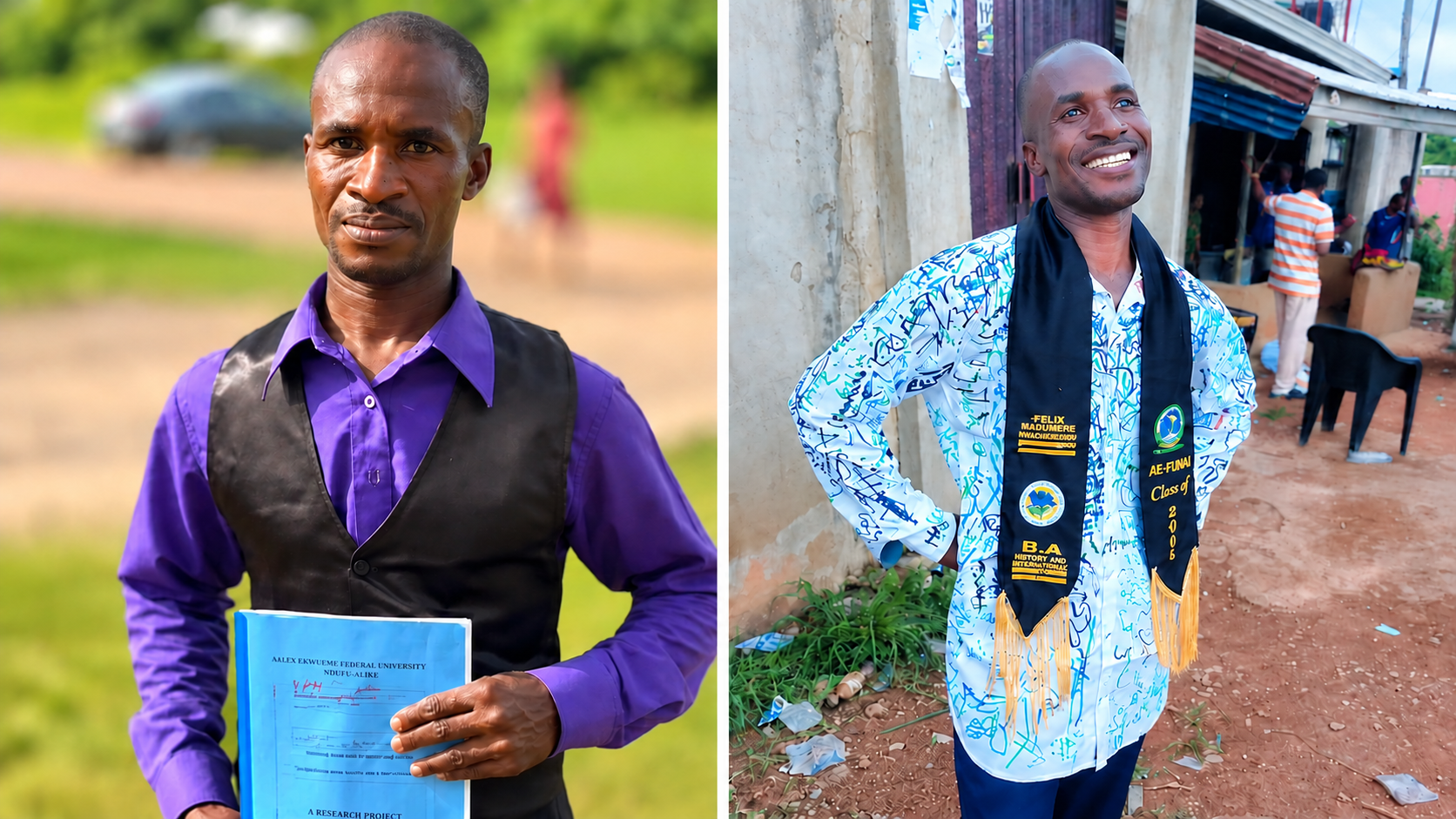
That distinction sits at the heart of the story of Madumere Felix Nwachikerendu, a graduate of Alex Ekwueme Federal University, Ndufu-Alike, Ebonyi State, whose final-year project-defence photographs became a subject of online mockery before the story behind them emerged.
On August 31, 2026, photographs of Felix during his final-year project defence were posted on X by an account identified in the supplied report as @vector_olal. The post attracted widespread attention and millions of views. Some social-media users mocked Felix’s appearance, clothing and delayed graduation.
But the photograph did not tell the whole story.
As people who knew Felix began explaining the circumstances surrounding his university journey, the public narrative changed. What initially appeared to some as an opportunity for ridicule became a story about financial hardship, persistence, dignity and the determination to finish what had been started.
Felix, popularly known on X as @Felix_the_SUG and nicknamed “the Peanut Seller,” had reportedly struggled severely to finance his education. According to an account shared by Mercy Ninian, an X user who said she knew him, his efforts to remain in school included fetching water, washing other students’ clothes, hawking peanuts and other items, and at times sleeping in classrooms.
Those details changed the meaning of the photograph.
The young man being judged from an image was also someone who had reportedly been trying to overcome circumstances that the image could never show.
And that is where Felix Nwachikerendu’s story becomes bigger than a viral social-media episode.
It becomes a question for anyone who has ever been judged by an appearance, a delay, a failure or a difficult season of life:
How much of another person’s story can we really know from what we see?
When the Picture Became the Story
The photograph that brought Felix widespread attention was connected to an achievement: his final-year project defence.
Yet the online conversation initially focused on things that had little to do with the significance of that achievement.
His appearance was scrutinised. His clothing became part of the discussion. His delayed graduation was mocked.
That reaction is important because it demonstrates how easily a visible moment can overshadow an invisible journey.
Felix himself eventually responded to the post that had mocked his project defence. His response offered context that the original photograph could not provide.
He explained that he had expected to graduate with his set in the History Department in 2023, but had fallen behind. He rejected the suggestion that the delay was because he was lazy or unserious.
Instead, he wrote that he had “fell behind but refused to give up.”
That sentence provides one of the clearest windows into the central lesson of his story.
His achievement was not simply that he reached a final-year project defence. It was that he continued after falling behind.
For many people, falling behind can become a source of shame. A person’s classmates graduate. Friends move forward. Others begin careers while one person remains on an earlier step.
Felix’s experience suggests another way of looking at delay.
Being behind is not necessarily the same as being finished.
The Struggle Behind the “Peanut Seller”
The details that emerged after the photograph went viral gave the story a different dimension.
Mercy Ninian said Felix had faced extreme financial difficulties while studying History at AE-FUNAI. According to an account reported by The Punch, Felix had faced severe financial difficulties while studying History at AE-FUNAI. According to her account, he could not pay his school fees when he was initially admitted.
The consequences were serious.
Ninian said Felix struggled academically and was eventually withdrawn from the university after he could not meet the required CGPA.
That could have been the end of the story.
It was not.
According to Ninian, Felix rewrote the Joint Admissions and Matriculation Board examination and returned to the university to continue his education.
His reported survival methods were equally revealing.
He fetched water.
He washed the clothes of other students.
He hawked peanuts and other items.
And, according to Ninian, he sometimes slept in classrooms.
These details should not be romanticised. Financial hardship is not automatically noble simply because someone survives it. Nor should poverty become entertainment.
But these experiences matter because they explain the distance between the public image of Felix and the reality of his reported journey.
The nickname “Peanut Seller” could easily be interpreted as a joke when stripped of its context.
Within the context of his story, however, peanut selling represents something different: an example of the work he reportedly undertook while trying to remain on an educational path.
That distinction is important.
There is dignity in honest work, regardless of how ordinary the work may appear.
Falling Behind Did Not Mean Giving Up
One of the most powerful aspects of Felix’s story is that his journey apparently included a genuine setback.
He did not simply encounter a difficult day and overcome it.
According to the supplied account, he initially struggled to pay his school fees, later struggled academically, and was eventually withdrawn after failing to meet the required CGPA.
His graduation was also delayed.
For someone pursuing university education, these setbacks can carry consequences far beyond a transcript.
There is the pressure of watching others graduate first. There is the possibility of feeling left behind. There is the temptation to conclude that an earlier failure has permanently defined the future.
But Felix returned.
He rewrote JAMB and came back to university, according to Ninian’s account.
That decision matters because it demonstrates a practical form of perseverance.
Perseverance is not always dramatic.
Sometimes it is simply the decision to attempt the next available route after the first route has failed.
The lesson is not that every person must pursue exactly the same goal regardless of circumstances. Nor does Felix’s story prove that persistence guarantees success.
Rather, his experience demonstrates something more grounded:
A setback can change the route without necessarily ending the journey.
The Moment He Refused to Be Defined by Delay
Felix’s own words provide another important part of the story.
Responding to the mockery surrounding his photograph, he explained that he had not graduated with his 2023 set because he had fallen behind, but insisted that this was not evidence that he was lazy or unserious.
Then came the crucial distinction:
He had fallen behind.
But he had refused to give up.
That distinction is worth considering beyond Felix’s particular circumstances.
Modern life encourages comparison.
People announce graduations, promotions, new businesses, new jobs, marriages, acquisitions and other milestones online. It can become easy to measure one’s own progress against somebody else’s timeline.
But timelines are not identical.
Two people can enter the same institution and encounter entirely different financial, family, academic or personal circumstances.
The visible result may be the same—a graduation photograph—but the road to that photograph can be completely different.
Felix’s story therefore challenges the assumption that delayed progress automatically represents diminished ability or character.
Sometimes it means someone had more obstacles to navigate.
That does not excuse every failure. But it does remind us that judgment requires context.
When the Internet Changed Its Mind
The most striking transformation in the story did not happen only in Felix’s life.
It happened in the audience.
The same social-media environment that had amplified the photograph and the ridicule later amplified the explanation.
Mercy Ninian’s account attracted significant attention. Other people who knew Felix reportedly began sharing their own experiences of him.
A former roommate reportedly said that Felix had been housed for months during his first year.
The story was no longer about a photograph.
It had become about a person.
That change illustrates both the danger and the potential of social media.
Online platforms can reduce people to images, captions and brief moments. They can turn a stranger into an object of ridicule before anyone knows the circumstances.
But those same platforms can also expose information, mobilise compassion and connect people who are willing to help.
In Felix’s case, the second dynamic eventually became powerful.
Popular X user Wisdom Obi-Dickson, popularly known as Sir Dickson Wizarab, called on Nigerians to support Felix and announced an initial personal donation of ₦100,000.
The appeal triggered further donations.
Updates placed the amount above ₦4 million, then above ₦5 million, and eventually above ₦10 million.
By Thursday, Wizarab announced that the fundraising had reached ₦14 million.
What began as mockery had become financial support.
That reversal is perhaps the most memorable part of the entire episode.
But even here, the money should not become the only point of the story.
The ₦14 million is significant because it represents what happened after people understood the person behind the image.
The deeper story is the change in perception.
What the ₦14 Million Really Represents

It would be easy to tell Felix’s story as a story about money.
A student struggled.
A photograph went viral.
People donated.
The fund reached ₦14 million.
End of story.
But that would miss the most valuable lesson.
Money may change Felix’s immediate circumstances, but the event also revealed something about how people respond when they are given context.
The public initially saw an image.
Then they saw the story.
The response changed.
That is a lesson worth carrying beyond social media.
People are often more complicated than the first impression they create.
Someone who appears unsuccessful may be fighting a battle nobody knows about.
Someone whose career is moving slowly may be carrying responsibilities others cannot see.
Someone who appears poorly dressed may have made sacrifices that are invisible to everyone looking at them.
Someone who graduates late may have travelled a much harder road than the person who graduated on schedule.
None of this means that every negative impression is wrong.
It means that certainty should be proportional to knowledge.
If we know only the photograph, we should be cautious about claiming to know the person.
Felix’s Promise to His Mother
Another important dimension of Felix’s story emerged when he reflected on his journey.
He said he had designed a poster on the day of his sign-out as a tribute to his late mother.

According to Felix, he had promised her that he would never fail, never engage in illegal activities and never bring disgrace.
He connected that promise with his faith and with the changes that followed in his circumstances.
This part of his story adds an important dimension to the central lesson.
His perseverance was not presented merely as a desire for public recognition.
He described it in terms of a personal standard he had set for himself.
His message to people reading his story was equally clear. He urged them to remain upright, be good to people and trust that good actions can eventually produce results.
That is Felix’s own interpretation of his experience, and it should remain his interpretation rather than being presented as a universal guarantee.
Good behaviour does not mean that hardship will always disappear or that financial success is guaranteed.
But character still matters.
When circumstances become difficult, the choices a person makes under pressure can become part of the legacy they leave behind.
He Also Rejected the Comparison Game
There was another revealing element in Felix’s response to the attention.
As social-media users began comparing his story with that of another person who had also attracted online attention, Felix rejected the competition.
He said he was not interested in determining who was more successful or more deserving of support.
His position was essentially that his presence in the moment was not about competing with another person.
That is another useful lesson in an age dominated by public comparison.
Success does not become more meaningful because somebody else has less.
One person’s opportunity does not have to diminish another person’s achievement.
And one person’s struggle does not need to become a competition over who suffered more.
Felix’s response suggests that there is another approach:
Let your journey be your journey.
Comparison can sometimes provide motivation, but it can also distort perspective. It encourages people to evaluate their lives using somebody else’s timeline, resources and circumstances.
The better question is often not:
“Am I ahead of them?”
It is:
“Am I still moving in the direction that matters to me?”
The Real Transformation Was Not the Money
Felix’s story changed dramatically within a matter of days.
At first, he was the subject of online ridicule.
Then people discovered the hardship behind his journey.
Then the narrative became one of empathy.
Then Nigerians rallied around him.
Then the reported support reached ₦14 million.
But the most important transformation may be the one that happened in the minds of the people watching.
The photograph did not change.
The person in it did not suddenly become more valuable.
What changed was what people knew.
That is why this story should not simply be remembered as the story of a “Peanut Seller” who received ₦14 million.
It should be remembered as a reminder that context can change judgment.
Life Lessons From Felix Nwachikerendu
Do Not Judge a Person From One Visible Chapter
The first lesson is also the central one.
Felix’s photograph showed one moment. It did not show the financial difficulties, reported work or setbacks behind his educational journey.
That is a powerful reminder that an image is evidence of a moment—not necessarily evidence of a person’s character.
In everyday life, this means pausing before judging people by clothing, appearance, job status, academic timeline or financial circumstances.
You may not know the story behind what you see.
Falling Behind Is Not the Same as Giving Up
Felix acknowledged that he fell behind his set.
But he also made clear that he refused to give up.
That distinction matters.
Life does not always move according to the schedule we expect. A delayed graduation, failed examination, lost opportunity or career setback can feel like the end when it may simply mean the route has changed.
The practical lesson is to distinguish between delay and defeat.
If the goal remains worthwhile and the circumstances allow it, look for the next legitimate route forward.
Honest Work Has Dignity
Peanut selling became part of Felix’s public identity.
But the deeper lesson is that honest work should not be treated as shameful simply because it is modest.
According to the supplied account, Felix hawked peanuts and other items, fetched water and washed other students’ clothes while struggling to remain in school.
These were not glamorous activities.
But if they helped him pursue his education, they served a meaningful purpose.
A person’s temporary occupation does not necessarily define their final destination.
A Setback Can Change Your Route Without Ending Your Goal
Felix reportedly faced academic difficulties and was withdrawn from university after failing to meet the required CGPA.
He subsequently rewrote JAMB and returned.
That sequence offers a practical way to understand failure.
A failed attempt should be examined honestly. If something went wrong, understand the consequence and determine what can be done differently.
The answer is not always to continue blindly.
Sometimes it is to find another route.
Do Not Let Other People’s Timelines Define Your Worth
Felix expected to graduate with his set in 2023 but did not.
That delay became part of the ridicule directed at his photograph.
Yet the delayed timeline did not erase the fact that he continued until his project defence.
For anyone who feels behind in life, the lesson is not to ignore reality. It is to stop treating somebody else’s timeline as the universal standard.
Progress should be measured against the circumstances and goals that actually belong to you.
Be Willing to Change Your Judgment
The public reaction to Felix’s story changed after people learned more about him.
That should be a lesson in intellectual humility.
Sometimes new information proves that our first interpretation was incomplete.
Changing your mind when evidence changes is not weakness.
It is maturity.
Whether online or offline, people should be willing to say, in effect: I did not know the whole story.
Character Matters When Nobody Is Watching
Felix’s reflection on his late mother, his faith and the promise he said he made to remain upright adds another lesson.
Hard circumstances can test what a person is willing to do.
Felix specifically spoke about his commitment not to engage in illegal activities or bring disgrace.
The broader lesson is that difficult circumstances do not remove the importance of character.
Success gained at the expense of integrity carries a different meaning from progress achieved while maintaining one’s principles.
What Felix Nwachikerendu’s Story Ultimately Teaches
The most important lesson in Felix Nwachikerendu’s story is not that perseverance automatically produces a financial reward.
It does not.
Nor is the lesson that every person who struggles will eventually receive millions of naira in public donations.
That would be an unrealistic interpretation.
The deeper lesson is about how we see people and how we respond to our own difficult seasons.
Felix’s journey reportedly included financial hardship, academic setbacks, delayed graduation and work undertaken to survive and continue his education. Those circumstances did not make his eventual achievement less meaningful.
If anything, they provide context for understanding it.
At the same time, his story offers a warning to observers.
The easiest thing to judge is what is visible.
The harder thing is to acknowledge what we cannot see.
That is why the photograph matters.
Not because it was a perfect picture.
Not because it showed a celebrity.
Not because it eventually became connected to ₦14 million.
It matters because it exposed the limitations of judging a human life from a single frame.
A photograph captured Felix at one point in his journey.
His life contained everything that came before it.
The hardship.
The setback.
The return.
The work.
The delay.
The persistence.
And finally, the project defence.
That is the story worth remembering.
Final Reflection
There is a particular danger in judging people from photographs, titles, clothes, academic timelines or brief encounters: we mistake what is visible for what is complete.
Felix Nwachikerendu’s story is a reminder that a person’s most important struggles are often the least visible. The photograph that attracted ridicule could not show the reported financial hardship behind his education. It could not show the work he undertook, the academic setback that interrupted his studies or the decision to return and continue. It could not show the promise he said he made to his late mother.
It showed only a moment.
And yet that moment became a judgment of an entire person.
The story changed when the missing context became known. Mockery gave way to empathy, and empathy eventually produced remarkable public support.
But perhaps the most valuable lesson is not what Nigerians gave Felix. It is what his story asks us to give other people before we know their full circumstances: patience, dignity and the benefit of context.
For those currently facing their own setbacks, his journey offers another reminder. Being behind is not automatically being defeated. A difficult route does not make a worthwhile destination meaningless.
We may not control every circumstance that shapes our journey. But we can control how we respond to the next obstacle—and how we choose to see the people walking through theirs.
Before judging the next person you encounter, remember Felix’s photograph.
You may be looking at a moment.
You are not necessarily looking at the whole story.
RECOMMENDED COVERAGE
FREE PUBLIC LIBRARY — EDUCATION & OPPORTUNITY
Felix’s journey shows what students can endure simply to remain in school. But what happens when communities deliberately create better opportunities for young people? Read how a free public library is giving students a new path to learn and dream.
KAMDI OKEKE SCHOLARSHIP — OVERCOMING EDUCATIONAL CHALLENGES
Felix’s experience is not an isolated story. Across Nigeria, educational opportunities can change the direction of a young person’s life. Here is another remarkable story of a Nigerian student whose journey brought scholarship and recognition.
DR. EBERECHUKWU UNEZE — INSPIRING LIFE JOURNEY
Felix’s story reminds us that today’s struggle does not necessarily define tomorrow’s destination. For another Nigerian story of growth, influence and impact, discover the journey of Dr. Eberechukwu Uneze.
About the Author