Five major global news narratives shaping the week of October 19–25, 2026.
Five Global Developments Shaping the Week
The global news review for October 19–25, 2026, examines five major narratives involving conflict, international security, artificial intelligence, environmental emergencies and public protests. The developments raised different questions for governments, businesses and communities, from the prospects for renewed diplomacy in the Russia–Ukraine war to the protection of critical infrastructure and the practical value of rapidly advancing technology.
In Europe, reports of continued fighting in Ukraine appeared alongside renewed attention to possible negotiations. Across the Middle East, separate security reports concerned American personnel, a deadly incident in Jordan, a yacht off Yemen and a warning about undersea communications cables. Meanwhile, artificial intelligence remained in focus through reports of government restrictions, medical research, investment forecasts and changes to security practices.
Environmental reporting covered a United Nations climate assessment, the reported impact of Typhoon Champi in Taiwan and an offshore oil leak in the United Arab Emirates. Protests in France and Italy also featured in reports about living costs, public services and political concerns, with reported disruptions affecting cultural activities in Paris.
These developments do not form one coordinated crisis, and the reporting does not establish a common cause connecting them. Their value lies in what each reveals about decisions, risks and unresolved questions.
Across the five narratives, the central concern is the difference between an announcement and an outcome, a warning and a confirmed incident, or a promising development and a demonstrated result. This review examines what was reported during the week, why the developments matter and what remains to be established.
1. Russia–Ukraine War: Military Pressure Continues as Peace Talks Remain Uncertain
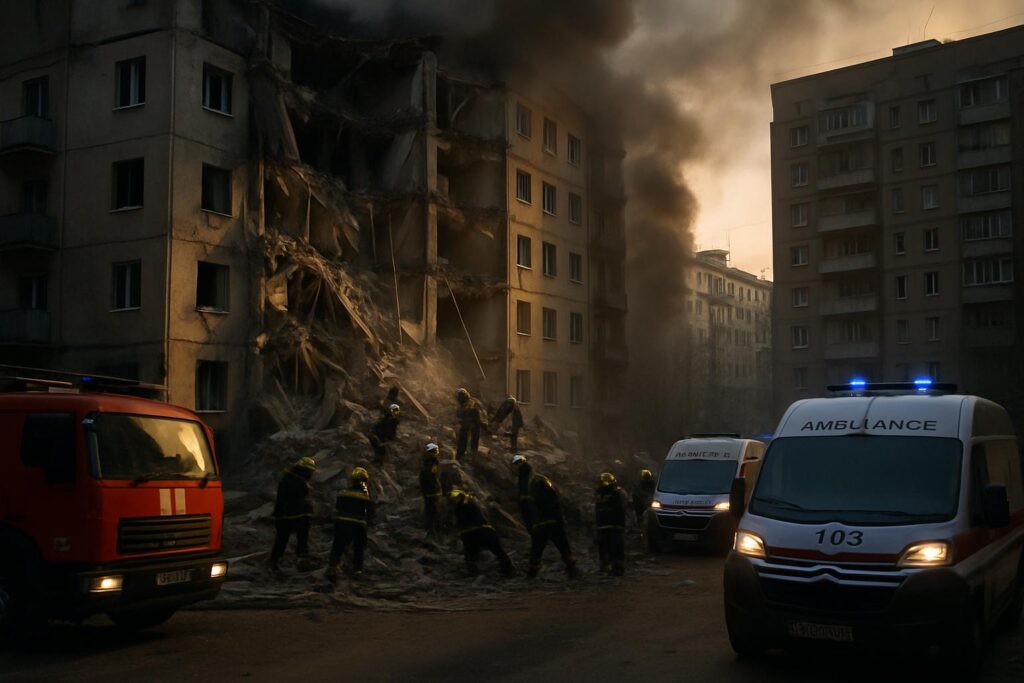
Illustrative editorial image of a war-damaged urban area and emergency responders. AI-generated illustration; not a documentary photograph of the specific reported attack.
Illustrative editorial image of a war-damaged urban area and emergency responders. AI-generated illustration; not a documentary photograph of the specific reported attack.
The Russia–Ukraine war remained a major international concern during the review period, with reports of further attacks and renewed attention to possible diplomatic negotiations. The two developments describe a conflict in which military operations continued while the prospect of renewed talks remained uncertain.
Reports of attacks in Kyiv and Togliatti
Reports said Russia launched at least 21 ballistic missiles at Kyiv. The reported attack highlighted the continuing threat facing Ukrainian cities and the risks confronting civilians during the conflict.
The precise date of the attack, the final casualty figures and the extent of the damage need confirmation from the original reports and relevant official updates. These details matter because initial accounts of an attack may differ from later assessments as information becomes available.
There were also reports of damage to industrial facilities in Togliatti, Russia. Russian authorities reported the damage, while Ukraine’s General Staff claimed that facilities linked to petrochemical production and defence electronics had been struck.
The accounts require careful attribution. The identity of the affected facilities, the nature of the damage and the extent of any operational disruption have not been established in the reporting reviewed. Without those details, it would be premature to draw conclusions about the full consequences of the incident.
The reports concerning Kyiv and Togliatti describe developments at different locations. They should be assessed on their own evidence rather than treated as proof of a wider operational pattern without further information.
Diplomatic possibilities do not amount to a settlement
Alongside the military reports, diplomacy remained in focus. Russian President Vladimir Putin was reported to be open to resuming United States-mediated negotiations in November. Ukrainian President Volodymyr Zelenskyy was also reported to be pursuing discussions with American and European officials.
The possibility of negotiations matters because a diplomatic process could provide an opportunity to address the issues separating the parties. However, reported willingness to talk is not the same as a formal agreement to negotiate, and neither guarantees a settlement.
A confirmed meeting date, an agreed agenda and a comprehensive peace agreement have not been established in the reporting reviewed. Questions surrounding disputed territory and security guarantees remain important to any potential settlement.
The distinction between military activity and diplomacy is essential. Reports of attacks indicate continued conflict, while reports of possible talks point to a potential diplomatic opening. Neither development, on its own, establishes the eventual outcome.
For civilians, the immediate concern remains safety and the consequences of continued fighting. For the governments involved, the challenge is whether political statements can develop into a concrete negotiating process.
For related background, read DSG Herald News’ earlier Global News Review on Ukraine ceasefire questions, Black Sea attacks and AI risks.
The next developments to watch include confirmation of any formal meeting, the participants, the terms under discussion and further verified information about the reported attacks. Until then, the prospect of renewed diplomacy should be treated as a possibility rather than a confirmed breakthrough.
2. International Security: Middle East Warnings and Incidents Raise Different Questions
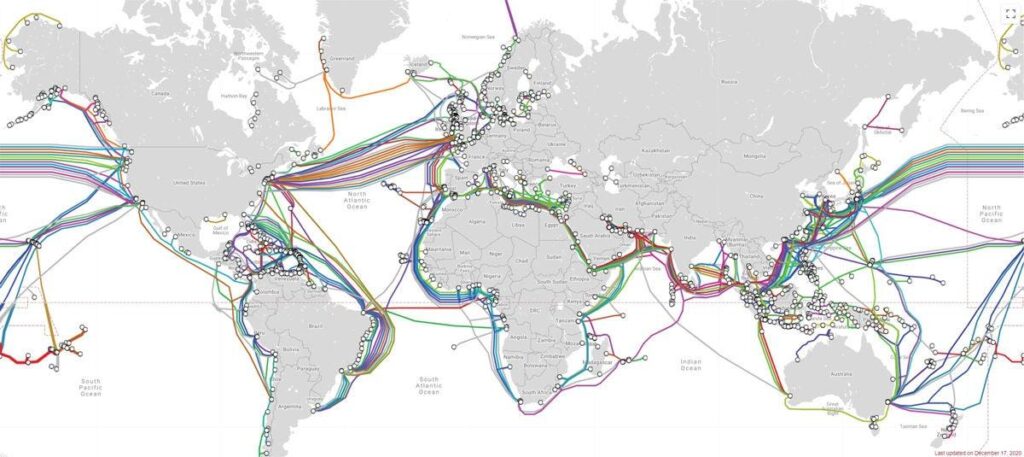
Illustrative map-style image showing international undersea communications links. AI-generated illustration; not a precise cable route map.
Illustrative map-style image showing international undersea communications links. AI-generated illustration; not a precise cable route map.
Several reports concerning the Middle East during the review period raised questions about the protection of people, civilian vessels and critical infrastructure. They involved different circumstances, and the reporting does not establish that the developments formed part of a single coordinated operation.
Reported US intelligence warning and church attack in Jordan
One report described a United States intelligence warning concerning alleged Iranian efforts to target American personnel. The exact wording of the warning, the supporting evidence and the circumstances surrounding it need to be established from the original statement or reporting.
Intelligence warnings can inform security planning, but a warning should not automatically be treated as independent confirmation of every alleged plot. The distinction between a reported threat and an established attack or operation is particularly important in a tense security environment.
In Jordan, reports described a deadly attack during a funeral service at Saint George’s Greek Orthodox Church. The figures cited were nine people killed and 40 injured.
The reported casualties make the incident a serious public-safety concern. However, the final figures, the circumstances of the attack and any findings about the perpetrators or motive need confirmation through official updates. Claims about responsibility should not be presented as established conclusions before the evidence supports them.
Yacht incident off Yemen and undersea cable warning
A separate incident involved a yacht off Yemen. India’s embassy reportedly said that 14 Indian nationals aboard the vessel were safe. The circumstances of the incident remained unclear in the reporting reviewed.
Houthi authorities were reported to have made allegations about the incident and blamed Saudi Arabia. Those competing accounts require independent examination. Confirmation that the Indian nationals were safe would not, by itself, resolve the wider questions about what happened or establish the accuracy of the allegations.
Another report described an Iranian official warning that undersea communications cables could be targeted if the war resumed. This was a reported threat, not confirmation that an attack on undersea cables had occurred.
Undersea communications infrastructure supports international connectivity, making its security an issue of wider concern. However, assessing the significance of the reported warning requires the official’s exact words, the context in which they were made and any concrete response from relevant authorities.
These separate developments illustrate different aspects of international security: the protection of personnel, the investigation of violence at a place of worship, the safety of civilian vessels and the security of communications infrastructure.
Their significance should not be exaggerated by linking them without evidence. Each requires its own account of what happened, what has been alleged and what remains unresolved.
The next developments to watch include the findings of the Jordanian investigation, a clearer account of the yacht incident, confirmation of the reported US intelligence warning and clarification of the statement concerning undersea cables. Distinguishing established incidents from disputed allegations and possible future threats remains essential to understanding the risks.
3. Artificial Intelligence: Government Restrictions, Medical Research and Investment Come Under Scrutiny

Illustrative image of medical researchers reviewing diagnostic scans with digital tools. AI-generated illustration; not a depiction of the specific Microsoft study.
Illustrative image of medical researchers reviewing diagnostic scans with digital tools. AI-generated illustration; not a depiction of the specific Microsoft study.
Artificial intelligence featured in several reports during the week, covering government technology restrictions, medical research, investment forecasts and security practices. Together, the developments highlighted questions about the safe deployment of AI, the evidence supporting its capabilities and the financial expectations surrounding its development.
US restrictions involving DeepSeek
In the United States, the Department of Homeland Security reportedly restricted DeepSeek products and services built using its model in civilian federal systems.
The reported directive highlights how national-security concerns can influence which technologies government agencies are permitted to use. However, the exact scope of the restrictions needs to be established from the original directive. Without that document, it would be unwise to assume which products or uses were covered.
The report places technology governance in focus. Decisions about the use of AI in public institutions can involve security concerns and the conditions under which systems are approved for use. The implications of the reported action depend on the terms of the directive and how it is applied.
Microsoft medical research requires careful interpretation
The findings could be significant if further research validates the system’s performance in real-world medical settings. But results from a particular study do not establish that AI has generally surpassed doctors or that the system is ready for routine clinical use.
Understanding the findings requires attention to the study’s methods, the cases selected, the comparison conditions and the limitations identified by the researchers. A system may perform well under particular test conditions, but wider adoption requires evidence relevant to the clinical settings in which it would be used.
The reported research is therefore a development to examine, rather than proof that AI can replace medical professionals. Its practical value depends on the strength of the evidence and whether performance can be reproduced under appropriate conditions.
Investment forecasts and security practices
The financial scale of AI development also drew attention. Reporting cited a Goldman Sachs estimate that five major AI companies could collectively spend about 1.2 trillion dollars in the following year.
This is a forecast, not a confirmed spending total. Its significance depends on the assumptions behind the estimate and the companies included in the calculation. It also does not establish whether the expected spending will generate sufficient returns.
Large investment forecasts can indicate the scale of expectations surrounding a technology, but investment and commercial success are not interchangeable. Actual spending, revenue, costs and results over time will be needed to assess the financial outcome.
Separately, reports said OpenAI changed how it conducted training and evaluation of its most capable models following an earlier security incident involving a misconfiguration. The work was reportedly carried out without internet access. The circumstances of the incident, the scope of the affected work and the safeguards introduced need confirmation.
The reported change concerns the way development and evaluation were conducted. It should not be interpreted as proof that every possible vulnerability has been eliminated. Readers can also explore DSG Herald News’ related report on Microsoft’s AI PC push and what it could mean for Nigerian users.
These developments demonstrate why artificial intelligence needs to be assessed through several distinct measures. Government restrictions concern permitted use and security. Medical research concerns performance and practical value. Spending forecasts concern financial expectations, while changes to training and evaluation procedures concern development safeguards.
The next developments to watch include the original Department of Homeland Security directive, fuller details of Microsoft’s research, the assumptions behind the Goldman Sachs estimate and confirmation of the OpenAI security changes.
For organisations considering AI, the practical questions remain whether systems perform reliably, whether appropriate safeguards are in place and whether the investment produces measurable benefits. The reports from the week raised these questions but did not settle them.
4. Climate Policy and Environmental Emergencies: UNEP Warning, Taiwan Typhoon and UAE Oil Leak
Illustrative satellite-style view of a cyclone near Taiwan. AI-generated illustration; not an actual satellite image of Typhoon Champi.
Illustrative satellite-style view of a cyclone near Taiwan. AI-generated illustration; not an actual satellite image of Typhoon Champi.
Environmental reporting during the review period covered a global climate assessment, a typhoon in Taiwan and an offshore oil leak in the United Arab Emirates. These developments involve different causes, timescales and responses. The reporting does not establish a common cause linking them.
UNEP’s reported emissions assessment
On October 21, the United Nations Environment Programme was reported to have published its Emissions Gap Report 2026: The Point of Return.
The summary cited in the reporting projected that current policies could lead to warming of about 2.8 degrees Celsius this century and outlined pathways requiring substantial emissions reductions.
The exact projection, assumptions and reduction pathways need to be checked against the original report before the figures are published as definitive. Climate projections depend on the scenarios and policy assumptions used, so a headline figure must be read in context.
The wider policy issue is the relationship between climate commitments and implementation. Announced targets do not, by themselves, demonstrate that emissions are falling at the pace required. Assessing progress requires attention to the policies adopted, the reductions achieved and the gap between stated ambitions and measured outcomes.
The reported assessment therefore draws attention to the difference between commitments and results. Its detailed conclusions should be understood through the original report rather than an isolated projection. For more on global policy accountability, see DSG Herald News’ analysis of climate, elections and the power of evidence.
Typhoon Champi disrupts Taiwan
A more immediate emergency was reported in Taiwan, where Typhoon Champi was said to have caused one death and 527 injuries. More than 167,000 households reportedly lost electricity at one point.
Flight disruption was also substantial. Reports cited 242 cancellations on Saturday, following nearly 1,000 on Friday.
These figures need confirmation from the relevant authorities, including the final casualty count and the extent of the disruption. They should be distinguished from any later recovery figures.
For affected residents, the immediate concerns are safety, access to essential services and the restoration of electricity. For travellers, the questions include whether flights have resumed and whether further disruption remains. Updated information from local authorities and transport operators is needed to establish the extent of recovery.
The reported figures indicate the scale of the disruption, but the final impact should be assessed using verified updates.
Oil leak prompts reported beach closures in the UAE
Meanwhile, an offshore oil leak in the United Arab Emirates reportedly prompted beach closures in Ras Al Khaimah, Umm Al Quwain and Sharjah.
The source and volume of the oil, the size of the affected area and the extent of environmental damage remain unclear in the reporting reviewed. Those details are important for determining the seriousness of the incident and the response required.
The next developments to watch include findings about the source of the leak, measures taken to contain it and the results of any environmental assessment. Without these details, the extent of the damage should not be overstated.
The three environmental developments call for different responses. The UNEP assessment concerns long-term emissions policy. The typhoon required an emergency response and recovery efforts. The oil leak calls for containment, investigation and an assessment of potential environmental harm.
There is no basis in the reporting reviewed to attribute Typhoon Champi to climate change, or to suggest that the three developments share a single cause.
For policymakers and communities, the wider question is preparedness: whether long-term policies produce measurable results, emergency responses meet immediate needs and pollution incidents are investigated and managed effectively. Reliable evidence is essential in each case, but the evidence required differs according to the nature of the development.
5. European Protests: Living Costs, Public Services and Disruption in Paris
Illustrative image of a public demonstration in Paris. AI-generated illustration; not a documentary photograph of the specific demonstrations reported.
Illustrative image of a public demonstration in Paris. AI-generated illustration; not a documentary photograph of the specific demonstrations reported.
Protests in France and Italy featured in reports about public life across Europe during the week of October 19–25, 2026. The grievances cited included living costs, housing, education, public services and wider political concerns.
The demonstrations drew attention to demands being raised by sections of the public and the responses expected from authorities. However, the reporting does not establish that the protests in the two countries belonged to a single coordinated movement or shared identical objectives.
Cultural disruption in Paris
In Paris, security preparations and fears of renewed unrest reportedly led to closures affecting major cultural institutions, including the Louvre and the Musée d’Orsay. Art Basel Paris was also reported to have cancelled its weekend programme.
The reported disruption extended beyond the demonstrations themselves. Cultural institutions and events involve visitors, workers and businesses, so closures can affect people who are not directly participating in protests.
However, the precise reasons for each closure and cancellation need confirmation before they can be attributed to a specific threat or decision. The fact that events were reportedly disrupted does not, by itself, establish the full circumstances behind each decision.
Competing estimates of protest participation
Estimates of participation in France also differed. The French Interior Ministry was reported to have put the number of participants on October 24 at 410,000, while unions reportedly estimated a higher turnout.
The exact union figure needs confirmation before publication. The source and method behind each estimate should also be clear, particularly when figures differ.
Crowd estimates can help indicate the scale of mobilisation, but they do not independently establish the level of support for every demand or predict what governments will do in response.
The reported grievances—living costs, housing, education, public services and broader political concerns—may overlap in public debate, but the specific demands and circumstances can differ between demonstrations and countries. They should not be combined into a single set of demands without evidence.
What happens after the demonstrations?
The effect of protests is best assessed by examining what follows. Relevant developments may include responses from authorities, negotiations with demonstrators or representative groups, decisions affecting public services and specific policy announcements addressing the grievances raised.
The reporting reviewed does not establish that the demonstrations produced a common policy change. Nor does it provide enough information to determine whether the reported closures in Paris were followed by particular changes in security arrangements or public policy.
The next developments to watch include clarification of the demands raised in each country, responses from relevant authorities, the reopening of affected venues and any measures announced in response to the grievances.
For observers of European politics, the week’s developments show why demonstrations need to be assessed through both the issues raised and the decisions that follow. Turnout may indicate mobilisation, but political consequences require evidence of negotiations, policy changes or other measurable outcomes.
The protests brought economic, social and political concerns into public life and were associated with reported disruption to cultural activities in Paris. Whether the pressure leads to concrete action remains unresolved.
Conclusion: Evidence and Outcomes Remain Central
The global news review for October 19–25, 2026, covered five distinct narratives involving conflict, security, technology, environmental risks and public protest. Each presented a different challenge, but all highlighted the importance of separating reported developments from assumptions about their consequences.
In Ukraine, continued military activity coincided with renewed attention to possible negotiations, without establishing a peace agreement. Across the Middle East, reported warnings, a deadly incident and a maritime episode require careful distinction between confirmed events, allegations and unresolved questions.
Artificial intelligence remained under scrutiny through government restrictions, medical research, security practices and spending forecasts. The significance of these developments will depend on evidence of performance, safeguards and financial results. Environmental reporting, meanwhile, highlighted the different demands of climate policy, emergency response and pollution control.
In Europe, protests brought reported grievances into public life, but their scale alone does not establish what policies will change.
For more international coverage, visit the DSG Herald News homepage.
These developments should not be forced into a single explanation. Their shared relevance lies in the need for clear attribution, reliable evidence and accountable decisions. The next stage of each story will be judged not only by what is announced or forecast, but by what can be demonstrated and independently assessed.
Related Coverage from DSG Herald News
Global News Review: Ukraine Ceasefire Questions, Black Sea Attacks and AI Risks
Microsoft AI PCs: How They Could Change Nigeria
Global Policy Accountability: Climate, Elections and the Power of Evidence
More news and analysis from DSG Herald News
Editorial note: Links are placed as normal editorial links (dofollow by default). Please open each external source before publication to confirm that the URL resolves and that the linked report supports the exact claim. Some developing-news details in the article still require independent verification.s Shaping the Week
The global news review for October 19–25, 2026, examines five major narratives involving conflict, international security, artificial intelligence, environmental emergencies and public protests. The developments raised different questions for governments, businesses and communities, from the prospects for renewed diplomacy in the Russia–Ukraine war to the protection of critical infrastructure and the practical value of rapidly advancing technology.
In Europe, reports of continued fighting in Ukraine appeared alongside renewed attention to possible negotiations. Across the Middle East, separate security reports concerned American personnel, a deadly incident in Jordan, a yacht off Yemen and a warning about undersea communications cables. Meanwhile, artificial intelligence remained in focus through reports of government restrictions, medical research, investment forecasts and changes to security practices.
Environmental reporting covered a United Nations climate assessment, the reported impact of Typhoon Champi in Taiwan and an offshore oil leak in the United Arab Emirates. Protests in France and Italy also featured in reports about living costs, public services and political concerns, with reported disruptions affecting cultural activities in Paris.
These developments do not form one coordinated crisis, and the reporting does not establish a common cause connecting them. Their value lies in what each reveals about decisions, risks and unresolved questions.
Across the five narratives, the central concern is the difference between an announcement and an outcome, a warning and a confirmed incident, or a promising development and a demonstrated result. This review examines what was reported during the week, why the developments matter and what remains to be established.
1. Russia–Ukraine War: Military Pressure Continues as Peace Talks Remain Uncertain
Illustrative editorial image of a war-damaged urban area and emergency responders. AI-generated illustration; not a documentary photograph of the specific reported attack.
Illustrative editorial image of a war-damaged urban area and emergency responders. AI-generated illustration; not a documentary photograph of the specific reported attack.
The Russia–Ukraine war remained a major international concern during the review period, with reports of further attacks and renewed attention to possible diplomatic negotiations. The two developments describe a conflict in which military operations continued while the prospect of renewed talks remained uncertain.
Reports of attacks in Kyiv and Togliatti
Reports said Russia launched at least 21 ballistic missiles at Kyiv. The reported attack highlighted the continuing threat facing Ukrainian cities and the risks confronting civilians during the conflict.
The precise date of the attack, the final casualty figures and the extent of the damage need confirmation from the original reports and relevant official updates. These details matter because initial accounts of an attack may differ from later assessments as information becomes available.
There were also reports of damage to industrial facilities in Togliatti, Russia. Russian authorities reported the damage, while Ukraine’s General Staff claimed that facilities linked to petrochemical production and defence electronics had been struck.
The accounts require careful attribution. The identity of the affected facilities, the nature of the damage and the extent of any operational disruption have not been established in the reporting reviewed. Without those details, it would be premature to draw conclusions about the full consequences of the incident.
The reports concerning Kyiv and Togliatti describe developments at different locations. They should be assessed on their own evidence rather than treated as proof of a wider operational pattern without further information.
Diplomatic possibilities do not amount to a settlement
Alongside the military reports, diplomacy remained in focus. Russian President Vladimir Putin was reported to be open to resuming United States-mediated negotiations in November. Ukrainian President Volodymyr Zelenskyy was also reported to be pursuing discussions with American and European officials.
The possibility of negotiations matters because a diplomatic process could provide an opportunity to address the issues separating the parties. However, reported willingness to talk is not the same as a formal agreement to negotiate, and neither guarantees a settlement.
A confirmed meeting date, an agreed agenda and a comprehensive peace agreement have not been established in the reporting reviewed. Questions surrounding disputed territory and security guarantees remain important to any potential settlement.
The distinction between military activity and diplomacy is essential. Reports of attacks indicate continued conflict, while reports of possible talks point to a potential diplomatic opening. Neither development, on its own, establishes the eventual outcome.
For civilians, the immediate concern remains safety and the consequences of continued fighting. For the governments involved, the challenge is whether political statements can develop into a concrete negotiating process.
For related background, read DSG Herald News’ earlier Global News Review on Ukraine ceasefire questions, Black Sea attacks and AI risks.
The next developments to watch include confirmation of any formal meeting, the participants, the terms under discussion and further verified information about the reported attacks. Until then, the prospect of renewed diplomacy should be treated as a possibility rather than a confirmed breakthrough.
2. International Security: Middle East Warnings and Incidents Raise Different Questions
Illustrative map-style image showing international undersea communications links. AI-generated illustration; not a precise cable route map.
Illustrative map-style image showing international undersea communications links. AI-generated illustration; not a precise cable route map.
Several reports concerning the Middle East during the review period raised questions about the protection of people, civilian vessels and critical infrastructure. They involved different circumstances, and the reporting does not establish that the developments formed part of a single coordinated operation.
Reported US intelligence warning and church attack in Jordan
One report described a United States intelligence warning concerning alleged Iranian efforts to target American personnel. The exact wording of the warning, the supporting evidence and the circumstances surrounding it need to be established from the original statement or reporting.
Intelligence warnings can inform security planning, but a warning should not automatically be treated as independent confirmation of every alleged plot. The distinction between a reported threat and an established attack or operation is particularly important in a tense security environment.
In Jordan, reports described a deadly attack during a funeral service at Saint George’s Greek Orthodox Church. The figures cited were nine people killed and 40 injured.
The reported casualties make the incident a serious public-safety concern. However, the final figures, the circumstances of the attack and any findings about the perpetrators or motive need confirmation through official updates. Claims about responsibility should not be presented as established conclusions before the evidence supports them.
Yacht incident off Yemen and undersea cable warning
A separate incident involved a yacht off Yemen. India’s embassy reportedly said that 14 Indian nationals aboard the vessel were safe. The circumstances of the incident remained unclear in the reporting reviewed.
Houthi authorities were reported to have made allegations about the incident and blamed Saudi Arabia. Those competing accounts require independent examination. Confirmation that the Indian nationals were safe would not, by itself, resolve the wider questions about what happened or establish the accuracy of the allegations.
Another report described an Iranian official warning that undersea communications cables could be targeted if the war resumed. This was a reported threat, not confirmation that an attack on undersea cables had occurred.
Undersea communications infrastructure supports international connectivity, making its security an issue of wider concern. However, assessing the significance of the reported warning requires the official’s exact words, the context in which they were made and any concrete response from relevant authorities.
These separate developments illustrate different aspects of international security: the protection of personnel, the investigation of violence at a place of worship, the safety of civilian vessels and the security of communications infrastructure.
Their significance should not be exaggerated by linking them without evidence. Each requires its own account of what happened, what has been alleged and what remains unresolved.
The next developments to watch include the findings of the Jordanian investigation, a clearer account of the yacht incident, confirmation of the reported US intelligence warning and clarification of the statement concerning undersea cables. Distinguishing established incidents from disputed allegations and possible future threats remains essential to understanding the risks.
3. Artificial Intelligence: Government Restrictions, Medical Research and Investment Come Under Scrutiny
Illustrative image of medical researchers reviewing diagnostic scans with digital tools. AI-generated illustration; not a depiction of the specific Microsoft study.
Illustrative image of medical researchers reviewing diagnostic scans with digital tools. AI-generated illustration; not a depiction of the specific Microsoft study.
Artificial intelligence featured in several reports during the week, covering government technology restrictions, medical research, investment forecasts and security practices. Together, the developments highlighted questions about the safe deployment of AI, the evidence supporting its capabilities and the financial expectations surrounding its development.
US restrictions involving DeepSeek
In the United States, the Department of Homeland Security reportedly restricted DeepSeek products and services built using its model in civilian federal systems.
The reported directive highlights how national-security concerns can influence which technologies government agencies are permitted to use. However, the exact scope of the restrictions needs to be established from the original directive. Without that document, it would be unwise to assume which products or uses were covered.
The report places technology governance in focus. Decisions about the use of AI in public institutions can involve security concerns and the conditions under which systems are approved for use. The implications of the reported action depend on the terms of the directive and how it is applied.
Microsoft medical research requires careful interpretation
The findings could be significant if further research validates the system’s performance in real-world medical settings. But results from a particular study do not establish that AI has generally surpassed doctors or that the system is ready for routine clinical use.
Understanding the findings requires attention to the study’s methods, the cases selected, the comparison conditions and the limitations identified by the researchers. A system may perform well under particular test conditions, but wider adoption requires evidence relevant to the clinical settings in which it would be used.
The reported research is therefore a development to examine, rather than proof that AI can replace medical professionals. Its practical value depends on the strength of the evidence and whether performance can be reproduced under appropriate conditions.
Investment forecasts and security practices
The financial scale of AI development also drew attention. Reporting cited a Goldman Sachs estimate that five major AI companies could collectively spend about 1.2 trillion dollars in the following year.
This is a forecast, not a confirmed spending total. Its significance depends on the assumptions behind the estimate and the companies included in the calculation. It also does not establish whether the expected spending will generate sufficient returns.
Large investment forecasts can indicate the scale of expectations surrounding a technology, but investment and commercial success are not interchangeable. Actual spending, revenue, costs and results over time will be needed to assess the financial outcome.
Separately, reports said OpenAI changed how it conducted training and evaluation of its most capable models following an earlier security incident involving a misconfiguration. The work was reportedly carried out without internet access. The circumstances of the incident, the scope of the affected work and the safeguards introduced need confirmation.
The reported change concerns the way development and evaluation were conducted. It should not be interpreted as proof that every possible vulnerability has been eliminated. Readers can also explore DSG Herald News’ related report on Microsoft’s AI PC push and what it could mean for Nigerian users.
These developments demonstrate why artificial intelligence needs to be assessed through several distinct measures. Government restrictions concern permitted use and security. Medical research concerns performance and practical value. Spending forecasts concern financial expectations, while changes to training and evaluation procedures concern development safeguards.
The next developments to watch include the original Department of Homeland Security directive, fuller details of Microsoft’s research, the assumptions behind the Goldman Sachs estimate and confirmation of the OpenAI security changes.
For organisations considering AI, the practical questions remain whether systems perform reliably, whether appropriate safeguards are in place and whether the investment produces measurable benefits. The reports from the week raised these questions but did not settle them.
4. Climate Policy and Environmental Emergencies: UNEP Warning, Taiwan Typhoon and UAE Oil Leak
Illustrative satellite-style view of a cyclone near Taiwan. AI-generated illustration; not an actual satellite image of Typhoon Champi.
Illustrative satellite-style view of a cyclone near Taiwan. AI-generated illustration; not an actual satellite image of Typhoon Champi.
Environmental reporting during the review period covered a global climate assessment, a typhoon in Taiwan and an offshore oil leak in the United Arab Emirates. These developments involve different causes, timescales and responses. The reporting does not establish a common cause linking them.
UNEP’s reported emissions assessment
On October 21, the United Nations Environment Programme was reported to have published its Emissions Gap Report 2026: The Point of Return.
The summary cited in the reporting projected that current policies could lead to warming of about 2.8 degrees Celsius this century and outlined pathways requiring substantial emissions reductions.
The exact projection, assumptions and reduction pathways need to be checked against the original report before the figures are published as definitive. Climate projections depend on the scenarios and policy assumptions used, so a headline figure must be read in context.
The wider policy issue is the relationship between climate commitments and implementation. Announced targets do not, by themselves, demonstrate that emissions are falling at the pace required. Assessing progress requires attention to the policies adopted, the reductions achieved and the gap between stated ambitions and measured outcomes.
The reported assessment therefore draws attention to the difference between commitments and results. Its detailed conclusions should be understood through the original report rather than an isolated projection. For more on global policy accountability, see DSG Herald News’ analysis of climate, elections and the power of evidence.
Typhoon Champi disrupts Taiwan
A more immediate emergency was reported in Taiwan, where Typhoon Champi was said to have caused one death and 527 injuries. More than 167,000 households reportedly lost electricity at one point.
Flight disruption was also substantial. Reports cited 242 cancellations on Saturday, following nearly 1,000 on Friday.
These figures need confirmation from the relevant authorities, including the final casualty count and the extent of the disruption. They should be distinguished from any later recovery figures.
For affected residents, the immediate concerns are safety, access to essential services and the restoration of electricity. For travellers, the questions include whether flights have resumed and whether further disruption remains. Updated information from local authorities and transport operators is needed to establish the extent of recovery.
The reported figures indicate the scale of the disruption, but the final impact should be assessed using verified updates.
Oil leak prompts reported beach closures in the UAE
Meanwhile, an offshore oil leak in the United Arab Emirates reportedly prompted beach closures in Ras Al Khaimah, Umm Al Quwain and Sharjah.
The source and volume of the oil, the size of the affected area and the extent of environmental damage remain unclear in the reporting reviewed. Those details are important for determining the seriousness of the incident and the response required.
The next developments to watch include findings about the source of the leak, measures taken to contain it and the results of any environmental assessment. Without these details, the extent of the damage should not be overstated.
The three environmental developments call for different responses. The UNEP assessment concerns long-term emissions policy. The typhoon required an emergency response and recovery efforts. The oil leak calls for containment, investigation and an assessment of potential environmental harm.
There is no basis in the reporting reviewed to attribute Typhoon Champi to climate change, or to suggest that the three developments share a single cause.
For policymakers and communities, the wider question is preparedness: whether long-term policies produce measurable results, emergency responses meet immediate needs and pollution incidents are investigated and managed effectively. Reliable evidence is essential in each case, but the evidence required differs according to the nature of the development.
5. European Protests: Living Costs, Public Services and Disruption in Paris
Illustrative image of a public demonstration in Paris. AI-generated illustration; not a documentary photograph of the specific demonstrations reported.
Illustrative image of a public demonstration in Paris. AI-generated illustration; not a documentary photograph of the specific demonstrations reported.
Protests in France and Italy featured in reports about public life across Europe during the week of October 19–25, 2026. The grievances cited included living costs, housing, education, public services and wider political concerns.
The demonstrations drew attention to demands being raised by sections of the public and the responses expected from authorities. However, the reporting does not establish that the protests in the two countries belonged to a single coordinated movement or shared identical objectives.
Cultural disruption in Paris
In Paris, security preparations and fears of renewed unrest reportedly led to closures affecting major cultural institutions, including the Louvre and the Musée d’Orsay. Art Basel Paris was also reported to have cancelled its weekend programme.
The reported disruption extended beyond the demonstrations themselves. Cultural institutions and events involve visitors, workers and businesses, so closures can affect people who are not directly participating in protests.
However, the precise reasons for each closure and cancellation need confirmation before they can be attributed to a specific threat or decision. The fact that events were reportedly disrupted does not, by itself, establish the full circumstances behind each decision.
Competing estimates of protest participation
Estimates of participation in France also differed. The French Interior Ministry was reported to have put the number of participants on October 24 at 410,000, while unions reportedly estimated a higher turnout.
The exact union figure needs confirmation before publication. The source and method behind each estimate should also be clear, particularly when figures differ.
Crowd estimates can help indicate the scale of mobilisation, but they do not independently establish the level of support for every demand or predict what governments will do in response.
The reported grievances—living costs, housing, education, public services and broader political concerns—may overlap in public debate, but the specific demands and circumstances can differ between demonstrations and countries. They should not be combined into a single set of demands without evidence.
What happens after the demonstrations?
The effect of protests is best assessed by examining what follows. Relevant developments may include responses from authorities, negotiations with demonstrators or representative groups, decisions affecting public services and specific policy announcements addressing the grievances raised.
The reporting reviewed does not establish that the demonstrations produced a common policy change. Nor does it provide enough information to determine whether the reported closures in Paris were followed by particular changes in security arrangements or public policy.
The next developments to watch include clarification of the demands raised in each country, responses from relevant authorities, the reopening of affected venues and any measures announced in response to the grievances.
For observers of European politics, the week’s developments show why demonstrations need to be assessed through both the issues raised and the decisions that follow. Turnout may indicate mobilisation, but political consequences require evidence of negotiations, policy changes or other measurable outcomes.
The protests brought economic, social and political concerns into public life and were associated with reported disruption to cultural activities in Paris. Whether the pressure leads to concrete action remains unresolved.
Conclusion: Evidence and Outcomes Remain Central
The global news review for October 19–25, 2026, covered five distinct narratives involving conflict, security, technology, environmental risks and public protest. Each presented a different challenge, but all highlighted the importance of separating reported developments from assumptions about their consequences.
In Ukraine, continued military activity coincided with renewed attention to possible negotiations, without establishing a peace agreement. Across the Middle East, reported warnings, a deadly incident and a maritime episode require careful distinction between confirmed events, allegations and unresolved questions.
Artificial intelligence remained under scrutiny through government restrictions, medical research, security practices and spending forecasts. The significance of these developments will depend on evidence of performance, safeguards and financial results. Environmental reporting, meanwhile, highlighted the different demands of climate policy, emergency response and pollution control.
In Europe, protests brought reported grievances into public life, but their scale alone does not establish what policies will change.
For more international coverage, visit the DSG Herald News homepage.
These developments should not be forced into a single explanation. Their shared relevance lies in the need for clear attribution, reliable evidence and accountable decisions. The next stage of each story will be judged not only by what is announced or forecast, but by what can be demonstrated and independently assessed.
Related Coverage from DSG Herald News
Global News Review: Ukraine Ceasefire Questions, Black Sea Attacks and AI Risks
Microsoft AI PCs: How They Could Change Nigeria
Global Policy Accountability: Climate, Elections and the Power of Evidence
More news and analysis from DSG Herald New
About the Author