Uganda Media Shutdown Stokes Fears Over Press Freedom
Uganda’s media landscape was shaken on June 28, 2026, when the army sealed off the Nation Media Group’s headquarters in Kampala and forced its outlets off the air. Chief of Defence Forces Gen. Muhoozi Kainerugaba – the son of President Yoweri Museveni – announced on social media that he had ordered the shutdown of NMG’s top publications and broadcasters. The unprecedented move immediately drew rare regional and international condemnation, with press freedom advocates warning that it signals a deepening assault on independent journalism in Uganda.
The Uganda media shutdown has quickly evolved from a domestic press dispute into an international concern over democracy, military influence, and freedom of expression. Analysts say the crisis could reshape how Uganda is viewed by investors, development partners, and press freedom organisations across Africa.
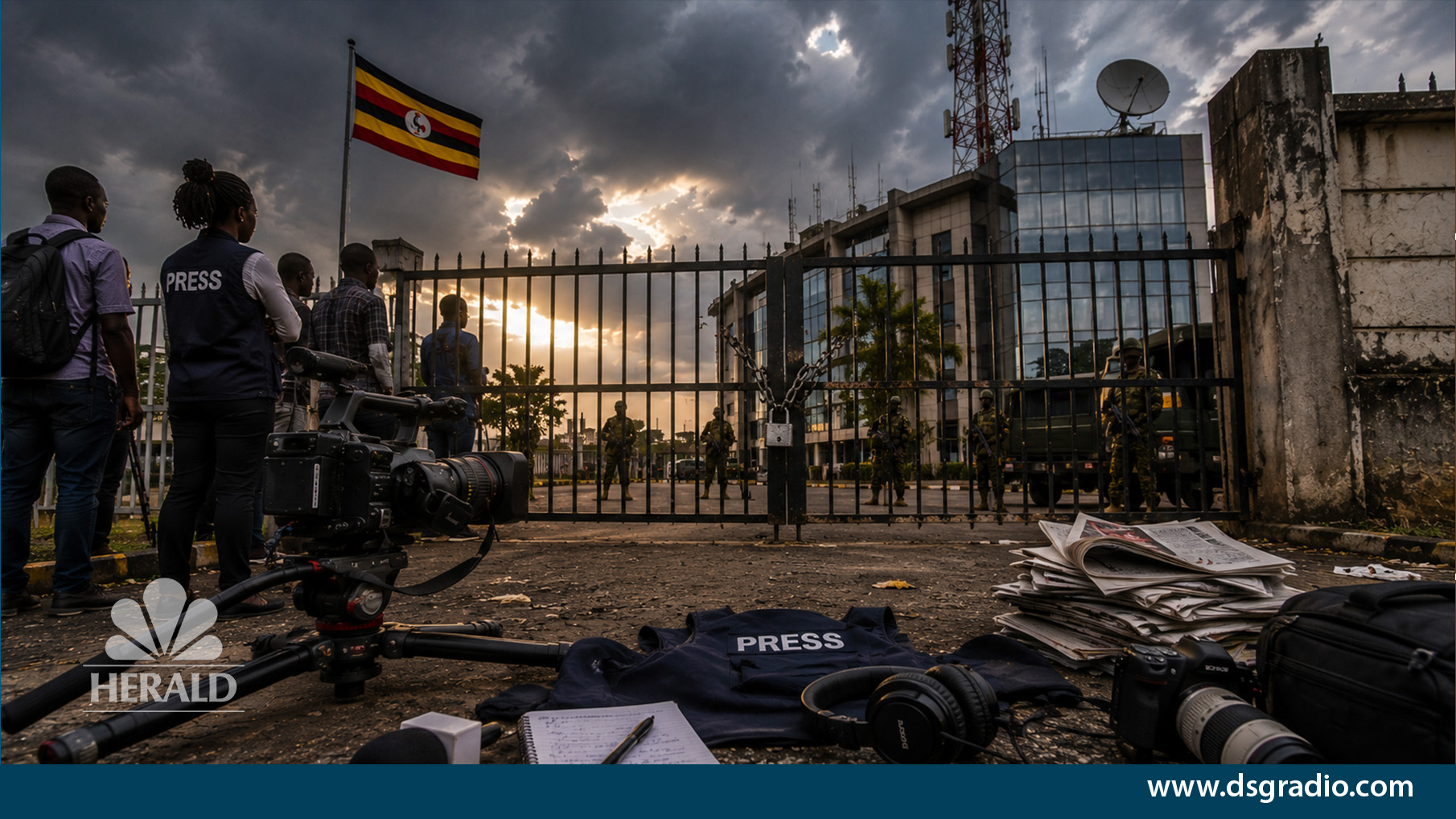
The siege began in the early hours of June 28, when armed soldiers surrounded NMG’s Namuwongo offices and a studio at the Serena Conference Centre. Media workers reported being locked out of buildings; transmissions from NTV Uganda and Spark TV were cut off (viewers saw blank “video unavailable” screens), and radio stations 93.3 KFM and 90.4 Dembe FM likewise went silent. The Daily Monitor newspaper and the weekly East African were pulled from newsstands. Muhoozi issued the orders via his X (formerly Twitter) account, declaring, “From now on ALL media in Uganda will follow the rules!” and bluntly stating “In Uganda, I do not believe in a free press”. The Uganda Communications Commission (UCC) later announced it was seeking “verified information” about the closures and urged calm.
Uganda Media Shutdown Draws International Condemnation
The army-enforced blackout of independent media quickly drew a storm of criticism. Human rights groups and journalist federations condemned the shutdown as a brazen violation of constitutional rights. Amnesty International’s East and Southern Africa Director Tigere Chagutah denounced the operation as part of the military chief’s “unchecked and unjust campaign of harassment and intimidation of independent media”. Amnesty noted that six NMG outlets – including the Daily Monitor, NTV Uganda, Spark TV, KFM, Dembe FM and The East African – were ordered closed “with no justification”, and urged authorities to withdraw troops and restore broadcasts immediately. The Federation of African Journalists likewise called the storming of newsrooms “a naked assault on media freedom,” demanding that soldiers leave media premises at once. Press bodies in neighbouring countries joined the chorus: in Kenya, top broadcasters (NTV Kenya and Citizen TV) ran special reports accusing Uganda’s army chief of undermining press freedoms in the region.
The Uganda media shutdown has been described by several rights groups as one of the most serious attacks on independent journalism in East Africa in recent years.
The fallout was not limited to NGOs and broadcasters. A senior U.S. lawmaker, Senator Jim Risch (R-Idaho), publicly urged Washington to review its security ties with Uganda. On X he wrote that Kainerugaba’s actions – including openly shuttering major news outlets – made him and the Ugandan military “unfit partners” for the United States. In Parliament in Europe, several members of the European Parliament expressed alarm over the prospect of official media censorship. Even within Uganda, political organizations and civil society spoke out: the newly formed Democratic Front party called the raid a violation of constitutional guarantees on speech and demanded the outlets be reopened.
Uganda Media Shutdown Leaves Major Media Houses Off Air
Eyewitnesses and journalists inside Uganda reported that the military operation was swift and heavy-handed. Around midnight on June 27-28, the army and police surrounded NMG’s two main sites in Kampala. In Namuwongo (housing the Daily Monitor and radio stations), guards barred employees from entering. At the Serena Conference Centre (housing NTV Uganda and Spark TV studios), armed troops disarmed a visiting Kenyan correspondent who tried to enter. No official order from the UCC or any media regulator was presented; the action was taken directly under Gen. Muhoozi’s command. NMG’s Managing Director Susan Nsibirwa was specifically targeted – Gen. Muhoozi posted on X “Sue Nsibirwa…I’m looking for her” and later ordered that “All police patrols are instructed to arrest her on sight!”. By dawn, NMG’s digital operations shifted to emergency online updates (Nsibirwa said NMG was “operating digitally as shutdown continues”), but none of its broadcast services were restored.
According to NMG and workers on the ground, the blackout halted roughly 90% of Uganda’s private broadcasting output. The Daily Monitor – the country’s largest independent newspaper – and its sister weekly The East African were pulled from circulation. Spark TV (a popular entertainment channel) and NTV Uganda (one of the main private news networks) stopped transmitting entirely. Shortwave radio signals from KFM and Dembe went silent. In total, at least six NMG outlets (TV, radio and print) were taken off the air by force. Retailers and vendors in Kampala found no copies of NMG papers in markets on June 28, a stark contrast to the usual bustle around Monitor publications.
The UCC, for its part, said on June 29 it had “noted the circumstances” and was consulting stakeholders to get accurate information on the shutdown. No formal legal justification was offered by the government. Local journalists noted that this seizure followed Gen. Muhoozi’s own tweets posted just hours earlier ordering the stations closed without the army asking permission from regulators. By evening, however, Gen. Muhoozi himself hinted at a possible reversal: he tweeted that talks were underway with foreign allies about reopening the outlets, to be approved by President Museveni.
Why Did Muhoozi Strike? Power and Provocation
Analysts say the immediate spark for the crackdown was likely critical reporting about Gen. Muhoozi’s conduct. Ugandan media sources report that around June 17, NTV Uganda ran an investigative program posing the question, “Is General Muhoozi Kainerugaba above the law?” The segment highlighted his extra-legal social media broadcasts attacking opposition politicians and neighboring governments. Though Gen. Muhoozi himself gave no official explanation for the raid, observers note the timing: within two weeks of that broadcast, he moved to silence the network. Officials close to the regime tell reporters that Museveni’s son had privately complained about the coverage, and that he decided to use his authority to neutralize what he viewed as a direct challenge.
Whatever the trigger, Gen. Muhoozi made it clear on X that he acted with personal authority. He wrote that since 2017 he has had “the power in Uganda to shut down ANY media house I want…given to me by my great father President Museveni”. In public posts, he proclaimed himself the de facto censor-in-chief: “From now on ALL media in Uganda will follow the rules!” and insisted that “all bad stories about Uganda” must be cleared by his office. His terse declaration “In Uganda, I do not believe in a free press!” summed up his defiant stance. In short, Muhoozi signaled that only content approved by him – and ultimately by President Museveni – would be tolerated.
Gen. Muhoozi’s motives are also viewed through the lens of his growing political role. At 46, he has emerged as one of the most powerful figures in Uganda, widely seen as his father’s heir apparent. He boasts a fervent following and has launched his own “Patriotic League of Uganda” political movement. Reining in the press may serve multiple ends: it sends a message of strength to critics, and it consolidates Muhoozi’s control over public narratives ahead of future elections. International experts note he is notorious for making threats on social media – Ugandan opposition leader Bobi Wine has survived several posts in which Muhoozi vowed harm – and this latest escalation fits that pattern of aggressive tactics.
Uganda’s Media Landscape and Past Crackdowns
This heavy-handed shutdown did not come out of nowhere. Uganda’s media environment has been under tight control for decades, and independent journalists have long complained of harassment. Under President Museveni’s 40-year rule, opposition outlets and critical reporters have often faced obstacles. The country ranked a low 143rd out of 180 in Reporters Without Borders’ 2025 World Press Freedom Index, reflecting a steady decline in openness. In recent years, journalists covering politics have been harassed, detained, or barred from key events. For example, ahead of the 2025 elections CPJ documented that NMG reporters were suddenly forbidden from covering parliament and presidential events – orders officials attributed to “misreporting”. CPJ’s Africa director warned this “aversion to independent scrutiny” posed serious threats to democracy.
Even before Sunday’s siege, Uganda’s NMG outlets had a history of clashes with authorities. Gen. Muhoozi’s supporters note that previous governments, including that of Museveni himself, had sanctioned media houses. Indeed, NTV Uganda was temporarily shut down in 2007 after airing critical coverage, and the Daily Monitor was closed for 10 days in 2013 following a parliament expose. In each case, the justification was spurious or unstated. But many analysts see a new level of boldness in Muhoozi’s unilateral move. “Blocking journalists from reporting on the legislature and the presidency reflects the Ugandan government’s aversion to independent scrutiny,” CPJ warned in 2025 – a phrase that could have foretold Sunday’s events.
In context, Uganda’s slide mirrors a broader regional trend. Around East Africa, independent media have faced growing pressure: politicians in Kenya, Tanzania and elsewhere have similarly accused private outlets of bias. However, explicitly deploying soldiers to shut newsrooms is almost unheard of in the region. Observers note that the only comparable case was the police assault on Ugandan media during past Walk to Work protests, and state curbs after contested elections. By contrast, the 2026 crackdown appears planned and directed from the top, underscoring the government’s disregard for legal norms.
Why the Uganda Media Shutdown Matters
Ugandans and foreign partners are now grappling with the fallout. Inside the country, the shutdown has alarmed civil society and political opposition. Legal experts argue it blatantly violates Article 29 of Uganda’s constitution, which guarantees freedom of speech and media independence. Many citizens see the move as a chilling sign that even loyal companies like NMG are not safe. In interviews, young Ugandans expressed anger and fear that dissent will be stifled entirely. Opposition leaders, already marginalized by arrests and intimidation, fear the media clampdown will further close off any space for critique. (Details on Uganda’s next elections were not specified in official statements, but analysts note any move to silence the press complicates plans for free and fair contests.)
Economically and diplomatically, the repercussions could be significant. Uganda’s international image as a moderate East African economy has taken a hit. Investors may hesitate in a country where the military can shut down major businesses overnight. Already, the banking sector and the stock index fell on Monday as markets reacted to the news. Analysts say aid donors and lenders – including the U.S. and European Union – will face pressure to respond. Indeed, beyond Senator Risch’s statement, some Western envoys in Kampala are believed to be urgently seeking explanations from Uganda’s government. If key allies impose sanctions or withdraw support, Uganda’s stability could be tested.
Regionally, the incident raises broader concerns about “cadres of the revolution,” as Muhoozi put it. The international community has pointed to parallels in neighboring countries: for example, the current debate over presidential term limits in Zimbabwe (see DSG Herald coverage on Zimbabwe’s term extension debate). Zimbabwe’s President Emmerson Mnangagwa recently pushed through a referendum to extend his rule, provoking regional unease. In Uganda’s case, critics warn that the assault on the press is another step toward unchecked authority in the post-Museveni era (see our report on Museveni’s succession plan). East African business leaders are watching closely, concerned that a crackdown on information could presage similar moves in markets they invest in.
Ugandan soldiers’ storming of newsrooms has also stirred memories of past human rights battles. Rights advocates have linked the media raid to a wave of arrests of activists around the same time – including prominent campaigner Miria Matembe – suggesting a broader campaign to silence dissent. Universities and student groups have quietly signaled support for press freedom; some student unions are reportedly planning protests if the shutdown continues. Meanwhile, social media in Uganda has been ablaze, with hashtags calling for #FreePressUganda trending locally, despite ongoing internet disruptions.
What’s Next for the Uganda Media Shutdown?
By the time of writing, a tenuous dialogue appeared to be unfolding. Uganda’s media ministry announced on June 30 that talks were underway with NMG management about resuming operations. Renowned columnist Andrew Mwenda, a Muhoozi ally, announced he had met the General and agreed that “we shall reopen both Daily Monitor and NTV soon,” pending corporate discussions. Muhoozi himself confirmed via X that discussions were taking place with international “allies in the UK and Europe” and that the final decision would go up to President Museveni. UCC director Nyombi Thembo reiterated that his office is consulting widely and will issue updates once facts are established.
However, no definitive timeline has been set. The military has not withdrawn its presence from NMG’s premises, and Muhoozi’s earlier posts made clear the outlets “will not re-open without my permission.” Journalists inside Uganda remain in a bind: many refuse to return to their locked offices for fear of arrest, as Muhoozi explicitly warned police about Ms. Nsibirwa. Some NMG employees have continued working remotely or for sister operations abroad, but the local platforms are essentially frozen.
If the shutdown persists into July, Ugandan authorities may face mounting pressure from the African Union and East African Community. In the short term, media watchers expect at least the return of NMG’s key outlets, if only to stem the outcry. But even a partial reopening would not erase the chill this episode has sent through Uganda’s newsrooms. “The soldiers have left some of our sites, but everyone is still under siege,” one Monitor journalist told CPJ on condition of anonymity. (Accurate details on any government concessions or future guarantees for press freedom remain unclear at press time.)
This crisis illustrates the precarious balance in Uganda between authority and accountability. The international backlash may force a compromise, but analysts warn that without stronger institutional checks, the fundamental issues will endure. Uganda’s experiment with a more assertive, personality-driven media policy could define its democracy in the years ahead. For now, the solitary glint of hope for many is that global attention and local defiance might compel Muhoozi to back down.
Recommended Coverage:
- Museveni’s succession plan raises fears for Uganda’s future – Analysis of political transition dynamics and youth movements in Uganda.
- Mnangagwa term extension sparks democracy debate – How leadership changes in Zimbabwe are influencing regional political trends.
About the Author