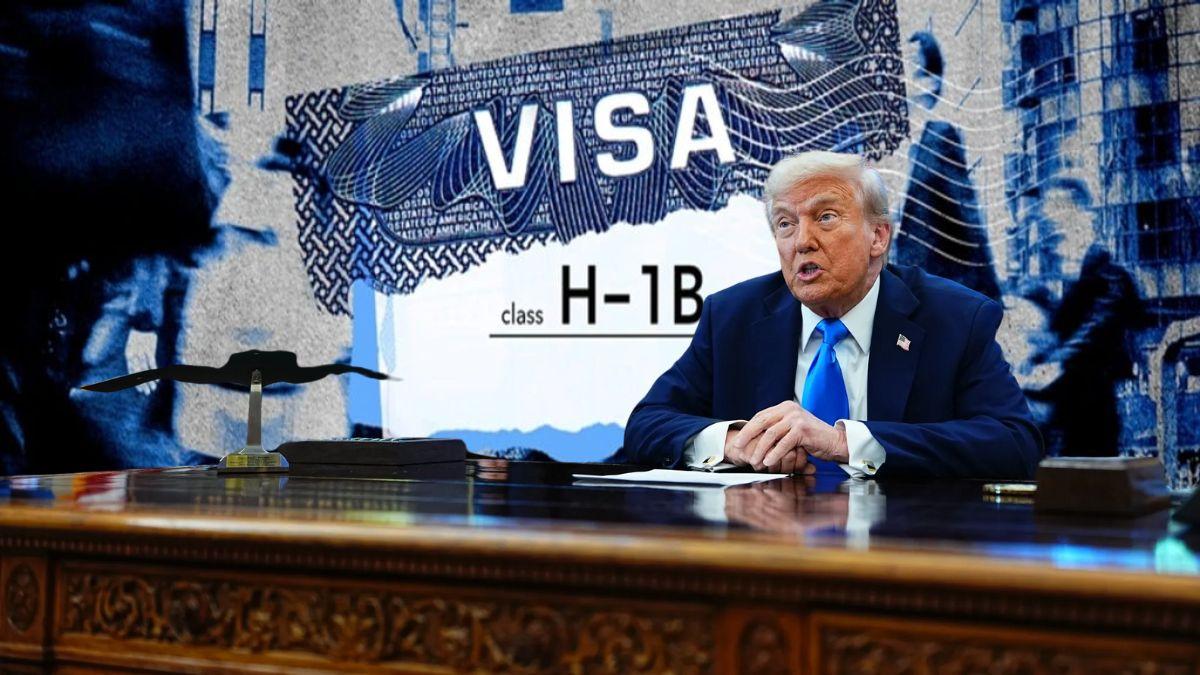
H-1B Visa Fee: Trump’s $100K Hiring Shock
H-1B visas are at the centre of Donald Trump’s latest crackdown on skilled foreign workers, with proposed higher employer fees and tougher wage rules threatening to reshape how US companies recruit international talent. The proposal, published this week, would add a $103,265 fee to covered petitions, on top of existing H-1B costs, potentially affecting US employers, foreign professionals and industries that rely heavily on international talent.
The measure comes amid a long-running political and economic dispute over the H-1B programme. Supporters regard it as an important mechanism for bringing highly skilled workers into the US, particularly in technology, while critics argue that the programme can be used to reduce labour costs and weaken the bargaining power of American and foreign workers alike.
For employers, the immediate issue is cost. For foreign professionals, the concern is whether companies will remain willing to sponsor them. And for the US technology sector, the proposed H-1B visa fee could become another factor in decisions about where and how companies recruit specialised talent.
What the New H-1B Visa Fee Would Change
The proposed charge is substantially different from ordinary H-1B filing costs.
Under the proposal described in the supplied report, employers seeking covered new H-1B petitions would face a one-off payment of more than $100,000, in addition to existing fees that range from roughly $2,000 to $5,000. The formal proposal identifies the amount as $103,265.
That distinction matters because the fee would not simply represent another routine immigration-processing expense. It could become a major consideration when a company decides whether sponsoring a particular foreign worker makes economic sense.
The proposed policy also goes beyond the scope of Trump’s previous H-1B action. The supplied report says the earlier measure focused on applicants submitting visa applications from overseas, while the latest proposal appears to extend to some foreign nationals already living in the US on student visas.
However, the proposal is not necessarily the final policy. The rule entered a public-comment period, giving employers, industry groups and members of the public an opportunity to respond before the administration proceeds.
That means the precise operation and eventual impact of the H-1B visa fee could still change.
Who Could Be Affected by the H-1B Visa Fee?
The most direct impact would fall on employers seeking covered H-1B petitions.
The H-1B programme allows US employers to recruit foreign nationals for specialised occupations. Technology companies are particularly prominent users of the system, although H-1B employment extends beyond technology.
A six-figure additional charge could therefore change the calculation behind individual recruitment decisions.
Employers could respond by becoming more selective about the workers they sponsor. Companies could decide that sponsorship is worthwhile only when a candidate possesses skills that are difficult to find in the domestic labour market.
Smaller companies could face a different calculation from large corporations with greater financial resources. A cost that may be manageable for a major technology company could be much more significant for a smaller employer.
The effect on foreign workers would therefore be indirect but potentially important.
The worker may not personally write the cheque for the employer’s H-1B filing, but the employer’s willingness to sponsor that worker could depend partly on the additional cost.
That creates a crucial distinction in understanding the policy: the fee is imposed on employers, but its consequences could extend to workers.
Why the H-1B Programme Matters to American Employers
The scale of the programme helps explain why the proposed H-1B visa fee has attracted attention.
The US government issues about 85,000 H-1B visas each year, including 20,000 reserved for applicants with advanced degrees from US institutions. The supplied report says employers registered more than 344,000 applications in the previous year, leaving the government to use a lottery to determine which applications proceed.
More than half of H-1B workers are employed in computer-related occupations, including programming, systems analysis and technical support.
The programme also has a strong international dimension. Roughly three-quarters of H-1B workers are India-born, according to the report, while China is the next-largest country of birth at a little over one in 10.
That makes the policy particularly relevant to India and the broader international technology workforce.
For thousands of professionals seeking careers in the United States, the H-1B system has become an important route into the American labour market. Any significant increase in the cost of sponsorship could therefore influence recruitment patterns well beyond US borders.
Why Trump Wants Employers to Pay More
The Trump administration’s approach reflects a broader argument that the H-1B programme should not allow companies to obtain foreign labour simply because it can be cheaper or easier to control.
Critics of the programme have accused some employers of using H-1B workers to fill positions that could otherwise be occupied by US-born employees.
The debate is complicated by the structure of the programme itself.
Companies applying for H-1B workers are not required to demonstrate that they first attempted to recruit US-born workers for the position. That has become one of the central points raised by critics seeking reform.
Supporters of the programme counter that US companies operate in a global economy and need access to specialised skills wherever those skills are available.
The technology industry has been particularly vocal in defending H-1B recruitment, arguing that international talent contributes to America’s innovation economy.
This places the H-1B visa fee at the centre of a larger disagreement over what the programme is supposed to achieve.
Is it primarily an immigration mechanism for attracting global talent, or is it fundamentally a labour-market tool that should be redesigned to give greater protection to workers?
Silicon Valley Faces a New Cost Calculation
The technology sector has the most direct interest in how the proposal develops.
Technology companies are the leading employers of H-1B workers, and prominent technology figures, including Elon Musk, have previously defended the programme as an important way to attract highly skilled international professionals.
Musk’s involvement illustrates the unusual political tensions surrounding H-1B.
The programme has attracted support from parts of the technology industry while simultaneously drawing criticism from both the political left and right.
The disagreement is not simply between Republicans and Democrats.
Some conservative critics argue that American workers should receive greater protection from foreign-worker programmes. On the left, labour advocates have raised concerns about worker exploitation and wage suppression.
The result is an unusually broad coalition of people calling for changes to the system, even though they do not necessarily agree on what those changes should be.
The Debate Over Foreign Workers and American Jobs
One of the strongest criticisms of H-1B is that foreign workers can sometimes occupy positions at lower labour costs.
Hal Salzman, a professor of planning and public policy at Rutgers University’s Edward J. Bloustein School, argued in the supplied report that the technology industry’s claims of a persistent skilled-worker shortage deserve greater scrutiny.
He questioned why the industry has continued to describe a skills shortage for decades while many H-1B positions involve common IT support and back-office functions rather than exceptionally rare specialist roles.
That argument challenges one of the programme’s central justifications.
If H-1B workers are being recruited because companies genuinely cannot find appropriately skilled American workers, then the programme can be viewed as a mechanism for addressing labour shortages.
But if companies can readily find qualified US workers and instead choose foreign employees because they are less expensive or more dependent on employer sponsorship, critics argue that the programme is operating differently from its stated purpose.
The evidence, however, does not establish that all H-1B employment follows one model.
The programme encompasses a wide range of employers and occupations, meaning broad claims about every H-1B worker or company should be treated cautiously.
The Worker-Power Problem
The debate also extends beyond American workers.
Ron Hira, an associate professor at Howard University who has advocated H-1B reform, argued that the programme can leave foreign workers themselves in a vulnerable position.
Under the system described in the report, H-1B workers depend heavily on their employers for their legal status. H-1B visas generally last between three and six years, while a pathway to permanent residence can depend on employer sponsorship.
Hira argued that this dependency can reduce a worker’s ability to challenge poor working conditions or negotiate for better pay.
The issue becomes particularly significant when a worker faces dismissal.
According to the expert cited in the report, an H-1B worker who loses employment generally has a limited period in which to find another qualifying arrangement before having to leave the country.
That creates an unusual labour-market relationship: the employer is not simply paying the worker’s salary but can also play a central role in maintaining the worker’s immigration status.
For critics, that imbalance is one of the fundamental problems that any H-1B reform should address.
The H-1B Wage Gap Debate
Pay is another major fault line.
Labour advocates have argued that existing wage structures can allow employers to pay H-1B workers less than comparable US-born employees.
The supplied report cites research by economist George Borjas claiming that H-1B workers earned an average of 16% less than comparable US-born workers, with the alleged difference reaching 30% for software developers and computer programmers. The report also notes that other economists have disputed those findings.
That qualification is important.
The figures are part of an ongoing economic debate rather than an uncontested measurement of the entire H-1B workforce.
Nevertheless, the dispute demonstrates why the proposed H-1B visa fee is only one part of a much larger policy discussion.
Increasing the cost of sponsorship could discourage some employers from using H-1B workers. But it does not, by itself, guarantee that foreign workers will receive higher wages.
An employer could simply decide not to sponsor a candidate.
Alternatively, a company with a strong financial incentive to recruit a particular specialist could absorb the additional expense.
The outcome could therefore vary significantly between workers, employers and industries.
A Separate Push to Raise H-1B Wages
The Trump administration’s proposed fee is also unfolding alongside a separate Department of Labor effort concerning H-1B wage levels.
According to the supplied report, that proposal would raise the minimum prevailing-wage bracket from the 17th percentile to the 34th percentile.
The change would still leave the minimum below the median wage for US-born workers in the same occupation, but it represents an attempt to address the wage issue directly rather than through an employer filing fee.
That creates two different policy approaches.
The H-1B visa fee targets the employer’s cost of obtaining foreign labour.
The wage proposal targets the amount employers must pay those workers.
The distinction could prove important.
If the objective is to reduce the economic incentive to hire lower-paid foreign workers, raising wage requirements directly attacks the wage differential.
If the objective is to reduce the overall volume of H-1B recruitment, a large employer fee could be a more direct deterrent.
The administration is therefore addressing different parts of the same dispute through separate policy mechanisms.
Why $100,000 May Not Mean the Same Thing to Every Company
A six-figure H-1B charge sounds prohibitive, but its actual effect depends on the economics of each hire.
Hira argued that when the fee is considered across a six-year H-1B period, it amounts to roughly $16,000 to $17,000 annually.
For an employer generating substantial value from a highly skilled employee, that additional annual cost may not be enough to eliminate the incentive to hire internationally.
For other positions, however, the calculation could be very different.
If the economic value of sponsorship is relatively small, a six-figure fee could make the recruitment decision difficult to justify.
That could lead to a more selective H-1B market in which companies reserve sponsorship for candidates they consider particularly valuable.
In that sense, the proposal may not eliminate demand for foreign workers. Instead, it could change which foreign workers companies are willing to sponsor.
What the Policy Could Mean for India
The proposal also carries particular significance for India because Indian-born professionals account for roughly three-quarters of H-1B workers cited in the report.
For India’s technology and professional-services sector, the US has long been a major destination for internationally mobile skilled workers.
Any policy that raises the cost or difficulty of entering the US labour market could therefore affect the career decisions of Indian professionals and the strategies of companies that recruit internationally.
However, the supplied material does not establish the precise number of Nigerian or other African professionals who would be affected by the proposal.
What can be established from the available material is that the issue has global implications because H-1B recruitment connects US employers with an international pool of skilled workers.
For African professionals seeking opportunities in the American technology sector, the broader lesson is that immigration policy can directly influence access to global labour markets.
The Global Talent Competition
The H-1B dispute also comes at a time when skilled workers can increasingly work across national borders.
Companies do not necessarily have to employ every specialist inside the United States. Depending on the nature of the work, businesses can use international offices, remote teams and outsourcing arrangements.
That creates another consideration for US employers facing higher immigration costs.
If employing a foreign specialist in the United States becomes substantially more expensive, some companies may consider whether the work can instead be performed from another country.
The supplied report specifically discusses the role of IT staffing and outsourcing firms in the H-1B system, highlighting concerns that third-party arrangements can influence how companies recruit foreign workers.
The consequences therefore extend beyond immigration.
They touch on how multinational companies organise their workforces and where highly skilled jobs are physically located.
What Happens Next
The proposed H-1B visa fee is not yet the end of the process.
The proposed rule entered a public-comment period, allowing employers, industry organisations and members of the public to submit their views.
That period gives affected businesses an opportunity to challenge the policy, request changes or explain how they believe it could affect recruitment.
It also means the final version could differ from the proposal.
The administration’s previous attempt to impose a $100,000 H-1B fee provides another important part of the background. The supplied report says that measure was suspended in June after a federal judge ruled that the payment amounted to an unlawful tax.
That legal history means employers and immigration advocates will be watching both the substance of the new proposal and the legal arguments surrounding it.
The Bigger Question for Employers and Workers
Trump’s proposed H-1B visa fee is ultimately about more than the cost of filing an immigration petition.
It is an attempt to change the incentives surrounding the recruitment of foreign skilled workers.
If employers face a $103,265 additional charge, some may reduce their reliance on H-1B sponsorship. Others may concentrate their applications on candidates with highly specialised skills whose value justifies the additional cost.
That could strengthen the bargaining position of some highly sought-after professionals while making the US market less accessible to workers competing for more ordinary technology and professional positions.
The policy could also intensify the debate over whether the H-1B programme is primarily a tool for attracting global talent or a mechanism that can be used to reduce labour costs.
Those competing interpretations explain why the programme continues to divide technology executives, labour advocates, immigration specialists and politicians across party lines.
For American employers, the immediate calculation is straightforward: is a foreign worker valuable enough to justify the additional cost?
For foreign professionals, the calculation may be more consequential: will American companies still be willing to sponsor them?
And for policymakers, the challenge is broader still—whether the United States can protect domestic workers and prevent exploitation while retaining its ability to attract the global talent that has helped drive its technology economy.
The answer may determine whether the H-1B programme becomes smaller and more selective, more expensive but still influential, or fundamentally reshaped by the Trump administration’s approach to skilled immigration.
Recommended Coverage
Nigeria’s E-Visa System Opens New Travel Opportunities
Visa rules are changing around the world, and Nigeria is also reshaping how international travellers enter the country. Read how Nigeria’s e-visa system could make travel easier and more accessible.
US Student Visa Rules Raise New Education Concerns
The H-1B debate is closely connected to the future of international students hoping to study and work in America. See how changing US visa policies could affect students planning their education and careers in the United States.
Dr Eberechukwu Uneze: The Rise, Influence and Impact
Global opportunities are increasingly shaped by access to education, professional networks and international mobility. Read the story of Dr Eberechukwu Uneze and explore the journey behind his professional rise and influence.
About the Author