Cristiano Ronaldo Farewell Ends With Reflection, Not Regret, After Final World Cup Exit
Cristiano Ronaldo’s remarkable FIFA World Cup journey came to an emotional close after Portugal’s dramatic elimination from the 2026 tournament, but the legendary forward insisted he walks away with peace of mind rather than regret.
Speaking moments after Portugal suffered a heartbreaking 1-0 defeat to Spain in the Round of 16 in Arlington, Texas, Ronaldo said he leaves his sixth and final FIFA World Cup with a “clear conscience,” maintaining that he had given everything possible to his country throughout an international career spanning more than two decades.
The defeat, sealed by Mikel Merino’s stoppage-time winner in the 91st minute, ended Portugal’s hopes of lifting the one major international trophy that had eluded one of football’s most decorated players. Yet rather than dwelling on disappointment, Ronaldo chose to reflect on sacrifice, achievement and the enduring legacy he believes he leaves behind.
His comments shifted attention away from the result itself and towards a career that has redefined Portuguese football and inspired generations of players across the globe.
Cristiano Ronaldo Farewell Marks the End of a Historic World Cup Era
For many football supporters, Ronaldo’s final appearance represented more than Portugal’s exit from the tournament—it marked the closing chapter of one of the sport’s defining eras.
From his World Cup debut in Germany in 2006 to his final appearance on American soil in 2026, Ronaldo became one of only a handful of footballers to compete in six FIFA World Cups. Across those tournaments, he amassed 27 appearances, placing him second only to Argentina captain Lionel Messi in all-time World Cup appearances.
Perhaps even more remarkable is the record that sets Ronaldo apart from every other player in football history: he remains the first and only footballer to score in six different FIFA World Cup editions.
That achievement alone underlines not only his longevity but also his extraordinary ability to remain competitive across multiple generations of football.
His final tournament therefore carried significance beyond Portugal’s campaign. It symbolised the conclusion of an era dominated by players who transformed global football throughout the last twenty years.
‘I Gave Everything’ — Ronaldo Explains His ‘Clear Conscience’
Despite visible emotion following the final whistle, Ronaldo struck a composed and reflective tone while addressing reporters.
Rather than focusing on missed opportunities or tactical shortcomings, he emphasised the commitment he had shown every time he represented Portugal.
According to his post-match remarks, Ronaldo said he had given “1,000 percent” whenever he wore the national team’s colours.
That, he explained, allows him to leave the World Cup without lingering regret.
His comments reflected the mindset of an athlete measuring success not solely by trophies but by dedication, consistency and service to his country.
The statement also resonated with supporters who have watched him shoulder enormous expectations for nearly two decades.
While the World Cup title ultimately remained beyond Portugal’s reach during his career, Ronaldo suggested that personal fulfilment comes from knowing he exhausted every possible effort on behalf of the national team.
An Emotional Farewell Before Thousands of Supporters
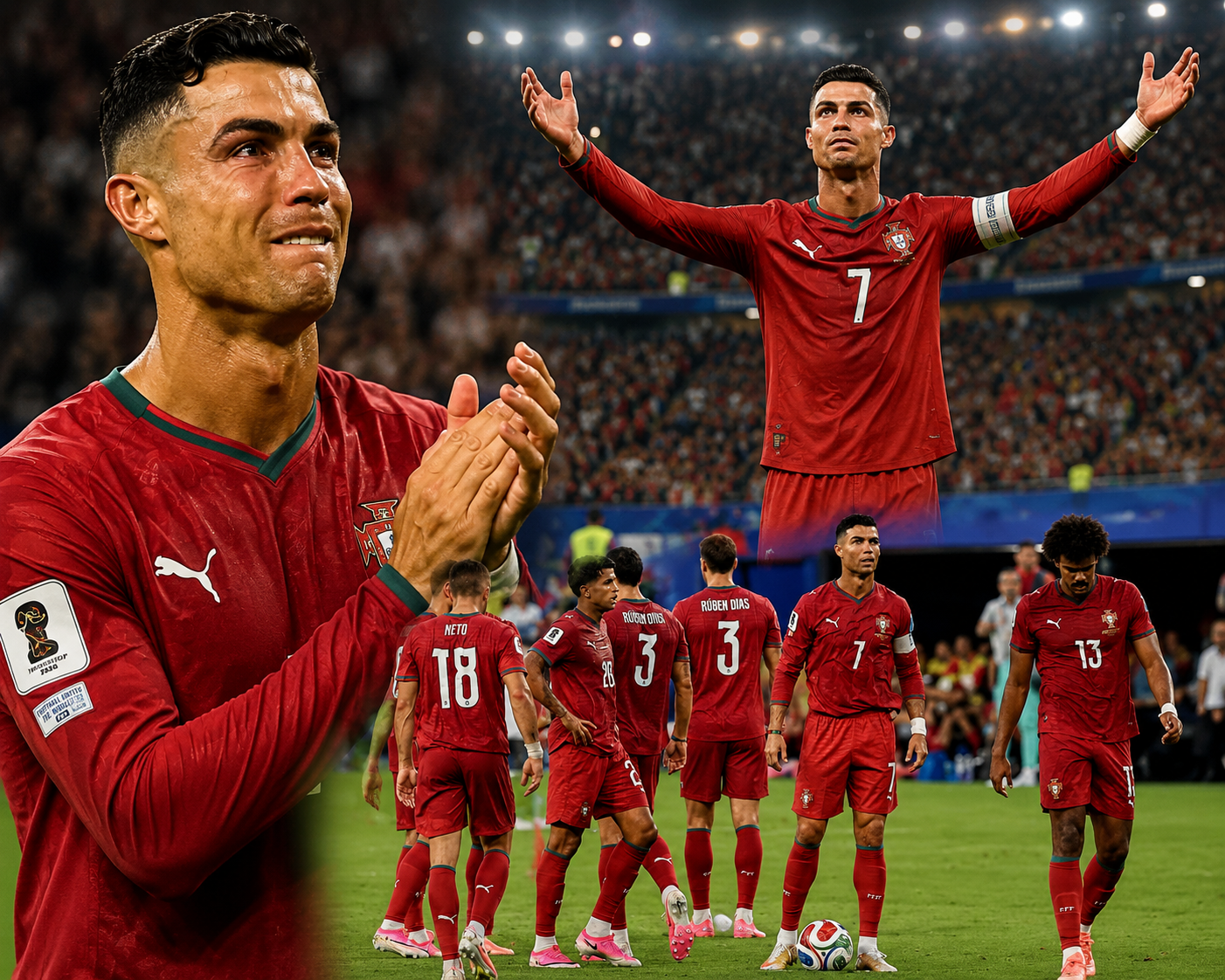
Television cameras captured one of the tournament’s most emotional scenes immediately after the match.
As Spain celebrated progression to the quarter-finals, Ronaldo applauded Portugal supporters inside the stadium while visibly fighting back tears.
There was no dramatic announcement, farewell speech or ceremonial send-off.
Instead, the image of the Portugal captain acknowledging fans who had followed his journey for twenty years became one of the defining moments of the 2026 FIFA World Cup.
For millions watching around the world, it served as a reminder that even football’s greatest competitors eventually confront the end of their biggest stage.
The moment quickly spread across social media, where tributes from fans, former players and football analysts highlighted Ronaldo’s influence on modern football regardless of the result.
Retirement Question Remains Unanswered
Although Ronaldo confirmed that this tournament would be his final FIFA World Cup, he stopped short of announcing the end of his international career altogether.
Instead, he said he intends to spend time with his family before making any decision about continuing with Portugal.
That measured response leaves open the possibility that supporters could still see him in UEFA Nations League fixtures or other international competitions, even if another World Cup appearance is no longer possible.
At 41, Ronaldo acknowledged the importance of reflecting carefully before making such a significant decision.
His approach contrasts with immediate retirement announcements often seen after major tournaments and suggests he wants his final decision to come after thoughtful consideration rather than emotional reaction following defeat.
Football observers will now watch closely to see whether Portugal’s all-time leading scorer chooses to extend his international journey for a limited period or decides that his extraordinary career with the national team has reached its natural conclusion.
A Legacy Built Beyond the World Cup
While the FIFA World Cup remained the one major honour missing from Ronaldo’s collection, he rejected any suggestion that his international career should be judged solely on that absence.
Instead, he pointed to Portugal’s transformation during his era.
Before Ronaldo emerged onto the international stage, Portugal had never won a major senior men’s international tournament.
During his career, however, the country secured three historic titles:
- UEFA Euro 2016
- UEFA Nations League (2019)
- UEFA Nations League (2025)
Ronaldo reminded reporters that these achievements fundamentally changed Portuguese football history.
He also stressed that winning Euro 2016 remains every bit as meaningful to him as lifting the FIFA World Cup, highlighting how that triumph fulfilled a dream shared by generations of Portuguese supporters.
His comments reflected a broader perspective on legacy—one rooted not simply in individual records but in helping elevate an entire football nation to unprecedented success.
Cristiano Ronaldo Farewell Leaves a Lasting Legacy for Portugal
Cristiano Ronaldo’s emotional departure from the FIFA World Cup does not diminish what many analysts consider the greatest international career in Portuguese football history. Instead, it invites a broader conversation about how one player helped reshape the identity, expectations and global reputation of an entire football nation.
When Ronaldo made his World Cup debut in 2006, Portugal was respected but had yet to establish itself among football’s most consistent title contenders. Over the next two decades, the country evolved into a team capable of competing for and winning major international honours.
Although football is always a collective effort, Ronaldo became the defining face of that transformation. His consistency, leadership and relentless pursuit of excellence elevated expectations not only within the national team but also across Portuguese football at every level.
His influence extended far beyond goals and trophies. He inspired investment in youth development, increased the global visibility of Portuguese football and became an ambassador whose achievements attracted millions of supporters worldwide.
More Than Records: Ronaldo’s Impact on Modern Football
Statistics tell only part of Ronaldo’s story.
Across six FIFA World Cups, he accumulated 27 appearances—second only to Lionel Messi’s tally of 30—and became the first player to score in six separate World Cup editions. These records reflect extraordinary longevity in one of the world’s most demanding sports.
Yet his greatest contribution may lie in redefining what elite athletes can achieve through discipline and professionalism. Ronaldo’s commitment to fitness, recovery and continuous improvement allowed him to compete at the highest level well into his forties, setting a benchmark for future generations.
Sports scientists and coaches have often pointed to his training habits, nutritional discipline and mental resilience as examples of how preparation can extend an athlete’s career. His influence has therefore reached beyond football tactics, shaping conversations about sports performance across multiple disciplines.
The World Cup Dream That Remained Elusive
For all his achievements, one objective remained beyond Ronaldo’s grasp: winning the FIFA World Cup.
Unlike Euro 2016 and the UEFA Nations League titles that Portugal celebrated during his career, football’s most prestigious trophy continued to evade both the player and the nation.
However, Ronaldo made it clear after Portugal’s elimination that he does not measure his international career solely by that missing title.
He reminded reporters that Portugal had never won a major men’s international trophy before his generation. Helping the nation capture three significant honours, he argued, represents a legacy that should not be overshadowed by the absence of a World Cup triumph.
That perspective reflects an important distinction in football history. While World Cup victories often define careers, sustained contributions to national football can leave an equally enduring mark.
According to FIFA and ESPN’s post-match coverage, Ronaldo stressed that Portugal’s UEFA Euro 2016 success remains as meaningful to him as any World Cup victory could have been. That achievement fundamentally altered Portugal’s place in international football.
What Comes Next for Portugal?
Ronaldo’s departure from the World Cup also signals a period of transition for Portugal.
The national team now faces the challenge of maintaining its competitiveness without relying on the player who has defined its identity for much of the past two decades.
Portugal, however, enters this new phase with reasons for optimism.
A new generation of talented footballers has emerged in recent years, providing depth across defence, midfield and attack. Their development suggests Portugal remains well positioned to compete in future European Championships and World Cups.
Even so, replacing Ronaldo’s leadership, experience and ability to inspire teammates will be a difficult task.
History shows that replacing iconic players is rarely straightforward. Nations such as Brazil, Germany, Italy and Argentina have all experienced transitional periods following the retirement of legendary footballers.
Portugal now begins a similar journey.
Why Ronaldo’s Story Resonates Beyond Europe
Ronaldo’s farewell carries significance far beyond Portugal.
Across Africa—including Nigeria—his career has inspired countless young footballers who view his journey from Madeira to global superstardom as proof that determination and discipline can overcome humble beginnings.
His popularity across the continent is reflected in football academies, grassroots tournaments and fan communities where children continue to wear his famous number seven shirt.
For many Nigerian supporters, Ronaldo has been one of the defining sporting figures of their lifetime. His matches have consistently attracted large television audiences, while debates comparing him with Lionel Messi have become part of football culture in homes, schools and sports centres.
His influence has also extended into commercial partnerships, fitness culture and social media, demonstrating how modern athletes can become global brands while continuing to perform at the highest level.
A Lesson in Leadership Beyond Victory
Perhaps the most striking aspect of Ronaldo’s post-match remarks was his refusal to allow defeat to define his career.
Rather than expressing bitterness, he focused on gratitude, responsibility and the privilege of representing Portugal.
His repeated emphasis on having a “clear conscience” suggests a leadership philosophy rooted in commitment rather than outcomes.
In elite sport, where success is often measured exclusively by trophies, Ronaldo’s reflections offer a different perspective: fulfilment comes from knowing every possible effort was made, regardless of the final result.
That message may resonate with athletes, coaches and supporters alike, particularly those who understand that careers are ultimately judged not only by victories but also by resilience, professionalism and lasting influence.
Cristiano Ronaldo Farewell Marks the End of an Era
Every generation of football has defining figures whose careers shape the sport’s history.
For Portugal, Cristiano Ronaldo is undoubtedly one of those figures.
His final FIFA World Cup appearance closes a remarkable chapter, but it does not conclude the conversation about his legacy. Instead, it invites renewed appreciation of a player who transformed expectations, rewrote record books and helped establish Portugal among football’s elite nations.
Whether he ultimately retires from international football or chooses to continue representing Portugal for a little longer, his place in the game’s history is already secure.
His farewell from the World Cup is therefore less about one painful defeat to Spain than about celebrating a career that changed Portuguese football forever.
As supporters around the world look ahead to future tournaments, Ronaldo leaves behind more than records. He leaves a standard of dedication, ambition and excellence that future generations will continue to measure themselves against.
Recommended Coverage
2026 FIFA World Cup: Shock Results Shake Round of 32
Discover how a series of unexpected upsets transformed the Round of 16 and reshaped the race for football’s biggest prize.
2026 FIFA World Cup Delivers Records, and Drama
Catch up on the tournament’s biggest milestones, unforgettable matches and standout performances from football’s global showpiece.
About the Author