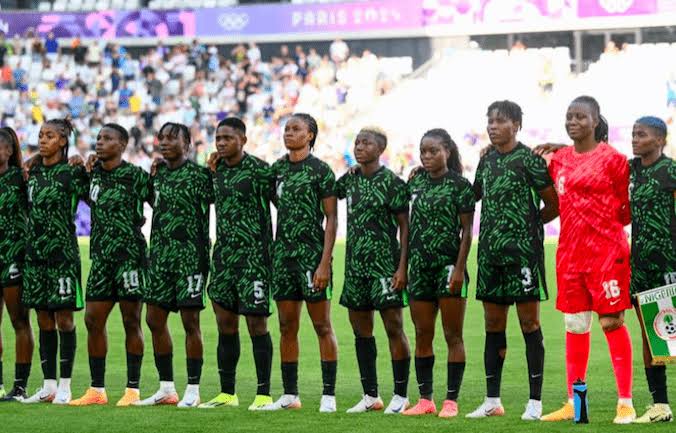
Super Falcons WAFCON Exit Ends Nigeria’s Title Defence
Nigeria’s Super Falcons WAFCON exit has ended the defending champions’ pursuit of another Women’s Africa Cup of Nations title after Cameroon defeated them 1-0 in the quarter-finals in Casablanca on Sunday, August 9.
The result was decided by a moment of individual brilliance from Cameroon’s Myriam Maéva Nyadjou, whose 19th-minute strike gave the Indomitable Lionesses the lead. Nigeria responded with sustained pressure, particularly after half-time, but could not find the goal needed to force extra time.
The defeat is significant beyond the immediate disappointment of losing a quarter-final. Nigeria entered the tournament as holders and one of the most successful teams in the history of African women’s football. Their elimination now shifts the Super Falcons’ attention away from defending their continental crown and toward securing a route to the 2027 FIFA Women’s World Cup.
CAF’s tournament structure makes the stakes particularly high. The 2026 WAFCON features 16 teams, and the knockout stages are linked directly to qualification for the 2027 Women’s World Cup in Brazil.
Super Falcons WAFCON exit decided by one goal
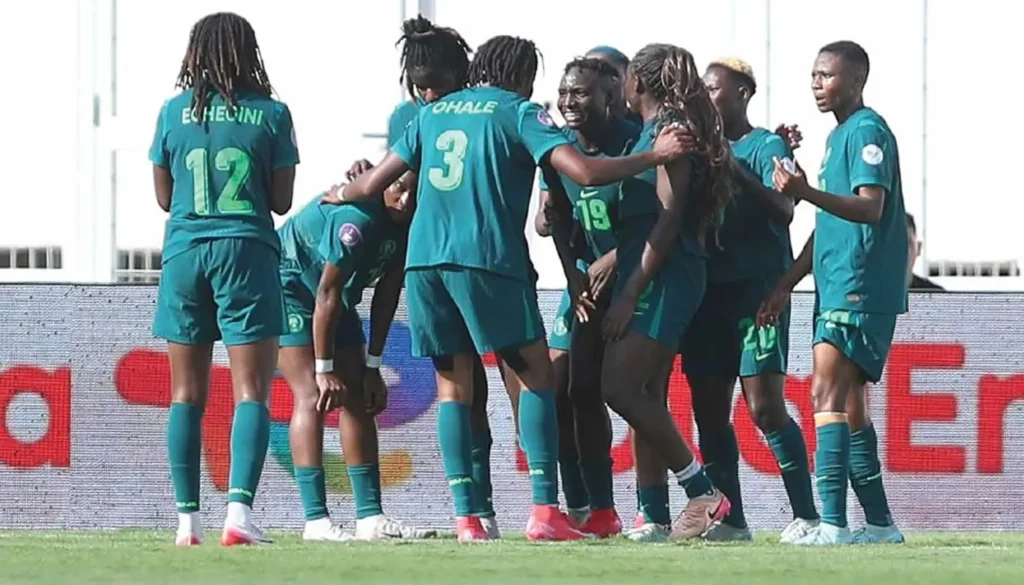
The quarter-final was ultimately settled by a single moment.
Cameroon won a promising free-kick in the 19th minute before Nyadjou stepped up and produced the decisive effort.
The goal gave Cameroon something Nigeria immediately had to chase.
The Super Falcons attempted to respond and created opportunities, but Cameroon remained organised and protected its advantage.
Nigeria’s challenge became increasingly difficult as the match progressed. Every missed opportunity increased the pressure on the defending champions, while Cameroon grew more confident in its defensive structure.
The Indomitable Lionesses eventually reached half-time still leading 1-0.
For Nigeria, the second half became a test of whether possession and attacking pressure could eventually produce the equaliser.
They could not.
Nigeria increased the pressure after half-time
The Super Falcons returned from the interval with greater urgency.
Nigeria pushed more players forward and repeatedly looked for openings in the Cameroonian defence.
According to the supplied match reports, goalkeeper Michaely Bihina played an important role in preserving Cameroon’s advantage, making crucial interventions as Nigeria increased its attacking pressure.
The most frustrating aspect of the defeat for Nigeria was that the match did not end with a comfortable Cameroon victory.
Instead, the defending champions had opportunities.
Nigeria remained within one goal of survival until the final whistle, meaning one successful attack could have changed the entire direction of the contest.
But the equaliser never arrived.
That distinction matters.
Cameroon did not need to dominate every phase of the match. It needed to defend its advantage better than Nigeria could attack it.
And it did.
Cameroon’s defensive discipline made the difference
The result also demonstrated the importance of efficiency in knockout football.
Nigeria had the pedigree.
Cameroon had the lead.
Once Nyadjou scored, the match changed.
The Indomitable Lionesses could concentrate on protecting their advantage while Nigeria assumed greater responsibility for creating the decisive opportunities.
That dynamic placed pressure on the Super Falcons.
As Nigeria pushed forward, Cameroon continued to defend its penalty area and rely on its goalkeeper to deal with the chances that did get through.
The result was a reminder that knockout football often rewards the team that handles the decisive moments better rather than the side that simply produces more attacking pressure.
For Nigeria, the failure to convert those moments ultimately proved costly.
The end of Nigeria’s WAFCON title defence
The defeat carries additional weight because Nigeria arrived in Morocco as defending champions.
CAF’s official tournament information lists Nigeria among the seeded teams and confirms its position as the holders entering the 2026 competition.
Nigeria’s women’s national team has traditionally occupied a dominant position in African football.
That history created expectations around the Super Falcons before the tournament.
But the 2026 competition has demonstrated that the African women’s game is becoming increasingly competitive.
The tournament was expanded to 16 teams, creating a broader field and a more demanding route through the competition.
Cameroon’s victory is therefore significant for more than just one quarter-final.
It shows that established African powers can no longer assume that historical reputation will be enough to carry them through difficult knockout matches.
The margin between advancing and going home can be a single free-kick, a single save or a single missed opportunity.
That was the margin between Nigeria and Cameroon.
A changing landscape in African women’s football
The wider development of African women’s football provides important context.
Nigeria remains one of the continent’s most successful teams, but other national teams have invested heavily in their own programmes and increasingly possess players capable of competing at the highest level.
Morocco’s emergence as a major force, South Africa’s continued competitiveness, Zambia’s progress and Cameroon’s resilience all point toward a broader distribution of power.
The 2026 tournament itself reflects this changing landscape.
CAF expanded the competition from 12 to 16 teams, bringing more national teams into the final tournament and increasing the number of matches.
That expansion creates greater opportunities for development, exposure and competition.
It also means established powers face more difficult paths to the latter stages.
For Nigeria, the lesson from Cameroon is therefore not simply that the Falcons lost a match.
It is that the margin for error at the top of African women’s football is becoming smaller.
The World Cup consequences are even bigger
The most immediate consequence of the Super Falcons WAFCON exit is that Nigeria can no longer secure a 2027 World Cup place by reaching the WAFCON semi-finals.
The tournament is being used as part of Africa’s qualification pathway for the Women’s World Cup in Brazil.
CAF’s competition structure provides World Cup places through the WAFCON knockout stages, while teams eliminated before the semi-finals enter the additional play-in route.
That makes Nigeria’s next match crucial.
Rather than preparing for a semi-final, the Super Falcons must now prepare for South Africa.
The supplied reports state that Nigeria will meet South Africa on Thursday in a match connected to the inter-confederation play-off route.
The fixture gives Nigeria an immediate opportunity to recover from the disappointment.
But it also introduces a different type of pressure.
The Super Falcons are no longer chasing a trophy.
They are fighting to keep their World Cup hopes alive.
Nigeria cannot afford to dwell on Cameroon
For the coaching staff and players, the challenge is now psychological as much as tactical.
A team that entered a major tournament expecting to compete for the title must suddenly adjust to a different objective.
The emotional effect of elimination can be significant.
Players must recover quickly, identify what went wrong and approach the next match without allowing the Cameroon defeat to dominate their thinking.
The technical staff also face difficult decisions.
The team must determine whether the problem was primarily finishing, chance creation, tactical execution or the ability to respond after conceding.
The supplied reports provide evidence that Nigeria created opportunities but failed to convert them.
That makes clinical finishing one of the obvious issues to examine.
But the answer should not be reduced to one missed chance.
Nigeria must assess the complete performance.
The importance of the 19th-minute goal
Nyadjou’s goal demonstrates how quickly a major tournament can turn.
For the opening stages of the match, Nigeria and Cameroon were still competing to establish control.
The free-kick changed that balance.
Suddenly, Cameroon had something valuable to protect while Nigeria had to chase.
The goal also placed enormous importance on every subsequent Nigerian attack.
Every missed opportunity became more significant because Cameroon had already established the scoreboard advantage.
In this sense, the match was decided not simply by the quality of the goal but by what happened after it.
Cameroon successfully converted the lead into a result.
Nigeria could not convert its pressure into a goal.
That is the central tactical story of the quarter-final.
What the defeat means for Nigeria’s next generation
There is also a longer-term question for Nigerian football.
The Super Falcons have historically benefited from a deep pool of talented players, but maintaining dominance requires continuous development.
The expansion of WAFCON and the growing competitiveness of African teams mean Nigeria cannot rely solely on established stars and historical success.
The next generation must be developed within an environment capable of competing with increasingly sophisticated opponents.
That means investing in youth development, technical coaching, domestic women’s football, player pathways and competitive opportunities.
The defeat to Cameroon should therefore be treated as an opportunity for serious assessment rather than simply a moment of disappointment.
Nigeria’s football authorities and coaching structure now have an important decision to make: how to preserve the strengths that have made the Super Falcons successful while adapting to a changing continental environment.
Cameroon advances with a major opportunity
For Cameroon, the victory represents an important achievement.
The Indomitable Lionesses eliminated the defending champions and secured their place in the final four.
The victory also strengthens Cameroon’s position in the race for the 2027 Women’s World Cup.
CAF’s tournament structure means the semi-final stage carries automatic World Cup qualification significance.
Cameroon therefore leaves the quarter-final with both a continental opportunity and a World Cup place within reach.
The result also provides a confidence boost for a team that has now shown it can defeat one of Africa’s most established women’s football powers when the stakes are highest.
Nigeria’s challenge is now different
The Super Falcons’ next task is no longer about defending the WAFCON crown.
It is about survival.
That shift should shape the team’s preparation.
Nigeria must recover physically, but perhaps more importantly, the squad must recover mentally.
The players now have to accept that their tournament objective has changed.
The disappointment of losing to Cameroon must give way to concentration on South Africa.
The opportunity remains significant.
Nigeria can still pursue a place at the 2027 Women’s World Cup through the remaining pathway.
But the margin for error has become considerably smaller.
Super Falcons WAFCON exit is a warning, not necessarily a decline
It would be premature to interpret one quarter-final defeat as proof that Nigeria has lost its place among Africa’s elite.
The Super Falcons remain one of the continent’s most decorated women’s national teams.
But the Cameroon defeat provides a clear warning.
Historical dominance does not guarantee future success.
African women’s football is changing, and the teams challenging Nigeria are becoming increasingly capable of turning small advantages into major results.
Cameroon did exactly that in Casablanca.
A 19th-minute goal became a quarter-final victory.
Nigeria’s pressure became frustration.
And the defending champions went home.
What comes next for the Super Falcons?
The immediate priority is clear.
Nigeria must regroup for its next fixture and concentrate on securing its route toward the 2027 FIFA Women’s World Cup.
The team has little time to dwell on the loss.
The next match provides an opportunity to change the narrative.
A victory would not erase the disappointment of losing the WAFCON title defence, but it could prevent the tournament from becoming an even greater setback.
For the players, the task is to turn disappointment into urgency.
For the coaching staff, the task is to identify why Nigeria could not break through Cameroon’s defence.
For Nigerian football administrators, the longer-term task is to ensure that the country remains competitive as the women’s game across Africa continues to develop.
The bigger lesson from Casablanca
The story of Nigeria’s elimination is ultimately about more than one goal.
It is about the changing nature of African women’s football.
Cameroon did not need to overwhelm Nigeria.
It needed to execute one decisive moment and defend its advantage.
Nigeria had opportunities to respond but could not find the breakthrough.
That is how a defending champion can leave a major tournament before the semi-finals.
For the Super Falcons, the title defence is finished.
But the wider campaign is not necessarily over.
The fight for the 2027 Women’s World Cup now becomes the immediate priority.
And that may prove to be the most important test of how quickly Nigeria can turn a painful WAFCON exit into a renewed campaign.
According to CAF, the 2026 WAFCON runs from July 26 to August 16 and includes a 16-team field, with the competition also serving as part of Africa’s qualification pathway for the 2027 FIFA Women’s World Cup.
The Super Falcons therefore leave their quarter-final with Cameroon without the trophy they came to defend, but with one final objective still within reach: finding a way forward.
RECOMMENDED COVERAGE
FIFA U20 Women’s World Cup: Nigeria Faces Spain, China
Nigeria’s WAFCON exit is only one chapter in the country’s women’s football story.
See how Nigeria’s emerging generation is preparing to face the world’s best in the U20 Women’s World Cup.
Nigeria U17 Women World Cup
The future of the Super Falcons depends on the players coming through Nigeria’s youth system today.
Explore Nigeria’s U17 women’s World Cup journey and the next generation carrying the national team’s hopes.
UK Women’s World Cup 2035 Faces South Africa Rivalry
Nigeria’s WAFCON setback comes as women’s football continues to expand rapidly across Africa and around the world.
Discover how the race to host future Women’s World Cups could reshape the global game
About the Author