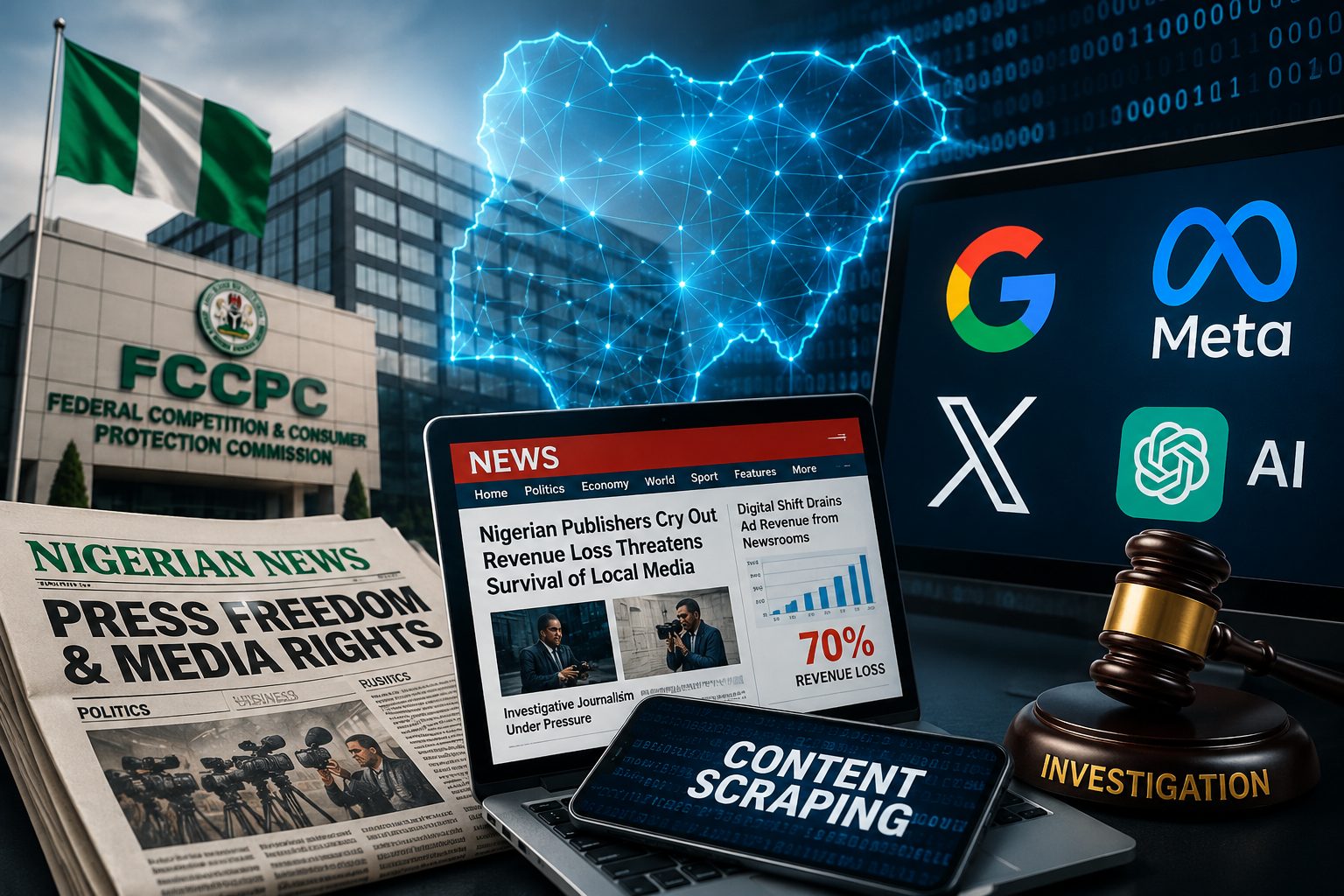
Big Tech Investigation: Why Nigeria Is Challenging Global Tech Giants Over Local News Content
Nigeria’s decision to investigate some of the world’s largest technology companies marks a significant moment in the country’s evolving digital economy. Rather than focusing solely on the government’s directive, the development reflects a broader struggle over who benefits financially from journalism in the internet age.
President Bola Tinubu has directed the Federal Competition and Consumer Protection Commission (FCCPC) to investigate Meta, Google, X and several artificial intelligence (AI) platforms over allegations that they have engaged in anti-competitive practices and unlawfully exploited Nigerian media content.
The investigation follows a petition submitted by the Nigerian Press Organisation (NPO), which represents major newspaper publishers and media stakeholders. According to the petition, international technology companies have built profitable digital ecosystems using locally produced journalism while providing little or no financial compensation to the publishers responsible for creating that content.
Although the companies involved will be given an opportunity to respond during the FCCPC proceedings, the case has already ignited an important national debate about the future of journalism, digital competition and the growing influence of artificial intelligence in Nigeria’s information ecosystem.
Big Tech Investigation Signals a New Chapter for Nigerian Journalism
For decades, newspapers and broadcast organisations generated revenue primarily through newspaper sales, subscriptions and advertising.
That business model has undergone dramatic changes over the last fifteen years.
As audiences increasingly consume news through search engines, social media platforms and AI-powered services, technology companies have become the primary gateways through which millions of people access information.
Instead of visiting publishers’ websites directly, many readers now discover headlines through Google Search, Facebook, X, AI chatbots and content recommendation systems.
Publishers argue that while these platforms benefit commercially from increased user engagement and advertising revenue, the original producers of the news receive only a small fraction of the economic value generated.
This concern is at the heart of Nigeria’s Big Tech Investigation.
According to the Nigerian Press Organisation, local media organisations have experienced severe financial losses as digital platforms expanded their dominance over online news distribution. The organisation estimates that publishers have lost as much as 70 percent of their revenue, attributing part of that decline to the commercial use of their journalism without fair compensation. That figure reflects the NPO’s claim and will likely form part of the issues examined during the FCCPC inquiry.
Why Publishers Say Their Content Is Being Exploited
Modern technology platforms interact with news content in several different ways.
Search engines index news articles to help users find information.
Social media platforms display article previews, headlines and images to encourage sharing.
Increasingly, AI systems analyse, summarise and sometimes generate responses based on publicly available online information.
Publishers argue that these systems derive significant commercial value from professionally produced journalism.
Their concerns include:
- Unauthorized scraping of published articles.
- AI systems trained using copyrighted or publisher-created content.
- Search engines monetising news-related searches through advertising.
- Social media platforms generating engagement from professional journalism.
- Reduced direct website traffic for news organisations.
- Declining advertising revenue as audiences remain on technology platforms rather than visiting original news websites.
While technology companies generally maintain that they drive valuable traffic to publishers and comply with applicable laws, media organisations in several countries have challenged that position, arguing that the economic relationship has become increasingly one-sided.
Nigeria’s investigation therefore reflects a wider international debate rather than an isolated domestic dispute.
What the FCCPC Will Examine
The Federal Competition and Consumer Protection Commission is expected to determine whether the companies violated provisions of the Federal Competition and Consumer Protection Act (FCCPA) 2018.
Among the issues likely to receive close examination are:
- Whether dominant technology platforms abused their market position.
- Whether publishers were denied fair commercial opportunities.
- Whether unauthorized content scraping occurred.
- Whether Nigerian journalism was commercially exploited without appropriate compensation.
- Whether competition within Nigeria’s digital media market has been distorted.
The FCCPC has indicated that all companies named in the investigation will be afforded a fair hearing before any conclusions are reached. That approach aligns with due process requirements and ensures that allegations raised by the Nigerian Press Organisation can be tested alongside responses from the companies concerned.
Artificial Intelligence Adds a New Dimension
The inclusion of AI platforms makes this investigation particularly significant.
Unlike traditional search engines, many generative AI systems can provide users with detailed summaries or direct answers that reduce the need to visit original news websites.
Publishers worldwide have expressed concern that if AI tools rely extensively on professionally produced journalism without licensing agreements or compensation, the economic foundation of news production could weaken further.
Supporters of stronger regulation argue that quality journalism requires sustained investment in reporters, editors, photographers and fact-checkers. If publishers are unable to recover those costs because digital intermediaries capture a growing share of online revenue, fewer organisations may be able to maintain comprehensive news coverage.
For Nigeria, where independent journalism already faces economic pressures, the outcome of this investigation could influence not only relations between publishers and technology firms but also the long-term sustainability of the country’s media industry.
PART 3
Global Precedents Show Nigeria Is Not Acting Alone
Nigeria’s Big Tech Investigation comes at a time when governments across the world are reassessing the relationship between technology companies and news publishers.
Over the past several years, concerns have grown over whether global digital platforms have accumulated enormous economic power while traditional news organisations struggle to maintain sustainable business models.
Several countries have already introduced policies aimed at correcting what they describe as an imbalance between technology companies and content creators.
One notable example is South Africa, where discussions between publishers and Google resulted in agreements designed to compensate media organisations for certain uses of their content. Similar debates have also taken place in Australia, Canada and parts of the European Union, where lawmakers have introduced or strengthened rules requiring digital platforms to negotiate with publishers under specific circumstances.
Although each country’s legal framework differs, the underlying concern remains largely the same: ensuring that the organisations investing in journalism receive fair economic value when their work contributes to the success of digital platforms.
Nigeria’s latest action therefore reflects a broader international trend rather than an isolated regulatory decision.
The Earlier Meta Case Adds Important Context
The latest investigation also follows previous regulatory action involving one of the companies now under scrutiny.
Meta is already challenging an earlier $220 million administrative penalty imposed by the FCCPC over alleged consumer protection and data privacy violations.
While that matter is separate from the current investigation into media content, together they demonstrate Nigeria’s increasingly assertive approach toward regulating multinational technology firms operating within its digital economy.
The present inquiry focuses on competition law and publisher compensation rather than privacy issues, but it reinforces the message that Nigerian regulators intend to apply domestic laws to global technology companies operating in the country.
What This Could Mean for Nigerian Publishers
For many local news organisations, the investigation represents more than a legal process—it is viewed as a potential turning point for an industry that has faced years of declining revenue.
Publishers argue that producing credible journalism requires significant investment in:
- Reporters and correspondents
- Editors and newsroom staff
- Photography and video production
- Investigative reporting
- Digital infrastructure
- Fact-checking and verification
- Legal compliance and editorial oversight
As advertising spending increasingly shifts toward digital platforms, many publishers have struggled to replace traditional revenue streams.
Industry groups believe that establishing clearer rules governing the commercial use of journalistic content could help strengthen the long-term sustainability of independent media.
Supporters of the investigation also argue that fair compensation would encourage greater investment in quality reporting, particularly investigative journalism and public-interest news that serves democratic accountability.
Technology Companies Are Likely to Present Their Own Defence
The FCCPC has stated that every company named in the investigation will receive a fair hearing before any decision is reached.
Technology companies have historically argued in similar cases around the world that their platforms provide substantial benefits to publishers.
Common arguments include:
- Driving millions of readers to publishers’ websites.
- Providing free distribution channels.
- Helping smaller publishers reach wider audiences.
- Supporting businesses through advertising and digital tools.
- Investing in journalism training and innovation programmes.
Whether those arguments satisfy Nigerian regulators will depend on the evidence presented during the investigation and the application of the Federal Competition and Consumer Protection Act.
No findings have yet been made against any of the companies named in the inquiry, and the investigation remains ongoing.
Implications for AI and Nigeria’s Digital Future
One of the most closely watched aspects of the investigation is its inclusion of artificial intelligence platforms.
Around the world, publishers, authors, artists and content creators are increasingly questioning how AI systems obtain, process and reproduce copyrighted material.
If Nigeria eventually develops clearer regulatory standards governing AI content usage, it could influence future policy discussions on:
- AI transparency
- Copyright protection
- Digital licensing
- Publisher compensation
- Ethical AI development
- Competition in digital markets
Such measures could also encourage technology companies to negotiate licensing agreements directly with Nigerian publishers, similar to arrangements seen in other jurisdictions.
For the country’s growing technology sector, the investigation highlights the need to balance innovation with respect for intellectual property, competition law and sustainable journalism.
Why the Outcome Matters Beyond the Media Industry
Although the immediate dispute centres on news publishers, the implications extend much further.
The outcome could influence:
- Digital advertising markets.
- Competition within Nigeria’s online economy.
- Future regulation of AI platforms.
- Consumer access to trustworthy information.
- Investment in local journalism.
- The relationship between government regulators and multinational technology companies.
If regulators conclude that changes are necessary, Nigeria could join a growing list of countries seeking to redefine how value is shared between digital platforms and the creators of original content.
Conversely, if the investigation finds no evidence of anti-competitive conduct, it could clarify the legal boundaries governing technology companies operating within the Nigerian market.
Either way, the case is likely to become a significant reference point for future digital policy debates.
Conclusion
Nigeria’s Big Tech Investigation represents more than a dispute between regulators and multinational technology companies. It reflects a wider global debate over who should benefit from the economic value created by journalism in the digital era.
As the FCCPC reviews allegations involving Meta, Google, X and several AI platforms, the investigation will test the balance between technological innovation, competition law and the financial sustainability of independent media.
For Nigerian publishers, the case could shape future business models and determine whether local journalism receives greater protection in an increasingly AI-driven information economy. For technology companies, it offers an opportunity to demonstrate compliance with Nigerian law while responding to growing international demands for fairer relationships with content creators.
The FCCPC has emphasised that all parties will be given an opportunity to present their positions before any conclusions are reached. Until that process is completed, the allegations remain under investigation, and the final outcome could have lasting consequences for Nigeria’s digital economy, media industry and regulatory landscape.
Recommended Coverage
Nigeria’s Economy Under Tinubu: Progress or Growing Challenges?
Explore how the current administration’s economic policies are reshaping business confidence, investment and the wider Nigerian economy.
How a Nigerian Student Won an International Scholarship
Read the inspiring story of academic excellence and the opportunities opening up for talented Nigerian students on the global stage.
Diezani Alison-Madueke Acquittal Ends 11-Year UK Legal Battle
An in-depth report examining one of the most closely followed legal cases involving a former Nigerian public official.
Owerri West’s Rapid Growth Renews Calls for Strong Leadership
Discover why rapid urban expansion is increasing demands for better governance, infrastructure and sustainable development in Owerri West.
About the Author