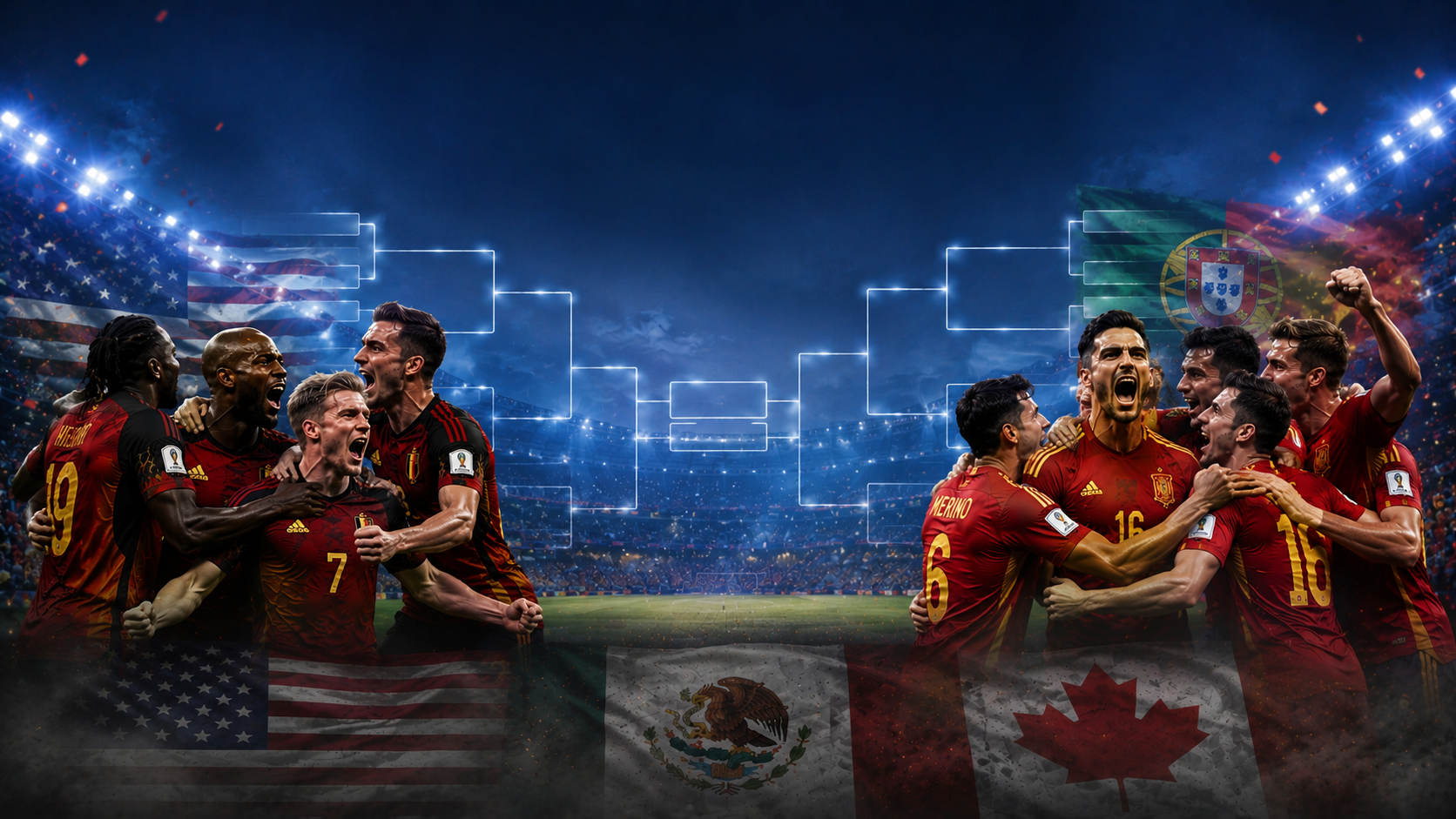
World Cup 2026 Quarterfinals Set After Belgium, Spain Advance While All Three Co-Hosts Crash Out
Belgium and Spain book last-eight places as the United States, Mexico and Canada suffer a historic early exit, leaving the 2026 FIFA World Cup without any of its host nations in the quarterfinals.
The World Cup 2026 Quarterfinals are rapidly taking shape following a dramatic round of knockout matches that delivered stunning upsets, emotional farewells and significant managerial changes. Belgium and Spain emerged as the latest teams to secure their places in the last eight after eliminating the United States and Portugal, respectively, while the tournament also witnessed an unprecedented milestone as all three co-host nations—the United States, Mexico and Canada—were knocked out before reaching the quarterfinal stage.
Beyond determining who advances, the latest results have reshaped the narrative of the tournament. What began as a World Cup designed to showcase football across North America has instead highlighted the growing competitiveness of the global game, with traditional European powers and emerging football nations now dominating the latter stages.
As anticipation builds ahead of the remaining Round of 16 fixtures, attention has shifted from host nation optimism to an increasingly unpredictable race for football’s biggest prize.
Belgium End USA’s World Cup Dream
Belgium delivered one of the most commanding performances of the Round of 16 by defeating the United States 4-1 in Seattle to secure their place in the quarterfinals.
The victory was built on clinical finishing and disciplined attacking football. Charles De Ketelaere scored twice to put Belgium firmly in control before Romelu Lukaku added another goal in stoppage time to complete an emphatic victory.
The match attracted global attention even before kickoff following FIFA’s decision to suspend Folarin Balogun’s red-card ban after political intervention by U.S. President Donald Trump. Although the decision generated considerable debate before the game, Belgium ultimately ensured that discussions surrounding officiating had little influence on the final outcome.
Instead, Belgium’s superior quality across the pitch proved decisive as they comfortably progressed to the tournament’s final eight.
For the United States Men’s National Team (USMNT), the defeat represents another disappointing end to a World Cup campaign that many supporters had hoped would produce the country’s deepest tournament run in modern history, particularly as one of the tournament’s hosts.
Spain Eliminate Portugal as Ronaldo’s World Cup Journey Ends
Perhaps the most emotional moment of the knockout round came when Spain edged neighbours Portugal 1-0 through a dramatic 90th-minute winner scored by substitute Mikel Merino.
The narrow victory not only secured Spain’s place in the World Cup 2026 Quarterfinals, but also marked what is widely regarded as Cristiano Ronaldo’s final FIFA World Cup appearance.
For nearly two decades, Ronaldo has remained one of international football’s defining figures, helping Portugal win major honours while becoming one of the game’s greatest goalscorers. His latest World Cup campaign therefore carried enormous emotional significance for supporters across the world.
Spain’s disciplined defensive display frustrated Portugal throughout the contest before Merino’s late strike settled one of the tournament’s biggest fixtures.
The result immediately triggered major developments off the pitch, with Portugal head coach Roberto Martinez stepping down shortly after the team’s elimination. His resignation signals the beginning of another rebuilding phase for Portuguese football as attention gradually shifts toward the next generation of international stars.
Historic Failure for World Cup Co-Hosts
The elimination of the United States carries significance well beyond a single knockout defeat.
With Canada already eliminated after losing 3-0 to Morocco and Mexico having earlier fallen 3-2 to England, all three co-host nations have now officially exited the competition before reaching the quarterfinals.
That outcome represents one of the most remarkable statistical stories of the tournament.
Hosting a FIFA World Cup has traditionally provided national teams with advantages including familiar conditions, passionate home support and reduced travel demands. While those factors often contribute to improved performances, they ultimately proved insufficient for the North American trio.
For tournament organisers, however, the commercial success of the competition remains largely unaffected. Record attendances, worldwide television audiences and significant digital engagement have demonstrated the continued global appeal of the FIFA World Cup despite the early departures of its host nations.
From a football perspective, the results reinforce the increasing competitiveness of international football, where traditional advantages can quickly disappear against technically superior and tactically disciplined opponents.
A Tournament Full of Surprises
The knockout stage has already delivered several unexpected outcomes that continue to reshape the championship race.
Among the biggest developments:
- Belgium eliminated the United States 4-1.
- Spain defeated Portugal with a last-minute winner.
- Morocco knocked out Canada.
- England eliminated Mexico.
- Paraguay stunned Germany.
- Norway eliminated Brazil after Erling Haaland’s outstanding performance.
- France continued their impressive march toward another World Cup title.
Taken together, these results underline how quickly fortunes can change during the knockout stages, where a single mistake or moment of brilliance often determines who advances and who goes home.
The unpredictability has also strengthened the appeal of the World Cup 2026 Quarterfinals, with several heavyweight clashes now guaranteed as the tournament enters its decisive phase.
Germany Begin Another Coaching Search After Shock Exit
While Belgium and Spain celebrated qualification, Germany entered a period of uncertainty following one of the tournament’s biggest disappointments.
Germany’s campaign ended earlier than expected after a shock Round of 32 defeat to Paraguay, prompting head coach Julian Nagelsmann to resign. According to the primary source, the German Football Association (DFB) has entered advanced contract negotiations involving Red Bull in an effort to appoint former Liverpool manager Jurgen Klopp as Germany’s next head coach.
Although no official appointment has been confirmed, the development reflects the immense pressure placed on traditional football powers after disappointing performances at major international tournaments.
Germany remains one of the most successful nations in FIFA World Cup history, making every early elimination a subject of intense national debate. Should Klopp eventually accept the role, he would inherit one of football’s highest-profile rebuilding projects.
The situation also illustrates a wider trend across international football: elite federations are increasingly turning to experienced managers with proven records of developing competitive squads capable of succeeding under the unique pressures of tournament football.
World Cup 2026 Quarterfinals Promise Heavyweight Battles
With Belgium and Spain joining France, Morocco, England and Norway in the last eight, attention has shifted to what promises to be one of the most competitive quarterfinal rounds in recent World Cup history.
The confirmed fixtures include:
Thursday, July 9
France vs Morocco
Boston Stadium
A repeat meeting between two nations whose football relationship has continued to grow in recent years. France enter as favourites, while Morocco hope to continue another memorable World Cup campaign.
Friday, July 10
Spain vs Belgium
Los Angeles Stadium
Arguably the standout quarterfinal.
Spain’s possession-based approach will be tested against Belgium’s clinical attack led by Romelu Lukaku and Charles De Ketelaere, making this one of the tournament’s most anticipated encounters.
Saturday, July 11
Norway vs England
Miami Stadium
Norway arrive with enormous confidence after eliminating Brazil, inspired by Erling Haaland’s prolific scoring form.
England, meanwhile, continue to demonstrate consistency under pressure after overcoming Mexico and now face one of Europe’s most dangerous attacking teams.
Saturday, July 11
Winner of Argentina/Egypt vs Winner of Switzerland/Colombia
Kansas City Stadium
The final quarterfinal place will be determined after the remaining Round of 16 fixtures conclude.
Messi and Salah Prepare for a Potential Classic
Before the quarterfinal lineup becomes complete, football supporters around the world will focus on one of the tournament’s biggest remaining Round of 16 contests.
Argentina face Egypt in a match widely described as a potential “Last Dance” between two global icons—Lionel Messi and Mohamed Salah.
For Messi, another World Cup represents an opportunity to extend one of football’s greatest international careers.
For Salah, it offers perhaps the biggest opportunity yet to guide Egypt deeper into the competition and further cement his status among Africa’s greatest footballers.
From an African perspective, Egypt’s progress would carry enormous symbolic importance.
African nations have steadily narrowed the competitive gap with Europe and South America over recent decades. A victory over reigning football heavyweight Argentina would rank among the continent’s greatest World Cup achievements and further strengthen confidence in African football’s continued development.
Nigerian football supporters are also expected to follow the encounter closely, with many across Africa viewing Egypt as one of the continent’s standard bearers on the global stage.
Golden Boot Race Remains Wide Open
The battle to finish as the tournament’s leading goalscorer remains remarkably close.
According to the tournament standings, Erling Haaland joined France’s Kylian Mbappé and Argentina captain Lionel Messi on seven goals after scoring twice during Norway’s victory over Brazil.
The trio now headline one of the most competitive Golden Boot races in recent World Cup history.
Several factors could influence the outcome:
- Remaining matches available to each player.
- Quarterfinal opponents and tactical matchups.
- Penalty responsibilities.
- Team progression into the semifinals and final.
- Individual fitness and squad rotation.
With every knockout match carrying greater significance, each goal could ultimately decide both the Golden Boot award and the destination of football’s biggest trophy.
What the Tournament Says About Modern International Football
Beyond individual results, the World Cup 2026 Quarterfinals reflect several broader trends shaping the modern international game.
One of the clearest lessons has been the diminishing importance of home advantage. Despite sharing hosting duties, the United States, Canada and Mexico all exited before reaching the last eight—a reminder that tournament success increasingly depends on tactical discipline, squad depth and execution under pressure rather than familiar surroundings.
The competition has also demonstrated the growing balance between football’s traditional powers and ambitious challengers. Morocco’s continued progress, Norway’s elimination of Brazil and Paraguay’s victory over Germany illustrate how established hierarchies are being tested by nations with improving development systems and stronger domestic football structures.
For African football, Morocco and Egypt’s performances highlight the continent’s expanding influence on the global stage. Success against elite opposition reinforces the argument that African nations are no longer merely participants but genuine contenders capable of shaping the outcome of major tournaments.
As reported in BBC Sport’s World Cup coverage, the knockout stage has become increasingly unpredictable, with several traditional favourites already eliminated before the quarterfinals.
Looking Ahead
The remaining Round of 16 fixtures will complete the World Cup 2026 Quarterfinals lineup, but the tournament has already delivered defining moments—from the historic exit of all three host nations to Cristiano Ronaldo’s emotional farewell and the emergence of new title contenders.
With heavyweight clashes now scheduled and the Golden Boot race finely balanced, the competition enters a decisive phase where every match could redefine football history.
Whether Belgium can maintain their momentum, Spain can continue their disciplined run, or another surprise contender emerges, the race for the FIFA World Cup trophy remains as open as it has been in years.
Recommended Coverage
Tinubu Certificate Petition Puts INEC Under Pressure
A detailed report examining the legal petition seeking clarification on President Bola Tinubu’s academic credentials ahead of Nigeria’s 2027 elections.
Nigeria Tax Acts 2025: What the New Transition Rules Mean
An explainer on the Federal Government’s transition guidelines and how businesses and taxpayers could be affected.
Owerri West Growth Fuels Calls for Stronger Leadership
An analysis of infrastructure expansion, governance and development priorities in one of Imo State’s fastest-growing local government areas.
About the Author