
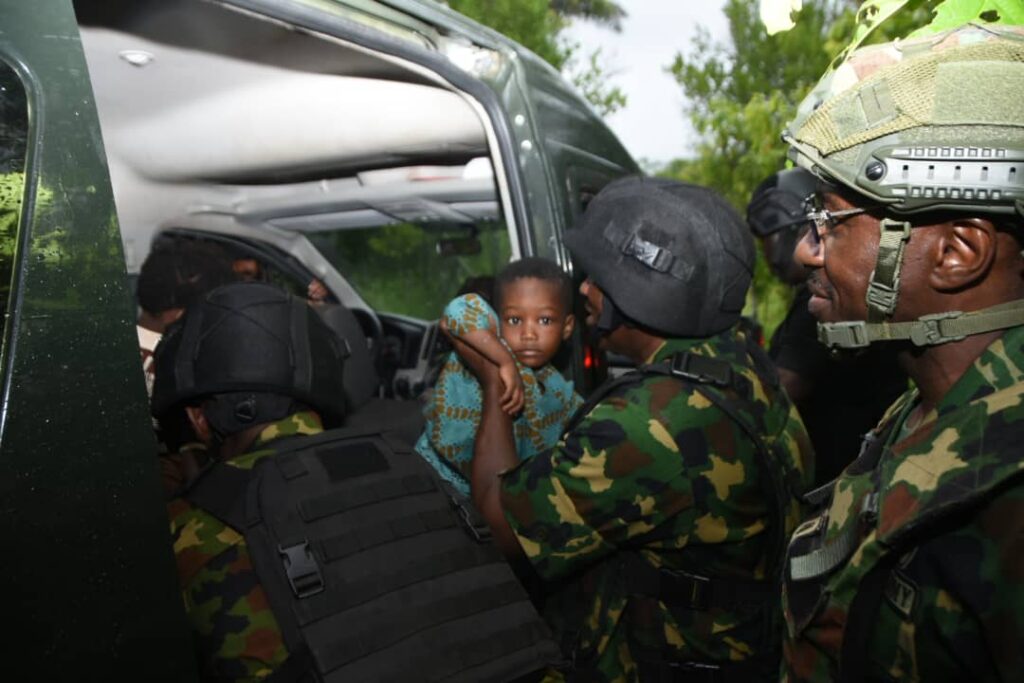
Rescued pupils gather after regaining their freedom following a 56-day captivity, marking the end of an intelligence-led security operation in Oyo State.
Oyo School Rescue: How Intelligence Strategy Forced Kidnappers to Free 44 Victims
The Oyo school rescue has emerged as one of Nigeria’s most significant intelligence-led counter-kidnapping operations in recent years, with security agencies successfully securing the release of 44 abducted pupils and teachers after 56 days in captivity without paying ransom or agreeing to the kidnappers’ demands. Instead of relying on negotiations alone, authorities combined intelligence gathering, coordinated military operations, psychological pressure and a firm no-ransom policy to gradually weaken the kidnappers’ network, demonstrating an evolving approach to tackling organised abductions in the country.
The operation, carried out by multiple security agencies with support from local security groups, has attracted national attention not only because of the safe rescue of the victims but also because it highlights how intelligence-driven strategies are becoming increasingly central to Nigeria’s response to terrorism and mass kidnapping.
How the Oyo School Rescue Changed the Narrative
School kidnappings have become one of Nigeria’s most persistent security challenges over the past decade. Criminal groups have repeatedly targeted schools because children often provide high-value bargaining power during ransom negotiations.
The successful rescue of the victims from Oriire Local Government Area represents a departure from previous operations where prolonged negotiations or ransom payments often dominated public discussions.
Instead, security agencies reportedly focused on weakening the kidnappers’ operational capabilities while steadily reducing their options inside the forest.
That shift forms the central lesson from the operation.
Rather than allowing the kidnappers to dictate the pace of negotiations, authorities worked to reverse the pressure by targeting the group’s support structure and restricting its ability to operate.
An Intelligence-Led Operation Instead of a Conventional Assault
Officials described the rescue as an intelligence-driven mission that depended heavily on gathering information before any decisive action was taken.
According to available accounts, operatives spent weeks identifying individuals connected to the kidnappers and mapping out the wider network supporting the criminal group.
This reportedly included locating close relatives and associates living in different communities across Nigeria.
While military force remained part of the strategy, intelligence collection appears to have provided the operational advantage that guided subsequent decisions.
Modern hostage rescue missions increasingly rely on this type of intelligence because direct military assaults often carry significant risks for captives.
Security experts frequently note that understanding a criminal network’s communication channels, movement patterns and logistics can be more valuable than deploying overwhelming force at the earliest opportunity.
The Oyo operation appears to reflect that philosophy.
Psychological Pressure Became a Critical Element
One of the most discussed aspects of the rescue operation was the reported use of psychological pressure against the kidnappers.
According to security accounts, authorities questioned relatives of suspected kidnappers and communicated developments directly to those holding the captives.
The objective was reportedly to convince the abductors that continuing to hold the victims would expose their own families to prolonged legal scrutiny and increase pressure on the network.
Whether viewed primarily as a psychological tactic or as part of broader intelligence operations, the reported strategy appears to have shifted the balance of leverage.
Hostage situations are often built around one central calculation: the kidnappers believe they possess something authorities desperately want.
The reported operation sought to alter that calculation by demonstrating that the kidnappers themselves also had vulnerabilities.
This approach, according to officials involved in the operation, contributed to increasing pressure on the group while reducing its negotiating strength.
Military Coordination Reinforced Intelligence Efforts
Intelligence alone rarely succeeds without operational support.
Security agencies reportedly combined information gathering with sustained military deployments around the Old Oyo National Park, where the abductors were believed to be hiding.
A coordinated security presence involving the Nigerian Army, Navy, Department of State Services (DSS), Nigeria Police Force, Amotekun Corps and local hunters reportedly established a wide security cordon around the suspected hideout.
Instead of launching an immediate assault, security personnel focused on restricting movement into and out of the forest.
Such tactics can significantly reduce the operational flexibility of armed groups by limiting opportunities to relocate hostages or receive reinforcements.
Reports indicate that escape routes were closely monitored while surveillance continued throughout the operation.
The combination of intelligence and military coordination allowed authorities to maintain constant pressure without unnecessarily increasing the danger faced by the hostages.
Cutting Off Supplies Weakened the Kidnappers
Another important feature of the operation was the reported disruption of supply networks.
Armed groups operating in remote forests depend heavily on external support for food, medicine, fuel, communication equipment and other essential resources.
By reportedly restricting these supply routes, security agencies sought to reduce the kidnappers’ ability to sustain a prolonged hostage situation.
Counter-insurgency experts have long argued that disrupting logistics can sometimes prove more effective than direct confrontation.
Without reliable supplies, criminal groups often face internal strain, declining morale and reduced operational capability.
In the Oyo operation, authorities believe sustained logistical pressure contributed to weakening the kidnappers over time, complementing intelligence and military efforts already underway.
The No-Ransom Policy That Shaped the Rescue
One of the defining elements of the Oyo school rescue was the Federal Government’s reported refusal to yield to the kidnappers’ demands despite mounting public concern over the prolonged captivity of the pupils and teachers.
According to reports, the kidnappers initially demanded ₦1.2 billion in ransom and the release of a suspected Boko Haram commander standing trial. Authorities, however, maintained the government’s long-standing position against paying ransom or exchanging prisoners for hostages.
The policy has remained controversial.
Supporters argue that paying ransom strengthens criminal organisations by providing them with financial resources to acquire more weapons, recruit additional members and finance future kidnappings. Critics, on the other hand, contend that governments should prioritise saving lives where negotiations may offer the quickest route to freedom.
In the Oyo operation, officials believe that refusing concessions denied the kidnappers both financial and political victories while allowing security agencies to continue applying pressure through intelligence and military operations.
Although every hostage crisis presents different circumstances, this rescue is likely to strengthen arguments among policymakers that strategic patience can sometimes achieve better long-term security outcomes than immediate concessions.
Inter-Agency Cooperation Proved Critical
Another major lesson from the operation was the level of coordination reportedly achieved among Nigeria’s security institutions.
Large-scale rescue missions often fail when agencies operate independently or compete over intelligence. In this case, available reports indicate that multiple organisations worked under a coordinated framework.
Those involved reportedly included:
- Department of State Services (DSS)
- Nigerian Army
- Nigerian Navy
- Nigeria Police Force
- Amotekun Corps
- Local hunters and community intelligence networks
Each organisation brought different operational strengths.
The DSS reportedly focused on intelligence gathering and surveillance.
Military personnel provided operational security around the forest.
Police officers assisted with investigations and arrests.
Amotekun Corps and local hunters contributed valuable knowledge of the terrain and surrounding communities.
This multi-layered approach illustrates how modern security operations increasingly depend on collaboration rather than isolated action.
Experts frequently point out that criminal networks operate across state boundaries and often exploit communication gaps between agencies. Joint operations reduce those vulnerabilities by allowing information to move more quickly between intelligence officers and field commanders.
Why Forest-Based Kidnapping Has Become a Security Challenge
The Old Oyo National Park has repeatedly featured in discussions about insecurity because of its vast vegetation and difficult terrain.
Forested regions across Nigeria have increasingly become hideouts for kidnapping gangs, armed bandits and terrorist-linked groups.
Several factors contribute to this trend.
Dense forests provide natural concealment from aerial surveillance.
Remote terrain makes rapid military deployment more difficult.
Limited road infrastructure slows emergency response.
The distance from major urban centres can also complicate intelligence gathering.
For these reasons, security agencies have gradually shifted towards intelligence-led operations rather than relying solely on conventional search missions.
The Oyo rescue demonstrates how understanding criminal logistics can become just as important as locating the kidnappers themselves.
Restricting movement, identifying supply routes and monitoring communications may ultimately prove more effective than large-scale assaults that risk endangering hostages.
A Different Model From Earlier School Kidnappings
Nigeria has experienced several high-profile school abductions over the past decade, beginning with the global attention drawn by the 2014 Chibok schoolgirls’ kidnapping.
Subsequent attacks in states including Kaduna, Katsina, Niger and Zamfara reinforced concerns that educational institutions had become attractive targets for armed groups seeking ransom or publicity.
Many previous incidents were characterised by prolonged negotiations, community fundraising efforts or reports of ransom payments by families or intermediaries.
The circumstances surrounding each case differed significantly, making direct comparisons difficult.
However, the Oyo school rescue appears to highlight a greater emphasis on coordinated intelligence, sustained operational pressure and strategic patience.
Rather than allowing the kidnappers to dictate the pace of events, authorities reportedly focused on steadily reducing the group’s freedom of movement and operational capacity until its bargaining position weakened.
Whether this approach becomes a standard model for future operations will likely depend on the unique circumstances of each kidnapping and the quality of intelligence available.
The Human Cost Behind the Operation
While much attention has focused on the operational success of the rescue, the human impact remains impossible to ignore.
The pupils and teachers reportedly spent nearly two months living under extreme uncertainty.
Families endured weeks of anxiety while waiting for news about their loved ones.
Communities faced emotional trauma as schools, parents and local leaders struggled to cope with the prolonged crisis.
Reports also indicate that two teachers lost their lives during the ordeal, underscoring the dangers associated with mass abductions and the urgency of effective rescue operations.
Beyond the immediate victims, such incidents often leave lasting psychological consequences.
Children who survive kidnapping may require long-term counselling and educational support before returning to normal school life.
Teachers and school administrators may also experience lasting trauma that affects classroom performance and community confidence.
These human consequences remind policymakers that the success of any rescue operation should ultimately be measured not only by tactical achievements but also by how effectively survivors are supported during recovery.
Communities Remain the First Line of Intelligence
Security analysts frequently argue that communities play a decisive role in preventing kidnapping.
Residents often notice unusual movements long before security agencies receive formal intelligence.
Local hunters, vigilante groups, traditional rulers and community leaders can provide valuable information about unfamiliar persons, suspicious supply chains or emerging criminal activity.
The reported collaboration between security agencies and local actors during the Oyo operation reinforces this reality.
Effective intelligence often begins with trusted relationships between communities and law enforcement agencies.
Strengthening those partnerships may become increasingly important as Nigeria continues to confront organised kidnapping networks operating across multiple states.
What the Oyo School Rescue Means for Nigeria’s Security Strategy
Beyond the successful recovery of the victims, the Oyo school rescue may influence how future kidnapping cases are handled across Nigeria.
For years, security experts have argued that defeating organised kidnapping requires more than reacting after an abduction has occurred. It demands sustained intelligence gathering, stronger inter-agency cooperation, better surveillance technology, and closer collaboration with communities living near vulnerable areas.
The reported operation appears to reflect that thinking. Rather than relying on a single tactic, authorities combined intelligence, logistics disruption, coordinated deployment of security personnel and strategic patience to weaken the kidnappers over time.
If similar operations continue to produce positive outcomes, they could shape future operational planning against kidnapping gangs and terrorist-linked groups operating in forests and rural communities.
However, security analysts also caution that every hostage situation is unique. Strategies that prove effective in one case may not automatically succeed in another, making flexibility and accurate intelligence essential components of future rescue missions.
Implications for Schools and Public Safety
The rescue has once again highlighted the need to strengthen security around schools, particularly those located in remote or semi-rural communities.
Although governments at both federal and state levels have introduced initiatives such as the Safe Schools Programme, attacks on educational institutions remain a concern in several parts of Nigeria.
Education stakeholders continue to advocate for measures that include:
- Improved perimeter security for schools.
- Enhanced collaboration between schools and local security agencies.
- Emergency communication systems for rapid reporting of threats.
- Regular security awareness training for teachers and pupils.
- Greater investment in community policing and intelligence networks.
Protecting schools goes beyond responding to attacks. It also involves creating an environment where children can learn without fear and where parents have confidence in the safety of educational institutions.
International Lessons from Intelligence-Led Rescue Operations
Around the world, intelligence has become a central pillar of hostage rescue operations.
Countries confronting terrorism and organised crime increasingly rely on surveillance, financial intelligence, communication intercepts and human intelligence to dismantle criminal networks before launching tactical interventions.
While operational methods differ depending on national laws and security environments, the broader principle remains consistent: understanding how criminal groups operate often provides a more sustainable advantage than relying solely on force.
The reported strategy used in the Oyo operation reflects this wider trend by placing intelligence at the centre of operational planning while supporting it with coordinated field operations.
Balancing Security Success with Human Rights Considerations
The reports surrounding the operation have also generated discussion about the methods employed during the rescue, particularly claims involving the detention and use of kidnappers’ relatives as part of the broader strategy.
While security agencies have presented the operation as an effective intelligence-driven response to a complex hostage crisis, legal experts and human rights advocates may continue to examine whether every aspect of the operation complied with Nigeria’s laws and constitutional protections.
As with many counter-terrorism and counter-kidnapping operations around the world, governments often face the challenge of balancing urgent security objectives with the protection of individual rights and due process.
Any assessment of the operation is therefore likely to consider not only its tactical success but also the legal and ethical questions that may arise from the methods reportedly employed.
A Defining Moment in Nigeria’s Fight Against Kidnapping
The rescue of the 44 pupils and teachers represents more than the successful conclusion of a prolonged hostage crisis.
It offers insight into how Nigeria’s security architecture may be evolving in response to increasingly sophisticated criminal networks.
Rather than allowing kidnappers to control the tempo of negotiations, authorities reportedly focused on systematically dismantling the group’s operational advantages through intelligence gathering, coordinated security deployments and sustained logistical pressure.
Although no single strategy can eliminate kidnapping entirely, the operation demonstrates the value of planning, patience and cooperation among multiple security institutions.
Whether these lessons can be consistently applied across future operations remains to be seen, but the Oyo rescue is likely to become an important case study in discussions about counter-kidnapping policy and intelligence-led security operations in Nigeria.
Conclusion
The Oyo school rescue stands as a significant example of how intelligence-led operations, coordinated military action and firm government policy can work together in responding to complex kidnapping incidents.
The release of 44 abducted pupils and teachers after 56 days in captivity provides hope to affected communities while reinforcing the importance of collaboration among security agencies, local intelligence sources and government institutions.
At the same time, the operation highlights the continuing need to strengthen school security, improve intelligence capabilities and address the underlying conditions that enable kidnapping networks to thrive.
As Nigeria continues to confront evolving security threats, the lessons from the Oyo rescue are likely to influence future counter-kidnapping strategies, public policy and national conversations about how best to protect lives without compromising the rule of law.
Recommended Coverage
Oyo School Security Fears Trigger Teachers’ Strike
Before the successful rescue, fears over insecurity forced teachers to take action. Discover how the kidnapping crisis disrupted education in Oyo State and why school safety remains a pressing concern.
Tinubu Security Strategy Targets Terror With AI
Could artificial intelligence become Nigeria’s next weapon against kidnapping and terrorism? Explore how technology is expected to strengthen intelligence gathering and improve national security operations.
Nigeria Security Crisis: Reps Push State Police, Forest Guards
Lawmakers are proposing major security reforms to tackle kidnapping and violent crime. Find out how state police and forest guards could reshape Nigeria’s fight against insecurity.
Before the successful rescue, fears over insecurity forced teachers to take action. Discover how the kidnapping crisis disrupted education in Oyo State and why school safety remains a pressing concern.
Tinubu Security Strategy Targets Terror With AI
Could artificial intelligence become Nigeria’s next weapon against kidnapping and terrorism? Explore how technology is expected to strengthen intelligence gathering and improve national security operations.
Follow DSG Herald News for verified breaking news, in-depth analysis, and exclusive reports from Nigeria, Africa, and across the globe.
About the Author