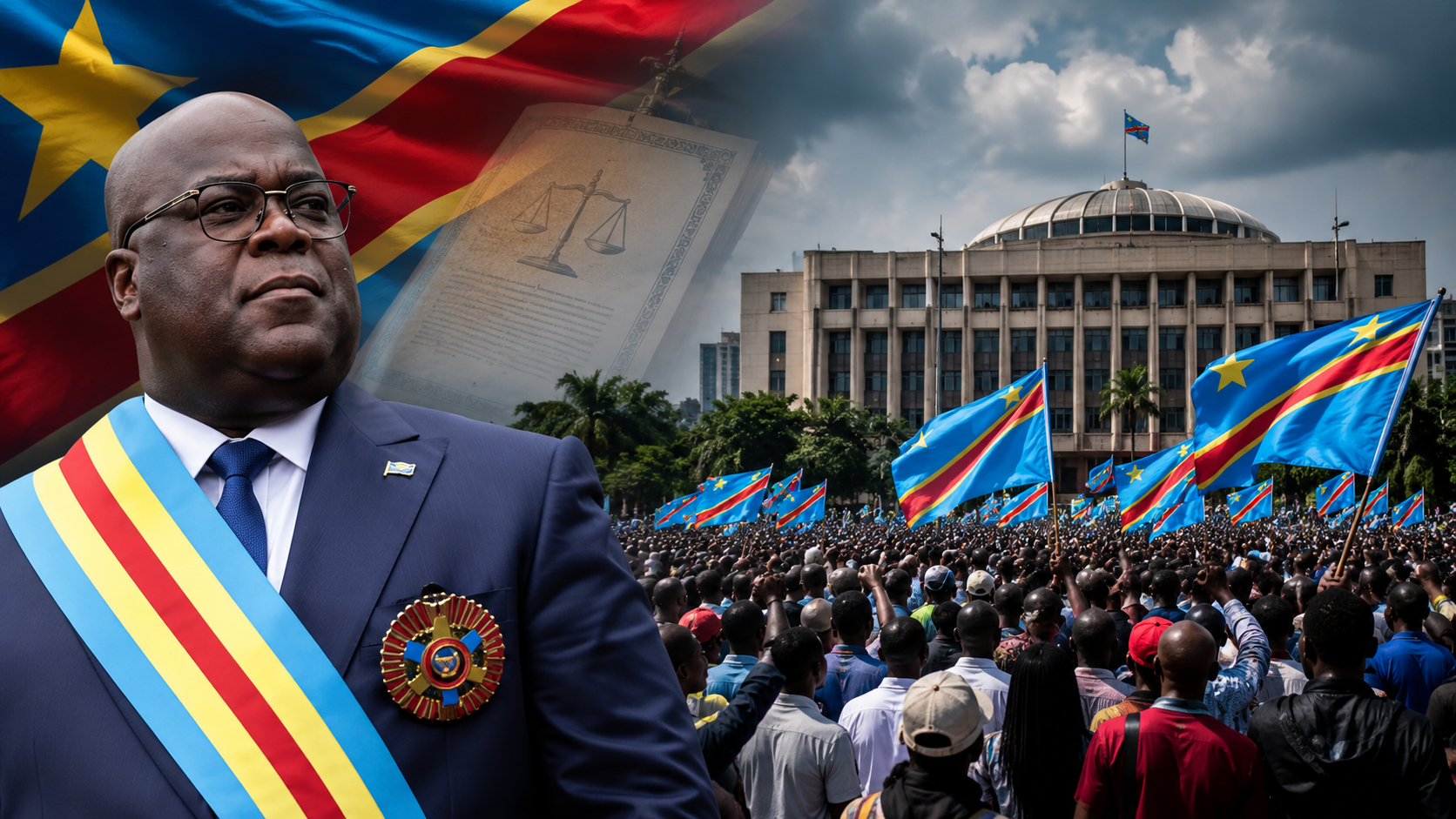
Why the DR Congo Constitution Is at the Centre of the Political Crisis
The latest confrontation between the government and the opposition extends beyond a dispute over proposed legal reforms. At its core lies a debate about constitutional governance, democratic succession and the limits of executive power in one of Africa’s largest and most strategically important countries.
The current Constitution limits a president to two five-year terms. President Félix Tshisekedi, who assumed office in January 2019 after winning the 2018 election, is serving his second and final constitutional term, which is due to end in 2028.
The controversy intensified after lawmakers approved legislation outlining procedures for organising national referendums. Although government officials have presented the bill as a legal framework rather than an immediate constitutional amendment, critics argue that it could eventually be used to alter presidential term limits if approved through the constitutional process.
Readers seeking additional background on the constitutional reform debate can also refer to Deutsche Welle’sdetailed analysis of the proposal and its wider political implications.
For opposition leaders, the concern is not simply about legal procedures but about protecting constitutional safeguards they believe were designed to prevent prolonged stays in power.
That explains why the debate has evolved into one of the country’s most significant political issues well before the next presidential election.
C64 Coalition Emerges as the Face of Opposition
The movement leading resistance to the proposed reforms is the opposition coalition known as C64.
Established in May 2026, the coalition takes its name from Article 64 of the Democratic Republic of Congo’s Constitution, which states that citizens have both the right and the responsibility to resist any unlawful attempt to seize or exercise power contrary to constitutional provisions.
The alliance brings together several of the country’s best-known opposition figures, including:
- Moïse Katumbi
- Martin Fayulu
- Jean-Marc Kabund
- Delly Sesanga
Despite their political differences in previous elections, the leaders have united around a single objective: preventing constitutional reforms they believe could weaken democratic checks and balances.
Speaking during a press conference in Kinshasa, coalition leaders announced plans for a nationwide mobilisation on 22 July, saying demonstrations would continue until the proposed constitutional changes are withdrawn.
The coalition also renewed its call for President Tshisekedi’s resignation, significantly raising the political stakes.
African Union Mediation Failed to Break the Deadlock
TThe protests had originally been scheduled earlier in the week before being postponed following intervention by African Union Chairperson and Burundian President Évariste Ndayishimiye. The African Union has continued to encourage dialogue and peaceful resolution of political disputes across the continent.
Opposition leaders agreed to delay demonstrations to allow consultations with regional leaders, raising hopes that dialogue could reduce tensions.
However, coalition representatives later declared that those consultations failed to produce meaningful progress.
According to opposition leader Jean-Marc Kabund, the African Union chair listened to the coalition’s concerns and was expected to engage directly with President Tshisekedi.
When no breakthrough emerged, the coalition concluded that further delays were unjustified and reinstated plans for nationwide demonstrations.
The collapse of mediation illustrates the difficulty regional organisations often face when attempting to resolve domestic constitutional disputes without appearing to interfere in national sovereignty.
Human Rights Concerns Continue to Grow
Political tensions have already spilled onto the streets.
During opposition demonstrations held in Kinshasa on 12 June, clashes reportedly erupted between protesters, security forces and pro-government supporters.
Several people sustained injuries during the violence.
The United Nations later confirmed that at least one protester died.
Human Rights Watch subsequently criticised Congolese security forces, alleging that officers used excessive force—including tear gas and batons—against demonstrators.
The organisation further claimed that security personnel failed to adequately protect protesters from attacks by pro-government groups.
Although authorities have consistently maintained that public order remains their priority, the allegations have renewed scrutiny of how demonstrations are managed during politically sensitive periods.
For many observers, the manner in which future protests are handled could prove just as important as the constitutional debate itself.
Religious Leaders Add Moral Pressure
The constitutional debate has also drawn strong reactions from religious institutions, particularly the Catholic Church, which remains one of the country’s most influential civil society voices.
Church leaders have urged President Tshisekedi to uphold the constitutional oath taken upon assuming office.
They have equally encouraged citizens to oppose any constitutional amendments using peaceful and lawful means.
Throughout the Democratic Republic of Congo’s modern political history, churches have frequently acted as mediators during periods of national crisis.
Their intervention therefore adds another important dimension to the current debate, reinforcing calls for dialogue instead of confrontation.
Multiple National Crises Increase the Stakes
The constitutional dispute is unfolding while the Democratic Republic of Congo faces several other pressing national challenges.
In eastern provinces, government forces continue military operations against the M23 rebel movement, one of the country’s longest-running security threats.
At the same time, health authorities are responding to a renewed Ebola outbreak, placing additional pressure on already stretched public institutions.
Nobel Peace Prize laureate Dr Denis Mukwege is among those arguing that constitutional reforms should not become a national priority while the country confronts simultaneous security and public health emergencies.
According to critics, government attention would be better directed toward improving security, containing disease outbreaks and addressing humanitarian needs before pursuing major constitutional changes.
Supporters of constitutional reform, however, maintain that legislative processes and governance reforms can continue alongside efforts to resolve national crises.
Constitutional Court Faces an Important Decision
Attention is now shifting toward the Constitutional Court.
The recently approved referendum legislation must undergo judicial review before moving further through the constitutional process.
Legal experts note that the Court’s eventual interpretation could significantly influence the next stage of the political debate.
Should the legislation survive constitutional scrutiny, discussions surrounding a possible referendum are likely to intensify.
If legal objections are upheld, pressure for constitutional reform could weaken considerably.
Either outcome is expected to shape political calculations well before campaigning begins for the 2028 presidential election.
For now, the Court remains one of the country’s most closely watched institutions as competing political camps await its decision.
Political Implications Ahead of the 2028 Election
Although the next presidential election remains two years away, the constitutional debate has effectively marked the beginning of a high-stakes political contest in the Democratic Republic of Congo. Rather than focusing solely on electoral campaigns, political actors are now competing over the rules that could shape the race itself.
For President Félix Tshisekedi, the controversy presents a delicate balancing act. His administration must convince both domestic and international audiences that any constitutional reform is intended to strengthen governance rather than extend presidential tenure. While Tshisekedi has not yet signed the referendum legislation into law, uncertainty surrounding the proposal has become a focal point of national debate.
For the opposition, the issue offers an opportunity to unite around a common objective. The formation of the C64 coalition demonstrates how constitutional questions can bridge ideological differences, bringing together prominent political figures who have previously competed against one another.
The coming months are therefore likely to test not only the resilience of the country’s democratic institutions but also the willingness of political leaders to resolve disagreements through constitutional and legal channels.
Regional Significance for Central Africa
Developments in the Democratic Republic of Congo rarely remain confined within its borders.
As Africa’s second-largest country by landmass and one of its most resource-rich economies, political instability in the DRC can have consequences for neighbouring states, regional trade, humanitarian operations and security cooperation.
The African Union’s decision to facilitate dialogue highlights the wider regional concern over preserving constitutional order while avoiding political violence. Many African countries have faced contentious debates over presidential term limits, making the Congolese situation closely watched across the continent.
The outcome could influence future discussions on constitutional governance and democratic transitions in other African states where similar debates periodically emerge.
Economic and Investment Considerations
Political uncertainty often has consequences beyond government institutions.
Investors typically monitor constitutional disputes because prolonged instability can affect business confidence, infrastructure projects and foreign direct investment.
The Democratic Republic of Congo occupies a strategic position in the global supply chain for critical minerals, including cobalt and copper, which are essential for electric vehicles, renewable energy technologies and modern electronics.
While mining operations continue to underpin the national economy, analysts generally note that sustained political uncertainty can influence investor sentiment, project timelines and long-term economic planning.
Maintaining institutional stability therefore remains important not only for governance but also for economic development and international commercial partnerships.
Why This Story Matters Across Africa
The constitutional debate in the DRC resonates across Africa because it touches on broader questions that many democracies continue to confront:
- Should constitutional term limits remain fixed?
- Under what circumstances should constitutions be amended?
- How should governments balance legal reform with political consensus?
- What role should regional organisations play in domestic constitutional disputes?
- How can public protests be managed while protecting fundamental rights?
These questions extend beyond the Democratic Republic of Congo and continue to shape political discourse across the continent.
Nigerian Relevance
For Nigerian readers, the developments offer an opportunity to reflect on the importance of constitutional institutions and peaceful democratic processes.
Nigeria has experienced its own constitutional debates over governance, electoral reforms and the separation of powers. The Congolese experience illustrates how constitutional proposals can quickly become politically charged when questions arise over presidential succession or democratic safeguards.
It also reinforces the importance of dialogue, judicial independence and adherence to constitutional procedures in resolving political disagreements without violence.
What Happens Next?
Several developments are expected to determine the direction of the crisis in the weeks ahead:
- The Constitutional Court will review the referendum legislation.
- President Félix Tshisekedi must decide whether to approve or withhold the proposed law.
- The opposition coalition plans nationwide demonstrations on 22 July.
- Regional leaders may continue diplomatic efforts to encourage dialogue.
- Human rights organisations are expected to closely monitor the conduct of security forces during future protests.
Each of these developments could significantly influence the country’s political trajectory before campaigning begins for the 2028 presidential election.
Conclusion
The DR Congo Constitution debate has evolved into far more than a disagreement over legal reforms. It has become a defining test of constitutional governance, democratic accountability and political stability in one of Africa’s most influential nations.
With opposition leaders determined to proceed with nationwide protests, regional mediators seeking dialogue and the Constitutional Court preparing to examine the referendum framework, the coming weeks are likely to shape both the immediate political climate and the longer-term future of the country’s democratic institutions.
How the government, opposition, judiciary and civil society respond will determine whether the current impasse moves toward dialogue or deeper confrontation. For now, the Democratic Republic of Congo finds itself at a critical constitutional crossroads whose outcome will be closely watched across Africa and beyond.
This report was developed using verified information from official statements and Africanews reporting.
Recommended Coverage
37 Constitution Amendment Bills in National Assembly
Why constitutional reforms matter goes beyond the Democratic Republic of Congo. Discover how Nigeria is also debating constitutional amendments and what the changes could mean for democratic governance.
Congo Ebola Outbreak Highlights Africa’s Health System Struggles
The constitutional dispute is unfolding as the DRC battles an Ebola outbreak. Read how the health emergency is adding pressure to one of Africa’s most complex political crises.
Somaliland Recognition Reshapes Horn of Africa Politics
Political developments across Africa continue to reshape regional stability. Explore how constitutional debates and diplomatic shifts are influencing the continent’s changing political landscape.
About the Author