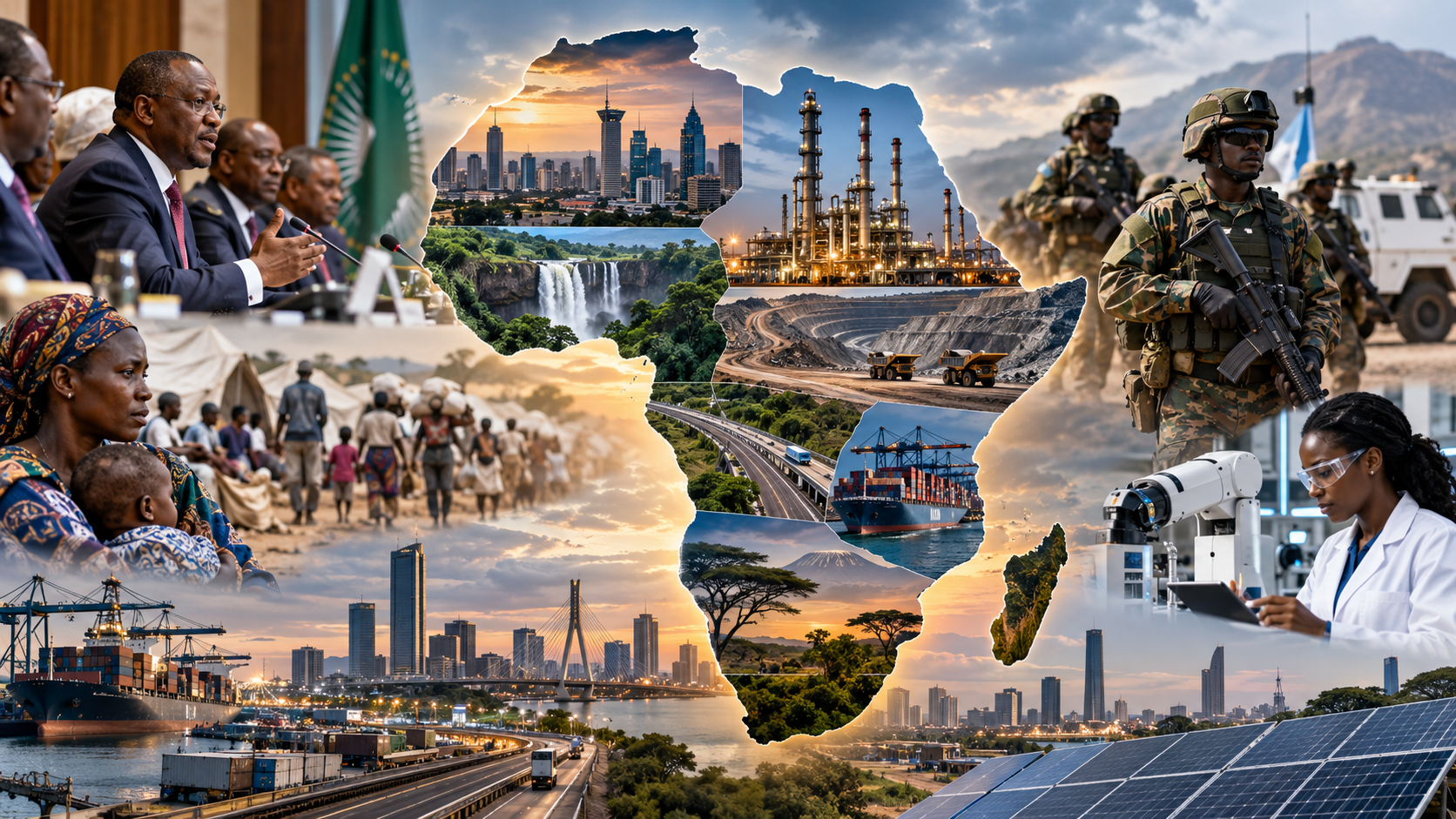
From politics and security to energy, business, technology and humanitarian crises, these are the major stories shaping Africa today.
AFRICA NEWS: FIVE PRESSURES SHAPING THE CONTINENT
Africa news during the week of September 13–20, 2026, was marked by a convergence of crises and structural pressures unfolding across different parts of the continent.
In the Democratic Republic of Congo, intensified fighting, mass displacement, an Ebola outbreak and political tension developed simultaneously. In Sudan, the continuing war deepened an already severe humanitarian emergency while drawing greater attention to the external networks supporting the conflict.
At the same time, Africa’s strategic mineral resources became increasingly tied to international economic arrangements involving major external partners. The continent’s security architecture was also undergoing a period of uncertainty, particularly as the transition around Somalia’s AUSSOM mission raised questions about future funding and security capacity.
And beneath these security and political developments was another source of pressure: the global economy.
Fuel supply disruptions, currency movements and discussions over international financing showed how external economic conditions were increasingly affecting African markets.
Taken together, these developments provide a picture of a continent confronting multiple pressures at once — humanitarian, political, security and economic — while its relationship with the wider international system continues to evolve.
AFRICA NEWS: CONGO FACES A MULTI-FRONT NATIONAL CRISIS
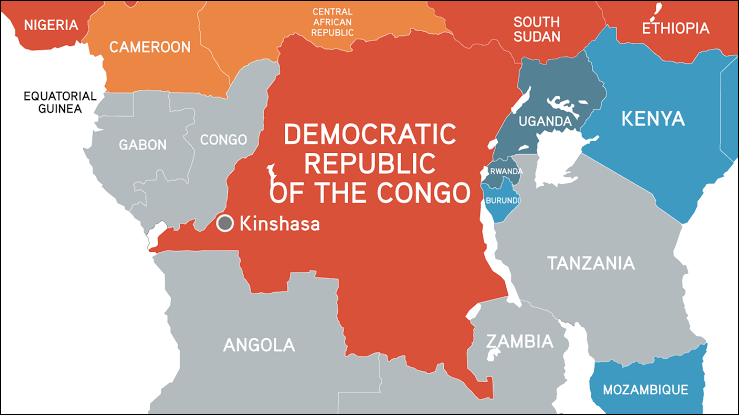
The Democratic Republic of Congo became one of the clearest examples this week of how several major pressures can converge within a single country.
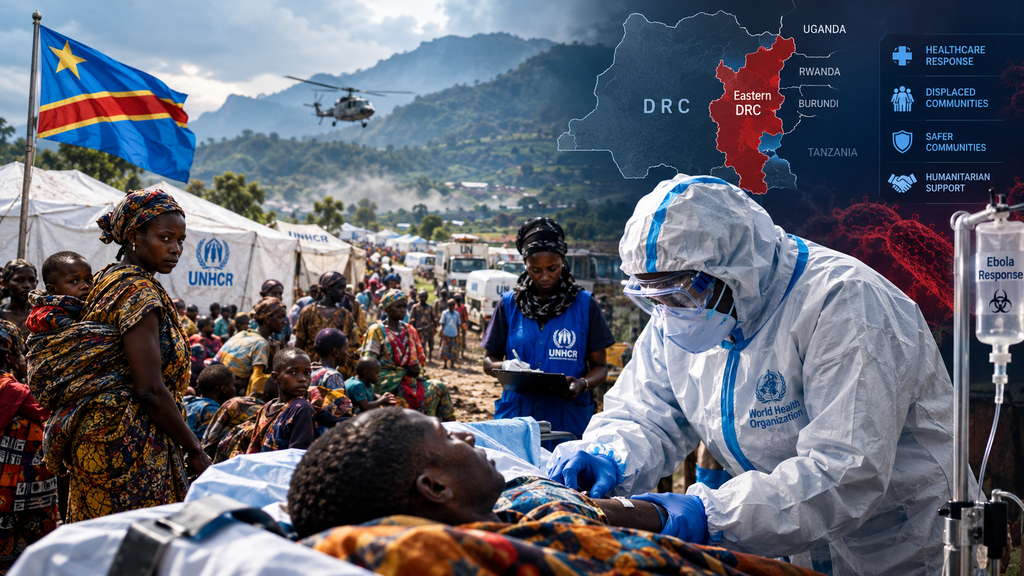
More than 70,000 people have been displaced by intensified fighting in eastern Congo since mid-August, according to the UN Office for the Coordination of Humanitarian Affairs.
The displacement is taking place alongside another major emergency: an Ebola outbreak.
Frontline health workers in Ituri have begun receiving the Ervebo vaccine as the response expands. But the Africa CDC continues to describe the outbreak as serious, with transmission not yet consistently brought under control.
The scale of the health emergency adds another layer to an already difficult security environment.
The supplied reporting recorded more than 7,000 confirmed Ebola cases by September 11, with more than 3,000 deaths. About 50,000 frontline workers are being targeted for vaccination.
The situation therefore cannot be understood simply as a conflict story.
It is simultaneously a humanitarian, public-health and political story.
Conflict and displacement
The intensified fighting in the east is producing a large population displacement at a time when health systems and humanitarian agencies are already under pressure.
The combination creates overlapping needs.
People displaced by conflict require humanitarian assistance, while health authorities and frontline workers are simultaneously dealing with disease transmission and vaccination efforts.
That convergence is one of the defining elements of this week’s Africa news.
Political tension adds another layer
Congo is also experiencing political tension over proposed constitutional changes.
Demonstrations against the proposed changes were dispersed by police in Kinshasa and other cities.
Opposition groups argue that the reforms could allow President Félix Tshisekedi to seek another term.
That interpretation remains contested, however, and the final political consequences of the constitutional reform process have not yet been established.
The political question therefore remains a developing issue rather than a settled outcome.
A crisis operating on several fronts
The significance of Congo’s situation lies in the fact that these pressures are occurring at the same time.
Conflict is producing displacement.
The Ebola outbreak is putting pressure on the health system and frontline workers.
Political tensions are generating demonstrations and disputes over constitutional reform.
Together, these developments form a broader African crisis in which security, public health, humanitarian needs and political questions are overlapping.
The immediate developments to watch are the response to Ebola, the security situation in eastern Congo and the continuing constitutional reform process.
AFRICAN CRISIS: SUDAN’S WAR DEEPENS THE HUMANITARIAN EMERGENCY
If Congo illustrated the convergence of several crises within one country, Sudan demonstrated how a prolonged war can expand into a wider humanitarian and regional emergency.
The humanitarian situation continued to deteriorate during the week.
The World Food Programme said it had received approximately $206 million in funding, compared with $645 million the previous year.
At the same time, nearly 20 million people were facing hunger, while about 14 million people had been displaced.
The WFP was reaching around 4 million people.
Those figures underline the scale of the humanitarian challenge facing Sudan.
But the week’s Africa news also highlighted another dimension of the war: the growing focus on the external support networks sustaining the conflict.
International support becomes a central issue
UN Secretary-General António Guterres called for accountability involving countries supplying weapons and other forms of support to Sudan’s warring parties.
He said foreign weapons, military technology, fighters and logistical networks were helping sustain the conflict.
That development is significant because it broadens the international discussion around Sudan.
The conflict is not being examined only as a war between Sudanese forces.
Attention is also increasingly being directed toward the external networks that provide the resources and support necessary to sustain the fighting.
The humanitarian consequences extend beyond the main battlefield
The consequences are also being felt in other parts of the country and in sensitive areas around it.
In Abyei, clashes left 26 people dead and 82 injured, according to the supplied UN reporting.
In West Kordofan, a gold-mine collapse was initially reported to have killed at least 60 people.
A later figure was higher, but that number was not independently established by Reuters, meaning the final death toll remains uncertain.
That qualification is important because the scale of the Sudan crisis makes reliable information especially significant.
A war becoming harder to contain
The broader picture is of a war that continues to generate humanitarian needs while also raising regional security concerns.
The funding gap facing humanitarian operations adds another layer of difficulty.
The international community is therefore confronting several issues at the same time: access for humanitarian agencies, food security, displacement, continued fighting and the external support sustaining the conflict.
For Africa news watchers, Sudan remains one of the continent’s major pressure points.
The immediate issues to monitor include humanitarian funding, humanitarian access, food security, continued fighting and developments around Abyei.
AFRICA NEWS AND STRATEGIC MINERALS: GLOBAL COMPETITION INTENSIFIES
Africa’s mineral resources provided another major theme in the week’s news, particularly as developments involving the Democratic Republic of Congo and Rwanda placed strategic minerals further into the international spotlight.
In Congo, the government approved a task force to accelerate implementation of its strategic minerals partnership with the United States, particularly around copper and cobalt.
In Rwanda, the government agreed to a tungsten venture with Almonty Industries under a US-backed economic framework.
Rwanda is expected to hold a 25 percent stake.
These are separate developments.
But together they point to a broader shift in how Africa’s strategic mineral resources are being incorporated into international economic arrangements.
From resource interest to institutional arrangements
For years, international attention to Africa’s mineral resources has been driven by the importance of commodities needed for industrial and technological development.
The developments reported this week move the discussion toward more concrete arrangements involving governments, companies and international partners.
The question is therefore no longer simply whether Africa possesses valuable mineral resources.
It is increasingly about what happens after those resources attract international interest.
Who controls the resources?
Who finances their development?
Who processes the minerals?
And how much value ultimately remains in the African countries where the resources are found?
These questions form an important part of the week’s Africa news, particularly as governments seek to establish stronger positions in strategic-resource partnerships.
The DRC and Rwanda developments are not the same
The Congo and Rwanda arrangements should not be treated as a single agreement or project.
The DRC development concerns implementation of a strategic minerals partnership with the United States, particularly around copper and cobalt.
The Rwanda development concerns a tungsten venture involving Almonty Industries under a US-backed economic framework.
Their significance comes from the broader pattern rather than from treating them as one coordinated development.
The economic outcome is not yet established
The supplied material confirms the institutional and commercial developments.
It does not, however, establish their eventual economic impact.
Potential benefits involving investment, employment and infrastructure may become important areas for future investigation, but they should not yet be described as achieved outcomes.
That distinction is important in reporting on strategic minerals because agreements and announced partnerships do not automatically establish their eventual economic results.
For Africa, the longer-term questions will involve implementation, investment, infrastructure, processing capacity and the distribution of economic value.
The next developments to watch include implementation of the DRC task force, progress on the Rwanda-Almonty project, investment commitments and infrastructure arrangements.
AFRICA SECURITY: THE CONTINENT’S SECURITY ARCHITECTURE ENTERS AN UNCERTAIN TRANSITION
Africa’s security environment is changing at the same time that serious threats remain active across several parts of the continent.
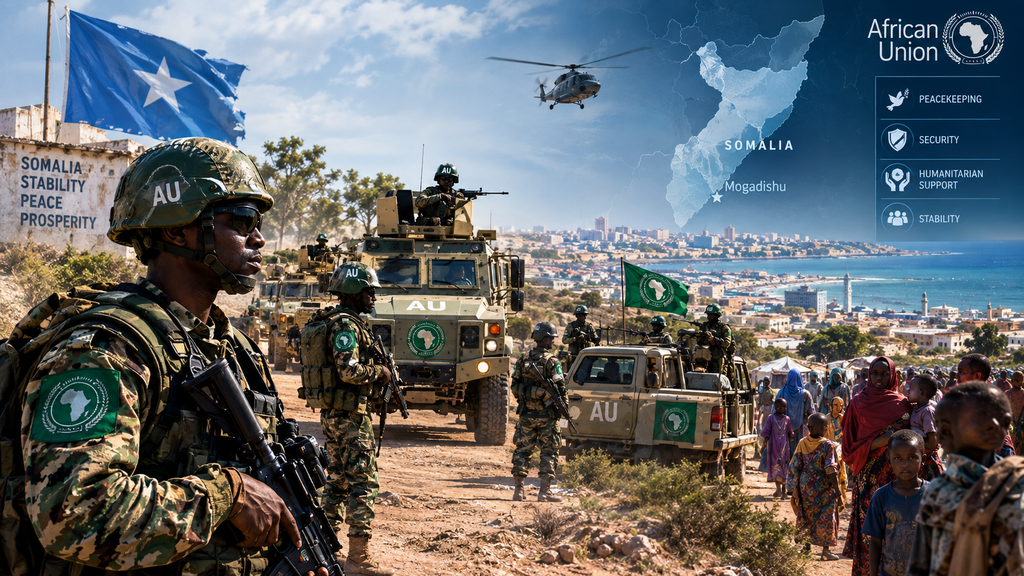
One of the most important developments this week came from Somalia, where the United States agreed to give the United Nations another year to phase out support for the African Union’s AUSSOM mission.
The decision extends the transition timetable.
The UN Support Office for Somalia has operated with an annual budget of roughly $500 million, while the future funding and operational structure remain unresolved.
The central issue is therefore not simply the timetable.
It is what happens to security capacity when an international support structure changes.
Somalia and the future of security support
The AUSSOM transition raises questions about the ability of national and regional institutions to sustain security operations as international support arrangements change.
The issue is particularly significant because the transition is taking place while serious security threats remain active elsewhere across the continent.
This makes the week’s Africa security story less about one individual mission and more about the changing architecture through which security responsibilities are shared between international, regional and national actors.
Other security developments
Elsewhere, the United States removed sanctions on Eritrean Defence Forces and other Eritrean entities.
In northern Cameroon, at least 15 people were reported killed in an attack blamed on suspected Islamist militants.
However, the supplied material does not establish the responsible group.
In Abyei, clashes left 26 people dead and 82 injured.
These incidents should not be presented as one coordinated security development.
They are separate developments occurring in different locations and contexts.
What they illustrate together is a broader reality: international security arrangements are changing even as serious security threats remain active.
The uncertainty around future capacity
For Somalia, the central questions include future funding, the AUSSOM transition and the ability of regional and national institutions to maintain security capacity.
The developments involving Eritrea, Cameroon and Abyei also require continued monitoring.
The week’s Africa security picture therefore contains two simultaneous trends.
International arrangements are being adjusted, while the underlying security challenges that require those arrangements remain.
That creates uncertainty over how responsibilities, resources and operational capacity will be distributed in the future.
The next phase of the Somalia transition will therefore be particularly important, alongside developments in other areas experiencing continuing violence.
AFRICAN ECONOMY: GLOBAL ENERGY PRESSURES REACH AFRICAN MARKETS
The final major theme of the week was economic.
Global energy disruptions and financial pressures were increasingly visible across African markets, demonstrating how developments outside the continent can quickly affect domestic supply decisions, regional trade and currency markets.
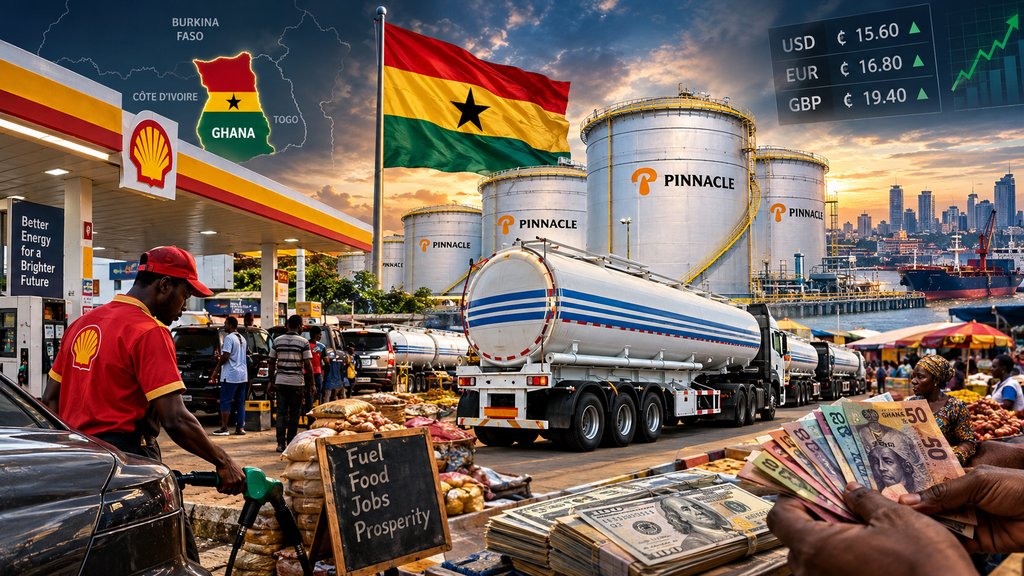
In Ghana, the state-owned fuel distributor BOST reduced diesel and gasoline exports to Burkina Faso and Mali in an effort to protect domestic supply amid global energy disruptions.
The consequences were already visible in regional fuel allocations.
Burkina Faso had requested 80,000 metric tonnes for July and August but received 40,000 tonnes.
Mali requested 50,000 tonnes and received only 10,000 tonnes.
BOST accounts for roughly 30 percent of Ghana’s fuel market, according to the supplied reporting.
A domestic decision with regional consequences
The Ghana case illustrates how an energy-supply decision in one country can affect neighbouring economies.
When neighbouring countries depend on regional fuel supplies, a reduction in exports can quickly become a regional issue.
The development therefore forms an important part of the week’s African economy story.
It also shows why global energy disruptions cannot be considered only in terms of international commodity markets.
Their effects can eventually appear in domestic supply decisions and cross-border trade.
Currency pressure adds another layer
Fuel was not the only channel through which economic pressure was visible.
Currencies in Uganda, Ghana and Zambia also faced renewed pressure.
Uganda’s shilling was trading at approximately 3,925 to 3,935 per dollar, compared with about 3,860 to 3,870 the previous week.
That movement formed part of a wider picture of pressure in African currency markets.
However, the supplied material does not establish the precise effects of these movements on households or consumer prices.
Those effects should therefore not be assumed.
Mozambique and the IMF
In Mozambique, discussions with the International Monetary Fund continued over a possible new financial-support programme.
The IMF mission ran from September 9 to September 18.
Additional reforms were still required, and a possible follow-up mission had been identified for November.
But no new IMF programme had been agreed by the end of the reporting period.
That makes the Mozambique development another example of how external financing conditions can become an important part of national economic policy.
Economic pressure comes through several channels
The broader lesson from this week’s African economy developments is that external pressure does not enter the continent through one route.
It can appear in fuel supply.
It can appear in currency markets.
And it can appear through negotiations over international financing.
These developments are different, but together they demonstrate the range of channels through which global economic conditions can affect African economies.
The immediate developments to watch are Ghana’s fuel position, regional fuel availability, currency movements and Mozambique’s reform and IMF process.
CONCLUSION: A WEEK OF CONVERGING PRESSURES
The week’s Africa news presented a continent dealing with several different challenges at the same time.
In the Democratic Republic of Congo, conflict, displacement, an Ebola outbreak and political tension created a multi-front crisis. Sudan continued to face a severe humanitarian emergency as the war generated displacement, hunger and renewed international attention to the external support sustaining the fighting.
Elsewhere, strategic minerals moved deeper into international economic arrangements involving Congo, Rwanda and external partners. The developments point to growing attention around copper, cobalt and tungsten, while leaving the eventual economic outcomes still to be established.
Africa’s security architecture was also entering a period of transition. Somalia’s AUSSOM timetable raised questions about future funding and security capacity, even as violence remained active in other parts of the continent.
And across the African economy, global energy and financial pressures were increasingly visible through fuel allocations, currency movements and international financing discussions.
The five narratives are different, but they reveal a common feature of the week’s continental news cycle: Africa is navigating humanitarian crises, security uncertainty, strategic economic competition and global economic pressures simultaneously.
The developments to watch in the coming weeks will therefore extend across all five fronts.
RECOMMENDED STORIES:
Museveni Succession Plan Raises Fears Over Uganda’s Future
Africa Media Convention 2026 Pushes Press Freedom Agenda
About the Author