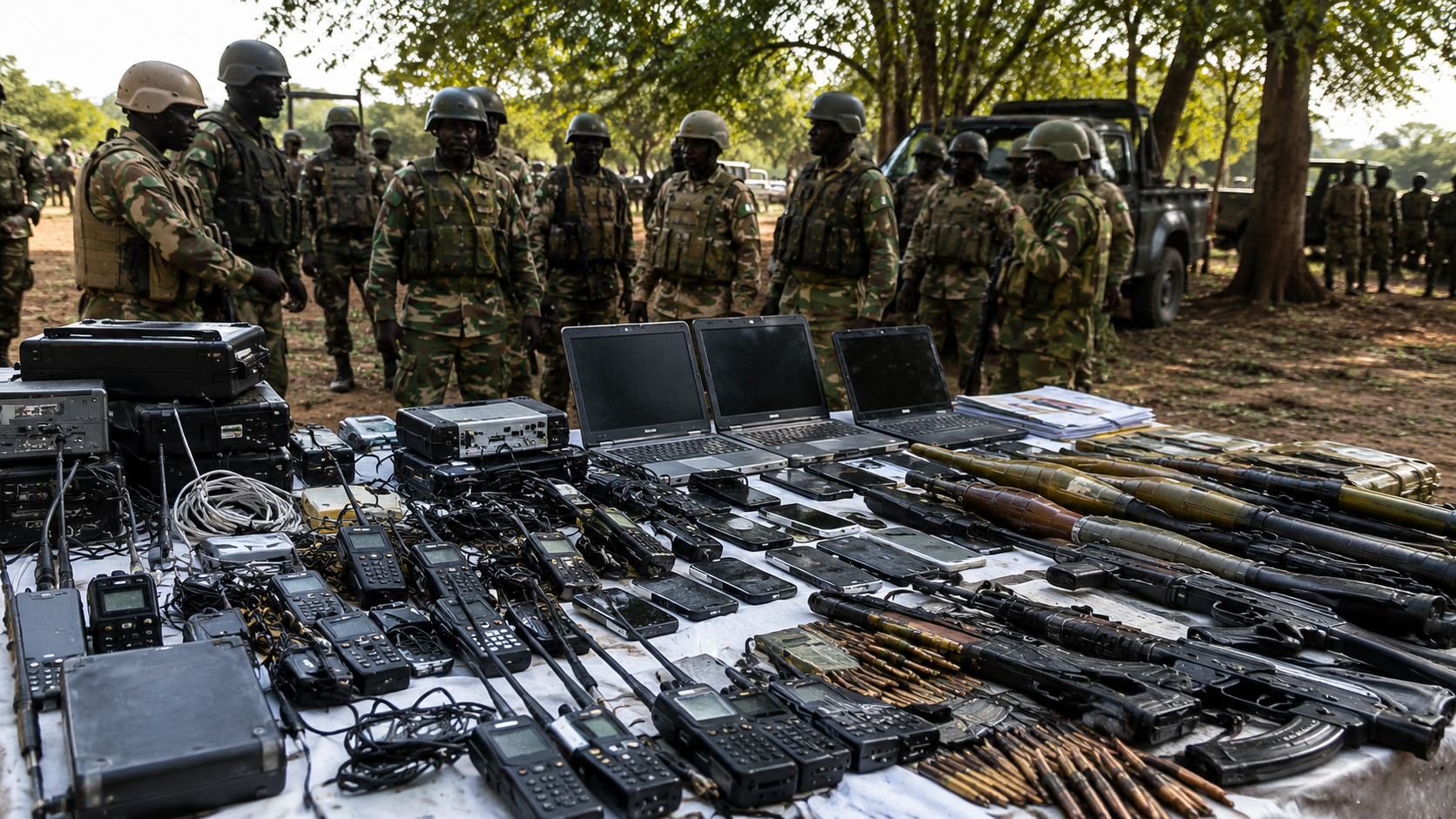
The recovery of sophisticated communications equipment, electronic devices and heavy weapons from terrorist camps in Nigeria is emerging as one of the most strategically significant intelligence breakthroughs in recent years. Beyond the immediate battlefield success, security officials believe the materials could provide valuable insight into how extremist groups communicate, finance operations and coordinate attacks across the Lake Chad Basin and parts of the wider Sahel.
United States officials disclosed on June 29 that a recent joint counter-terrorism operation with Nigerian security forces resulted in the elimination of 199 jihadist fighters and the seizure of what a senior White House counter-terrorism official described as the largest cache of enemy electronic materials recovered by the United States since the September 11, 2001 terrorist attacks. According to Sebastian Gorka, Deputy Assistant to U.S. President Donald Trump and Senior Director for Counterterrorism at the National Security Council, the quantity of recovered electronic equipment was so large that an additional aircraft was required to transport the materials for intelligence analysis. (Channels Television)
While the figures and operational details originated from U.S. officials, Nigeria’s Defence Headquarters later clarified that the operation referenced was not a fresh military action, but the public disclosure of a successful joint mission conducted in May 2026. (allAfrica.com)
That clarification does little to diminish what security analysts regard as the most important aspect of the announcement—not necessarily the number of militants reportedly killed, but the enormous volume of intelligence recovered from terrorist strongholds.
Nigeria Terrorist Equipment Offers More Than Battlefield Success
Modern counter-terrorism campaigns are increasingly driven by intelligence rather than conventional firepower alone.
Military planners often describe electronic devices captured during raids as “intelligence multipliers.” Every recovered satellite terminal, encrypted phone, laptop, GPS tracker or storage device can potentially reveal operational plans, communication channels, financial transactions, recruitment networks and supply routes.
This is why the latest Nigeria Terrorist Equipment recovery has attracted international attention.
According to the U.S. account, the operation yielded an unprecedented volume of electronic materials requiring specialist examination after their removal from Nigeria. Officials believe the recovered data could assist investigators in identifying surviving members of terrorist networks and disrupting future attacks. (Premium Times Nigeria)
Unlike conventional weapons that lose their value once confiscated, digital intelligence often continues generating operational leads months or even years after a successful raid.
Security agencies routinely analyse:
- Mobile phone contacts
- Satellite communication records
- GPS movement histories
- Digital financial transactions
- Stored photographs and videos
- Electronic maps
- Command structures
- Cross-border communication patterns
Each dataset helps intelligence services reconstruct terrorist networks that often extend beyond national borders.
Growing Focus on Technology in Counter-Terrorism
The latest developments also illustrate how terrorist organisations operating in West Africa have increasingly embraced commercial technology.
Nigerian military operations in recent months have recovered satellite communication systems, including Starlink terminals allegedly used by Boko Haram and the Islamic State West Africa Province (ISWAP), alongside drones, motorcycles, improvised explosive devices, assault rifles and other battlefield equipment recovered during multiple operations across northern Nigeria. (PRNigeria News)
The presence of sophisticated communications equipment demonstrates how insurgent groups have adapted to military pressure.
Rather than relying solely on traditional radio systems, extremist organisations increasingly exploit commercially available internet technology, encrypted messaging platforms and satellite communications to maintain contact across remote terrain where conventional telecommunications infrastructure is limited.
For Nigerian security planners, dismantling these communication networks may prove as significant as destroying weapons stockpiles.
Without reliable communications, insurgent commanders face greater difficulty coordinating attacks, moving fighters, managing logistics or issuing operational instructions to dispersed cells.
Why Intelligence Matters More Than Weapons
Military experts frequently argue that successful counter-insurgency campaigns depend less on the quantity of weapons recovered than on the quality of intelligence obtained.
A single encrypted storage device can reveal:
- Planned attacks
- Safe houses
- Weapons suppliers
- Financial backers
- Recruitment channels
- International contacts
Such information often leads to additional arrests and follow-up operations long after an initial raid has concluded.
That explains why the electronic materials recovered during the joint operation have generated almost as much attention as the military action itself.
According to Sebastian Gorka, the intelligence haul represented an unprecedented recovery for U.S. counter-terrorism operations since 9/11. However, Nigerian authorities have not publicly released detailed inventories of the electronic materials recovered, and the full intelligence value remains unknown. (Premium Times Nigeria)
A Broader Security Partnership
The announcement also highlights the continuing evolution of security cooperation between Nigeria and the United States.
For years, bilateral cooperation has centred on intelligence sharing, specialised military training, surveillance support, logistics assistance and equipment transfers aimed at strengthening Nigeria’s capacity to combat Boko Haram, ISWAP and other armed extremist groups.
Although U.S. military involvement inside Nigeria has historically remained limited compared with American operations in other conflict zones, intelligence collaboration has steadily expanded as terrorism in the Lake Chad Basin acquired greater international significance.
The latest disclosures suggest that intelligence cooperation may now be delivering increasingly sophisticated operational outcomes, particularly where high-value terrorist targets and digital intelligence exploitation are concerned.
The emphasis is no longer confined to eliminating militant fighters. It increasingly focuses on dismantling the information systems that enable terrorist organisations to survive, recruit members, finance activities and coordinate attacks across multiple countries.
Nigeria Terrorist Equipment Recovery Reflects a New Phase in Counter-Terrorism
For more than a decade, Nigeria’s military campaigns against Boko Haram, the Islamic State West Africa Province (ISWAP), and other armed groups have largely been measured by the number of insurgents neutralised, communities liberated, or weapons recovered.
Increasingly, however, security experts argue that the true measure of success lies in what military forces learn after an operation ends.
That is why the latest Nigeria Terrorist Equipment recovery is attracting attention beyond the battlefield. Intelligence gathered from electronic devices, communication systems, and logistics records may provide investigators with information capable of disrupting future attacks rather than merely responding to them.
Modern extremist organisations rely heavily on digital communications to maintain operational secrecy. Encrypted messaging applications, satellite internet terminals, GPS navigation systems, and electronic payment channels have become essential tools for coordinating fighters dispersed across vast and often inaccessible terrain.
Every recovered device therefore represents a potential source of intelligence.
Analysts say information extracted from confiscated electronics could reveal command structures, operational planning, movement patterns, supply chains, financial transactions, and links between terrorist cells operating across Nigeria and neighbouring countries.
Unlike weapons, which become unusable once seized, intelligence can continue generating operational value long after military operations conclude.
Recovered Technology Highlights Changing Nature of Insurgency
One notable aspect of recent Nigerian military operations has been the reported recovery of sophisticated communications technology alongside conventional weapons.
Security forces have announced the seizure of satellite communication equipment, including Starlink terminals allegedly used by insurgent groups to maintain internet connectivity in remote areas where conventional telecommunications infrastructure is weak or absent.
Although Starlink is a legitimate commercial satellite internet service used worldwide for civilian purposes, authorities say some terrorist groups have exploited the technology because it enables communications in isolated regions beyond the reach of traditional mobile networks.
The reported recovery of hundreds of such devices demonstrates how insurgent organisations continue adapting to advances in commercial technology.
Military planners increasingly face adversaries capable of combining inexpensive civilian technology with asymmetric warfare tactics.
This evolution has altered the nature of counter-terrorism.
Success is no longer determined solely by superior firepower.
Instead, it depends equally on intelligence collection, cyber analysis, electronic surveillance, and the ability to identify communication networks before attacks are launched.
Operations HADIN KAI and FANSAN YAMMA Remain Central
The intelligence breakthrough comes against the backdrop of sustained Nigerian military offensives under two major operational commands.
Operation HADIN KAI
Operating primarily across Nigeria’s North-East, Operation HADIN KAI continues to target Boko Haram and ISWAP strongholds in Borno State and surrounding areas.
Military updates over recent months have described repeated offensives against insurgent camps, resulting in the destruction of logistics bases, weapons factories, vehicle workshops, and ammunition depots.
Authorities have also reported recovering communication equipment, motorcycles, fuel supplies, food stockpiles, and other materials used to sustain prolonged insurgent operations.
The objective extends beyond battlefield victories.
By destroying logistical infrastructure, security forces seek to reduce terrorists’ ability to regroup after suffering military losses.
Operation FANSAN YAMMA
Meanwhile, Operation FANSAN YAMMA continues to address growing security threats across Nigeria’s North-West.
The operation focuses primarily on heavily forested regions where armed groups exploit difficult terrain to establish camps, store weapons, and launch attacks against rural communities.
Recent military operations have reportedly led to the recovery of:
- Rocket-propelled grenade launchers
- Improvised explosive devices (IEDs)
- Machine guns
- Tactical motorcycles
- Ammunition
- Operational cash
- Communications equipment
These recoveries indicate that many criminal and extremist groups now possess increasingly sophisticated capabilities.
Security analysts note that disrupting these logistics networks may prove more strategically valuable than individual battlefield victories.
Why Logistics Often Determine the Outcome of Conflict
Military history consistently demonstrates that logistics determine the sustainability of armed campaigns.
Insurgent organisations require continuous access to:
- Food supplies
- Fuel
- Communications
- Medical materials
- Ammunition
- Transportation
- Financial resources
Without these systems, operational capacity gradually deteriorates.
This explains why Nigerian security forces have increasingly prioritised destroying supply routes alongside direct combat operations.
Officials believe denying armed groups access to communications technology and transportation may reduce their ability to coordinate simultaneous attacks across multiple locations.
The reported seizure of modified motorcycles is particularly significant.
Such vehicles provide insurgents with mobility through forests and rough terrain that conventional military vehicles often cannot access.
Removing these assets limits tactical flexibility and complicates escape routes during military offensives.
Regional Implications Extend Beyond Nigeria
The significance of the latest Nigeria Terrorist Equipment recovery extends beyond Nigeria’s borders.
Extremist organisations operating in West Africa rarely function within one country alone.
Groups affiliated with Boko Haram and ISWAP have historically operated across areas bordering:
- Niger
- Chad
- Cameroon
Meanwhile, armed groups linked to wider Sahel instability have expanded activities across Burkina Faso, Mali, and parts of Niger.
Weapons, fighters, financing, and communications frequently move across porous international borders.
Consequently, intelligence recovered in Nigeria could assist investigations involving security agencies elsewhere in the region.
Counter-terrorism increasingly depends on multinational intelligence cooperation rather than isolated national operations.
This makes information sharing among regional governments particularly important.
The United States’ Continuing Security Role
The latest operation also highlights Washington’s ongoing security partnership with Nigeria.
For years, the United States has supported Nigeria through:
- Intelligence sharing
- Counter-terrorism training
- Military advisory assistance
- Surveillance cooperation
- Equipment support
Although direct U.S. combat involvement inside Nigeria has remained limited, intelligence collaboration has become an increasingly important pillar of bilateral security relations.
According to U.S. officials, the recent operation yielded intelligence materials requiring extensive technical analysis.
If verified intelligence identifies additional operational networks, future counter-terrorism efforts could become more targeted and more efficient.
However, many operational details remain classified, and officials have not disclosed precisely how the recovered electronic materials will be analysed or whether intelligence findings will be shared publicly.
Balancing Military Success With Long-Term Stability
Security gains achieved through military operations remain important.
Yet analysts frequently caution that defeating insurgency requires more than tactical victories.
Long-term stability also depends on:
- Effective governance
- Economic opportunities
- Community engagement
- Education
- Infrastructure
- Humanitarian support
- Border security
Military operations may dismantle terrorist infrastructure, but preventing extremist groups from rebuilding often requires broader political and socio-economic measures.
Success therefore depends on maintaining pressure across multiple fronts simultaneously.
The recovery of advanced communications equipment may significantly weaken operational capabilities.
Whether that translates into lasting security improvements will depend on how effectively intelligence gathered from the operation supports future prevention efforts.
Political Implications for Nigeria’s Security Strategy
The latest Nigeria Terrorist Equipment recovery is likely to reinforce the Federal Government’s emphasis on intelligence-led counter-terrorism operations rather than relying solely on conventional military offensives.
For several years, Nigerian security agencies have invested in improving surveillance capabilities, intelligence sharing and coordination among the Armed Forces, the Department of State Services (DSS), the Nigeria Police Force and other security institutions.
The reported seizure of electronic devices capable of revealing communication networks could strengthen this approach by providing investigators with information that extends beyond the immediate battlefield.
At the same time, the announcement underscores the importance of international partnerships in addressing security threats that transcend national borders.
Terrorist organisations operating in the Lake Chad Basin and the wider Sahel often exploit porous frontiers to move fighters, weapons and supplies. This makes cooperation between regional governments and international partners increasingly important in tracking networks that operate across multiple jurisdictions.
While military operations can disrupt terrorist activities, policymakers continue to face the broader challenge of ensuring that security gains translate into lasting peace and stability in affected communities.
Economic Impact of Improved Security
Beyond the military dimension, successful counter-terrorism efforts have significant economic implications.
Persistent insecurity has affected agricultural production, disrupted trade routes, displaced communities and discouraged private investment in several parts of northern Nigeria.
Improved security conditions could contribute to:
- Increased farming activities in previously inaccessible communities.
- Safer transportation corridors for businesses.
- Greater investor confidence.
- Expansion of humanitarian access to conflict-affected areas.
- Lower security costs for businesses operating in vulnerable regions.
Although a single operation cannot resolve these long-standing challenges, sustained disruption of terrorist logistics and communication networks may help create conditions that support broader economic recovery.
What the Recovery Means for Regional Security
Nigeria remains central to regional security in West Africa.
As Africa’s most populous country and one of its largest economies, developments within Nigeria’s security landscape often influence neighbouring states.
Extremist groups have historically operated across parts of Nigeria, Niger, Chad and Cameroon, making intelligence cooperation an essential component of regional counter-terrorism efforts.
Information obtained from recovered electronic devices may assist authorities in identifying cross-border movement patterns, financial networks and communication channels used by armed groups operating throughout the region.
If shared through existing security frameworks, such intelligence could strengthen multinational operations against insurgent organisations whose activities extend beyond Nigeria’s borders.
Technology Is Becoming the New Battlefield
One of the clearest lessons from recent operations is that technology has become a defining element of modern conflict.
Commercially available satellite internet services, encrypted messaging platforms, GPS devices and digital storage systems are increasingly used by both state and non-state actors.
For security agencies, this shift means that future counter-terrorism operations will depend not only on military strength but also on:
- Digital forensics.
- Cyber intelligence.
- Electronic surveillance.
- Data analysis.
- Artificial intelligence-assisted intelligence processing.
- Secure information sharing among partner nations.
The reported recovery of communication equipment demonstrates how technological innovation continues to reshape security challenges across Africa.
As extremist organisations adopt new technologies, governments are likely to increase investments in intelligence capabilities designed to detect and disrupt digital networks before attacks occur.
Importance of Careful Verification
While the operation has generated widespread attention, some aspects of the announcement require careful attribution.
The claim that the operation resulted in the elimination of 199 terrorists and produced the largest electronic intelligence haul since the September 11, 2001 attacks was made by Sebastian Gorka, Deputy Assistant to U.S. President Donald Trump and Senior Director for Counterterrorism at the National Security Council.
Subsequently, Nigeria’s Defence Headquarters clarified that the operation referenced by U.S. officials was not a newly conducted military mission, but the public disclosure of a successful joint operation carried out in May 2026.
Authorities have not publicly released a detailed inventory of all electronic devices reportedly recovered, and independent verification of every operational claim remains limited.
As with many counter-terrorism operations, certain operational details remain classified for security reasons.
Looking Ahead
The significance of the latest Nigeria Terrorist Equipment recovery may ultimately be measured not by the quantity of weapons or communication devices seized, but by the quality of intelligence extracted from them.
Military operations can eliminate immediate threats, but intelligence gathered from recovered materials has the potential to prevent future attacks, identify hidden terrorist networks and improve coordination among security agencies.
If successfully analysed, the recovered data could contribute to further operations targeting financiers, recruiters, logistics coordinators and senior commanders who remain active across the region.
For Nigeria, the operation also illustrates the growing importance of combining military force with intelligence-driven strategies and international cooperation.
As security threats continue to evolve, success will increasingly depend on understanding how extremist organisations communicate, finance their activities and adapt to changing technologies.
The latest recovery therefore represents more than the confiscation of battlefield equipment. It offers an opportunity to strengthen intelligence capabilities that could shape future counter-terrorism efforts in Nigeria and across West Africa.
Conclusion
The recent recovery of advanced communications systems, electronic devices and military hardware marks another significant development in Nigeria’s long-running battle against insurgency. While battlefield successes remain important, the intelligence value of the seized materials may prove even more consequential.
By combining sustained military operations with intelligence analysis and international cooperation, Nigerian authorities hope to further weaken the operational capabilities of terrorist organisations and improve long-term national security.
Much will depend on how effectively the recovered information is analysed and translated into future preventive action. If successful, the operation could represent an important step toward disrupting networks that have threatened communities across northern Nigeria and the wider Lake Chad region for more than a decade.
Recommended Coverage
Nigeria Terrorism Financing Sanctions List Names 48 Individuals
Discover how Nigerian authorities expanded sanctions against individuals and entities accused of financing terrorism, highlighting ongoing efforts to disrupt the financial networks that sustain extremist groups.
Boko Haram Attack in Chad Exposes Regional Security Gaps
Learn how a deadly Boko Haram attack in neighbouring Chad underscores the cross-border nature of terrorism and the need for stronger regional intelligence and military cooperation.
State Police Bill Moves to States: What Next?
Explore what Nigeria’s proposed state police reforms could mean for internal security, intelligence gathering, and the country’s broader response to terrorism and violent crime.
About the Author