A cargo vessel operates along a major international shipping route as rising Middle East tensions fuel concerns over global oil supplies, maritime trade and energy security.
Oil Prices Surge as Red Sea Crisis Deepens Amid Iran-Houthi Escalation
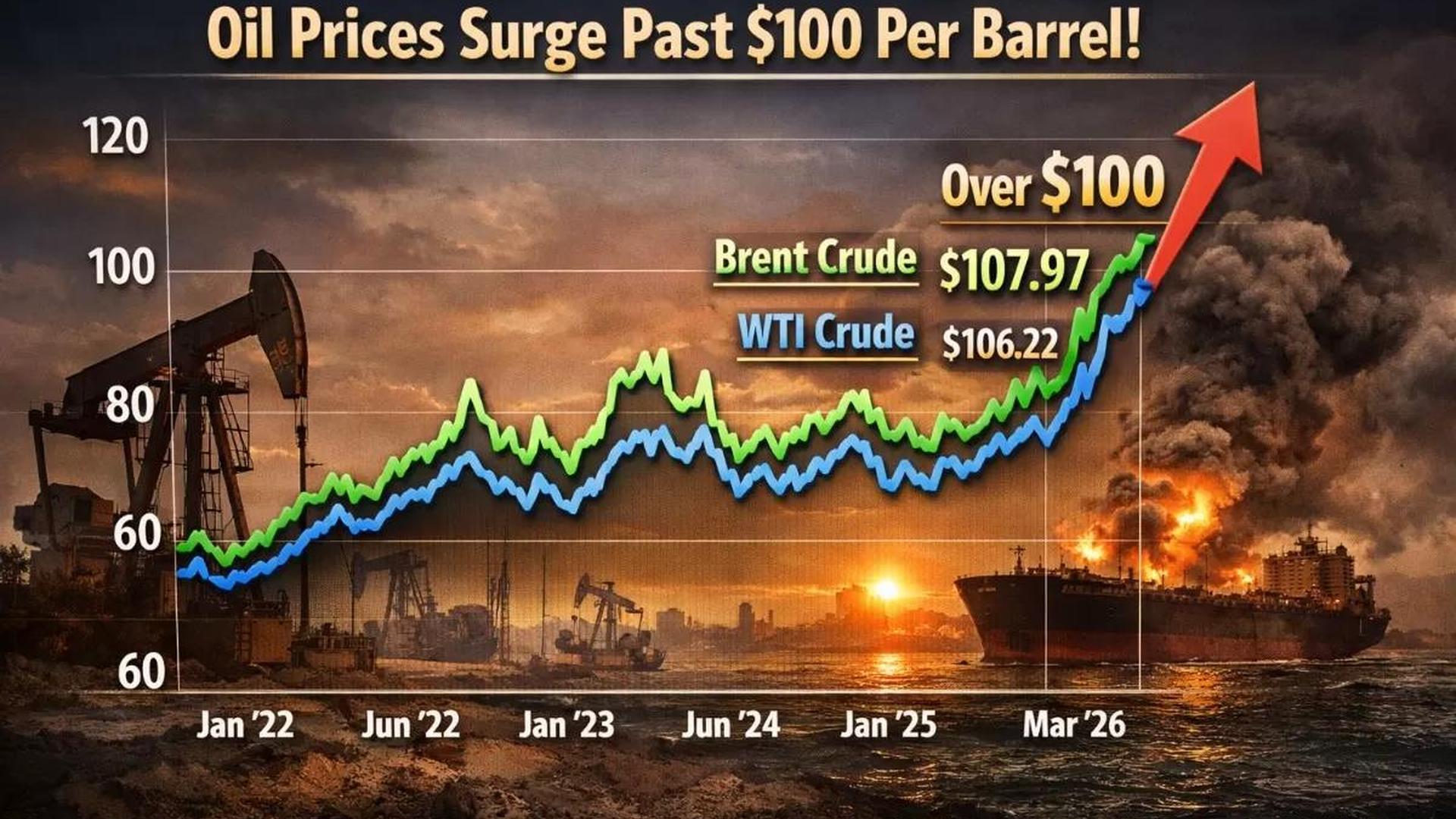
Global energy markets have entered another period of heightened uncertainty after oil prices climbed above $100 per barrel, following attacks on Saudi oil tankers in the Red Sea that intensified fears of wider disruptions across two of the world’s most strategic maritime trade routes.
The latest escalation comes as the United States continued military operations against Iran, President Donald Trump warned Tehran and its Houthi allies of “major military punishment” over any further attacks on commercial shipping, and governments across Europe and the Middle East called for restraint amid growing concerns that the conflict could trigger prolonged economic instability.
Rather than being confined to military exchanges between the United States and Iran, the crisis is increasingly becoming a global energy and trade story. With the Strait of Hormuz already operating under severe pressure and fresh attacks threatening shipping through the Bab el-Mandeb Strait and the Red Sea, analysts warn that the consequences could extend far beyond the Middle East, affecting fuel prices, inflation, supply chains and economic growth worldwide. As reported by major international agencies including CBS News and CNN, governments and shipping companies are reassessing risks as commercial navigation becomes increasingly uncertain.
Why Oil Prices Are Rising Again
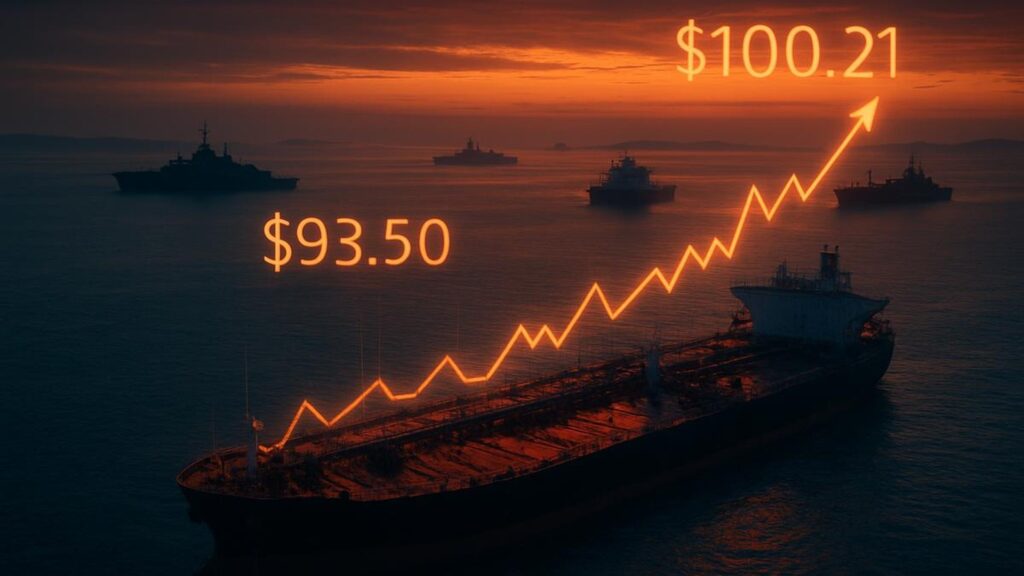
The immediate trigger for the latest market rally was the reported attack on Saudi oil tankers in the Red Sea by Yemen’s Iran-backed Houthi movement.
The incident has heightened concerns that two of the world’s most important maritime oil corridors may face simultaneous disruption.
These include:
- The Strait of Hormuz, through which a significant share of the world’s seaborne crude oil passes each day.
- The Bab el-Mandeb Strait, linking the Red Sea with the Gulf of Aden and serving as the southern gateway to the Suez Canal.
- The wider Red Sea shipping corridor, which carries energy supplies and manufactured goods between Asia, Europe and Africa.
Although neither waterway has been officially closed, increasing attacks have forced many shipping companies to reconsider routes, delay sailings or adopt more expensive security measures.
Energy traders typically respond quickly to such geopolitical risks because even limited disruptions can tighten global supplies and drive up transportation costs.
As fears intensified, Brent crude briefly crossed the psychologically important $100-per-barrel level—the first time in months that the international benchmark reached that threshold.
Higher crude prices often translate into increased costs for:
- Petrol and diesel
- Aviation fuel
- Shipping
- Manufacturing
- Food transportation
- Consumer goods
Financial markets have also reacted cautiously, with investors monitoring whether the conflict could develop into a prolonged regional crisis capable of disrupting global economic recovery.
Two Strategic Chokepoints Now Under Pressure
One reason markets have reacted so strongly is that the conflict is no longer centred on a single maritime corridor.
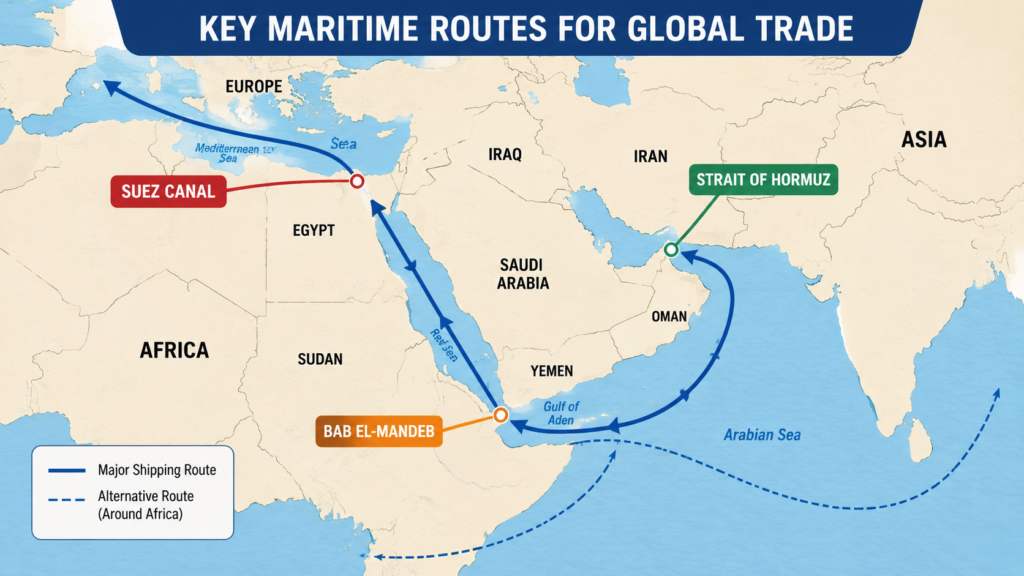
Instead, tensions are affecting two separate gateways that together support a substantial portion of global trade.
Strait of Hormuz
Located between Iran and Oman, the Strait of Hormuz remains one of the world’s most strategically important waterways.
Major oil exporters—including Saudi Arabia, Iraq, Kuwait, Qatar and the United Arab Emirates—depend heavily on the route for international energy exports.
Although U.S. military officials have repeatedly stated that commercial navigation remains open, shipping activity has reportedly slowed considerably as operators weigh the risks of transiting the area. Several commercial vessels have altered routes or delayed voyages because of security concerns, according to reports cited in the source material.
Bab el-Mandeb and the Red Sea
The latest Houthi attacks have shifted attention toward another critical maritime passage.
The Bab el-Mandeb Strait connects the Red Sea to the Gulf of Aden and provides access to the Suez Canal, making it essential for trade between Europe, Asia and Africa.
Any sustained disruption in this corridor could force vessels to sail around the Cape of Good Hope at Africa’s southern tip—a significantly longer journey that increases fuel consumption, insurance costs and delivery times.
Industry analysts note that such diversions would not only affect oil shipments but also container cargo carrying electronics, machinery, food products and industrial materials.
With pressure mounting simultaneously on both shipping corridors, global logistics companies are preparing for the possibility of prolonged operational disruptions.
Trump’s Warning Signals Harder U.S. Position
The geopolitical dimension of the crisis also intensified after President Donald Trump issued a fresh warning directed at both Iran and the Houthi movement.
Speaking after reports that Saudi-linked vessels had come under attack, Trump said any future Houthi strikes on commercial shipping would be treated as actions for which Iran would be held responsible.
He warned that further attacks could trigger “major military punishment” against both Tehran and the Yemeni group.
The remarks represent another step in Washington’s strategy of linking Houthi military operations directly to Iran, which the United States has long accused of providing weapons, training and financial support to the movement.
Meanwhile, U.S. military activity in the region has continued.
According to the supplied reports, American forces have maintained consecutive rounds of airstrikes targeting Iranian military infrastructure, maritime capabilities, drone facilities and missile-related assets while also reinforcing military readiness across the region.
The Pentagon has maintained that these operations are intended to reduce threats to international shipping and protect freedom of navigation through key maritime routes.
Global Economic Impact Extends Beyond the Battlefield
While military operations dominate headlines, economists say the broader concern is the growing risk to the global economy if instability persists across the Middle East’s major energy corridors.
Unlike previous regional confrontations that affected only one strategic route, the current crisis is placing simultaneous pressure on both the Strait of Hormuz and the Red Sea, increasing uncertainty for energy traders, shipping companies and financial markets.
The implications extend well beyond oil producers.
If elevated security risks continue, businesses around the world could face:
- Higher shipping and freight charges
- Increased marine insurance premiums
- Rising fuel and transportation costs
- More expensive imported goods
- Longer delivery times for international cargo
- Renewed inflationary pressure on consumer prices
These developments are particularly significant because many central banks have only recently begun making progress in slowing inflation after several years of elevated global prices.
A prolonged increase in oil prices could complicate monetary policy, delay interest-rate reductions and weigh on consumer spending in many economies.
Financial analysts have also warned that uncertainty surrounding major maritime trade routes often affects investor confidence, contributing to increased market volatility until geopolitical risks become clearer.
International Leaders Call for Restraint
As military operations continue, governments and international organizations have expressed concern over the possibility that the conflict could spread even further.
Among the notable diplomatic responses contained in the source material:
- The European Union condemned attacks on commercial shipping, describing strikes on oil tankers in the Red Sea as unacceptable and warning that freedom of navigation must be protected.
- Saudi authorities confirmed that one Saudi-linked vessel sustained damage following an attack, although all crew members were reported safe.
- Jordan reported intercepting several missiles and drones crossing its airspace, highlighting how neighbouring countries are increasingly being drawn into the wider conflict.
- Kuwait also reported military activity involving drones, illustrating the expanding geographic scope of regional tensions.
These developments reinforce growing international concerns that commercial shipping and civilian infrastructure could become increasingly vulnerable if hostilities continue.
For governments that rely heavily on uninterrupted maritime trade, ensuring the safety of international shipping remains a major diplomatic priority.
How the Houthis Became a Global Shipping Threat
Although the Houthis are based in Yemen, their influence now extends far beyond the country’s borders.
Officially known as Ansar Allah, the movement has controlled large parts of northern Yemen, including the capital Sana’a and much of the Red Sea coastline, for several years.
According to the source material, the group has increasingly targeted international shipping since the Gaza conflict began in late 2023, presenting its operations as support for regional allies while expanding its role within what Iran describes as the “Axis of Resistance.”
Security analysts believe the group’s ability to launch missile and drone attacks near one of the world’s busiest maritime corridors has transformed it from a local insurgent movement into a significant factor in global shipping security.
Its latest reported attacks on Saudi-linked vessels suggest that the conflict has entered a new phase in which commercial trade—not only military targets—faces heightened risk.
Why the Red Sea Matters to the World
The Red Sea serves as one of the world’s busiest maritime highways.
Through its connection to the Suez Canal, it links Europe with Asia and East Africa, carrying energy supplies, manufactured goods, agricultural products and consumer merchandise.
Every disruption along this route creates ripple effects across global supply chains.
If vessels are forced to avoid the Red Sea and sail around southern Africa instead, shipping companies face:
- Thousands of additional nautical miles
- Higher fuel consumption
- Longer delivery schedules
- Increased operating costs
- Reduced shipping capacity
Those higher costs are often passed on to businesses and consumers through increased prices for imported goods.
For this reason, even relatively limited attacks on shipping tend to receive close attention from financial markets.
What This Means for Nigerians
Although the conflict is taking place thousands of kilometres away, its economic effects could become increasingly visible in Nigeria if elevated oil prices persist.
Fuel Prices
Nigeria continues to rely on imported refined petroleum products despite being one of Africa’s largest crude oil producers.
Higher international crude prices could place upward pressure on domestic petrol and diesel prices, depending on exchange rates, import costs and government policy.
Inflation
More expensive fuel generally raises transportation costs.
Those higher costs can filter through the economy by increasing the prices of food, manufactured goods and other essential commodities.
For households already coping with inflation, additional increases could further strain disposable incomes.
Government Revenue
On the other hand, sustained higher crude prices may increase export earnings for Nigeria.
Greater oil revenue could improve government income, strengthen foreign exchange inflows and potentially support public finances—provided production targets are maintained.
However, analysts caution that gains from higher export prices can be offset if domestic fuel import costs also rise sharply.
Shipping and Trade
Nigeria’s import-dependent economy could also experience higher freight charges if global shipping companies continue avoiding high-risk maritime routes.
This may affect:
- Consumer goods
- Industrial equipment
- Pharmaceuticals
- Agricultural imports
- Manufacturing inputs
Ultimately, Nigerian businesses and consumers could feel the indirect consequences of a conflict occurring far beyond the country’s borders.
Historical Perspective
The current crisis has revived comparisons with previous periods of instability affecting Middle Eastern energy supplies.
Historically, tensions involving the Strait of Hormuz have repeatedly caused temporary spikes in oil prices because of its strategic importance to global energy exports.
Similarly, attacks on shipping in the Red Sea during recent years demonstrated how relatively localized conflicts can have disproportionate effects on international trade.
What distinguishes the present situation is that pressure is now emerging across multiple maritime chokepoints simultaneously, increasing uncertainty for governments, shipping operators and commodity markets.
Rather than a short-lived disruption, businesses are increasingly planning for the possibility of a prolonged period of elevated geopolitical risk.
What’s Next to Watch
The coming days are likely to determine whether the current crisis stabilises or evolves into a broader regional confrontation with longer-lasting economic consequences.
Several developments deserve close attention:
1. Will Attacks on Commercial Shipping Continue?
The immediate concern is whether Iran-backed Houthi forces carry out additional attacks against commercial vessels in the Red Sea or Bab el-Mandeb Strait.
Any successful strike on another tanker or cargo ship could further disrupt maritime traffic and intensify pressure on global energy markets.
2. Will Iran and the United States Escalate Further?
President Donald Trump has warned of “major military punishment” if attacks continue, while Iran has maintained that it will respond to actions it considers hostile.
Whether military operations remain limited or expand to new targets will significantly influence regional stability and investor confidence.
3. Can Diplomatic Efforts Gain Momentum?
Despite the continued military exchanges reported in the source material, diplomatic channels remain active in parts of the region.
The willingness—or unwillingness—of the parties involved to return to negotiations could determine whether the crisis gradually de-escalates or continues to widen.
Markets generally respond quickly to any credible signs of diplomacy, particularly when global energy supplies are involved.
4. How Will Global Oil Markets Respond?
Oil traders will closely monitor:
- Shipping activity through the Strait of Hormuz.
- Vessel movements in the Red Sea.
- OPEC member production levels.
- Strategic petroleum reserve decisions by major economies.
- Insurance costs for commercial shipping.
If supply disruptions remain limited, prices could stabilise.
However, prolonged attacks on critical shipping lanes could keep crude prices elevated for an extended period.
5. Will Inflationary Pressures Return?
Economists are also watching whether sustained increases in energy prices begin feeding into broader inflation.
Higher fuel costs typically affect:
- Food prices
- Air travel
- Manufacturing
- Logistics
- Consumer goods
- Agricultural production
For many economies that have spent the past two years attempting to control inflation, another prolonged energy shock would present a significant policy challenge.
Why This Story Matters Beyond Today’s Headlines
Although today’s headlines focus on military exchanges and political rhetoric, the deeper story is about the vulnerability of global supply chains.
History has shown that conflicts affecting strategic maritime corridors rarely remain regional issues.
Instead, they often influence:
- International trade
- Commodity prices
- Financial markets
- Consumer spending
- Government budgets
- Inflation expectations
The simultaneous pressure on both the Strait of Hormuz and the Red Sea represents an unusual convergence of geopolitical risks that businesses, investors and governments cannot afford to ignore.
Whether or not the conflict expands further, it has already reminded the international community that global economic stability remains closely tied to secure maritime trade routes.
Conclusion
The latest escalation demonstrates that the Middle East conflict has entered a phase where economic consequences are becoming just as significant as military developments.
While battlefield events continue to dominate daily headlines, the more enduring story is the growing uncertainty surrounding global energy security and international shipping. Oil markets, freight operators and policymakers are increasingly reacting not only to what has happened, but also to what could happen if tensions continue to spread across key maritime corridors.
For Nigeria, the implications are particularly important. Sustained high crude prices may boost export earnings and government revenue, but they could also increase fuel import costs, place additional pressure on inflation and raise the cost of doing business. The balance between these competing effects will depend on the duration of the crisis, developments in global oil markets and domestic economic policy.
For the international community, the priority remains preventing a wider regional conflict while preserving freedom of navigation through some of the world’s most important trade routes. Diplomatic efforts, military deterrence and commercial risk management are likely to shape the next chapter of this crisis.
As events continue to unfold, the focus should extend beyond daily military developments to the broader economic, political and humanitarian consequences that could influence global markets long after the immediate headlines have faded.
Oil Prices Surge as Iran-Houthi attacks threaten Red Sea shipping, push Brent above $100 and raise fresh concerns over global energy supplies.
Recommended Coverage
Trump Iran Strike Delay Sparks Fears of Wider Middle East Crisis
How did the current Middle East crisis reach this dangerous stage? Read our earlier analysis explaining the events that set the stage for today’s oil market turmoil and military escalation.
US-Iran Ceasefire Collapses
The latest fighting didn’t begin overnight. Discover why the collapse of the US-Iran ceasefire reopened one of the world’s most dangerous geopolitical flashpoints.
The Historical Significance of Jerusalem: Roots of the Middle East Conflict
Want to understand the deeper roots of today’s Middle East tensions? Explore the historical events that continue to shape conflicts across the region decades later.
About the Author