England World Cup Third Place: Saka’s Hat-Trick Powers Historic Bronze Medal Triumph
England produce record-breaking display to defeat France 6-4 as Bukayo Saka shines, Mbappé reaches new milestones, and Thomas Tuchel ends the tournament on a high.
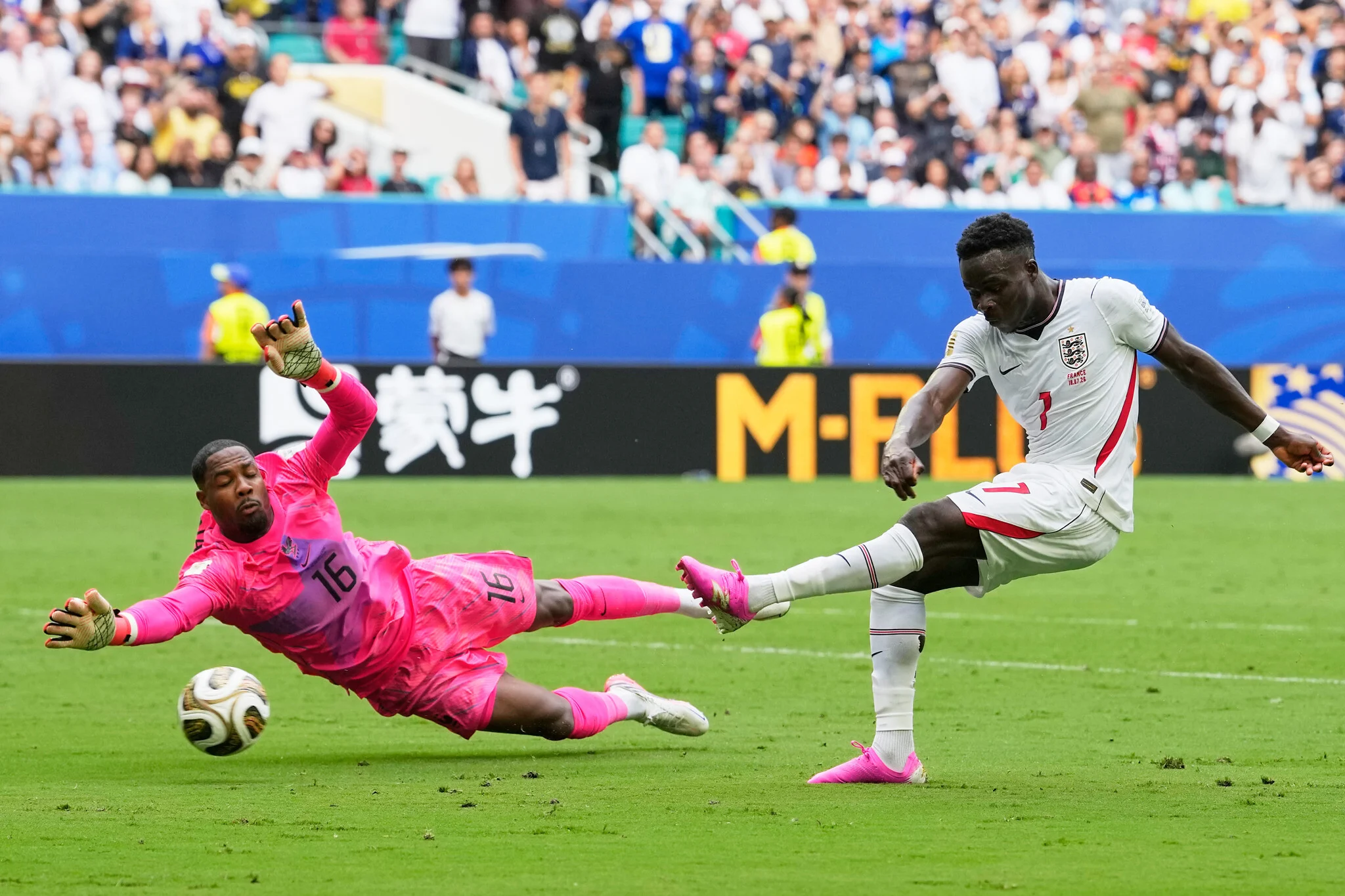
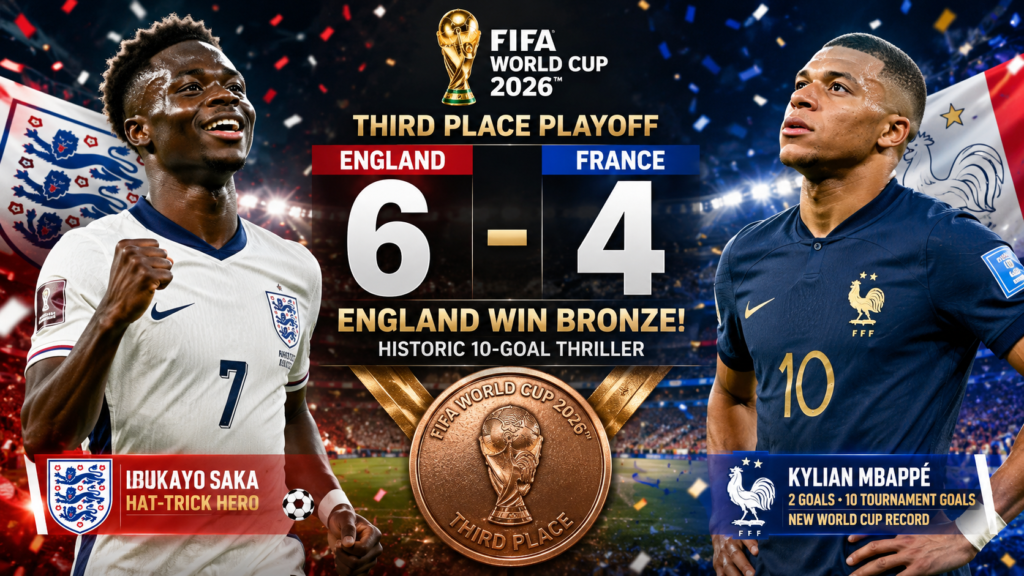
England secured World Cup third place in unforgettable fashion on Saturday, defeating France 6-4 in the highest-scoring third-place playoff in FIFA World Cup history. Bukayo Saka delivered a sensational hat-trick, Declan Rice and Ezri Konsa added first-half goals, while substitute Jude Bellingham struck deep into stoppage time to cap a dramatic victory at Miami Stadium.
Although France mounted an extraordinary second-half comeback through two goals from Kylian Mbappé, Bradley Barcola and Ousmane Dembélé, Thomas Tuchel’s side held their nerve to secure the bronze medal. The result provided England with a positive ending after the disappointment of their semi-final defeat and marked one of the most entertaining matches of the 2026 FIFA World Cup.
Beyond the scoreline, the contest produced a series of historic milestones. It showcased England’s attacking quality, underlined Bukayo Saka’s emergence as one of the tournament’s standout performers, and saw Mbappé continue rewriting World Cup history despite finishing on the losing side.
England World Cup Third Place Becomes a Historic Achievement
Third-place playoffs rarely capture the imagination of football supporters. Often viewed as a consolation fixture between two disappointed semi-finalists, the matches have historically lacked the intensity and drama associated with the World Cup’s latter stages.
This encounter shattered that perception.
From the opening whistle, England approached the game with purpose and urgency. Instead of allowing the disappointment of missing the final to linger, Tuchel’s players produced an attacking display that immediately placed France under immense pressure.
Within three minutes, Declan Rice gave England the perfect start after capitalising on defensive hesitation. The early breakthrough transformed the atmosphere and established the aggressive tempo that defined the opening half.
England doubled their advantage before the 20-minute mark when Ezri Konsa rose highest to convert Rice’s inviting delivery from a corner. The goal rewarded England’s dominance from set pieces and highlighted France’s defensive vulnerability.
As confidence flowed through the Three Lions, their attacking combinations became increasingly fluid.
Marcus Rashford, Morgan Rogers, Eberechi Eze and Bukayo Saka consistently stretched France’s defensive line with quick movement and intelligent passing. Every attack appeared capable of producing another goal.
Bukayo Saka Delivers a Career-Defining Performance
If there were any lingering doubts about Bukayo Saka’s importance to England, this performance removed them completely.
The Arsenal winger combined pace, composure and clinical finishing to produce one of the finest individual displays of the tournament.
His first goal arrived after sustained pressure from England’s front line, rewarding his persistence inside the penalty area.
The second demonstrated his movement and anticipation, arriving just before half-time after another flowing England attack that left France stunned.
At 4-0, many believed the contest had already been settled.
However, Saka’s most important contribution was still to come.
As France threatened an astonishing comeback during the second half, England required composure more than flair. With momentum swinging dramatically towards Didier Deschamps’ side, Saka stepped forward to convert an 87th-minute penalty, completing his hat-trick and restoring England’s two-goal advantage.
The strike effectively ended France’s hopes of forcing extra time and confirmed Saka as the defining player of the match.
Beyond the three goals, his relentless pressing, intelligent positioning and willingness to track back reflected the maturity that has made him one of Europe’s most complete attacking players.
Tuchel’s Tactical Gamble Pays Off
Thomas Tuchel entered the third-place playoff under considerable scrutiny.
England’s semi-final exit had prompted questions about his tactical decisions, while sections of supporters remained unconvinced despite the team’s overall progress during the tournament.
The German coach responded by making several changes to his starting lineup, rotating key players while maintaining England’s attacking philosophy.
The adjustments immediately paid dividends.
England pressed aggressively, transitioned quickly from defence to attack and exploited France’s defensive uncertainty with remarkable efficiency.
Declan Rice’s leadership from midfield proved particularly influential. Wearing the captain’s armband, he controlled possession, initiated attacks and contributed both a goal and an assist.
The tactical flexibility demonstrated throughout the first half highlighted Tuchel’s willingness to adapt rather than dwell on the disappointment of the semi-final.
Although England struggled to contain France’s resurgence after the interval, their resilience during the closing stages suggested a squad capable of responding under pressure—a quality essential for future international tournaments.
France Refuse to Surrender
At half-time, France faced what appeared to be an impossible task.
Trailing 4-0 against an England side playing with confidence, Didier Deschamps’ team required an extraordinary response to rescue the contest.
The French manager introduced fresh attacking options immediately after the restart, injecting pace and creativity into his frontline.
The changes transformed the match.
Within minutes, Kylian Mbappé reduced the deficit after finishing confidently from close range.
Suddenly, belief returned.
Bradley Barcola soon added another goal, cutting England’s lead to two and increasing the pressure on Tuchel’s defence.
When Mbappé struck again midway through the second half after an intricate passing move around England’s penalty area, the once-comfortable advantage had almost disappeared.
For a period, France completely dominated possession and territory, forcing England into desperate defensive work as the match evolved into an end-to-end spectacle.
Mbappé Rewrites the Record Books Despite France’s Defeat
While England celebrated a memorable victory, Kylian Mbappé once again demonstrated why he remains one of world football’s defining figures.
The French captain entered the third-place playoff with the Golden Boot still within reach and carrying the responsibility of inspiring France in what marked Didier Deschamps’ final match after 14 years in charge of Les Bleus.
Despite England’s dominant first-half display, Mbappé never stopped searching for opportunities.
His first goal shortly after the restart ignited France’s comeback, showcasing the explosive pace and clinical finishing that have become his trademark on football’s biggest stage. Less than 20 minutes later, he struck again after combining brilliantly with Michael Olise around England’s penalty area.
Those goals not only kept France alive but also strengthened Mbappé’s position in the race for the tournament’s Golden Boot.
More significantly, his latest brace added another remarkable chapter to an already extraordinary World Cup career. Individual milestones, however, offered little consolation as France ultimately fell short in one of the tournament’s most dramatic encounters.
A Farewell Filled With Emotion for Didier Deschamps
The match also marked the end of an era for French football.
Didier Deschamps took charge of France in 2012 and transformed the national team into one of the world’s most consistent international forces. During his tenure, France won the 2018 FIFA World Cup, reached another World Cup final four years later and remained regular contenders at major tournaments.
Although his final match ended in defeat, Deschamps leaves behind a legacy defined by consistency, tactical discipline and success.
Before kick-off, Mbappé publicly thanked his long-serving coach, describing the match as his “last dance” with the national team. That emotional message reflected the respect Deschamps earned throughout more than a decade in charge.
France’s spirited second-half comeback also reflected the resilience that became synonymous with his teams. Even when trailing by four goals, Les Bleus continued attacking with conviction, forcing England to defend desperately until the closing moments.
As France begins the search for a new manager, expectations will remain high. Deschamps leaves a talented squad featuring established stars and emerging young players capable of competing for future international honours.
England Answer Their Critics
England’s journey to the bronze medal was far from straightforward.
The disappointment of the semi-final defeat had inevitably raised questions about Thomas Tuchel’s tactical decisions and whether England had missed another golden opportunity to reach a World Cup final.
Rather than dwelling on criticism, the Three Lions responded with one of their most adventurous performances under the German coach.
The victory offered several encouraging signs.
England demonstrated attacking fluidity rarely seen against elite opposition, creating chances through quick transitions, intelligent movement and effective pressing. Their willingness to attack from the opening whistle contrasted sharply with the cautious approach often associated with knockout football.
Equally important was the character shown after France threatened an unlikely comeback.
Many teams would have struggled after seeing a four-goal advantage reduced to just one. England instead rediscovered their composure, regained control of possession and delivered decisive goals when the pressure was greatest.
For Tuchel, the performance provides a valuable foundation as preparations begin for UEFA Euro 2028.
While lifting the World Cup remains the ultimate ambition, securing third place offers tangible evidence that England remain among international football’s elite.
Bukayo Saka Strengthens His Status Among England’s Elite
Every major tournament produces defining moments for individual players.
For Bukayo Saka, the 2026 FIFA World Cup may ultimately be remembered as the competition that elevated him from outstanding international winger to genuine England icon.
His influence extended well beyond the three goals.
Throughout the match, Saka constantly stretched France’s defence, created space for teammates and remained composed whenever England needed calm under pressure.
Modern football increasingly values players capable of combining creativity, defensive responsibility and clinical finishing.
Saka delivered all three.
The Arsenal forward has steadily matured into one of Europe’s most dependable performers, and his display in Miami reinforced his reputation as a player capable of influencing football’s biggest occasions.
Supporters will undoubtedly remember the hat-trick, but coaches are likely to appreciate the discipline, intelligence and relentless work ethic that underpinned his performance.
A Match That Will Live Long in World Cup History
World Cup third-place playoffs rarely dominate conversations once tournaments conclude.
This one almost certainly will.
Ten goals.
Multiple lead changes in momentum.
A dramatic comeback attempt.
Individual records.
Historic milestones.
Late goals.
An unforgettable atmosphere.
The contest possessed nearly every ingredient associated with classic World Cup encounters.
For neutral supporters, it delivered 90 minutes of relentless entertainment. For England, it provided redemption after semi-final heartbreak. For France, it served as an emotional farewell to one of the nation’s greatest managers while highlighting the brilliance of Mbappé even in defeat.
Long after the final whistle, the Miami thriller is likely to remain one of the defining spectacles of the 2026 FIFA World Cup.
Why This Result Matters Beyond the Bronze Medal
Although the third-place playoff does not carry the prestige of the World Cup Final, its significance should not be underestimated.
For England, the victory restores confidence and provides momentum heading into the next international cycle.
For younger players within the squad, experiencing success on football’s biggest stage—even outside the final—can strengthen belief ahead of future tournaments.
The match also reinforced England’s growing squad depth. Goals came from defenders, midfielders and forwards, illustrating a balanced team capable of threatening opponents from multiple areas of the pitch.
France, meanwhile, leave the tournament with difficult questions but enormous optimism.
Their second-half performance highlighted the quality still available within the squad, while Mbappé’s leadership suggests the national team possesses a clear focal point for the years ahead.
Ultimately, both nations leave North America with reasons for encouragement despite falling short of the ultimate prize.
England’s Bronze Medal Could Shape the Next Chapter
For Thomas Tuchel, this victory represented far more than a third-place finish.
When he accepted the England job, expectations were clear: deliver major silverware and end the nation’s long wait for another World Cup title. Falling short in the semi-finals naturally brought criticism, but the response against France demonstrated the resilience and character that Tuchel has been trying to instill in the squad.
England showed attacking ambition, tactical flexibility and, perhaps most importantly, the mental strength to recover after suffering one of the biggest disappointments of the tournament.
While lifting the World Cup remains the ultimate objective, ending the campaign with a commanding victory over one of international football’s traditional powerhouses provides an important psychological boost.
The Three Lions will now shift their attention to UEFA Euro 2028, where expectations are likely to be even higher. The emergence of players such as Bukayo Saka, Jude Bellingham, Morgan Rogers and Eberechi Eze alongside experienced leaders including Harry Kane and Declan Rice suggests England possess one of the strongest squads in world football.
If Tuchel can build on the lessons learned during this tournament, England could enter their next major competition with renewed confidence and greater tactical maturity.
Records That Defined an Extraordinary Match
The Miami thriller will be remembered not only for its entertainment but also for the milestones achieved during one unforgettable evening.
Among the major talking points were:
- England secured their best men’s World Cup finish since lifting the trophy in 1966, ending the tournament with the bronze medal.
- Bukayo Saka scored the first World Cup hat-trick of his international career, producing the finest performance of England’s campaign.
- The 10-goal contest became the highest-scoring third-place playoff in FIFA World Cup history, eclipsing previous records for the fixture.
- Kylian Mbappé strengthened his Golden Boot challenge, once again demonstrating his ability to perform on football’s biggest stage.
- Jude Bellingham continued his impressive tournament, coming off the bench to score England’s decisive sixth goal deep into stoppage time.
- Thomas Tuchel secured a positive end to his first World Cup campaign with England, offering supporters reasons for optimism despite the disappointment of missing the final.
Collectively, these achievements transformed what is often viewed as a consolation fixture into one of the defining spectacles of the 2026 FIFA World Cup.
A Match That Captured Football at Its Best
The World Cup has always been remembered through moments rather than statistics alone.
Diego Maradona’s brilliance in 1986.
Zinedine Zidane’s dominance in 1998.
Spain’s era of possession football.
Argentina’s dramatic triumph in Qatar.
The unforgettable final between Argentina and France in 2022.
Now, the extraordinary 6-4 battle between England and France has earned its own place among the tournament’s memorable contests.
It was a match that celebrated everything supporters love about football: attacking ambition, tactical adjustments, individual brilliance, emotional swings and relentless drama until the very last whistle.
Neutral fans witnessed one of the most entertaining games ever played at a FIFA World Cup.
England supporters celebrated a historic achievement.
French fans saw their team refuse to surrender despite overwhelming odds.
Moments like these explain why the FIFA World Cup continues to captivate billions of viewers around the globe every four years.
African and Nigerian Perspective
The quality displayed by both England and France also offers valuable lessons for African football nations preparing for future global tournaments.
With the next World Cup cycle already underway, leading African teams—including Nigeria’s Super Eagles, Morocco, Senegal, Egypt and Côte d’Ivoire—will study how elite nations continue evolving tactically while integrating younger players into established squads.
England’s success illustrated the value of long-term player development, squad depth and tactical flexibility rather than reliance on individual stars alone.
For Nigerian football followers, Bukayo Saka’s continued rise remains a subject of particular interest. Although he chose to represent England internationally, his performances continue to attract widespread admiration among Nigerian supporters, many of whom have followed his remarkable journey from youth football to becoming one of Europe’s leading attacking players.
Looking Ahead
For England, the bronze medal may not have been the destination they envisioned when the tournament began, but it represents meaningful progress under Thomas Tuchel.
For France, attention now turns to a new era following Didier Deschamps’ departure. The challenge for his successor will be preserving France’s competitive identity while guiding a talented new generation toward future success.
As for Bukayo Saka, his performance in Miami has firmly established him among the standout stars of the 2026 FIFA World Cup.
His hat-trick will be remembered as one of the tournament’s defining individual displays, while England’s thrilling victory over France will remain a benchmark for excitement, resilience and attacking football.
Conclusion
England arrived in Miami seeking redemption after missing out on a place in the World Cup final.
They departed having delivered one of the greatest attacking performances in the competition’s history.
Bukayo Saka’s unforgettable hat-trick, Declan Rice’s leadership, Jude Bellingham’s late flourish and England’s collective resilience transformed a routine third-place playoff into an instant World Cup classic.
Although France fell short, Kylian Mbappé once again enhanced his remarkable legacy with another record-breaking performance, ensuring that both teams contributed to an extraordinary spectacle.
Years from now, football supporters may struggle to remember every statistic from the 2026 FIFA World Cup.
They are unlikely, however, to forget the afternoon in Miami when England and France produced a breathtaking 10-goal thriller that redefined what a World Cup third-place playoff could be.
Recommended Coverage
- Argentina Reach World Cup Final After Semi-Final Victory
Catch up on how the eventual finalists booked their place in football’s biggest match. - Mbappé Closes in on Golden Boot with Record-Breaking Tournament
Explore the French captain’s remarkable goalscoring campaign and pursuit of individual honours. - Thomas Tuchel’s England: Tactical Evolution at the 2026 World Cup
An in-depth analysis of England’s transformation under their new manager and what lies ahead before Euro 2028.
About the Author