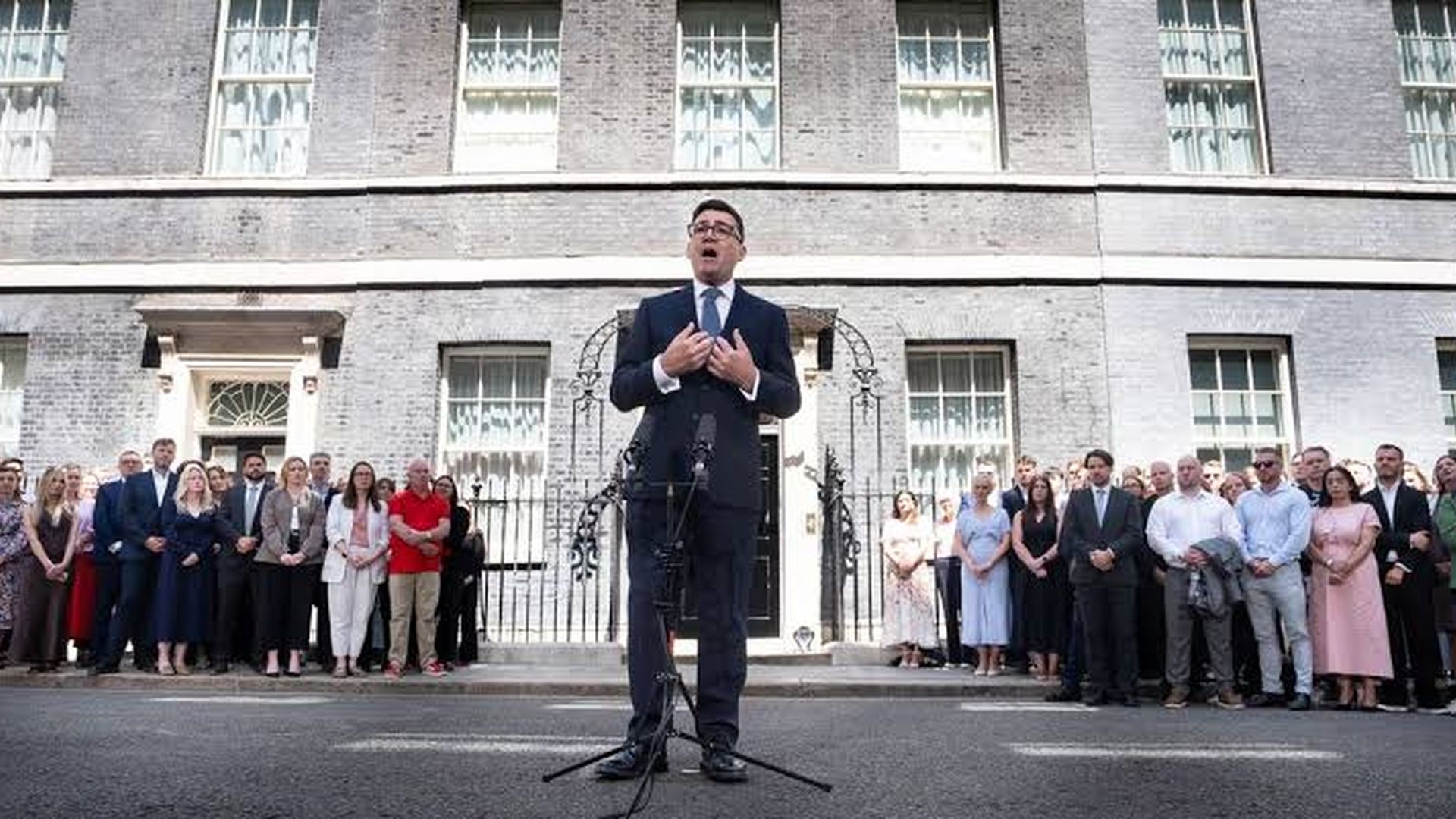
Andy Burnham addresses the nation outside 10 Downing Street after officially becoming Britain's Prime Minister, outlining plans to revive the economy and tackle the cost-of-living crisis.
Andy Burnham Prime Minister: What His Economic Vision Means for Britain’s Future
Andy Burnham Prime Minister Begins New Chapter With Economic Reform at the Centre
LONDON, United Kingdom — Andy Burnham has officially become the United Kingdom’s new Prime Minister, taking office after the resignation of Keir Starmer and immediately setting out an ambitious agenda focused on rebuilding Britain’s economy, easing the cost-of-living crisis and reshaping how political power is distributed across the country.
Standing outside 10 Downing Street after accepting King Charles III’s invitation to form a government, Burnham declared that Britain needed “a new political model and a new economic model” capable of restoring confidence after years of political turnover and persistent economic challenges. He also pledged immediate measures to help struggling households before unveiling a broader 10-year national strategy later this year.
Rather than presenting his leadership as merely another change at the top of government, Burnham framed it as an opportunity to rethink Britain’s economic direction. His message focused on rebuilding public trust, improving living standards and giving greater influence to regions outside London—issues that have dominated British political debate since the Brexit referendum.
For millions of Britons grappling with higher living costs, expensive housing and sluggish wage growth, Burnham’s promises represent more than political rhetoric. They raise expectations that a new administration can deliver practical improvements where previous governments have struggled.
A Peaceful Transition, but a Different Political Message
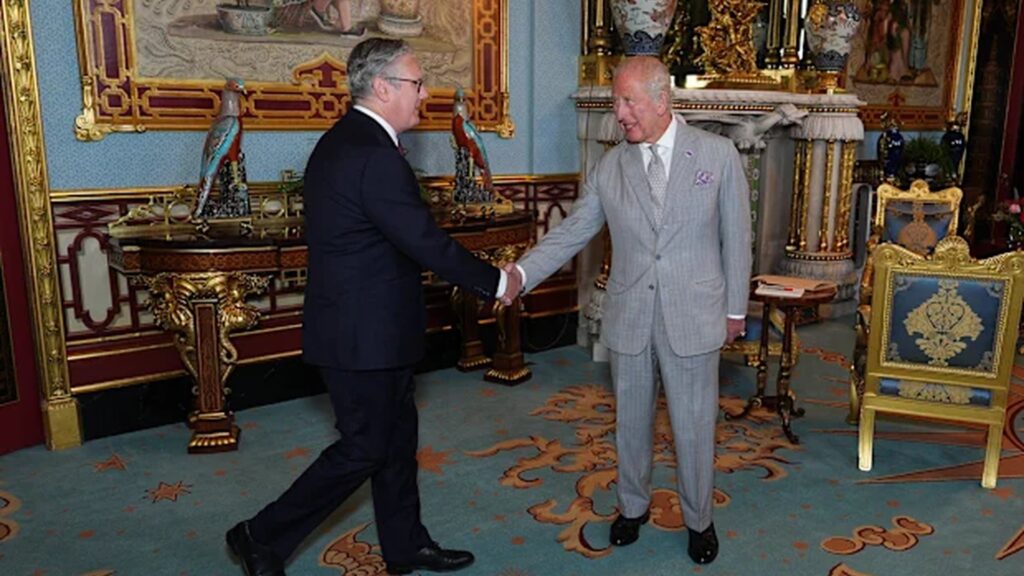
The handover from Keir Starmer to Andy Burnham followed Britain’s constitutional tradition of orderly democratic transitions. After formally tendering his resignation to King Charles III, Starmer wished his successor success and described serving as Prime Minister as “the privilege of my life.” Burnham was then invited by the monarch to form a new government before travelling to Downing Street to address the nation.
While the transition itself was smooth, the political message was markedly different.
Burnham acknowledged the instability that has characterised British politics over the past decade, noting that he had become the country’s seventh Prime Minister since 2016. Rather than treating that statistic as merely historical, he argued that frequent leadership changes had weakened public confidence in politics and highlighted the need for a more stable and effective system of government.
That emphasis on stability formed the foundation of his inaugural address.
He promised to restore faith in politics by focusing on practical governance rather than ideological battles, arguing that citizens were less interested in partisan disputes than in seeing tangible improvements in their everyday lives.
Why the Economy Dominated Burnham’s First Speech
Although Britain’s foreign policy commitments remain important, Burnham deliberately placed domestic economic issues at the centre of his first speech as Prime Minister.
His priorities reflected concerns that continue to dominate public opinion across the United Kingdom:
- Rising household costs
- Housing affordability
- Sluggish economic growth
- Regional inequality
- Public services under financial pressure
- Long-term industrial competitiveness
Rather than announcing sweeping constitutional reforms, Burnham sought to reassure households that economic relief would begin quickly. He promised to unveil measures aimed at reducing the pressure of everyday living costs while developing a broader strategy designed to transform Britain’s economy over the next decade.
This approach signals that his government intends to judge success not simply by headline economic figures but by whether ordinary families experience measurable improvements in their standard of living.
Cost-of-Living Crisis Remains the Immediate Test
Among the issues confronting the new Prime Minister, none appears more urgent than Britain’s prolonged cost-of-living crisis.

Although inflation has eased from previous peaks, many households continue to struggle with:
- High food prices
- Expensive housing
- Elevated energy costs
- Mortgage pressures
- Slower wage growth compared with household expenses
Burnham acknowledged these realities during his Downing Street speech, promising that people would soon receive “some breathing space” through new government measures.
While he did not immediately outline every policy detail, the commitment itself signals that economic relief will be the administration’s first major policy test. Investors, businesses and households alike will closely watch the government’s initial announcements to assess whether they can provide meaningful support without placing additional strain on Britain’s public finances.
The balance between helping consumers and maintaining fiscal discipline is likely to become one of the defining challenges of Burnham’s premiership.
From Political Transition to Economic Transformation
The significance of Burnham’s arrival in Downing Street extends beyond replacing one Labour leader with another.
His speech suggested that he intends to redefine how government approaches economic development by placing greater emphasis on regional growth, industrial renewal and public investment in essential services.
Rather than arguing that market forces alone can resolve Britain’s long-standing economic challenges, Burnham proposed stronger public involvement in areas he described as “life’s essentials.” While stopping short of promising widespread nationalisation, he indicated that government should play a more active role in ensuring affordability and accessibility in sectors that directly affect everyday life.
That philosophy marks one of the clearest differences between Burnham’s emerging agenda and the economic framework that has largely shaped Britain since the 1980s.
The coming months will determine whether those ambitions can be translated into practical legislation, sustainable economic growth and renewed public confidence in British governance.
Andy Burnham Prime Minister Seeks to Rebalance Britain’s Economy
One of the defining themes of Andy Burnham’s first speech as Prime Minister was his commitment to fundamentally reshape how economic opportunity is distributed across Britain.
For decades, successive governments have faced criticism that economic growth has been concentrated in London and parts of southeast England, while many former industrial regions have struggled with declining investment, lower productivity and fewer employment opportunities.
Burnham has long argued that this imbalance has weakened national prosperity. As Prime Minister, he now intends to move beyond local government initiatives and implement nationwide reforms that give cities and regions greater authority over economic development, transport, housing and public investment.
His commitment to decentralisation reflects a broader political philosophy that local communities are often better positioned than central government to understand their own economic priorities and development needs.
If implemented successfully, these reforms could alter the relationship between Westminster and regional governments more significantly than at any point in recent decades.
A Break From Britain’s Traditional Economic Model?
Perhaps the most closely watched element of Burnham’s inaugural address was his suggestion that Britain needs what he described as a “new economic model.”
Without announcing sweeping ideological changes, Burnham nevertheless questioned the long-standing economic framework that has shaped Britain since the reforms introduced during Margaret Thatcher’s premiership.
He argued that Britain made “wrong turns” during the 1980s, saying political power became increasingly centralised while economic assets were transferred into private ownership, leaving many communities behind as traditional industries declined.
His comments indicate a willingness to reconsider the balance between public responsibility and private enterprise rather than abandoning market economics altogether.
Instead of proposing widespread nationalisation, Burnham suggested that government should exercise stronger oversight over sectors providing essential public services where affordability has become a growing concern.
That distinction is likely to define much of the debate surrounding his economic programme in the months ahead.
Housing and Homelessness Move to the Top of Government Priorities
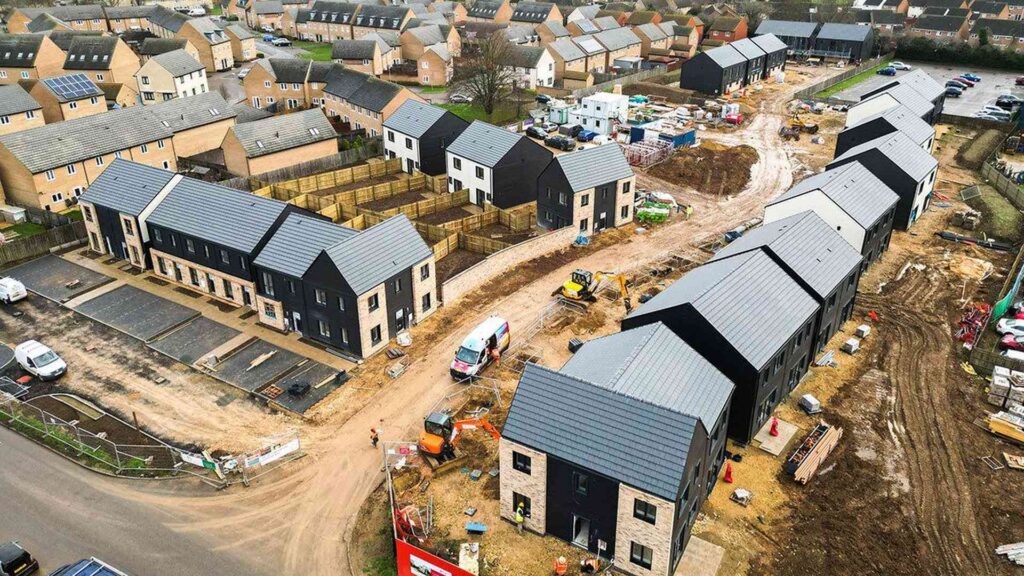
Among Burnham’s earliest commitments was a pledge to make tackling homelessness one of his administration’s first policy actions.

Speaking outside Number 10 Downing Street, he announced that his first official instruction would focus on ending rough sleeping across Britain.
The issue has long been central to Burnham’s political identity.
During his tenure as Mayor of Greater Manchester, he launched initiatives aimed at reducing homelessness, achieving early progress before numbers began rising again after 2021. Those mixed results mean his national strategy will attract close scrutiny from housing experts, local authorities and social welfare organisations.
Alongside homelessness, Burnham also promised to oversee one of Britain’s largest programmes of council house construction since the post-war era.
Affordable housing remains one of the country’s most persistent challenges.
Many younger Britons struggle to enter the property market due to high prices and mortgage costs, while rental expenses continue placing pressure on household finances.
Increasing housing supply could therefore serve multiple objectives:
- Expanding affordable accommodation
- Reducing homelessness
- Supporting construction employment
- Improving labour mobility
- Strengthening long-term economic productivity
Whether these ambitions can be delivered will depend heavily on government spending priorities, planning reforms and cooperation with local authorities.
Cost-of-Living Relief Will Be Judged Quickly
Political analysts often argue that new governments receive only a limited period in which to demonstrate meaningful progress.
For Burnham, that period may be particularly short.
Public expectations have been shaped by years of rising household expenses, elevated borrowing costs and slower economic recovery following the pandemic.
Recognising that urgency, Burnham promised immediate measures to provide what he described as “breathing space” for families before unveiling his longer-term national strategy.
Although detailed policies were not immediately announced, economists are expected to closely examine:
- Household support measures
- Public spending priorities
- Inflation management
- Fiscal sustainability
- Business confidence
- Consumer spending
Markets will also be watching how the government balances increased public investment with Labour’s commitment to maintaining fiscal discipline.
Failure to maintain investor confidence could increase borrowing costs, making many planned reforms more difficult to finance.
Rebuilding Britain’s Industrial Base
Another notable aspect of Burnham’s vision is his emphasis on rebuilding Britain’s productive economy.
Rather than relying predominantly on financial services and consumer spending, he has repeatedly argued that Britain should strengthen domestic manufacturing and strategic industries.
His priorities include supporting sectors such as:
- Steel
- Energy
- Defence
- Food production
- Advanced manufacturing
- Agriculture
The objective is not simply to create employment but also to improve Britain’s long-term economic resilience at a time when global supply chains have become increasingly vulnerable to geopolitical tensions and international conflicts.
Many governments around the world have adopted similar industrial strategies following disruptions caused by the COVID-19 pandemic and growing strategic competition between major economies.
Burnham’s approach therefore reflects wider international trends rather than an exclusively British policy shift.
Britain Faces Significant Economic Headwinds
Despite the optimism surrounding the change in leadership, Burnham inherits an economy facing considerable challenges.
Among the most pressing are:
- Weak long-term productivity growth
- Continuing inflationary pressures
- High government borrowing
- Elevated interest rates
- Pressure on public services
- Business investment uncertainty
The Bank of England continues balancing inflation control against the need to support economic growth, while households remain sensitive to mortgage repayments and everyday living costs.
These economic realities mean that even well-designed government policies may require time before producing visible improvements.
Political success will therefore depend not only on policy announcements but also on measurable outcomes that citizens experience in their daily lives.
For Burnham, the challenge extends beyond presenting an inspiring vision. His government must now demonstrate that ambitious promises can translate into practical reforms capable of restoring confidence in Britain’s economy and improving living standards across every region of the country.
Foreign Policy: Continuity Rather Than Immediate Change
Although Andy Burnham devoted most of his inaugural address to domestic issues, he also offered important signals about Britain’s foreign policy direction.
One of his clearest commitments was maintaining Britain’s support for Ukraine. Before formally taking office, Burnham said Ukrainian President Volodymyr Zelenskyy would be among the first world leaders he would contact, alongside U.S. President Donald Trump. He stressed there would be “no change” in Britain’s backing for Kyiv and pledged to continue the policy pursued under Keir Starmer.
That message is significant because it reassures NATO allies and international partners that Britain’s leadership transition is unlikely to alter its position on one of Europe’s most consequential security challenges.
On the Middle East, Burnham has previously described the destruction in Gaza as “a scar on our collective conscience” while acknowledging that Labour’s earlier handling of the conflict attracted criticism. However, his first speech as Prime Minister focused overwhelmingly on domestic priorities rather than foreign affairs, suggesting his government intends to concentrate initially on Britain’s internal economic recovery.
Cabinet Appointments Will Shape the Government’s Direction
While Burnham’s vision has attracted considerable attention, the effectiveness of his administration will depend heavily on the team he assembles.
One of the earliest tasks facing the new Prime Minister is selecting ministers capable of translating campaign promises into government policy.
Political observers are particularly focused on the appointment of the Chancellor, whose responsibility for managing public finances will be central to delivering Burnham’s economic agenda.
Questions also remain over whether experienced ministers from the previous administration will retain senior positions or whether Burnham will introduce a significantly reshaped cabinet reflecting his own priorities. The composition of the government is expected to provide an early indication of how quickly he intends to pursue reforms and whether he favours continuity or substantial change.
Why Burnham’s Leadership Matters Beyond Britain
Leadership changes in the United Kingdom rarely affect only British politics.
As one of the world’s largest economies, a permanent member of the United Nations Security Council and a key NATO ally, Britain’s domestic decisions often have wider international consequences.
Governments, investors and businesses across Europe and beyond will closely monitor Burnham’s approach to economic policy, trade, public investment and regional development.
His proposed emphasis on industrial renewal mirrors similar strategies being adopted in countries such as the United States, Germany and France, where governments have become increasingly willing to support strategic industries following disruptions caused by the COVID-19 pandemic, geopolitical tensions and energy market volatility.
For African economies, including Nigeria, Britain’s economic direction also carries practical implications.
The UK remains an important destination for African exports, investment, education and migration. Any policies that strengthen Britain’s economy, stimulate investment or alter trade priorities could indirectly influence business opportunities, educational partnerships and diplomatic engagement with African countries.
What Success Will Ultimately Be Measured By
Political speeches often generate optimism, but governments are ultimately judged by results.
Burnham’s administration will likely be evaluated against several measurable indicators over the coming years:
- Whether household living costs begin to ease.
- Whether affordable housing construction accelerates.
- Whether regional economic inequalities narrow.
- Whether industrial investment increases.
- Whether public confidence in government improves.
- Whether Britain’s economy achieves stronger and more sustainable growth.
Meeting these expectations will require balancing increased public investment with fiscal discipline, maintaining market confidence while responding to public demands for faster economic relief.
It is a complex challenge that has tested successive British governments for more than a decade.
Conclusion: A New Vision Faces Immediate Reality
Andy Burnham’s arrival at Number 10 Downing Street marks more than a routine change of leadership. It signals an attempt to redefine Britain’s political and economic priorities after years marked by leadership changes, economic uncertainty and growing public frustration.
By placing the cost-of-living crisis, housing, regional development and industrial renewal at the centre of his agenda, Burnham has sought to present his government as one focused on practical improvements rather than ideological division.
Whether that vision succeeds will depend less on the ambition of his speeches than on the government’s ability to deliver measurable progress for households across the United Kingdom.
For now, Burnham begins his premiership with significant public expectations, difficult economic realities and an opportunity to shape Britain’s direction for years to come. The coming months—through cabinet appointments, the first budgetary decisions and the unveiling of his promised 10-year national plan—will provide the first real test of whether his pledge for “a new political model and a new economic model” can become lasting policy rather than simply an aspirational slogan.
Recommended Coverage
Andy Burnham PM: New Leader Could Reshape UK
Explore how Andy Burnham’s rise to power could redefine Britain’s political landscape and influence its future at home and abroad. Discover the key events that paved his path to Downing Street.
G7 Summit 2026 Dominated by Iran, Ukraine Talks
Britain’s new Prime Minister inherits major international responsibilities. Find out how global security, Ukraine and Middle East tensions are shaping the agenda of world leaders.
Nigeria’s Economy: The Tinubu Administration—Progress or Crisis?
Compare Britain’s new economic direction with Nigeria’s ongoing economic reforms. See how both governments are confronting inflation, rising living costs and public expectations.
About the Author