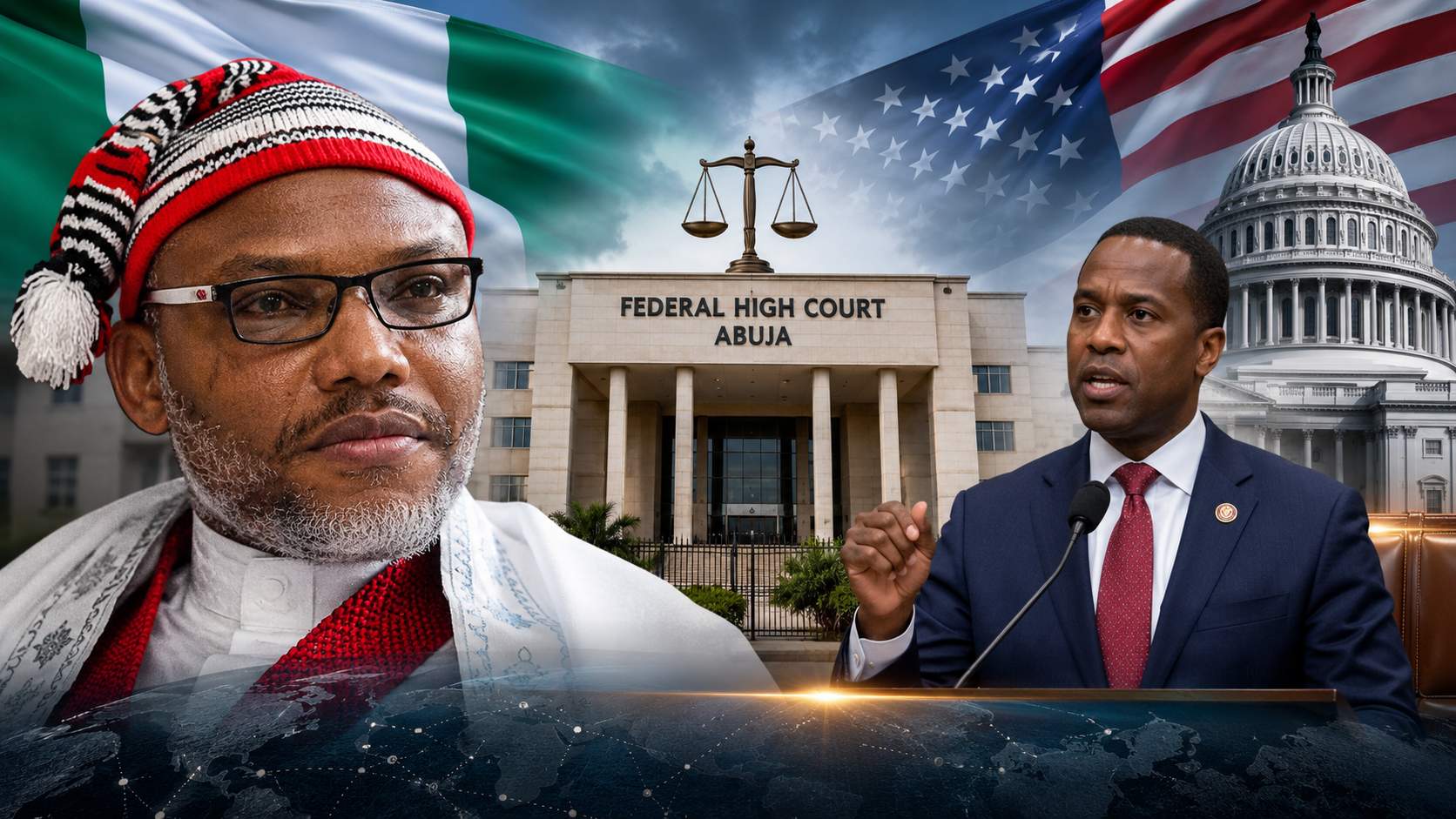
Nnamdi Kanu Release: What US Pressure Means for Nigeria’s Justice System and Foreign Relations
A Legal Battle That Has Become an International Diplomatic Conversation
What began as one of Nigeria’s most closely watched criminal cases has once again moved beyond the country’s borders. This time, the spotlight is not coming from another courtroom hearing in Abuja but from the floor of the United States House of Representatives, where Congressman John James has publicly urged Nigeria to either release Indigenous People of Biafra (IPOB) leader Nnamdi Kanu or grant him a fresh trial that complies with constitutional and international legal standards. His remarks have also introduced a broader diplomatic dimension by questioning whether continued American financial assistance to Nigeria should remain unchanged if those concerns are not addressed.
The intervention has revived international attention on one of Nigeria’s most contentious legal and political cases. Yet beyond the immediate headlines lies a deeper conversation about judicial independence, national sovereignty, international human rights obligations and the evolving nature of Nigeria’s relationship with one of its most important global partners—the United States.
Rather than focusing solely on the latest political statement, this analysis examines why the case continues to attract international scrutiny, what the US congressional resolution actually seeks to achieve, and whether foreign political pressure can realistically influence Nigeria’s judicial process.
According to a report by Punch, Congressman John James urged Nigeria to either release Nnamdi Kanu or conduct a fresh trial that complies with constitutional and international human rights standards.
Why Has the United States Congress Entered the Conversation?
Congressman John James, who represents Michigan in the United States House of Representatives, used a recent congressional session to renew calls for action on Nnamdi Kanu’s case. During his remarks, he urged fellow lawmakers to support House Resolution 1321, a proposal he introduced in May 2026 that calls on the Nigerian government to ensure any legal proceedings involving Kanu fully comply with Nigeria’s Constitution and internationally recognised human rights standards.
The resolution also advocates improved access to legal counsel, appropriate medical care and detention conditions consistent with international law. It further argues that if those standards cannot be guaranteed, Kanu should either receive a fresh trial or be released.
Although congressional speeches often attract media attention, it is important to distinguish political advocacy from legal authority. A resolution introduced by a member of the US House of Representatives does not automatically become American foreign policy, nor does it compel another sovereign nation to alter its judicial decisions. Instead, such resolutions generally serve as expressions of congressional opinion and may influence future diplomatic discussions or legislative debate within the United States.
Understanding that distinction is essential because much of the public discussion surrounding the latest intervention has blurred the line between political pressure and legally enforceable action.
Understanding House Resolution 1321
One of the least discussed aspects of the latest development is the resolution itself.
House Resolution 1321 is not a court judgment, nor is it an executive order issued by the White House. It remains before the US House Committee on Foreign Affairs and has not become binding legislation.
Its significance lies primarily in the political message it sends.
If eventually adopted by the House of Representatives, it would formally express the position of that chamber regarding concerns raised about Kanu’s detention and broader issues relating to religious freedom and human rights in Nigeria. Such resolutions can shape diplomatic conversations, encourage oversight hearings and influence how American lawmakers evaluate future foreign policy decisions, including development assistance and security cooperation.
However, they do not override Nigeria’s Constitution or direct Nigerian courts on how to determine criminal cases.
This distinction often becomes lost in political debate, yet it remains central to understanding what Congressman James’ proposal can—and cannot—achieve.
Why Congressman John James Connected the Case to Religious Freedom
A notable feature of Congressman James’ speech was his decision to link Nnamdi Kanu’s detention to wider concerns about violence against Christians in Nigeria.
During his address, he described Nigeria as one of the world’s most dangerous places for Christians, alleging that extremist violence has claimed thousands of lives over recent years. He argued that terrorist organisations such as Boko Haram have continued to operate while many victims have struggled to obtain justice. He further suggested that Kanu’s prosecution reflected broader concerns regarding the treatment of Christians and human rights. These are claims made by the congressman during his remarks and reflect his stated position.
Those assertions have become a central pillar of his argument for House Resolution 1321.
However, the relationship between religious violence in Nigeria and Kanu’s prosecution remains the subject of intense political disagreement. Nigerian authorities have consistently maintained that Kanu’s prosecution is based on terrorism-related offences and judicial proceedings conducted under Nigerian law, rather than on religious identity or political opinion.
That difference in interpretation illustrates why the case continues to generate strong reactions both within Nigeria and internationally.
The Long Road to International Attention
The latest congressional intervention did not emerge in isolation.
For several years, Nnamdi Kanu’s legal battle has attracted attention from governments, international organisations, legal experts and human rights advocates.
Kanu was arrested in Kenya in 2021 before being transferred to Nigeria to face prosecution. Following years of legal proceedings, he was convicted on terrorism-related charges and sentenced to life imprisonment by the Federal High Court in Abuja in November 2025. He remains in custody while pursuing legal avenues available under Nigerian law.
The case has repeatedly generated debate over issues including:
- the circumstances surrounding his transfer from Kenya;
- questions relating to due process;
- detention conditions;
- counter-terrorism legislation;
- constitutional rights; and
- Nigeria’s international legal obligations.
Each new legal development has attracted renewed public interest, making the case one of Nigeria’s longest-running and most internationally scrutinised judicial proceedings.
Why This Matters Beyond Nnamdi Kanu
Regardless of individual opinions about the IPOB leader, the latest intervention highlights a much broader issue.
Increasingly, domestic legal cases with significant political or human rights dimensions are no longer confined within national borders. International lawmakers, advocacy organisations, diplomatic partners and multilateral institutions frequently comment on judicial proceedings they believe carry wider implications for democracy, civil liberties or regional stability.
That reality places governments in a complex position.
On one hand, every sovereign nation has the responsibility to enforce its own laws through independent courts without external interference.
On the other hand, countries that are active members of the international community are also expected to uphold legal commitments arising from treaties, constitutional guarantees and recognised human rights standards.
It is within this tension—between sovereignty and international accountability—that the renewed debate over Nnamdi Kanu’s case now sits.
Nigeria’s Position: Why the Government Insists the Case Belongs in Court
While Congressman John James has framed Nnamdi Kanu’s detention as a human rights concern requiring international attention, the Nigerian government has consistently maintained a very different position.
Federal authorities argue that Kanu’s prosecution is not political, religious or ethnic in nature, but a criminal matter arising from terrorism-related offences prosecuted under Nigerian law. Government officials have repeatedly stated that the judicial process has been conducted through Nigeria’s established legal institutions and that the courts—not politicians or foreign governments—must determine the outcome of the case. According to the source material, the Federal Government maintains that the proceedings have been transparent, fair and conducted under the rule of law.
This distinction is crucial.
For Abuja, accepting external political pressure over an ongoing or concluded judicial matter could be interpreted as undermining the independence of Nigeria’s courts. Governments across the world generally resist attempts by foreign legislatures to influence domestic legal proceedings, particularly in cases involving national security or terrorism allegations.
That principle of judicial independence forms one of the strongest foundations of Nigeria’s response.
IPOB Welcomes Growing International Attention
The reaction from the Indigenous People of Biafra (IPOB) was markedly different.
According to the source material, IPOB spokesman Emma Powerful welcomed Congressman James’ intervention, describing it as evidence that Kanu’s case continues to attract increasing international scrutiny. He praised the congressman’s remarks and viewed them as further recognition of concerns previously raised by the organisation regarding the legal process surrounding its leader.
For IPOB supporters, international advocacy is seen as an important avenue for drawing global attention to what they believe are unresolved legal and human rights issues.
For critics, however, such interventions raise questions about the extent to which foreign political actors should become involved in highly sensitive domestic judicial matters.
These contrasting reactions illustrate why the debate extends far beyond the courtroom itself.
The UN Opinion Frequently Cited in the Debate
One of the reasons the case continues to attract international attention is that it has previously been examined by international human rights mechanisms.
Congressman James referenced a July 2022 opinion by the United Nations Working Group on Arbitrary Detention, which concluded that Kanu’s detention violated international human rights obligations and recommended his release together with appropriate remedies. That opinion has become a recurring point of reference for campaigners advocating Kanu’s freedom.
However, it is equally important to understand the legal significance of such findings.
Opinions issued by UN working groups can carry considerable moral and diplomatic weight and are often cited in international human rights discussions. They may influence advocacy campaigns and diplomatic engagement, but they do not automatically overturn decisions of national courts or compel sovereign governments to act in a particular way.
This distinction helps explain why, despite international criticism from various quarters, Nigeria’s judicial proceedings have continued through domestic legal channels.
Can the United States Actually Force Nigeria to Release Nnamdi Kanu?
This question lies at the centre of much of the public discussion.
The short answer is no.
The United States Congress cannot direct Nigerian courts to overturn convictions, order the release of prisoners or rewrite Nigeria’s Constitution.
Even if House Resolution 1321 were eventually adopted by the House of Representatives, it would primarily express the position of that legislative chamber. It would not automatically become binding US foreign policy, nor would it create a legal obligation requiring Nigeria to comply.
That said, congressional resolutions can still matter.
They may influence future diplomatic engagement, shape debates within the United States government, encourage additional hearings, or affect how lawmakers assess issues such as development assistance, security cooperation and human rights reporting.
In other words, while Congress cannot compel Nigeria’s courts, sustained political attention from influential lawmakers can shape the broader diplomatic environment in which bilateral relations operate.
Could US Financial Assistance Become Part of the Debate?
Perhaps the most striking aspect of Congressman James’ remarks was his suggestion that continued American financial assistance to Nigeria should be reconsidered.
During his speech, he argued that the United States provides billions of dollars in support to Nigeria and questioned whether such assistance should continue under current circumstances. This formed part of his broader argument linking Kanu’s detention with allegations concerning religious freedom and violence against Christians. These statements represent the congressman’s views as expressed during his address.
Whether those views ultimately influence US government policy remains uncertain.
American foreign assistance is determined through a complex process involving Congress, the executive branch, budget negotiations and broader strategic interests. Decisions relating to aid rarely depend on a single issue alone. Instead, they typically take into account security cooperation, regional stability, economic interests, humanitarian priorities and diplomatic objectives.
Consequently, while the congressman’s comments have attracted considerable attention, they should not automatically be interpreted as signalling an imminent change in official US policy toward Nigeria.
Why Nigeria-US Relations Extend Far Beyond One Court Case
Although the current debate centres on Nnamdi Kanu, the relationship between Nigeria and the United States is much broader than any single legal proceeding.
The two countries cooperate across numerous sectors, including:
- Counter-terrorism and regional security.
- Trade and investment.
- Public health programmes.
- Education and academic exchanges.
- Energy and economic development.
- Democratic governance initiatives.
- Humanitarian assistance.
Nigeria remains one of America’s most significant strategic partners in Africa, while the United States is an important diplomatic, economic and security partner for Nigeria.
Because of these extensive ties, disagreements over human rights or judicial matters are often managed through diplomatic engagement rather than public confrontation.
History shows that close allies can disagree on individual issues while continuing to cooperate in many other areas of mutual interest.
The Broader Debate: Sovereignty Versus International Accountability
Ultimately, the renewed attention surrounding Nnamdi Kanu’s case reflects a wider global debate that extends far beyond Nigeria.
Modern states increasingly find themselves balancing two important principles.
The first is national sovereignty—the right of every independent country to administer its own laws, courts and constitutional processes without outside interference.
The second is international accountability—the expectation that governments uphold commitments made under international human rights agreements and accepted legal standards.
Finding the right balance between these principles is rarely straightforward.
Supporters of greater international scrutiny argue that human rights should never be treated as purely domestic matters.
Those who prioritise sovereignty caution that allowing foreign political institutions to influence national judicial processes risks weakening constitutional independence and setting precedents that many countries would reject.
The renewed intervention from Washington has once again placed Nigeria at the centre of that difficult global conversation.
What Happens Next?
The immediate future of Nnamdi Kanu’s case will continue to unfold primarily within Nigeria’s legal system.
Although Congressman John James has urged the United States House of Representatives to support House Resolution 1321, the proposal remains before the House Committee on Foreign Affairs, meaning it has not yet become a formal position of the US Congress. Any further action would depend on the legislative process in Washington.
In Nigeria, the legal process also remains active. Kanu is serving a life sentence following his conviction on terrorism-related charges and continues to pursue legal remedies available under Nigerian law. Unless overturned through the judicial process or altered by lawful executive action, the court’s judgment remains in force.
That means the next significant developments are more likely to emerge from court proceedings or official government actions than from political statements abroad.
A Test of Nigeria’s Democratic Institutions
Regardless of how individuals view Nnamdi Kanu or the IPOB movement, the international attention surrounding this case has become a broader test of Nigeria’s democratic institutions.
Around the world, countries are increasingly judged not only by the outcomes of high-profile legal cases but also by how transparently and fairly those cases are handled. Public confidence in the justice system depends on more than convictions or acquittals—it also rests on due process, judicial independence and respect for constitutional safeguards.
For Nigeria, this means that every major legal proceeding with international visibility carries implications beyond the courtroom. Investors, foreign governments, international organisations and diplomatic partners often assess how institutions function when handling politically sensitive cases.
The debate, therefore, extends beyond one individual. It touches on the credibility of Nigeria’s legal institutions, the strength of its constitutional framework and the confidence that both citizens and international partners place in the rule of law.
Why This Story Resonates Across Africa
The issues raised by this case are not unique to Nigeria.
Across Africa, governments frequently face difficult questions about balancing national security with civil liberties, maintaining public order while protecting constitutional rights, and responding to international criticism without compromising national sovereignty.
Many African countries have experienced similar debates involving:
- national security prosecutions;
- separatist or secessionist movements;
- counter-terrorism legislation;
- freedom of expression;
- international human rights scrutiny; and
- the role of foreign governments in domestic affairs.
For that reason, the discussion surrounding Nnamdi Kanu is likely to be followed closely beyond Nigeria’s borders, particularly in countries confronting comparable constitutional and security challenges.
The Diplomatic Balancing Act
International diplomacy rarely operates in absolutes.
The United States has consistently presented itself as an advocate for democratic governance and human rights in its foreign policy. At the same time, Nigeria remains a strategic partner in West Africa, cooperating with Washington on regional security, counter-terrorism, trade, health and economic development.
Those overlapping interests mean that disagreements on individual issues do not automatically translate into broader diplomatic conflict.
History shows that close partners often raise concerns privately and publicly while continuing to collaborate on shared priorities.
Whether Congressman John James’ intervention gains wider political support in Washington remains uncertain. Equally uncertain is whether it will significantly influence future diplomatic engagement between both countries.
For now, the comments have succeeded in ensuring that Kanu’s case remains part of a wider international conversation.
The Bigger Questions That Remain
As this story continues to develop, several important questions remain unanswered.
- Will House Resolution 1321 progress through the US Congress?
- How, if at all, might it influence future diplomatic discussions between Nigeria and the United States?
- Will Kanu’s ongoing legal efforts produce further judicial developments?
- Can Nigeria address international concerns while maintaining the independence of its courts?
- Where should the line be drawn between legitimate international advocacy and respect for national sovereignty?
These are questions without simple answers.
They involve law, diplomacy, politics and human rights—areas where competing principles often intersect rather than align.
DSG Herald News Analysis
The renewed intervention from Congressman John James has undoubtedly elevated international attention on Nnamdi Kanu’s case. However, it should not be mistaken for a legal directive capable of determining the outcome of judicial proceedings in Nigeria.
The significance of this development lies less in its immediate legal effect and more in what it reveals about the increasing internationalisation of domestic legal disputes. In today’s interconnected world, major court cases—particularly those involving allegations of human rights violations, national security or political controversy—can quickly become subjects of diplomatic debate far beyond national borders.
For Nigeria, the challenge is twofold.
The country must demonstrate that its legal institutions are capable of administering justice fairly, transparently and independently, while also engaging constructively with legitimate international concerns raised by partners and multilateral organisations.
At the same time, foreign governments advocating for human rights must recognise the importance of respecting judicial processes within sovereign states. Durable solutions are more likely to emerge through lawful institutions, dialogue and adherence to constitutional principles than through political confrontation alone.
Ultimately, the future of Nnamdi Kanu’s case will be determined not by speeches delivered in foreign legislatures, but by the legal processes established under Nigerian law.
Whatever the eventual outcome, the case has already become more than a courtroom dispute. It has evolved into a broader conversation about justice, sovereignty, diplomacy and the place of human rights in an increasingly interconnected world.
Key Takeaways
- A US congressman has renewed calls for Nnamdi Kanu’s release or a fresh trial through House Resolution 1321.
- The proposal remains under consideration in the US House and does not have binding legal effect in Nigeria.
- Nigeria maintains that Kanu’s prosecution was conducted under its judicial system and in accordance with the rule of law.
- IPOB has welcomed the renewed international attention, while the wider debate continues to focus on sovereignty, judicial independence and human rights.
- The story has implications not only for Kanu’s legal journey but also for Nigeria-US relations and the broader discussion about how domestic legal cases intersect with international diplomacy.
Join the Conversation
Do you believe international pressure can strengthen accountability without undermining national sovereignty? Or should domestic court decisions remain entirely insulated from foreign political influence?
Share your views in the comments below and continue the discussion with DSG Herald News.
Recommended Coverage
Bishops’ Plea to U.S. Over Nigeria Sparks Controversy
Why are Nigerian issues increasingly attracting attention in Washington? Explore how the Catholic bishops’ appeal to the United States sparked another debate over sovereignty, diplomacy and international advocacy.
Appeal Court Rebukes Judge in ADC Deregistration Case
Judicial independence remains central to Nigeria’s democracy. Read how the Court of Appeal’s ruling in the ADC deregistration case highlighted the importance of due process and constitutional safeguards.
Ted Cruz’s Nigeria Plateau Killings Spark US Concern
This isn’t the first time American lawmakers have raised concerns about Nigeria. Discover why Senator Ted Cruz’s comments on the Plateau killings intensified international scrutiny of the country’s security challenges.
About the Author