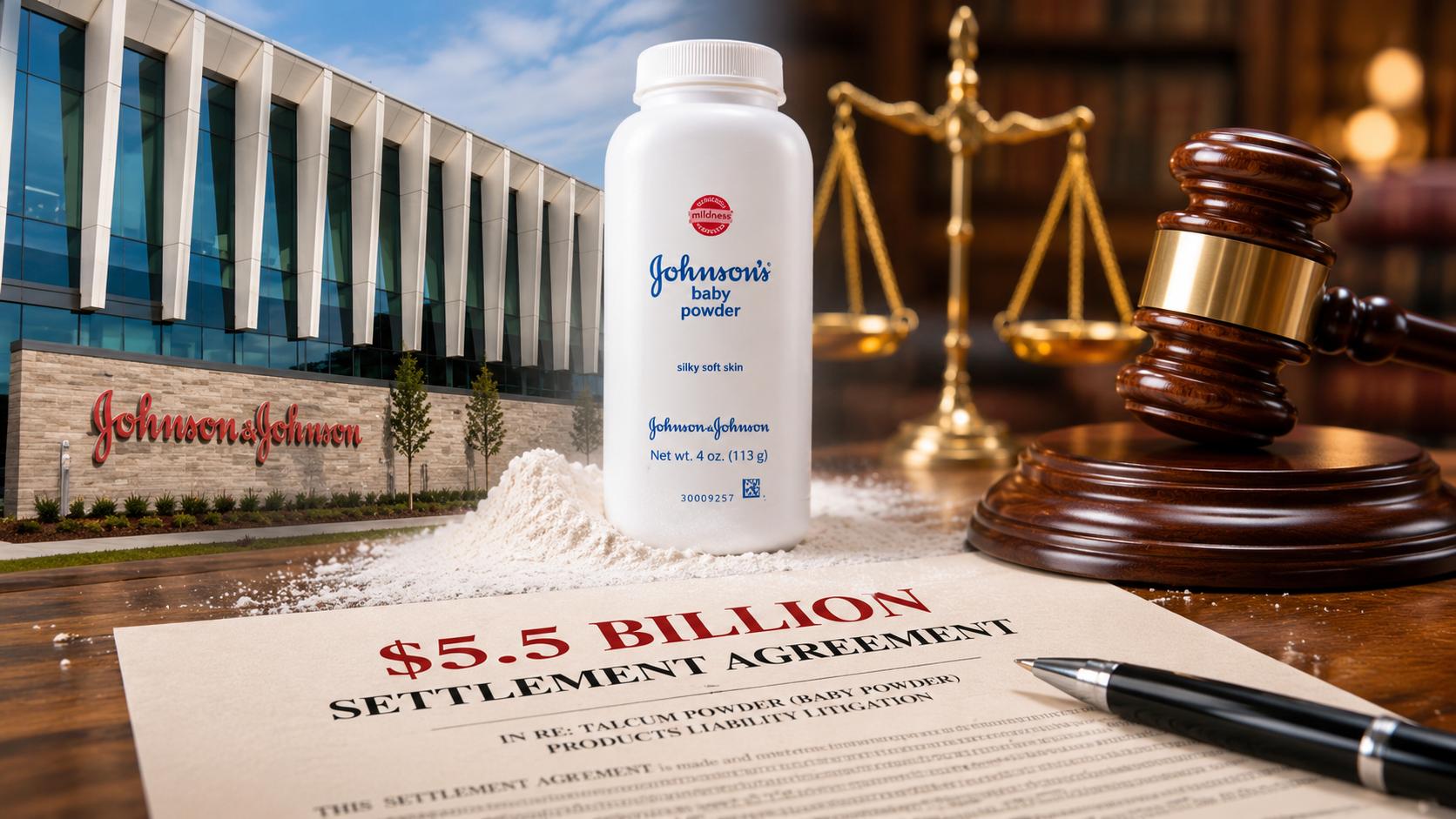
Johnson & Johnson Settlement: Why Pay $5.5 Billion While Denying Baby Powder Caused Cancer?
Johnson & Johnson has agreed to pay up to $5.5 billion to settle tens of thousands of lawsuits alleging that its talc-based baby powder and other talc products caused ovarian cancer, marking one of the largest product liability settlements in recent corporate history. The agreement, announced on July 27, covers about 69,000 federal cases and related state court claims, representing 99.75% of the company’s remaining talc-related ovarian cancer lawsuits. Yet despite the size of the proposed settlement, the healthcare giant continues to insist that its products are safe, do not contain asbestos, and did not cause cancer.
That apparent contradiction lies at the heart of this story. If Johnson & Johnson believes the claims are without merit, why commit billions of dollars to settle them? The answer goes far beyond a single legal dispute. It offers insight into how multinational corporations manage risk, protect their brands, respond to prolonged litigation, and weigh the financial costs of uncertainty against the benefits of closure.
For consumers, investors, regulators, and public health experts, the proposed settlement is about much more than compensation. It touches on scientific debate, legal strategy, corporate accountability, and public trust in household products that millions of families have used for generations.
More Than a Settlement: A Turning Point in Corporate Litigation
At first glance, the announcement appears straightforward: a global healthcare company has agreed to resolve thousands of lawsuits through a multibillion-dollar settlement. However, the details reveal a far more complex picture.
Johnson & Johnson said the agreement applies to approximately 69,000 lawsuits consolidated in federal court in New Jersey, together with related claims filed in various state courts. According to the company, these cases account for almost all remaining ovarian cancer claims linked to its talc products. The settlement will become final only if 95% of the ovarian cancer claimants in state and federal courts accept the agreement, making claimant approval—not judicial approval—the decisive requirement.
The company also stated that the proposed resolution applies only to existing claims and does not prevent future lawsuits from being filed if new claimants emerge.
That distinction is significant. Unlike previous attempts to resolve the litigation through bankruptcy proceedings, this agreement focuses exclusively on current cases rather than establishing a broader mechanism to address future claims.
Johnson & Johnson Maintains Its Position
Throughout more than a decade of litigation, Johnson & Johnson has consistently rejected allegations that its talc products caused cancer.
In announcing the proposed settlement, the company’s Vice President of Litigation, Erik Haas, reiterated that position, describing the claims as “meritless.” He said the company remained confident it would ultimately prevail in continued litigation, noting that it had succeeded in the majority of cases tried so far. According to the company, agreeing to the settlement is intended to bring years of costly legal disputes to a close and allow management to focus on developing medicines and medical devices.
That distinction matters because, in civil litigation, companies frequently choose settlement without admitting legal liability. Settling a lawsuit is not, by itself, a legal finding of guilt or wrongdoing. Instead, it is often a strategic decision intended to reduce financial uncertainty, avoid prolonged courtroom battles, and provide greater predictability for shareholders and business planning.
Understanding that difference is essential to interpreting this case. The proposed agreement represents a negotiated resolution between the parties rather than a judicial determination that Johnson & Johnson’s products caused ovarian cancer.
A Legal Battle That Spanned More Than a Decade
The talc litigation has become one of the longest-running and most closely watched product liability disputes in modern American legal history.
Lawsuits alleging that Johnson & Johnson’s talc-based baby powder contributed to ovarian cancer began emerging as early as 2009. Over time, thousands of women and their families filed claims alleging that prolonged use of talc products exposed them to harmful asbestos contamination, ultimately leading to cancer. Johnson & Johnson consistently disputed those allegations, arguing that scientific evidence supports the safety of cosmetic talc and that its products never contained asbestos.
As the number of cases grew, the litigation expanded across multiple state and federal jurisdictions, creating one of the largest coordinated product liability proceedings in the United States. Individual jury verdicts produced mixed outcomes, with some plaintiffs winning substantial awards while Johnson & Johnson successfully defended many other cases.
The conflicting results reflected the complexity of proving causation in individual cancer cases—a challenge that would continue to shape the litigation for years.
Product Changes Amid Growing Controversy
Although Johnson & Johnson has consistently maintained that its talc products were safe, the company gradually altered its commercial strategy as legal and public scrutiny intensified.
In 2020, the company stopped selling its talc-based baby powder in the United States and replaced it with a cornstarch-based alternative. Two years later, it expanded that decision globally, announcing that it would discontinue talc-based baby powder worldwide as part of a broader portfolio assessment. The company emphasized that the move was a commercial decision rather than an admission that its products were unsafe.
For many consumers, however, the timing prompted questions. If the product was considered safe, why remove it from the market?
Johnson & Johnson’s explanation remained consistent: changing market demand, declining sales, and persistent misinformation surrounding talc influenced the decision. Critics, on the other hand, argued that years of litigation and reputational pressure had made continued production increasingly difficult to justify.
Whatever the motivation, the transition marked the end of an era for one of the world’s most recognizable consumer healthcare products.
Previous Attempts to End the Litigation
The latest settlement proposal did not emerge in isolation. It follows several unsuccessful attempts by Johnson & Johnson to resolve the growing number of lawsuits through bankruptcy proceedings.
For more than three years, much of the litigation remained on hold while the company pursued a controversial legal strategy involving a subsidiary created to manage talc-related liabilities. Those efforts sought to channel the lawsuits into bankruptcy court, where a broader settlement framework could potentially resolve both existing and future claims.
However, the bankruptcy strategy faced repeated legal setbacks, and the litigation resumed in March 2025 after those efforts failed. The newly announced agreement represents a different approach—one based on negotiated settlements with current claimants rather than bankruptcy protection.
The change in strategy reflects the company’s effort to achieve certainty after years of legal challenges that had become increasingly costly, complex, and unpredictable.
A Recent Court Victory Before the Settlement
Interestingly, the proposed settlement comes shortly after Johnson & Johnson secured an important legal victory.
Only days before announcing the agreement, a federal judge questioned whether individual plaintiffs could reliably prove that talc itself directly caused their ovarian cancer. The ruling strengthened Johnson & Johnson’s legal position and reinforced the company’s long-standing argument that scientific evidence did not establish a direct causal relationship in individual cases.
Ordinarily, such a courtroom success might encourage a defendant to continue fighting additional lawsuits rather than negotiate a settlement.
Instead, Johnson & Johnson chose a different path.
That decision raises a broader question explored in the next section: why would a company that believes it is winning in court still decide to pay billions of dollars to resolve litigation? That question requires looking beyond courtroom victories to examine corporate strategy, financial planning, scientific uncertainty, and the realities of managing one of the world’s largest healthcare businesses.
Why Would Johnson & Johnson Pay Billions If It Says It Did Nothing Wrong?
This is perhaps the most important question surrounding the proposed Johnson & Johnson settlement.
For many people, a settlement of $5.5 billion appears to be an admission that the company was responsible for causing cancer. Yet that is not how civil litigation works.
In criminal law, guilt or innocence is determined by a court after prosecutors meet a high legal standard. Civil litigation operates differently. Companies may choose to settle lawsuits for many reasons, including reducing financial uncertainty, avoiding years of additional legal costs, limiting reputational damage, and providing greater certainty for shareholders. A settlement is a negotiated agreement; it is not, by itself, a judicial finding that a defendant caused the alleged harm.
Johnson & Johnson has consistently maintained that its talc products are safe and that scientific evidence does not support claims that they caused ovarian cancer. The company says its decision reflects a desire to end years of litigation and concentrate on its core healthcare business rather than continue a lengthy legal battle.
For plaintiffs, the proposed settlement also offers advantages. Rather than facing years of uncertain trials and appeals, many claimants may receive compensation sooner if the agreement secures the required acceptance threshold.
Understanding Talc: What Is It?
To understand why this litigation became so contentious, it is important to understand the material at the center of the dispute.
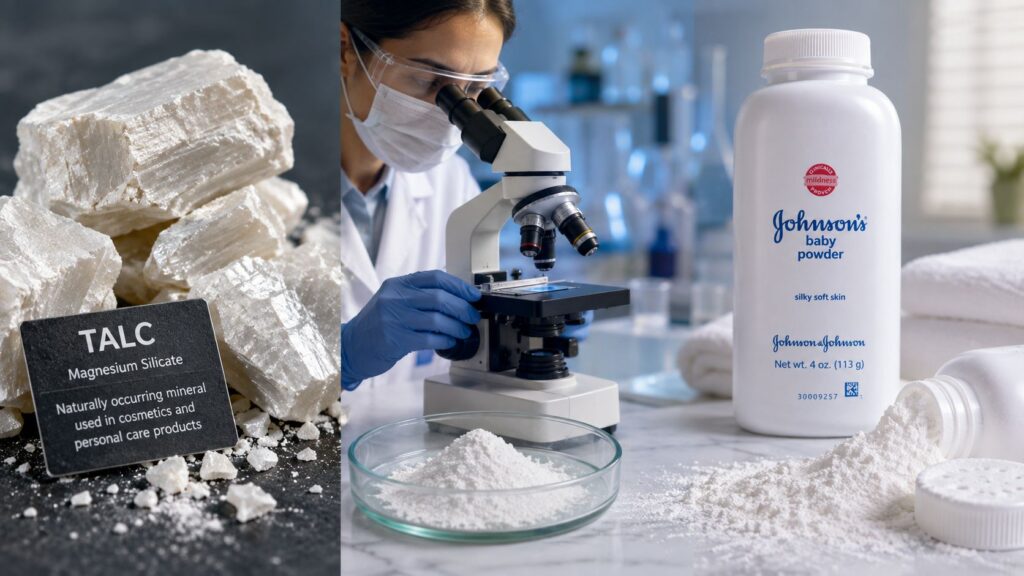
Talc is a naturally occurring mineral composed mainly of magnesium, silicon, oxygen, and hydrogen. Because it is extremely soft and absorbs moisture, manufacturers have long used it in products such as:
- Baby powder
- Cosmetic powders
- Facial makeup
- Pharmaceutical tablets
- Industrial products
For decades, talcum powder became synonymous with infant care because it helped reduce friction and absorb moisture.
The lawsuits, however, were not based simply on the presence of talc. Instead, many plaintiffs alleged that some talc products were contaminated with asbestos, a known carcinogen.
Why Are Talc and Asbestos Mentioned Together?
One reason the issue has generated scientific and legal debate is that talc and asbestos can occur naturally in close proximity underground.
Asbestos is a group of naturally occurring minerals whose microscopic fibers have been conclusively linked to serious diseases, including mesothelioma, lung cancer, and asbestosis after prolonged exposure.
Because talc deposits can exist near asbestos deposits, careful mining, testing, and quality control are necessary to prevent contamination. Plaintiffs in the litigation argued that asbestos contamination in talc products contributed to ovarian cancer, while Johnson & Johnson has repeatedly rejected that allegation, stating that its cosmetic talc was tested, did not contain asbestos, and was safe for consumer use.
This disagreement over contamination—and over what the available scientific evidence demonstrates—became one of the central issues in the courtroom.
What Does the Science Actually Say?
One reason the litigation has lasted so long is that the scientific evidence has not produced a single, universally accepted conclusion.
Some epidemiological studies have reported an association between long-term perineal use of talcum powder and a slightly increased risk of ovarian cancer. Other studies have found little or no statistically significant association after adjusting for other risk factors.
Researchers have also debated whether observational studies can establish causation or merely identify possible correlations. Scientific organizations have evaluated the evidence using different methodologies, leading to varying assessments of potential risk.
This complexity helps explain why courts reached different outcomes in individual cases. Plaintiffs and defendants often relied on competing scientific experts, each interpreting the available research differently.
Within the material supplied for this report, Johnson & Johnson continues to rely on studies that it says demonstrate talc is safe, contains no asbestos, and does not cause cancer.
Why Did Some Plaintiffs Win While Others Lost?
Observers sometimes assume that if one jury awards damages, every similar lawsuit should produce the same result. In practice, product liability litigation rarely works that way.
Each lawsuit may involve different:
- Medical histories
- Exposure patterns
- Expert witnesses
- Scientific evidence
- State laws
- Jury evaluations
As a result, verdicts can vary considerably.
Johnson & Johnson notes that it has prevailed in the majority of cases that have gone to trial, while plaintiffs have also secured significant verdicts in some proceedings. This mixed litigation record increased uncertainty for both sides and contributed to prolonged negotiations over a broader resolution.
The Bankruptcy Strategy That Failed
Before announcing the latest settlement proposal, Johnson & Johnson pursued another strategy that attracted widespread legal attention.
The company sought to resolve talc liabilities through a subsidiary that entered bankruptcy proceedings. That approach aimed to centralize thousands of lawsuits within a single bankruptcy process, potentially allowing existing and future claims to be addressed under one comprehensive settlement framework.
Supporters argued that bankruptcy could provide an efficient resolution for all parties. Critics contended that a financially strong corporation should not use bankruptcy procedures to manage litigation in this way.
Ultimately, courts rejected the strategy, and the litigation resumed after years of delay. The proposed $5.5 billion agreement therefore represents a significant shift toward negotiated settlements with current claimants instead of relying on bankruptcy protection.
The Business Case for Closure
From a financial perspective, prolonged litigation creates costs that extend far beyond legal fees.

Major corporations must account for:
- Ongoing legal expenses
- Investor uncertainty
- Shareholder concerns
- Insurance implications
- Executive management time
- Reputational risks
- Market confidence
When thousands of lawsuits remain unresolved, predicting future liabilities becomes increasingly difficult. Investors generally prefer greater certainty because it enables more reliable financial planning and long-term investment decisions.
Johnson & Johnson’s announcement suggests that management believes resolving most outstanding claims now will provide greater stability than continuing litigation for many more years. Even if the company remains confident in its legal arguments, the financial and operational costs of uncertainty can become significant.
For a multinational healthcare company operating across pharmaceuticals, medical devices, and consumer health products, restoring focus to its core business may itself represent a substantial strategic objective.
Reputation: A Cost Beyond the Courtroom
Large consumer brands depend not only on legal victories but also on public confidence.
Johnson’s Baby Powder was marketed for generations as a symbol of family care and infant health. As lawsuits expanded and media coverage intensified, the product increasingly became associated with controversy rather than trust.
The company responded by replacing talc-based baby powder with cornstarch formulations, first in the United States and later globally. Although Johnson & Johnson described the change as a commercial decision rather than an admission of product risk, the move reflected changing consumer preferences and a desire to simplify its product portfolio.
For global brands, reputation can be one of the most valuable corporate assets. Years of litigation—even when successfully defended in many cases—can influence consumer perception, purchasing decisions, and investor sentiment.
The proposed settlement therefore represents not only an effort to resolve legal disputes but also an attempt to move beyond a chapter that has shaped public discussion of one of the company’s most recognizable products for more than a decade.
What Does the Settlement Mean for Consumers?
For millions of consumers, the proposed Johnson & Johnson settlement does not automatically answer the question they care about most:
Is baby powder safe?
The settlement itself does not determine whether talc causes ovarian cancer. Instead, it resolves existing legal claims without changing the scientific debate or creating a judicial ruling that Johnson & Johnson’s products caused cancer. The company continues to maintain that its cosmetic talc is safe, does not contain asbestos, and does not cause cancer.
For consumers, that distinction is important.
A legal settlement addresses litigation. Product safety is determined through scientific research, regulatory oversight, manufacturing standards, and ongoing monitoring. The proposed agreement should therefore be viewed as the resolution of a legal dispute rather than a definitive scientific conclusion.
The case also serves as a reminder that consumers should remain informed about the products they use, read labels carefully, and follow advice from health authorities and healthcare professionals when making decisions about personal care products.
Why Did Johnson & Johnson Switch to Cornstarch?
One of the most visible outcomes of the controversy was Johnson & Johnson’s decision to replace talc with cornstarch in its baby powder products.
The company first stopped selling talc-based baby powder in the United States in 2020 before announcing in 2022 that it would discontinue the product globally. Johnson & Johnson described the move as a commercial decision made after reviewing its worldwide product portfolio rather than an acknowledgment that talc was unsafe.
Cornstarch-based powders provide similar moisture-absorbing properties but are produced from corn rather than mineral deposits. Because they do not involve mined talc, they avoid concerns about potential asbestos contamination.
For many consumers, the transition reflected changing public expectations. Even where companies maintain confidence in product safety, perceptions of risk can influence purchasing decisions just as strongly as scientific evidence.
A Global Regulatory Challenge
The Johnson & Johnson litigation has drawn attention to how countries regulate cosmetic and personal care products.
Different jurisdictions have adopted varying approaches to evaluating talc, testing for contamination, and assessing consumer safety. Regulatory agencies consider available scientific evidence, manufacturing practices, and product testing requirements when determining whether products comply with national safety standards.
The international debate highlights several broader questions:
- How should regulators assess long-term health risks when scientific evidence remains contested?
- What testing standards should manufacturers follow for naturally occurring minerals?
- How should companies communicate scientific uncertainty to consumers?
- When should regulators intervene as new research emerges?
These questions extend well beyond one company or one product. They affect manufacturers across the cosmetics, pharmaceutical, and personal care industries worldwide.
Lessons for Africa
Although the lawsuits were filed in the United States, their implications extend to African markets where imported personal care products remain widely available.
For African consumers, the case underscores the importance of:
- Strong product regulation
- Effective import inspection
- Consumer education
- Transparent product labeling
- Continuous post-market surveillance
Many African countries depend heavily on imported cosmetics and healthcare products. Ensuring those products comply with national standards remains an important responsibility for regulatory authorities.
The settlement also highlights the value of public awareness. Consumers increasingly seek information about product ingredients, manufacturing standards, and potential health risks before making purchasing decisions.
For regulators across the continent, the case reinforces the importance of maintaining robust quality-control systems while communicating clearly with the public whenever concerns arise.
What Does This Mean for Nigeria?
In Nigeria, baby powders and cosmetic products are commonly sold through supermarkets, pharmacies, neighborhood retailers, and online marketplaces.
The country’s National Agency for Food and Drug Administration and Control (NAFDAC) is responsible for regulating medicines, cosmetics, medical devices, and other consumer products before they enter the Nigerian market.
Although the source material does not indicate any regulatory action by NAFDAC in relation to the Johnson & Johnson settlement, the case is likely to renew public interest in:
- Cosmetic product safety
- Imported consumer goods
- Ingredient transparency
- Product registration
- Regulatory oversight
For Nigerian consumers, the settlement is also a reminder to purchase products through reputable distributors and to verify that regulated products carry appropriate registration and labeling where required.
The broader lesson is not necessarily about avoiding a specific brand but about understanding that consumer protection depends on effective regulation, quality assurance, and informed purchasing decisions.
Corporate Accountability Beyond the Courtroom
The Johnson & Johnson case illustrates how modern corporate accountability extends beyond legal liability.
Today’s multinational companies operate in an environment where reputation can be as valuable as patents, manufacturing facilities, or financial assets.
Years of litigation can affect:
- Consumer confidence
- Investor sentiment
- Brand loyalty
- Employee morale
- Regulatory relationships
- Long-term business strategy
For that reason, corporate decisions increasingly reflect not only legal considerations but also public perception, stakeholder expectations, and environmental, social, and governance (ESG) priorities.
Whether companies ultimately prevail in court may be only one part of a much broader business calculation.
What the Settlement Means for Investors
Financial markets generally dislike uncertainty.
When thousands of lawsuits remain unresolved, investors often struggle to estimate future liabilities accurately. Large settlements, although expensive, can sometimes reduce uncertainty by allowing companies to quantify legal exposure and focus on long-term planning.
Johnson & Johnson stated that it intends to make an initial payment of up to $3 billion next year, with no additional payments due before 2028, subject to the terms of the agreement and the required claimant approval.
For shareholders, that structure provides greater visibility into future financial obligations than years of unpredictable courtroom outcomes.
The Broader Lesson for Multinational Companies
The proposed settlement may become a case study in corporate governance and crisis management.
Several lessons emerge:
- Litigation can continue for many years even after product changes are introduced.
- Public confidence may take longer to rebuild than legal disputes take to resolve.
- Scientific uncertainty can create prolonged courtroom battles.
- Legal success does not always eliminate business risk.
- Reputation management has become a strategic priority alongside legal defence.
Companies operating in highly regulated industries may increasingly invest in stronger quality-control systems, clearer risk communication, and proactive consumer engagement to reduce future disputes.
Conclusion: A Settlement That Ends One Chapter—Not the Debate
Johnson & Johnson’s proposed $5.5 billion settlement marks a significant milestone in one of the largest product liability disputes in modern history. If accepted by the required 95% of ovarian cancer claimants, it will resolve nearly all remaining existing claims while allowing the company to move beyond a legal battle that has shaped public discussion for more than a decade.
Yet the agreement does not settle every question.
The scientific debate over talc, the legal standards for proving causation, and the broader discussion about consumer trust and corporate responsibility will continue long after the litigation concludes.
For Johnson & Johnson, the settlement represents an opportunity to close a costly chapter while maintaining its long-standing position that its products did not cause cancer.
For consumers, it is a reminder that legal settlements and scientific conclusions are not always the same thing.
For regulators, it reinforces the importance of vigilant oversight, transparent communication, and evidence-based decision-making.
And for multinational corporations everywhere, the case demonstrates that in today’s global marketplace, protecting public trust can be just as important as winning in court.
Recommended Coverage
Halle Berry Opens Up About Perimenopause Struggles
Health concerns often become public conversations through personal stories. Discover how celebrity experiences are helping to raise awareness about women’s health and encouraging more informed medical discussions.
Congo Ebola Outbreak Highlights Africa’s Health System Struggles
Public health goes beyond disease outbreaks—it also depends on trust, regulation, and timely information. Explore how Africa’s healthcare systems respond to major health challenges and why strong institutions matter.
Big Tech Investigation Sparks Nigeria Media Fight
Corporate accountability is reshaping industries worldwide. Read how growing scrutiny of powerful global companies is influencing regulation, public confidence, and the future of business oversight.
About the Author