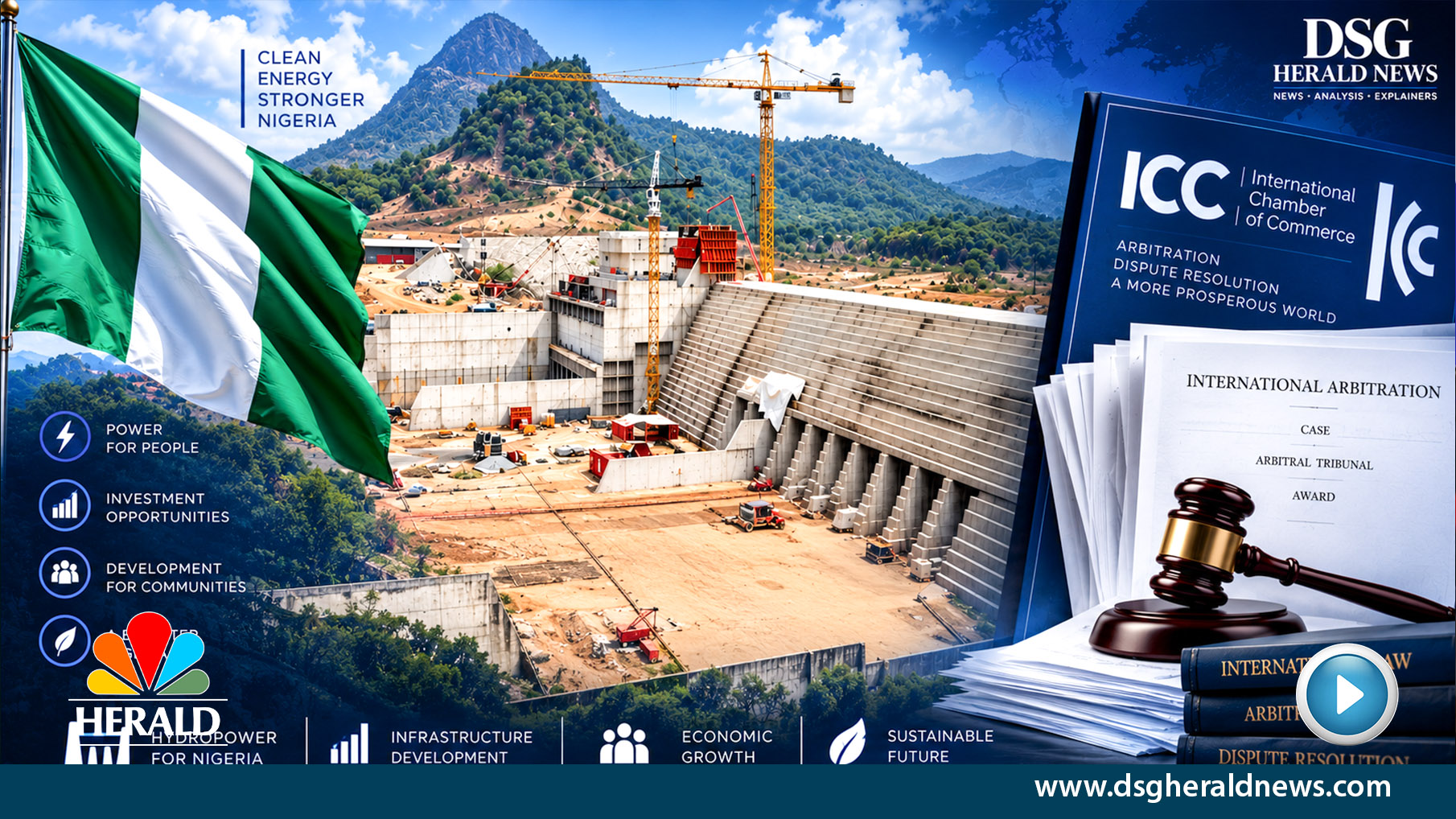
Mambilla Power Project Enters a New Phase After Arbitration Ruling
For more than two decades, the Mambilla Power Project has existed somewhere between national ambition and unfinished infrastructure.
Conceived as a major hydroelectric development in Taraba State, the project has survived changes of government, changes in project scope, financing difficulties and a prolonged international legal dispute. Now, one of the biggest legal obstacles surrounding the project has been removed.
On September 17, 2026, an International Arbitration Tribunal under the auspices of the International Chamber of Commerce in Paris rejected claims brought by Sunrise Power and Transmission Company Limited that could have exposed Nigeria to more than $3.38 billion in damages, settlement payments and interest.
The tribunal also rejected Sunrise’s demand connected to a disputed settlement agreement and ordered Sunrise and its promoter, Leno Adesanya, to reimburse Nigeria for a substantial portion of its legal costs. The award therefore closes a major chapter in the dispute.
But for Nigeria’s electricity sector, the more consequential question begins after the arbitration victory:
What happens to the Mambilla Power Project now?
The answer will depend on issues that arbitration alone cannot solve — financing, project structure, contractual arrangements, construction planning, transmission infrastructure and the government’s ability to turn a long-delayed proposal into an operating power asset.
The legal breakthrough is significant. It is not, by itself, a construction commencement date.
IMAGE — MAMBILLA PLATEAU


Why the Mambilla Power Project Matters
The importance of the Mambilla Power Project is tied to the scale of the electricity Nigeria has hoped to obtain from it.
The project is located in Taraba State and has historically been conceived as a large hydroelectric development. The original 2003 agreement provided for a 3,050MW hydroelectric plant under a build-operate-transfer arrangement, according to the source material supplied for this report.
IMAGE — MAMBILLA PROJECT LOCATION / MAP


The African Union’sPIDA investment prospectus continues to list a 3,050MW Mambilla Hydroelectric Power Project, describing it as a strategic energy project with implications for Nigeria’s electricity supply and potential regional power exports. The prospectus identifies project structuring, financing arrangements and procurement among the required next steps.
There is, however, an important distinction in the public record.
The Federal Government subsequently reduced the planned capacity. Former Power Minister Saleh Mamman said in 2021 that the project had been reduced from 3,050MW to approximately 1,500MW to improve its financial viability and make it acceptable to lenders.
Punch reported that the project was first reduced to about 1,525MW and later rescoped to approximately 1,500MW, with the original project estimated at between $5 billion and $5.8 billion and the revised scheme estimated at about $4 billion.
At the same time, the September 2026 State House statement described the wider Mambilla project in connection with a 3,960MW hydroelectric development.
These different capacity figures reflect the project’s long and changing development history. For the purposes of the current Mambilla project update, the critical point is that the scheme has been repeatedly redesigned as successive governments and project planners attempted to reconcile technical ambition with financing realities.
That history matters because the next phase will require Nigeria to settle not only the legal questions but also the precise commercial and engineering configuration of the project.
How the Mambilla Dispute Became a Barrier to the Project


The legal dispute dates back to the project’s early contractual history.
In 2003, Sunrise Power was associated with an agreement for development of the Mambilla hydroelectric project. The arrangement envisaged a build-operate-transfer model under which the private developer would undertake the project and recover its investment through electricity sales.
The dispute later escalated into international arbitration.
Sunrise commenced arbitration proceedings against Nigeria in October 2017 over alleged breaches associated with the project. The claims eventually developed into two related financial disputes, with the potential exposure reported at more than $3.38 billion.
A settlement was subsequently reached in 2020, but disagreements over the settlement’s implementation generated another round of arbitration.
That second stage became particularly important because the settlement itself became the subject of the legal dispute ultimately decided by the ICC tribunal.
The tribunal’s final award rejected Sunrise’s claim that Nigeria had breached its obligations under the settlement agreement and accompanying addendum. It also rejected a demand for $400 million connected with the settlement arrangement.
The result is that Nigeria is not required to make the payments sought by Sunrise under the claims rejected by the tribunal.
That removes a substantial financial and legal uncertainty from the project.
From 3,050MW to 1,500MW: Why the Project Was Rescoped


One of the most important parts of the Mambilla project update is the project’s changing capacity.
The original vision was considerably larger than the version discussed by government officials in recent years.
In 2021, former Power Minister Saleh Mamman explained that the Federal Government had reduced the planned capacity from 3,050MW to approximately 1,500MW because the larger scheme was considered difficult to finance under prevailing conditions.
The minister told the Senate Committee on Power that the reduction was intended to make the project bankable and acceptable to lenders.
This is a crucial detail in understanding what comes next.
A power project does not become viable simply because its legal disputes have been resolved. Lenders and investors still need confidence that the project’s cost, expected electricity output, revenue structure, contractual arrangements and repayment model are sustainable.
The Mambilla experience demonstrates the tension between national infrastructure ambitions and financial reality.
A larger plant promises greater generation capacity. But it can also require substantially greater capital expenditure, more complex construction arrangements and stronger financing commitments.
The Federal Government therefore moved toward a smaller configuration.
The source material supplied for this report states that the project was reduced to approximately 1,525MW in February 2021 before being further rescoped to about 1,500MW by July of that year. The stated objective was to reduce costs and improve financial viability.
That means any future announcement on Mambilla should be examined against the current approved project configuration, rather than relying automatically on figures associated with the original 2003 concept.
What the ICC Tribunal Actually Decided
The September 2026 arbitration award is significant because it resolved several claims that had hung over the project.
The three-member tribunal rejected Sunrise’s request for a declaration that Nigeria had breached obligations under the settlement agreement and addendum.
It also rejected the demand for $400 million comprising a $200 million settlement sum and an additional $200 million default payment.
The tribunal further affirmed its jurisdiction over Nigeria’s counterclaim against Sunrise and Adesanya. It ordered Sunrise and Adesanya to reimburse Nigeria for 75 per cent of its legal fees and expenses. The source material puts Nigeria’s legal costs at $11.82 million, with the claimants responsible for the remaining amount after an escrow-related payment.


The State House described the award as clearing what it called the “single biggest legal hurdle” that had paralysed the project for years.
That description captures the immediate significance of the ruling.
But it should not be confused with an announcement that the Mambilla hydro project is now under construction.
The tribunal settled the claims before it. It did not finance the project, award a construction contract, build transmission lines or commission a power station.
Those tasks remain outside the arbitration award.
The 2020 Settlement Remains an Important Part of the Story
The legal victory has also reopened questions about the 2020 settlement agreement.
Reports on the tribunal’s final award say the tribunal found that the settlement agreement and its addendum were not binding on Nigeria because the officials who signed them lacked the necessary authority to commit the Federal Government without presidential approval.
Reports also said the tribunal made findings concerning corruption in connection with the settlement arrangement.
Those findings have since generated a public dispute involving former Attorney-General of the Federation Abubakar Malami.
Malami has rejected allegations of a corrupt arrangement with Sunrise promoter Leno Adesanya. In a statement reported by Punch, he argued that the ICC proceedings were commercial arbitration rather than a criminal prosecution and said the award should not be presented as a criminal conviction against him. He also said the matters should be assessed against the complete documentary and evidentiary record.
This distinction is important in reporting the case accurately.
An arbitration tribunal’s findings in a commercial dispute and a criminal conviction are different legal outcomes. The relevant findings should therefore be attributed to the tribunal and the parties’ responses rather than presented as a criminal judgment.
For the future of the Mambilla Power Project, however, the practical significance is clearer: the settlement arrangement that generated another layer of litigation has now been rejected as the basis for Sunrise’s claims against Nigeria.
Financing Is Now the Central Question


Once the legal dispute is removed, financing becomes one of the most important questions facing the project.
The original Mambilla plan was associated with Chinese financing arrangements. In 2021, the Federal Government said China Export-Import Bank was expected to provide 85 per cent of the debt financing while Nigeria would contribute the remaining 15 per cent under the proposed structure.
The African Union’s PIDA material identifies financing arrangements as one of the project’s next steps.
More recently, Nigeria’s Attorney-General said financing of the project by China Export-Import Bank had been conditioned on resolving the disputes and argued that the unresolved legal issues had prevented financial close.
If that financing structure remains relevant, the government will now have to establish what happens next.
That could involve renewed negotiations with lenders, an updated feasibility and financing assessment, revised project agreements or a restructuring of the financing model.
The exact pathway cannot simply be assumed from the arbitration victory.
The government will have to demonstrate that the post-arbitration project is financially credible.
The Legal Victory Does Not Equal Construction
This may be the most important distinction in the current Mambilla story.
Nigeria has won the arbitration.
That is a documented development.
But the project still has to move through the stages required for a major hydroelectric infrastructure development.
Those stages include final project structuring, financing, procurement, construction, transmission integration and eventual commissioning.
The PIDA investment prospectus lists project structuring, finalisation of financing arrangements and procurement among the project’s next steps.


Consequently, the next meaningful milestones should not simply be political announcements celebrating the arbitration result.
They should be measurable implementation steps.
For example:
- confirmation of the current project capacity;
- publication or confirmation of the financing structure;
- financial close;
- confirmation of the engineering, procurement and construction arrangements;
- resolution of remaining contractual issues;
- commencement of physical works;
- transmission infrastructure development;
- construction progress reports;
- testing and commissioning.
These are the indicators that will show whether the legal breakthrough has translated into an infrastructure breakthrough.
What the Mambilla Project Could Mean for Nigeria’s Power Sector
If eventually completed and integrated successfully into Nigeria’s electricity system, a project of Mambilla’s scale would represent a substantial addition to the country’s generating capacity.
The PIDA prospectus describes Mambilla as a strategic project intended to increase electricity access, strengthen baseload generation and potentially support regional electricity exports. It also describes the project as capable of contributing to Nigeria’s wider electricity-generation and grid objectives.
Hydropower would also add another source of renewable generation to Nigeria’s electricity mix.


But generation capacity on paper is not the same as electricity delivered to consumers.
The ultimate impact of the Mambilla hydro project would depend on whether the generated electricity can be evacuated through an adequate transmission network and delivered through a functioning distribution system.
That means Mambilla cannot be treated as an isolated dam-and-turbine project.
Its success will depend on the wider power value chain.
Generation, transmission, distribution, market arrangements, grid stability and payment systems all have to work together.
For an electricity-starved economy, the significance of Mambilla will ultimately be measured not by the size of the project’s headline capacity but by how much reliable electricity reaches homes, businesses and industries.
A New Test for Government: Turning Legal Clearance Into Physical Progress

The September 2026 arbitration decision changes the environment around Mambilla.
For years, legal uncertainty was one of the major obstacles surrounding the project. The ICC ruling has now produced a definitive outcome in favour of Nigeria in the claims before the tribunal.
That gives the Federal Government an opportunity to move the discussion away from litigation and toward implementation.
The test now becomes administrative, financial and technical.
Can Nigeria establish a clear project structure?
Can it secure or reconfirm financing?
Can it settle the final contractual arrangements?
Can it demonstrate that the current project design is financially viable?
Can procurement proceed transparently?
Can construction begin and maintain momentum across successive administrations?
And can the resulting electricity be integrated effectively into the national grid?
Those questions are more important to the future of the project than the arbitration headline itself.
What Comes Next for the Mambilla Power Project?
The immediate next phase should be about converting the legal outcome into a clearly defined implementation programme.
The Federal Government has already described the arbitration ruling as a major breakthrough.
The next step is therefore to establish what that breakthrough means operationally.
A credible Mambilla project update should provide clarity on at least five areas.
1. Project scope
Government should clearly state the current approved generation capacity and whether the approximately 1,500MW configuration remains the operative design.
2. Financing
The government should clarify the status of China Export-Import Bank financing or any alternative financing structure and identify the conditions required for financial close.
3. Project agreements
Any contractual arrangements affected by the arbitration should be clearly explained, particularly where previous agreements have been invalidated, superseded or rendered unenforceable.
4. Construction timetable
The public should be able to distinguish between project preparation, financial close, procurement and actual construction.
5. Transmission readiness
The electricity generated by Mambilla will ultimately need to reach the national grid. Transmission planning therefore needs to move alongside generation development rather than being treated as a later issue.
These are the practical markers that will determine whether the project has genuinely entered a new phase.
The Bigger Story Is No Longer the Arbitration
For almost nine years, the Sunrise arbitration formed a major part of the Mambilla narrative.
Now that the ICC tribunal has ruled, that chapter has reached a decisive stage.
The story can therefore change.
The question is no longer simply whether Nigeria would face billions of dollars in claims.
The question is whether Nigeria can use the removal of that legal uncertainty to finally advance one of its most ambitious hydroelectric projects.
That is a considerably harder test.
A court or arbitration victory can remove an obstacle. It cannot pour concrete, install turbines or build transmission lines.
Mambilla still requires money, contracts, engineering, procurement, construction and sustained institutional commitment.
The project’s history also demonstrates why continuity matters. It has passed through multiple administrations and undergone major changes in capacity and financing strategy. Any new implementation programme will therefore need to survive political and administrative transitions if the project is to reach completion.
The legal battle may have lasted nearly nine years.
The infrastructure challenge is much older.
Conclusion: A Legal Breakthrough, Not Yet an Electricity Breakthrough
Nigeria’s $3.38 billionMambilla arbitration victory removes a major legal uncertainty from a project that has been delayed for years.
The ICC tribunal rejected Sunrise Power’s claims and dismissed the financial demands at the centre of the latest arbitration. It also ordered substantial reimbursement of Nigeria’s legal costs.
That is the end of one important chapter.
But it is not the end of the Mambilla story.
The project still faces the questions that have repeatedly shaped its history: how much will it cost, what will its final capacity be, who will finance it, what contractual structure will govern it, when will construction begin, and how will its electricity be transmitted into Nigeria’s power system?
The answers to those questions will determine whether September 2026 is remembered simply as the month Nigeria won a major international arbitration case — or as the point at which the Mambilla Power Project finally moved from prolonged dispute toward physical delivery.
For now, the legal roadblock has been cleared.
The much harder road to construction remains.
Mambilla Power Project: What $3.38bn Win Means
Mambilla Power Project Enters a New Phase After Arbitration Ruling
For more than two decades, the Mambilla Power Project has existed somewhere between national ambition and unfinished infrastructure.
Conceived as a major hydroelectric development in Taraba State, the project has survived changes of government, changes in project scope, financing difficulties and a prolonged international legal dispute. Now, one of the biggest legal obstacles surrounding the project has been removed.
On September 17, 2026, an International Arbitration Tribunal under the auspices of the International Chamber of Commerce in Paris rejected claims brought by Sunrise Power and Transmission Company Limited that could have exposed Nigeria to more than $3.38 billion in damages, settlement payments and interest.
The tribunal also rejected Sunrise’s demand connected to a disputed settlement agreement and ordered Sunrise and its promoter, Leno Adesanya, to reimburse Nigeria for a substantial portion of its legal costs. The award therefore closes a major chapter in the dispute.
But for Nigeria’s electricity sector, the more consequential question begins after the arbitration victory:
What happens to the Mambilla Power Project now?
The answer will depend on issues that arbitration alone cannot solve — financing, project structure, contractual arrangements, construction planning, transmission infrastructure and the government’s ability to turn a long-delayed proposal into an operating power asset.
The legal breakthrough is significant. It is not, by itself, a construction commencement date.
Why the Mambilla Power Project Matters
The importance of the Mambilla Power Project is tied to the scale of the electricity Nigeria has hoped to obtain from it.
The project is located in Taraba State and has historically been conceived as a large hydroelectric development. The original 2003 agreement provided for a 3,050MW hydroelectric plant under a build-operate-transfer arrangement, according to the source material supplied for this report.
The African Union’sPIDA investment prospectus continues to list a 3,050MW Mambilla Hydroelectric Power Project, describing it as a strategic energy project with implications for Nigeria’s electricity supply and potential regional power exports. The prospectus identifies project structuring, financing arrangements and procurement among the required next steps.
There is, however, an important distinction in the public record.
The Federal Government subsequently reduced the planned capacity. Former Power Minister Saleh Mamman said in 2021 that the project had been reduced from 3,050MW to approximately 1,500MW to improve its financial viability and make it acceptable to lenders.
Punch reported that the project was first reduced to about 1,525MW and later rescoped to approximately 1,500MW, with the original project estimated at between $5 billion and $5.8 billion and the revised scheme estimated at about $4 billion.
At the same time, the September 2026 State House statement described the wider Mambilla project in connection with a 3,960MW hydroelectric development.
These different capacity figures reflect the project’s long and changing development history. For the purposes of the current Mambilla project update, the critical point is that the scheme has been repeatedly redesigned as successive governments and project planners attempted to reconcile technical ambition with financing realities.
That history matters because the next phase will require Nigeria to settle not only the legal questions but also the precise commercial and engineering configuration of the project.
How the Mambilla Dispute Became a Barrier to the Project
The legal dispute dates back to the project’s early contractual history.
In 2003, Sunrise Power was associated with an agreement for development of the Mambilla hydroelectric project. The arrangement envisaged a build-operate-transfer model under which the private developer would undertake the project and recover its investment through electricity sales.
The dispute later escalated into international arbitration.
Sunrise commenced arbitration proceedings against Nigeria in October 2017 over alleged breaches associated with the project. The claims eventually developed into two related financial disputes, with the potential exposure reported at more than $3.38 billion.
A settlement was subsequently reached in 2020, but disagreements over the settlement’s implementation generated another round of arbitration.
That second stage became particularly important because the settlement itself became the subject of the legal dispute ultimately decided by the ICC tribunal.
The tribunal’s final award rejected Sunrise’s claim that Nigeria had breached its obligations under the settlement agreement and accompanying addendum. It also rejected a demand for $400 million connected with the settlement arrangement.
The result is that Nigeria is not required to make the payments sought by Sunrise under the claims rejected by the tribunal.
That removes a substantial financial and legal uncertainty from the project.
From 3,050MW to 1,500MW: Why the Project Was Rescoped
One of the most important parts of the Mambilla project update is the project’s changing capacity.
The original vision was considerably larger than the version discussed by government officials in recent years.
In 2021, former Power Minister Saleh Mamman explained that the Federal Government had reduced the planned capacity from 3,050MW to approximately 1,500MW because the larger scheme was considered difficult to finance under prevailing conditions.
The minister told the Senate Committee on Power that the reduction was intended to make the project bankable and acceptable to lenders.
This is a crucial detail in understanding what comes next.
A power project does not become viable simply because its legal disputes have been resolved. Lenders and investors still need confidence that the project’s cost, expected electricity output, revenue structure, contractual arrangements and repayment model are sustainable.
The Mambilla experience demonstrates the tension between national infrastructure ambitions and financial reality.
A larger plant promises greater generation capacity. But it can also require substantially greater capital expenditure, more complex construction arrangements and stronger financing commitments.
The Federal Government therefore moved toward a smaller configuration.
The source material supplied for this report states that the project was reduced to approximately 1,525MW in February 2021 before being further rescoped to about 1,500MW by July of that year. The stated objective was to reduce costs and improve financial viability.
That means any future announcement on Mambilla should be examined against the current approved project configuration, rather than relying automatically on figures associated with the original 2003 concept.
What the ICC Tribunal Actually Decided
The September 2026 arbitration award is significant because it resolved several claims that had hung over the project.
The three-member tribunal rejected Sunrise’s request for a declaration that Nigeria had breached obligations under the settlement agreement and addendum.
It also rejected the demand for $400 million comprising a $200 million settlement sum and an additional $200 million default payment.
The tribunal further affirmed its jurisdiction over Nigeria’s counterclaim against Sunrise and Adesanya. It ordered Sunrise and Adesanya to reimburse Nigeria for 75 per cent of its legal fees and expenses. The source material puts Nigeria’s legal costs at $11.82 million, with the claimants responsible for the remaining amount after an escrow-related payment.
The State House described the award as clearing what it called the “single biggest legal hurdle” that had paralysed the project for years.
That description captures the immediate significance of the ruling.
But it should not be confused with an announcement that the Mambilla hydro project is now under construction.
The tribunal settled the claims before it. It did not finance the project, award a construction contract, build transmission lines or commission a power station.
Those tasks remain outside the arbitration award.
The 2020 Settlement Remains an Important Part of the Story
The legal victory has also reopened questions about the 2020 settlement agreement.
Reports on the tribunal’s final award say the tribunal found that the settlement agreement and its addendum were not binding on Nigeria because the officials who signed them lacked the necessary authority to commit the Federal Government without presidential approval.
Reports also said the tribunal made findings concerning corruption in connection with the settlement arrangement.
Those findings have since generated a public dispute involving former Attorney-General of the Federation Abubakar Malami.
Malami has rejected allegations of a corrupt arrangement with Sunrise promoter Leno Adesanya. In a statement reported by Punch, he argued that the ICC proceedings were commercial arbitration rather than a criminal prosecution and said the award should not be presented as a criminal conviction against him. He also said the matters should be assessed against the complete documentary and evidentiary record.
This distinction is important in reporting the case accurately.
An arbitration tribunal’s findings in a commercial dispute and a criminal conviction are different legal outcomes. The relevant findings should therefore be attributed to the tribunal and the parties’ responses rather than presented as a criminal judgment.
For the future of the Mambilla Power Project, however, the practical significance is clearer: the settlement arrangement that generated another layer of litigation has now been rejected as the basis for Sunrise’s claims against Nigeria.
Financing Is Now the Central Question
Once the legal dispute is removed, financing becomes one of the most important questions facing the project.
The original Mambilla plan was associated with Chinese financing arrangements. In 2021, the Federal Government said China Export-Import Bank was expected to provide 85 per cent of the debt financing while Nigeria would contribute the remaining 15 per cent under the proposed structure.
The African Union’s PIDA material identifies financing arrangements as one of the project’s next steps.
More recently, Nigeria’s Attorney-General said financing of the project by China Export-Import Bank had been conditioned on resolving the disputes and argued that the unresolved legal issues had prevented financial close.
If that financing structure remains relevant, the government will now have to establish what happens next.
That could involve renewed negotiations with lenders, an updated feasibility and financing assessment, revised project agreements or a restructuring of the financing model.
The exact pathway cannot simply be assumed from the arbitration victory.
The government will have to demonstrate that the post-arbitration project is financially credible.
The Legal Victory Does Not Equal Construction
This may be the most important distinction in the current Mambilla story.
Nigeria has won the arbitration.
That is a documented development.
But the project still has to move through the stages required for a major hydroelectric infrastructure development.
Those stages include final project structuring, financing, procurement, construction, transmission integration and eventual commissioning.
The PIDA investment prospectus lists project structuring, finalisation of financing arrangements and procurement among the project’s next steps.
Consequently, the next meaningful milestones should not simply be political announcements celebrating the arbitration result.
They should be measurable implementation steps.
For example:
- confirmation of the current project capacity;
- publication or confirmation of the financing structure;
- financial close;
- confirmation of the engineering, procurement and construction arrangements;
- resolution of remaining contractual issues;
- commencement of physical works;
- transmission infrastructure development;
- construction progress reports;
- testing and commissioning.
These are the indicators that will show whether the legal breakthrough has translated into an infrastructure breakthrough.
What the Mambilla Project Could Mean for Nigeria’s Power Sector
If eventually completed and integrated successfully into Nigeria’s electricity system, a project of Mambilla’s scale would represent a substantial addition to the country’s generating capacity.
The PIDA prospectus describes Mambilla as a strategic project intended to increase electricity access, strengthen baseload generation and potentially support regional electricity exports. It also describes the project as capable of contributing to Nigeria’s wider electricity-generation and grid objectives.
Hydropower would also add another source of renewable generation to Nigeria’s electricity mix.
But generation capacity on paper is not the same as electricity delivered to consumers.
The ultimate impact of the Mambilla hydro project would depend on whether the generated electricity can be evacuated through an adequate transmission network and delivered through a functioning distribution system.
That means Mambilla cannot be treated as an isolated dam-and-turbine project.
Its success will depend on the wider power value chain.
Generation, transmission, distribution, market arrangements, grid stability and payment systems all have to work together.
For an electricity-starved economy, the significance of Mambilla will ultimately be measured not by the size of the project’s headline capacity but by how much reliable electricity reaches homes, businesses and industries.
A New Test for Government: Turning Legal Clearance Into Physical Progress
The September 2026 arbitration decision changes the environment around Mambilla.
For years, legal uncertainty was one of the major obstacles surrounding the project. The ICC ruling has now produced a definitive outcome in favour of Nigeria in the claims before the tribunal.
That gives the Federal Government an opportunity to move the discussion away from litigation and toward implementation.
The test now becomes administrative, financial and technical.
Can Nigeria establish a clear project structure?
Can it secure or reconfirm financing?
Can it settle the final contractual arrangements?
Can it demonstrate that the current project design is financially viable?
Can procurement proceed transparently?
Can construction begin and maintain momentum across successive administrations?
And can the resulting electricity be integrated effectively into the national grid?
Those questions are more important to the future of the project than the arbitration headline itself.
What Comes Next for the Mambilla Power Project?
The immediate next phase should be about converting the legal outcome into a clearly defined implementation programme.
The Federal Government has already described the arbitration ruling as a major breakthrough.
The next step is therefore to establish what that breakthrough means operationally.
A credible Mambilla project update should provide clarity on at least five areas.
1. Project scope
Government should clearly state the current approved generation capacity and whether the approximately 1,500MW configuration remains the operative design.
2. Financing
The government should clarify the status of China Export-Import Bank financing or any alternative financing structure and identify the conditions required for financial close.
3. Project agreements
Any contractual arrangements affected by the arbitration should be clearly explained, particularly where previous agreements have been invalidated, superseded or rendered unenforceable.
4. Construction timetable
The public should be able to distinguish between project preparation, financial close, procurement and actual construction.
5. Transmission readiness
The electricity generated by Mambilla will ultimately need to reach the national grid. Transmission planning therefore needs to move alongside generation development rather than being treated as a later issue.
These are the practical markers that will determine whether the project has genuinely entered a new phase.
The Bigger Story Is No Longer the Arbitration
For almost nine years, the Sunrise arbitration formed a major part of the Mambilla narrative.
Now that the ICC tribunal has ruled, that chapter has reached a decisive stage.
The story can therefore change.
The question is no longer simply whether Nigeria would face billions of dollars in claims.
The question is whether Nigeria can use the removal of that legal uncertainty to finally advance one of its most ambitious hydroelectric projects.
That is a considerably harder test.
A court or arbitration victory can remove an obstacle. It cannot pour concrete, install turbines or build transmission lines.
Mambilla still requires money, contracts, engineering, procurement, construction and sustained institutional commitment.
The project’s history also demonstrates why continuity matters. It has passed through multiple administrations and undergone major changes in capacity and financing strategy. Any new implementation programme will therefore need to survive political and administrative transitions if the project is to reach completion.
The legal battle may have lasted nearly nine years.
The infrastructure challenge is much older.
Conclusion: A Legal Breakthrough, Not Yet an Electricity Breakthrough
Nigeria’s $3.38 billion Mambilla arbitration victory removes a major legal uncertainty from a project that has been delayed for years.
The ICC tribunal rejected Sunrise Power’s claims and dismissed the financial demands at the centre of the latest arbitration. It also ordered substantial reimbursement of Nigeria’s legal costs.
That is the end of one important chapter.
But it is not the end of the Mambilla story.
The project still faces the questions that have repeatedly shaped its history: how much will it cost, what will its final capacity be, who will finance it, what contractual structure will govern it, when will construction begin, and how will its electricity be transmitted into Nigeria’s power system?
The answers to those questions will determine whether September 2026 is remembered simply as the month Nigeria won a major international arbitration case — or as the point at which the Mambilla Power Project finally moved from prolonged dispute toward physical delivery.
For now, the legal roadblock has been cleared.
The much harder road to construction remains.
About the Author