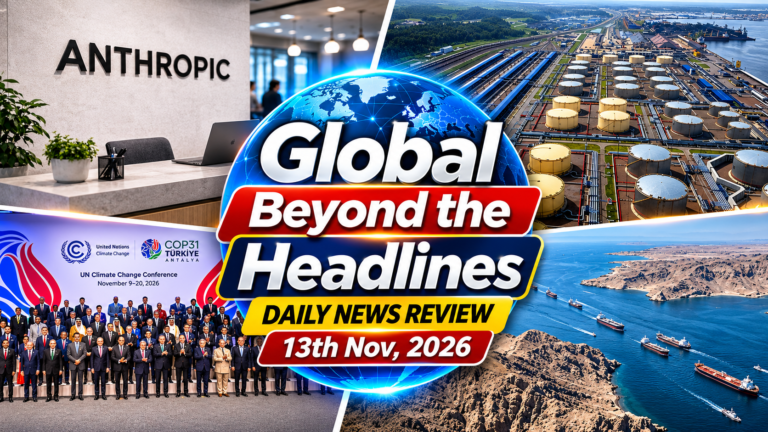
Global Pressures Intensify as Iran Conflict, Ukraine Talks, COP31 and Technology Shifts Shape the Week
INTRODUCTION
International security, diplomacy, climate action, technological change and public health shaped the global agenda during the week of 9–15 November 2026. Developments across the Middle East, Europe, Türkiye, the technology industry and Central Africa revealed the different pressures confronting governments, international institutions and businesses.
This Global News Review examines five major narratives from the period. The conflict involving Iran continued to raise concerns about commercial shipping through the Strait of Hormuz, a strategic passage for international energy supplies. Russia and Ukraine returned to direct negotiations in Abu Dhabi under United States mediation, but their disagreements over territory and security arrangements remained substantial.
At COP31 in Türkiye, governments and international organisations focused on the gap between climate commitments and the funding needed to implement them. In the technology sector, Nvidia announced a leadership transition, Microsoft experienced a major service disruption, and Australia’s Qantas outlined plans to eliminate approximately 850 jobs through restructuring and outsourcing.
Meanwhile, the continuing Bundibugyo virus outbreak in the Democratic Republic of the Congo remained a major public-health concern, with the European Centre for Disease Prevention and Control reporting more than 11,000 confirmed cases.
These developments were not parts of one coordinated crisis. They were distinct events with different causes and consequences. Together, however, they illustrate the difficult decisions facing international institutions, governments and businesses as they attempt to manage security risks, economic pressures, technological transformation and human welfare.
Story 1. GLOBAL ENERGY SECURITY: Iran Conflict Raises Fresh Concerns Over the Strait of Hormuz
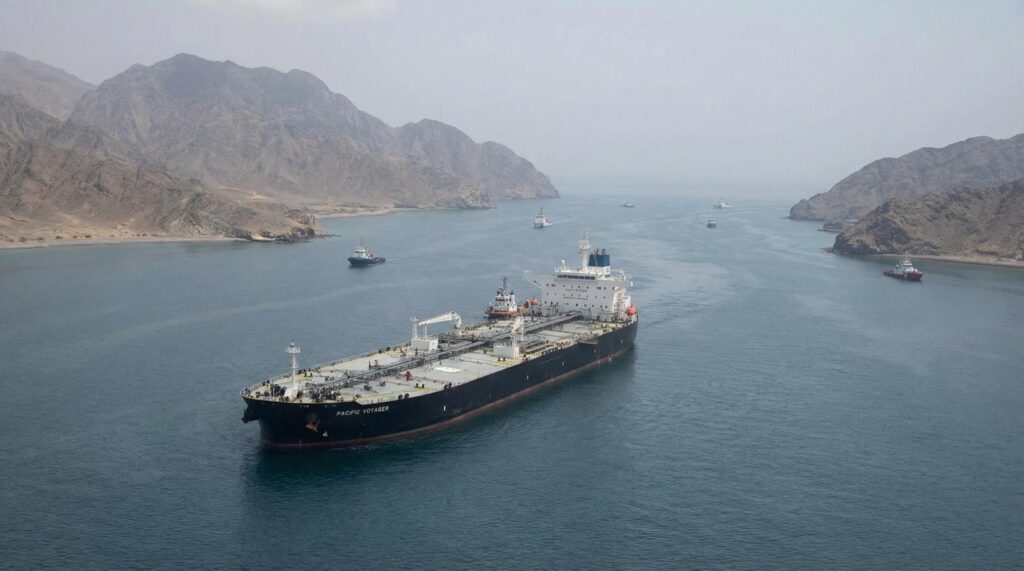
The conflict involving Iran remained a major international security concern during the week, with renewed attention focused on the safety of commercial shipping through the Strait of Hormuz.
The strategic waterway connects the Persian Gulf with the Gulf of Oman and the Arabian Sea. Its importance to international energy transportation makes it one of the world’s most closely watched maritime passages.
According to the United States Energy Information Administration, oil flows through the Strait averaged approximately 20.9 million barrels per day in the first half of 2025. That represented about 20 per cent of global petroleum liquids consumption and approximately one-quarter of globally traded maritime oil. The agency’s analysis of world oil transit chokepoints also notes that alternative pipeline routes could replace only part of the volumes normally transported through the passage.
The scale of that dependence explains why maritime insecurity around the strait has consequences beyond the immediate conflict. Prolonged disruption could affect energy transportation, shipping operations and countries that rely on imported fuel.
During the review period, Iranian authorities reported further incidents involving tankers in the waterway. On 13 November, Iran’s Revolutionary Guards Navy said a tanker carrying liquefied natural gas had struck a naval mine and suffered an explosion. Iranian state media described the vessel as using what authorities called an unauthorised and dangerous route.
The following day, Iranian authorities reported that three oil tankers caught fire after striking mines in the Strait of Hormuz.
These reports attracted international attention because of the importance of the waterway to commercial shipping. However, their attribution remains essential. Reuters’ reporting on the latest tanker incidents noted that the claims could not be independently verified. They should therefore be presented as reports by Iranian authorities, not as independently established findings.
The incidents came amid wider diplomatic activity. Foreign ministers from the Group of Seven countries met in Paris on 9 and 10 November. Their joint declaration published on 11 November addressed the conflict involving Iran, maritime security, the country’s nuclear programme and the disruption of international trade through the Strait of Hormuz.
The G7 declaration called for diplomatic efforts towards a lasting settlement addressing international concerns over Iran’s nuclear programme. It also called for renewed Iranian cooperation with the International Atomic Energy Agency.
On maritime security, the ministers condemned attacks on civilian vessels and emphasised the importance of safe and free passage through the strait. The declaration also referred to defensive activities intended to support maritime security, including efforts to address mines and facilitate the movement of civilian vessels.
The statement demonstrated that the concerns surrounding the conflict extended beyond military confrontation. The security of international trade and energy transportation had become central elements of the diplomatic response.
Another significant development emerged on 14 November, when Reuters reported that United States President Donald Trump might hold off further attacks on Iran if there were no new provocations from Tehran or the Iran-backed Houthis in Yemen.
The report was based on people familiar with the discussions who spoke on condition of anonymity. It indicated that Trump was considering restraint, but did not establish that a formal decision had been taken.
Saudi Crown Prince Mohammed bin Salman and Turkish President Recep Tayyip Erdoğan were also reported to have urged restraint. Their reported interventions added to the diplomatic engagement surrounding the conflict.
It is important to distinguish the reported possibility of holding off further attacks from a ceasefire agreement. No formal ceasefire or comprehensive settlement was announced during the review period.
The wider significance lies in the relationship between regional instability and global energy security. Commercial shipping depends on safe maritime routes, while countries importing energy through the region could face additional pressure if disruption continues.
The next developments to watch include independently verified information about the reported tanker incidents, any formal announcement from Washington and further diplomatic engagement involving Iran, the United States and regional intermediaries.
As the review period ended, the conflict remained unresolved. The central question was whether diplomatic engagement could prevent further escalation while concerns over maritime security and Iran’s nuclear programme remained outstanding.
Story 2. RUSSIA-UKRAINE NEGOTIATIONS: Abu Dhabi Talks Test the Possibility of Ending Europe’s War
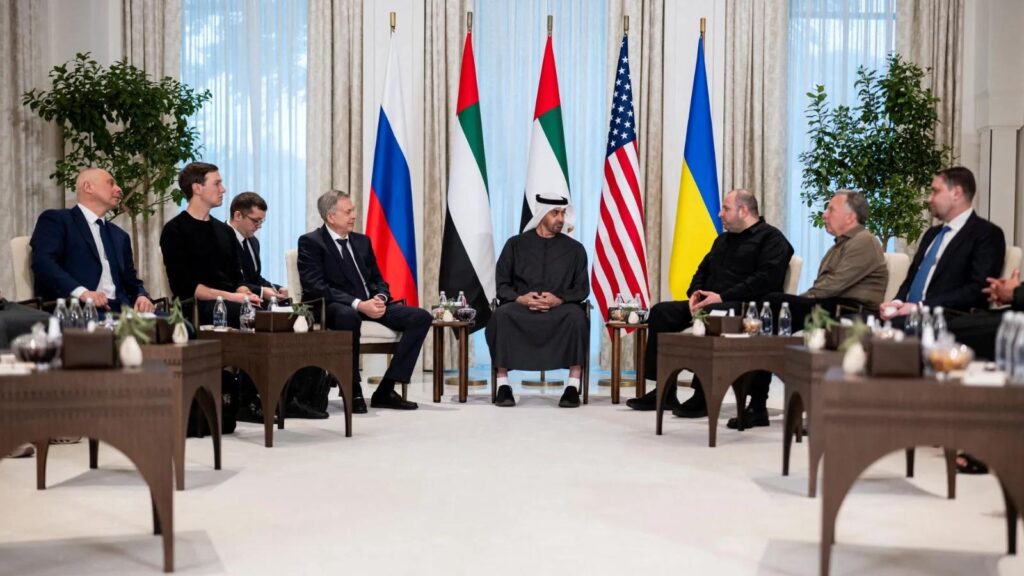
Russia and Ukraine returned to direct negotiations under United States mediation in Abu Dhabi on 10 and 11 November, creating another diplomatic opportunity to address the war. However, the discussions did not resolve the fundamental disagreements separating Moscow and Kyiv.
The two-day meetings brought together representatives of Russia, Ukraine and the United States. The first day’s discussions lasted nearly four hours, with further negotiations taking place the following day. The Associated Press report on the Abu Dhabi talks described the meeting as the first such engagement between the delegations since February.
The United States delegation included Jared Kushner and Steve Witkoff. Rustem Umerov represented Ukraine, while Vladimir Medinsky represented Russia.
The discussions focused on humanitarian and security issues, including possible prisoner exchanges, detained civilians and children, security guarantees and arrangements that could contribute to ending the war.
The humanitarian dimension was particularly important because the conflict has affected prisoners of war, detained civilians and families separated by hostilities. Discussions about exchanges and the return of detained people therefore addressed issues with direct consequences for individuals and families.
There was, however, a development requiring a more precise account than simply saying no exchange agreement emerged. Reporting by the Associated Press on 11 November said the parties had agreed to a large-scale prisoner exchange, although the negotiations produced little progress on the central political disagreements. The Associated Press report on the prisoner-exchange agreement did not establish that the exchange had been completed or provide a confirmed number of people to be released.
That distinction matters. An agreement to arrange an exchange is not the same as the actual transfer of prisoners. The implementation, scale and timing of any arrangement remained important questions.
The deeper obstacles concerned territory, military arrangements and Ukraine’s future security relationship with Western institutions.
Russia continued to demand territorial concessions and restrictions on Ukraine’s military and its ambitions concerning NATO. Ukraine rejected those conditions and maintained that a ceasefire should come before a wider settlement.
These positions illustrate the difficulty of reaching an agreement. The parties differ not only over the terms of a settlement but also over the sequence in which the main issues should be addressed.
For Moscow, territorial and security demands remained central to its negotiating position. For Kyiv, accepting territorial concessions and restrictions on its military would conflict with its stated position. Ukraine’s insistence on a ceasefire before wider negotiations reflects its preference for a different approach to ending the hostilities.
The United States was attempting to facilitate discussions between the two sides. However, the resumption of direct talks did not mean that a comprehensive settlement was close.
The Group of Seven also addressed Ukraine in its declaration published on 11 November. The ministers reaffirmed support for Ukraine’s sovereignty and territorial integrity. They also addressed military assistance, sanctions, energy resilience and Ukraine’s financing requirements for 2027 and beyond. These positions were outlined in the G7 joint declaration following the Paris foreign ministers’ meeting.
The declaration placed the Abu Dhabi negotiations within a wider international context. While Washington was directly involved in mediation, the G7 maintained its position on Ukraine’s sovereignty and continued support.
The humanitarian issues discussed in Abu Dhabi remain significant regardless of the wider political disagreements. Any implemented prisoner-exchange arrangement could provide relief to people detained during the war and their families. Yet the absence of a comprehensive ceasefire means that the wider humanitarian consequences of the conflict remain.
The next developments to watch include the implementation of any agreed prisoner exchange, the possibility of another negotiating round and the responses of Moscow, Kyiv and Washington to the discussions.
The Abu Dhabi meetings were a meaningful diplomatic development, but they were not a peace settlement. Their long-term importance will depend on whether subsequent negotiations can produce practical agreements on territory, security guarantees and the conditions for ending the war.
Story 3. COP31 AND CLIMATE FINANCE: Global Climate Promises Face the Test of Implementation
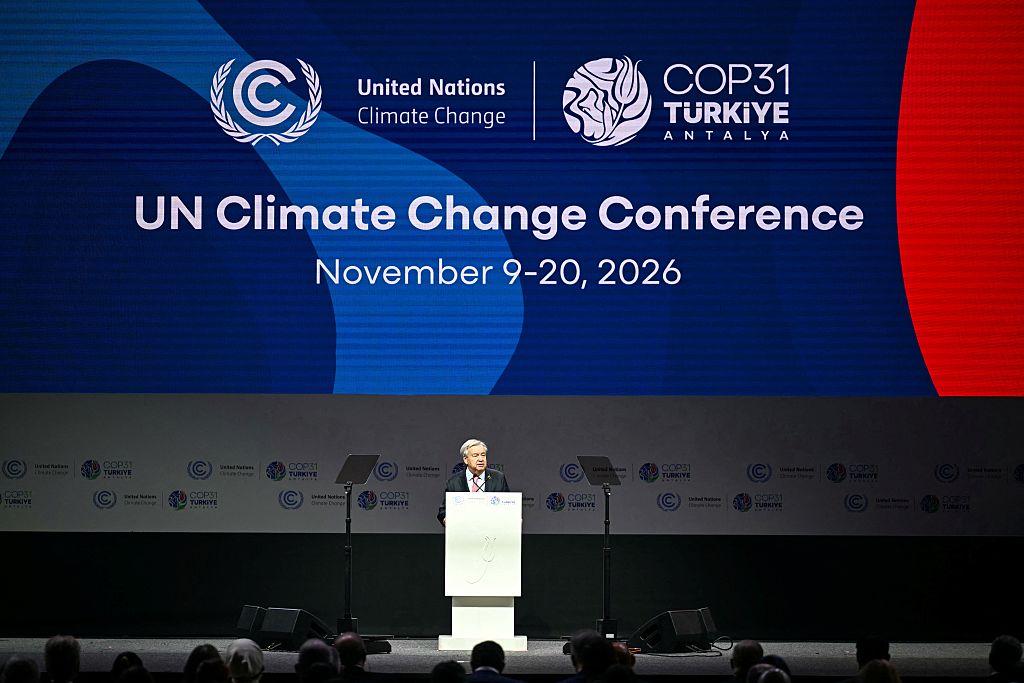
The opening of COP31 in Antalya, Türkiye, on 9 November brought governments, international organisations, scientists, businesses and civil society groups together to discuss climate action and the global energy transition.
Scheduled to continue until 20 November, the conference placed renewed attention on a persistent international challenge: how to turn climate commitments into measurable action and secure the financing required to implement them.
United Nations Secretary-General António Guterres called for faster reductions in fossil-fuel emissions and urgent climate action during his engagements at the conference on 11 and 13 November. His position was reflected in his remarks to the COP31 Leaders’ Summit and his subsequent address at the conference on 13 November.
In his remarks to the COP31 Leaders’ Summit on 11 November, Guterres warned that the climate crisis was progressing faster than the international response. His message focused on the need for countries to accelerate action rather than treat existing commitments as sufficient.
The climate debate also included Türkiye’s ambition to increase the share of final energy demand met by electricity from just over 20 per cent to 35 per cent by 2035. The COP31 Presidency’s announcement on electrification and other climate targets outlined the ambition as part of the wider energy-transition discussion.
The distinction between electrification and renewable energy is important. The target concerns the proportion of final energy demand supplied through electricity. It does not mean that renewable sources will automatically account for 35 per cent of all global energy consumption.
The climate benefits will depend on how the electricity is generated and whether countries invest sufficiently in clean-energy infrastructure, power grids and storage. Expanding electrification without addressing the sources of electricity could produce a different environmental outcome from one based on cleaner generation.
For developing countries, climate finance remained another central issue. Climate-vulnerable economies are seeking stronger financial support to adapt to changing weather conditions, strengthen infrastructure and respond to climate-related losses.
The debate is not limited to the total amount of money required. It also concerns the responsibilities of wealthier and historically high-emitting economies, the accessibility of funding and the conditions attached to financial support.
One significant development during the week was the launch of a major Pacific island-resilience financing initiative at COP31.
On 11 November, the Asian Development Bank announced that it had joined the Green Climate Fund, the governments of the Cook Islands and Palau, and other partners to launch a programme intended to support 14 Pacific island economies. The announcement was published in the bank’s official release on the Pacific resilience programme.
The programme aims to mobilise more than US$1 billion in financing to protect island communities, infrastructure and livelihoods against rising seas and increasingly destructive storms.
Importantly, the Green Climate Fund had approved US$250 million for the programme. This means the initiative had moved beyond the status of a funding proposal: the programme was launched and the fund’s support had been approved.
However, the distinction between approved support and the wider amount the programme aims to mobilise should be preserved. The more than US$1 billion figure represents the programme’s broader financing ambition, not a statement that the entire amount had already been disbursed.
The initiative illustrates why climate finance is particularly important for island economies. Roads, power systems, homes and other essential infrastructure can be vulnerable to climate-related hazards. Financial support can help governments and communities strengthen these systems and prepare for future risks.
The discussions also raised questions about trust between developed and developing countries. Commitments to climate action must be supported by resources if countries are to translate international agreements into practical programmes.
A country may recognise the need to strengthen infrastructure or adapt to climate risks, but implementation requires access to finance, technical capacity and functioning institutions. Without these, the distance between climate ambitions and actual delivery can remain substantial.
COP31 therefore placed financing and implementation alongside emissions reduction as central issues in the climate debate.
As the review period ended on 15 November, the conference had not reached a final agreement. Negotiations were scheduled to continue until 20 November, leaving further discussions on climate financing, adaptation and emissions reductions ahead.
The next developments to watch include additional financing commitments, the progress of the island-resilience programme and the decisions governments reach during the remaining conference sessions.
The central issue is no longer simply whether governments recognise the need for climate action. It is whether they can agree on the financing, responsibilities and implementation arrangements required to make their commitments effective.
Story 4. ARTIFICIAL INTELLIGENCE AND EMPLOYMENT: Nvidia, Microsoft and Qantas Highlight Technology’s Wider Impact
Developments involving Nvidia, Microsoft and Australia’s Qantas airline brought the global technology debate into sharper focus during the week. The events involved corporate leadership, digital service reliability and employment restructuring, illustrating different pressures facing businesses as technology changes how they operate.
On 12 November, Nvidia announced that Jensen Huang had resigned as the company’s president, chief executive and a member of its board, with the change taking effect immediately. The company confirmed the development in its official CEO transition announcement.
The company’s board appointed Chief Financial Officer Colette Kress as interim chief executive while it began searching for a permanent successor. Kress was expected to continue serving as CFO during the interim arrangement.
The company also announced that Harvey C. Jones had been appointed its first-ever chair of the board.
The leadership change was confirmed in Nvidia’s announcement and a regulatory filing submitted to the United States Securities and Exchange Commission. The SEC filing dated 11 November 2026 stated that the board had accepted Huang’s resignation on 11 November.
The announcement placed the leadership of one of the world’s most prominent artificial-intelligence companies in the spotlight. Nvidia’s position in the AI industry means that its corporate decisions are followed by investors, customers, technology developers and businesses that depend on its products.
However, the announcement of a leadership transition should be distinguished from speculation about its possible consequences. The company said its board would search for a permanent chief executive, but the announcement itself did not establish that Nvidia’s business strategy or technology roadmap would necessarily change.
A separate technology development occurred on the same day when Microsoft experienced a major disruption affecting Microsoft 365, Outlook and Teams.
According to Reuters’ report on the Microsoft service disruption, the disruption lasted more than five hours and also affected connectors used by OpenAI and Anthropic.
Microsoft said some servers had unexpectedly become unavailable under elevated load. The company described efforts to reduce the impact, including moving traffic away from affected infrastructure and restarting servers.
The incident highlighted how dependent businesses and connected digital services have become on major technology platforms. When widely used services become unavailable, the consequences can extend beyond the company operating the platform to organisations and users relying on connected systems.
The disruption also demonstrated how interconnected digital services can be. OpenAI and Anthropic both reported problems involving their Microsoft 365 connectors, showing how a disruption at one provider can affect services that depend on its infrastructure.
Downdetector recorded a peak of approximately 138,058 Outlook problem reports during the incident, according to Reuters’ follow-up reporting. These were user-submitted reports, not a verified count of the total number of individuals affected.
The distinction is important because outage-tracking platforms collect reports from users experiencing or observing service problems. Such figures provide an indication of reported disruption but should not be presented as an exact count of affected customers.
Meanwhile, in Australia, Qantas announced plans to eliminate approximately 850 jobs through restructuring and outsourcing arrangements involving Accenture. The airline’s announcement was covered by Reuters’ report on the Qantas restructuring.
The affected corporate functions include finance, procurement, human resources and marketing. Some of the work is expected to be handled by Accenture teams based largely in India.
The planned reductions represent roughly three per cent of Qantas’s Australian workforce of about 28,000 people. The first changes were expected by the middle of 2027.
Qantas presented the restructuring as part of its efforts to modernise its operations and respond to technological change, including artificial intelligence. The partnership with Accenture was intended to change how parts of the airline’s corporate functions operate.
The announcement also attracted criticism from the Australian Services Union, which raised concerns about the impact of outsourcing on workers. Qantas disputed the union’s account of earlier discussions about the possibility of roles moving overseas. ABC News’ coverage of the 850 planned job reductions provides further details about the company’s plans and the union’s response.
The employment debate therefore involves more than artificial intelligence alone. The announced changes include outsourcing and organisational restructuring, alongside the company’s stated interest in technology and modernisation.
This distinction is important because attributing all 850 planned job reductions to AI would go beyond what the announcement establishes. The term AI washing is sometimes used to describe situations in which companies attribute job reductions to artificial intelligence even when other factors, including cost-cutting and outsourcing, are also involved.
For affected employees, the plans could mean redeployment or redundancy. For Qantas, they represent a substantial reorganisation of selected corporate functions. For the wider labour market, the announcement adds to continuing questions about the relationship between technology, international outsourcing and job security.
These three developments at Nvidia, Microsoft and Qantas were separate corporate events. They should not be treated as evidence of one coordinated transformation or as proof that artificial intelligence alone explains every change.
Their wider significance lies in the different responsibilities facing technology companies and businesses: maintaining reliable services, managing leadership transitions and making employment decisions transparently.
The next developments to watch include Nvidia’s search for a permanent chief executive, Microsoft’s response to the service disruption and Qantas’s implementation of its restructuring plans.

Story 5. GLOBAL PUBLIC HEALTH: DR Congo’s Ebola Outbreak Remains a Major International Concern
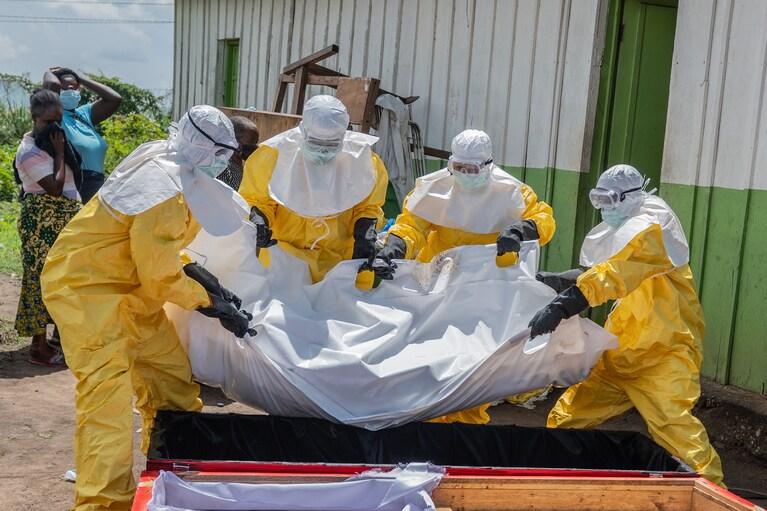
The continuing Ebola outbreak in the Democratic Republic of the Congo remained a major international public-health concern during the week ending 15 November 2026.
The outbreak is caused by the Bundibugyo virus. Figures published by the European Centre for Disease Prevention and Control showed that reported confirmed cases and related deaths continued to rise during November.
In its update published on 11 November, the ECDC reported 11,042 confirmed cases and 5,387 related deaths in the Democratic Republic of the Congo, using data up to 9 November. The agency’s 11 November outbreak update provides the figures and epidemiological information for that reporting period.
Its subsequent update, published on 13 November, reported 11,197 confirmed cases and 5,471 related deaths, based on data up to 11 November. The agency stated that community transmission was continuing in the DRC. These figures are detailed in the ECDC’s 13 November update.
These figures are attributed to the ECDC and should be understood according to the data dates specified in each update. They are not independently counted totals from DSG Herald News.
The geographical spread of the outbreak is another important concern. The ECDC identified eight affected provinces: Ituri, Nord-Kivu, Sud-Kivu, Tshopo, Haut-Uélé, Bas-Uélé, Sud Ubangi and Nord Ubangi.
The scale of the outbreak means that the response involves more than monitoring reported infections. Health authorities must identify cases, trace contacts, provide medical care and reach communities where transmission is occurring.
The World Health Organisation has identified insecurity, limited healthcare capacity and difficult operating conditions as challenges affecting the response. Its rapid risk assessment of the Bundibugyo virus outbreak has also highlighted the importance of surveillance, contact tracing, clinical preparedness, medical supplies and community engagement.
These challenges can make it difficult for health authorities to reach affected communities and interrupt transmission. Where access is limited, case identification and contact tracing may become more complicated. Weak healthcare infrastructure can also affect the availability of medical care for patients.
The outbreak has regional public-health implications, although the situation differs between countries.
The ECDC reported one case in Nigeria on 20 October involving a person who was medically evacuated to Switzerland. The individual had a travel history to Uganda. The agency also reported nine confirmed cases in Kenya, including two deaths, all linked to the first case.
The timing of those reports is important. The ECDC stated that Kenya’s last reported case occurred on 20 October. By 11 November, seven cases had recovered and all identified contacts under monitoring had completed 21 days of quarantine.
Consequently, the October reports should not be presented as evidence of continuing community transmission in Nigeria and Kenya at the end of the review period. The ECDC’s latest update identified ongoing community transmission in the DRC, while providing separate information about the earlier cases in the other countries.
The distinction matters for accurate public-health reporting. A reported case in a country does not automatically establish that sustained transmission is continuing there. The dates of the cases, their links and the status of identified contacts all matter when assessing the situation.
For communities in the DRC, the immediate priorities remain access to medical care, timely identification of cases and effective public-health support. Healthcare workers also face the challenge of operating in areas where insecurity and infrastructure limitations can complicate response activities.
The international dimension is equally important. The involvement of the ECDC and WHO in monitoring and supporting the response reflects the importance of cross-border surveillance and cooperation when an outbreak affects a large geographical area. The WHO’s overview of the 2026 Ebola outbreak in the DRC provides additional information about the outbreak and the international response.
Further updates from the ECDC and WHO, situation reports from the DRC Ministry of Health and developments in surveillance and containment will remain important indicators of the outbreak’s progress.
As the review period ended, the outbreak remained active in the DRC. The reported figures underline the continuing challenge facing health authorities and their international partners, particularly in reaching affected communities and interrupting transmission.
CONCLUSION
The week of 9–15 November 2026 was marked by developments that tested the ability of governments, international institutions and businesses to manage complex challenges.
The Iran conflict kept maritime security and global energy transportation under pressure. Russia and Ukraine returned to direct negotiations, but the disagreements preventing a comprehensive settlement remained unresolved. At COP31, climate finance and implementation emerged as central questions, with a new Pacific resilience programme providing a practical example of international funding cooperation.
In the technology sector, Nvidia’s leadership transition, Microsoft’s service disruption and Qantas’s planned job reductions highlighted different issues surrounding corporate governance, digital reliability and employment. Meanwhile, the continuing Ebola outbreak in the Democratic Republic of the Congo reinforced the importance of healthcare capacity, surveillance and international cooperation.
The five narratives were distinct, but each demonstrated the importance of practical outcomes. Diplomatic engagement must lead to progress, climate commitments require resources, businesses must manage technological change responsibly, and public-health responses must reach the communities most affected.
As the world moves beyond this review period, the most important developments will be measured not simply by announcements, but by the decisions implemented and the consequences for people, institutions and economies.
About the Author