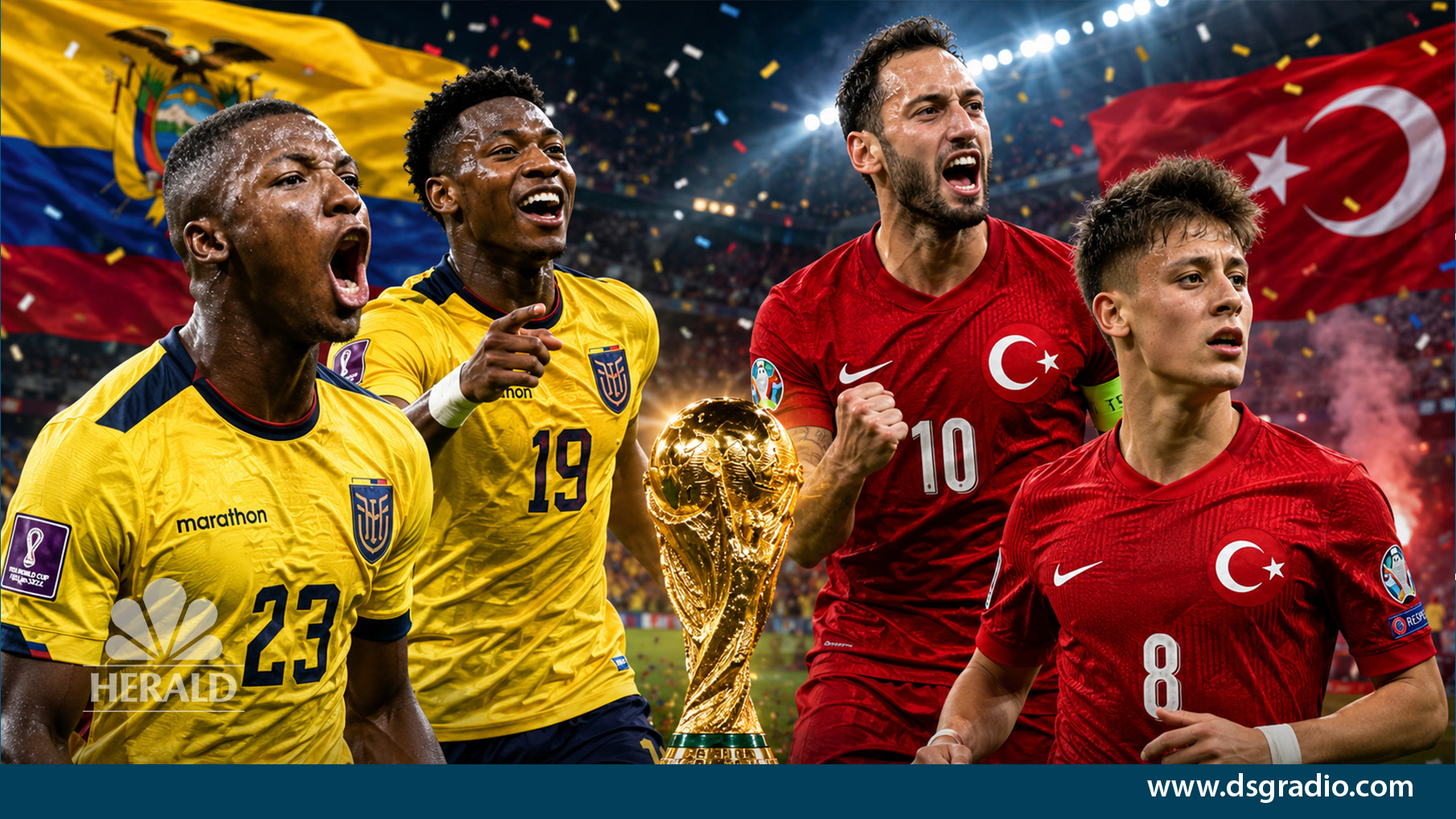
2026 FIFA World Cup: Ecuador Stuns Germany as Knockout Race Intensifies
The 2026 FIFA World Cup has reached one of its defining moments as the group stage nears completion, producing stunning upsets, emotional player returns and intense competition for the remaining places in the Round of 32. Ecuador’s remarkable comeback victory over Germany and Türkiye’s dramatic last-gasp win against tournament co-hosts the United States have transformed the knockout picture, while several African nations have strengthened the continent’s presence in football’s biggest competition.
Beyond the headlines, these results illustrate how the expanded 48-team World Cup continues to reward resilience, tactical flexibility and squad depth. With six decisive fixtures scheduled for June 26, the tournament now enters a phase where every goal, every point and every tactical decision could determine whether a nation continues its World Cup journey or returns home.
According toESPN and Sky Sports, the latest round of matches has reshaped qualification scenarios across several groups, leaving fans, coaches and analysts recalculating possible knockout paths ahead of the Round of 32.
Ecuador’s Victory Signals One of the Tournament’s Biggest Shocks
Few observers expected Ecuador to overturn an early deficit against four-time world champions Germany.
Germany appeared to be in control after Leroy Sané opened the scoring, reinforcing expectations that the European giants would comfortably progress. Instead, Ecuador produced one of the tournament’s most disciplined and determined performances.
Nilson Angulo restored parity before Gonzalo Plata completed the comeback, securing a 2-1 victory that sent Ecuador into the knockout stage while delivering one of the biggest surprises of the competition.
Although World Cups regularly produce memorable upsets, Ecuador’s performance stood out because it combined tactical discipline with composure under sustained pressure. Rather than relying solely on defensive resilience, Ecuador consistently attacked Germany whenever opportunities emerged, exposing vulnerabilities that had rarely been evident during the group stage.
For Germany, the defeat raises difficult questions about consistency and defensive organisation. The result also serves as another reminder that traditional football powers can no longer rely solely on historical pedigree in an increasingly competitive global tournament.
Why Surprise Results Are Defining the 2026 FIFA World Cup
One of the most noticeable characteristics of the 2026 FIFA World Cup has been the growing competitiveness between established football nations and emerging powers.
The tournament’s expanded format has provided more countries with opportunities to compete at football’s highest level. While critics initially questioned whether expansion would reduce overall quality, the group stage has instead delivered numerous closely contested matches and unexpected outcomes.
Ecuador’s victory over Germany represents more than a single upset. It reflects years of investment in youth development, improved domestic football structures and increased international experience among players competing in Europe’s leading leagues.
Similar trends have been observed across South America, Africa and parts of Asia, where football development programmes have narrowed the historical gap separating traditional giants from ambitious challengers.
As the knockout rounds approach, these developments suggest that predicting tournament favourites has become considerably more difficult than in previous editions.
Türkiye’s Last-Minute Victory Shows Pride Still Matters
While Ecuador’s success dominated headlines, Türkiye delivered another unforgettable moment.
Already eliminated from the competition, Türkiye entered its match against the United States with little more than pride to play for. Yet football has repeatedly demonstrated that teams without qualification pressure can become exceptionally dangerous opponents.
The United States, despite already securing top position in the group, sought to maintain momentum heading into the knockout phase.
Instead, the match produced remarkable late drama.
Kaan Ayhan scored in the 98th minute to secure a dramatic 3-2 victory for Türkiye, stunning home supporters and providing one of the competition’s most memorable finishes.
Although the defeat did not prevent the United States from progressing as group winners, it exposed defensive lapses that future opponents will undoubtedly study.
Momentum can become psychologically significant during knockout football. Teams entering elimination matches after disappointing defeats often require rapid tactical adjustments to regain confidence.
For Türkiye, the victory provided a positive conclusion to an otherwise disappointing campaign while demonstrating the competitive spirit that frequently defines major international tournaments.
African Nations Continue to Strengthen Their World Cup Presence
One of the tournament’s most encouraging stories has been Africa’s growing influence.
Morocco, South Africa and Ivory Coast have all officially secured qualification for the Round of 32, highlighting the continent’s continued football development.
Morocco confirmed its progress following an impressive 4-2 victory over Haiti, while South Africa edged South Korea 1-0 in a disciplined performance that underlined defensive organisation and tactical maturity.
Ivory Coast also booked its place among the remaining teams, further strengthening African representation during the knockout phase.
Attention now turns to Senegal, Egypt and Cabo Verde, who each face crucial fixtures capable of increasing Africa’s presence even further.
For African football supporters, these results reinforce a broader trend that has developed over recent World Cups.
African nations are increasingly entering tournaments with realistic ambitions of progressing beyond the group stage rather than merely participating.
Improved coaching structures, stronger domestic leagues, expanded scouting networks and greater representation within Europe’s elite competitions have all contributed to narrowing competitive differences.
The success of Morocco during the previous World Cup demonstrated that African teams possess the tactical sophistication and technical quality required to challenge the world’s strongest football nations.
This year’s performances suggest that Morocco’s achievements were not an isolated exception but part of a broader evolution across African football.
What African Success Means Beyond Football
Qualification carries significance beyond sporting achievement.
Successful World Cup campaigns generate increased commercial opportunities, attract sponsorship investment and strengthen domestic football development programmes.
National football federations often experience increased youth participation following strong international performances.
Governments also recognise the diplomatic value of sporting success, with football serving as an important instrument of national branding and international visibility.
Countries that perform well frequently experience measurable increases in tourism interest, commercial partnerships and international media exposure.
For African nations competing on football’s biggest stage, every victory contributes to changing long-standing global perceptions regarding the continent’s footballing capabilities.
These broader impacts explain why qualification for the Round of 32 extends well beyond football itself.
Neymar’s Return Provides Brazil With Timely Boost
Another significant storyline emerging from the latest round of matches involved Neymar.
Brazil’s all-time leading goalscorer returned from injury, making an emotional appearance from the bench during Brazil’s convincing 3-0 victory over Scotland.
Although Neymar did not start the match, his return represents a major boost as Brazil prepares for knockout football.
Experienced players often become increasingly influential during elimination rounds, where moments of individual brilliance can determine entire tournaments.
Brazil has consistently remained among the favourites entering each World Cup, combining technical quality with exceptional squad depth.
Neymar’s availability expands the tactical options available to Brazil’s coaching staff while also providing leadership within a squad seeking another world title.
Questions regarding his long-term fitness remain, but his successful return offers encouragement ahead of more demanding fixtures.
The Knockout Bracket Is Beginning to Take Shape
Alongside Ecuador, Morocco and South Africa, several other nations have officially secured progression.
The Netherlands, Australia, Paraguay, Japan and Sweden have also booked places in the Round of 32 following consistent group-stage performances.
Their qualification reflects the increasingly global nature of modern football, where success is no longer confined to a small group of traditional powers.
As additional qualification places are decided, coaching staffs will begin analysing potential knockout opponents while carefully managing player fitness and disciplinary records.
Every yellow card, injury concern and tactical adjustment now carries increased importance.
The group stage may be approaching its conclusion, but the tournament’s most demanding football is only beginning.
Decisive Fixtures Will Complete the Round of 32 Picture
The final round of group-stage fixtures scheduled for June 26 promises to answer the remaining qualification questions while determining several group winners.
Among the standout encounters is Norway versus France, a fixture that has attracted global attention because of the expected battle between Erling Haaland and Kylian Mbappé—two of the game’s biggest stars. While individual rivalries often dominate pre-match discussions, the outcome could significantly influence the knockout bracket and the calibre of opponents each team may face.
Elsewhere, Senegal take on Iraq in another Group I encounter. Senegal will be aiming to reinforce Africa’s impressive showing at the tournament and secure a favourable position heading into the Round of 32.
Group H also remains finely balanced, with Uruguay facing Spain in what could become one of the most technically accomplished matches of the group stage. At the same time, Cabo Verde meet Saudi Arabia, with qualification hopes hanging on every point available.
In Group G, Egypt play Iran, while Belgium face New Zealand. These fixtures will determine the remaining qualification spots and could yet produce more surprises before the knockout phase officially begins.
Off-Field Developments Reflect the Human Side of the Tournament
While football remains the central attraction, several off-field developments have reminded supporters that the World Cup is also shaped by deeply personal moments.
France head coach Didier Deschamps temporarily left the national team’s camp following the death of his mother. Assistant coach Guy Stephan is expected to oversee France’s touchline responsibilities during the team’s next match.
The development highlights the emotional realities that exist behind elite sport, where coaches and players often balance personal circumstances with professional commitments on the world’s biggest stage.
Belgium also welcomed positive personal news after winger Jeremy Doku rejoined the squad in Washington following the birth of his first child in London.
Although unrelated to on-field performance, such moments often strengthen squad morale during demanding international tournaments that require players and coaching staff to spend extended periods away from their families.
FIFA’s Five-Match Ban Sends a Strong Disciplinary Message
The tournament has also witnessed one of its most severe disciplinary decisions.
Qatari midfielder Assim Madibo received a five-match suspension after a challenge that resulted in a broken leg for Canada’s Ismaël Koné.
FIFA’s decision underscores its continued emphasis on player safety and disciplinary consistency during major international competitions.
While football remains a physical sport, governing bodies have increasingly sought to discourage dangerous tackles capable of causing serious injuries.
The suspension also serves as a reminder that disciplinary records can have lasting consequences beyond a single match, affecting both national teams and individual players.
How the Expanded Tournament Is Changing Competitive Balance
The 2026 FIFA World Cup is the first edition to feature 48 teams, expanding participation from the previous 32-team format.
Supporters and analysts debated the format before the tournament began. Critics feared that increasing the number of participating nations might reduce the quality of early-round matches.
Instead, the group stage has largely demonstrated the opposite.
The expanded format has:
- Created opportunities for emerging football nations.
- Produced more competitive group-stage contests.
- Increased continental representation.
- Delivered greater tactical diversity.
- Generated more unpredictable qualification scenarios.
Ecuador’s victory over Germany and Türkiye’s dramatic triumph over the United States are examples of how competitive depth has increased.
Rather than diminishing the spectacle, broader participation has introduced fresh storylines and expanded the tournament’s global appeal.
Why African Football Continues to Gain Global Respect
For African supporters, this World Cup represents more than qualification statistics.
The performances of Morocco, South Africa and Ivory Coast reinforce the continent’s growing competitiveness against established football powers.
Morocco’s historic run to the semi-finals at the 2022 FIFA World Cup fundamentally altered international perceptions of African football. The current tournament suggests that success was not an isolated achievement but part of a wider trend driven by stronger coaching, better youth academies and increased representation in Europe’s elite leagues.
Should Senegal, Egypt or Cabo Verde also secure qualification, Africa’s influence within the Round of 32 would become even more pronounced.
For Nigeria, despite not featuring in the tournament, these developments remain significant.
African success on the global stage often encourages greater investment in football infrastructure across the continent while increasing international scouting opportunities for young players.
The performances also provide valuable benchmarks for nations seeking to strengthen their own football development systems ahead of future international competitions.
Media, Commercial and Economic Impact
Beyond the sporting drama, the World Cup remains one of the world’s largest commercial events.
Every unexpected result influences television audiences, digital engagement, sponsorship visibility and global conversations across social media platforms.
Smaller football nations that progress deep into the tournament frequently experience increased international recognition, stronger tourism interest and enhanced commercial partnerships.
Sponsors also benefit from tournaments defined by unpredictability. Close contests and dramatic finishes typically generate higher audience retention than one-sided victories, creating greater value for broadcasters and advertisers.
The continued popularity of digital platforms means memorable moments—such as Ecuador’s comeback or Türkiye’s stoppage-time winner—can reach millions of viewers within minutes, extending the tournament’s impact well beyond the stadium.
Looking Ahead to the Knockout Stage
As the group stage concludes, the focus now shifts to a different type of football.
Knockout matches leave no margin for error.
Tactical discipline, squad depth, injury management and mental resilience become increasingly important as every fixture carries elimination consequences.
Several traditional favourites remain firmly in contention, but the group stage has already demonstrated that reputation alone guarantees nothing.
Emerging nations have shown they possess the quality, confidence and tactical organisation required to challenge established powers.
If the opening phase of the 2026 FIFA World Cuphas delivered unforgettable drama, the knockout rounds promise even greater intensity.
With Ecuador rewriting expectations, Türkiye restoring pride with a memorable victory, Neymar returning to strengthen Brazil and African nations continuing to make history, the tournament has entered its most compelling chapter.
The race for the Round of 32 is no longer simply about qualification—it is about momentum, belief and the possibility that another footballing surprise could be only one match away.
Conclusion
The 2026 FIFA World Cup has already demonstrated why football remains the world’s most compelling sporting spectacle. Ecuador’s remarkable comeback against Germany, Türkiye’s dramatic stoppage-time victory over the United States and the steady rise of African teams have transformed the narrative heading into the Round of 32.
With decisive group-stage fixtures still to be played, the knockout bracket remains fluid, ensuring that every remaining match carries enormous sporting, commercial and emotional significance. Whether the tournament ultimately crowns a traditional powerhouse or produces another historic underdog story, the group stage has established one clear message: the gap between football’s established giants and emerging challengers continues to narrow, promising an unpredictable and captivating road to the final.
Recommended Coverage
2026 FIFA World Cup Delivers Records and Drama
Explore how this year’s tournament has already broken records and produced unforgettable moments that are redefining modern World Cup football.
2026 FIFA World Cup: Messi and Mbappé Rewrite History
Read our analysis of how football’s biggest stars continue to shape the legacy of the 2026 FIFA World Cup.
About the Author