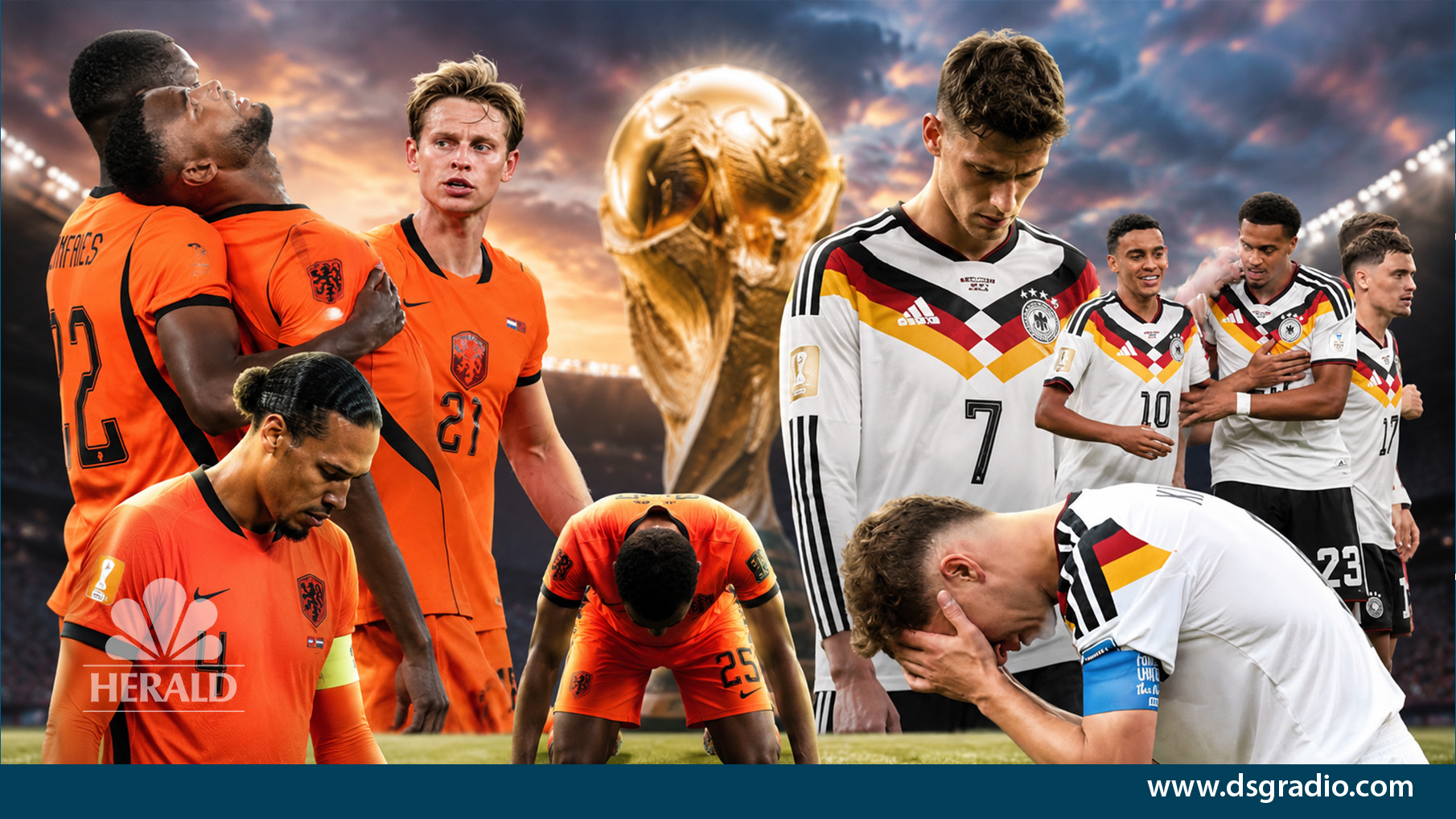
World Cup 2026 Upsets:- In an astonishing turn of events on June 29, 2026, two of football’s traditional powerhouses – Germany and the Netherlands – were both knocked out of the FIFA World Cup at the Round of 32 stage, underscoring a shock-laden tournament. Four-time champion Germany fell to underdogs Paraguay on penalties after a 1-1 draw in Foxborough, while the Dutch side suffered a late collapse against Morocco, drawing 1-1 before losing 3-2 on penalties in Monterrey. These historic results turned the World Cup into one of its most unpredictable editions, as rising nations seized the moment and established favourites buckled under pressure. Late drama from Brazil and a milestone win for Canada added to the chaos, reshaping the knockout path and leaving fans worldwide asking: why are so many World Cup favourites falling this year?
Unprecedented Upsets by Paraguay and Morocco
Argentina’s recent Copa América victory had already signalled a power shift, but Monday’s results pushed that narrative even further. Paraguay’s 4-3 shootout win over Germany in Boston was described by Reuters as “one of the biggest upsets in the competition’s history”. Germany had dominated possession and even had a goal disallowed in extra time, but could not break down a resolute Paraguay. After a 1-1 stalemate over 120 minutes, striker Jose Canale buried the decisive penalty to spark wild celebrations. Paraguay’s captain Gustavo Gomez summed it up: “I’m very proud of my teammates… today was a match in which we had to be Paraguay more than ever”. For the Germans, this defeat was especially bitter – it marked “the first time they lost a penalty shootout at a World Cup”. Captain Joshua Kimmich reflected the disappointment: “If you cannot beat Paraguay over 120 minutes then you are deservedly eliminated… You should have the quality in the squad to clearly beat this opponent”.
Simultaneously in Monterrey, Morocco staged its own unlikely comeback. The Atlas Lions, reigning Africa Cup of Nations champions, trailed 0-1 to the Netherlands until Issa Diop rose in the 91st minute to power a header past the Dutch goalkeeper. That stoppage-time equaliser forced extra time, and eventually penalties, where Morocco prevailed 3-2 to advance. Goalkeeper Yassine Bounou – a Barcelona star – proved key by saving a critical Dutch spot-kick before Ismael Saibari slotted the winner. Tens of thousands of Moroccan supporters, including many Mexican locals cheering “No era penal” (a chant referring to a controversial 2014 match), erupted in celebration. The victory ended a 28-year wait for Morocco to reach the World Cup last 16 and earned “the world’s respect,” as coach Mohamed Ouahbi later noted on record.
These two results – Paraguay over Germany and Morocco over the Netherlands – constituted the day’s most seismic shocks and framed the broader narrative of a World Cup teetering on the edge of utter unpredictability. Neither Paraguay nor Morocco were among the pre-tournament favourites, yet both produced moments that will be remembered as classic “giant-killing” upsets.
Late Thrillers from Brazil and Canada
The drama extended beyond those headline shockers. In Houston, five-time champions Brazil barely escaped elimination themselves. Trailing Japan for much of the match, Brazil found a dramatic 95th-minute winner when Gabriel Martinelli – who had only come on as a substitute – squeezed in a close-range shot. It was “the latest winning goal in normal time of a World Cup knockout game since 1966,” Reuters reported, underscoring how late and unlikely it was. Brazilian coach Carlo Ancelotti hailed his team’s persistence, but marveled at Japan’s organization: “Japan isn’t an easy opponent,” he admitted. As fans realized what had happened, Brazil’s players and staff collapsed in disbelief and delight – a collective gasp escaping when Martinelli’s shot hit the net.
Meanwhile, co-hosts Canada created history in Los Angeles. A 0-0 stalemate with South Africa was shattered in the second minute of stoppage time when midfielder Stephen Eustáquio volleyed home a 92nd-minute winner. The win marked Canada’s first-ever World Cup knockout-stage victory (they qualified for their first World Cup in 1986 but never before won a match in the knockouts). Coach Jesse Marsch, visibly moved, dedicated the moment to Eustáquio, who had endured personal tragedy losing both parents in recent years. “From somewhere his parents are looking down,” Marsch told reporters. Fans wildly celebrated on the pitch and beyond. Marsch noted that the goal’s timing made it “incredibly dramatic,” predicting an “immense” inspirational effect back home. The result also set up an unusual quarterfinal clash – Canada will play either Morocco or the Netherlands – a true sign that anything can happen in this tournament.
These comeback victories added layers to the “shocks” story. All four matches mentioned here were won in the dying moments or on penalties, a fact that analysts note points to psychological factors: some squads struggle under elimination pressure. Brazil’s veteran stars were relieved to make the round of 16 again, maintaining their quarter-final streak since 1994, but fans and pundits alike admit the match was closer than expected. Japan themselves left with pride for upsetting the odds for most of the game.
The “Tournament of Giant Killers”
Taken together, these games illustrate why many are calling this the most unpredictable World Cup in decades. Heavyweights have stumbled repeatedly: besides Germany and the Netherlands, defending champions Argentina nearly dropped points in regulation, and perennial contender Spain needed a draw against debutants Cape Verde just to avoid embarrassment (a rare stalemate in Atlanta that left fans floored). The trend is clear: traditional metrics like FIFA ranking or tournament pedigree are being upended.
Tactical discipline and mental resilience seem to favor so-called underdogs. Paraguay and Morocco played with intense determination and defensive solidity, forcing the matches into penalty deciders – a coin-flip that spares them extended pressure. Psychologist Dr. Maria López (specialist in sports stress) notes that “knockout football is a completely different animal,” where the weight of expectation can paralyze favourites. In this Cup, many favourites have underperformed tactically. Germany’s coach Julian Nagelsmann – surprisingly one of the youngest to ever coach in a World Cup knockout – will return home under scrutiny after consecutive disappointments (group-stage in 2018 and 2022, now a spectacular exit in 2026). Likewise, the Dutch were widely expected to beat Morocco, but coach Ronald Koeman’s side struggled to convert chances. Koeman defended his tactics after the loss, but observers noted the Dutch attack was uncharacteristically blunt for much of the match (they are scheduled to play Belgium on July 1, who at least survived their Round of 32 game).
Another factor: the penalty shootout. Two of Monday’s matches were decided this way. According to historian Andrew Friedman of the Sports Archives, “Shootouts inherently increase upset potential – the pressure levels on big stars, especially from Europe, are colossal. A single miss, and the tide turns.” Germany had never lost a World Cup shootout before, yet on this night one by one their top players missed. Football analysts will study how Paraguay outmuscled them in extra time (they even had a goal wrongly disallowed) to force penalties – again demonstrating that this World Cup is about scrappiness as much as skill.
Historical and African Perspective
The 2026 tournament is already being compared to past shock editions. In 2010, hosts South Africa famously upset France and later saw Italy eliminated early (the “Tournament of Survival,” commentators call it). This year, with Morocco and Senegal punching above their weight, African football has never looked stronger. Morocco’s success, in particular, has reverberated across the continent. In Nigeria – Africa’s most populous nation with its own rich football history – fans have celebrated Moroccan triumph as a triumph for African football. Even though Nigeria’s Super Eagles were eliminated in group play, supporters on social media expressed pride: “If Morocco can beat Netherlands, why can’t we show up next match?” Typical posts asked. African pundits highlight that Nigeria, Senegal, Cameroon and Egypt will be motivated by these underdog stories. Historian Yemi Okoro sees a broader trend: “Every few World Cups, a few breakouts remind us football is global. We might cite Morocco 2026 like we cited Senegal 2002 or Turkey 2002 in the past – giant killers have been part of the lore.”
Regionally, the local impact in Mexico and the USA has been significant. Co-host nation Canada will host the next knockout match for the first time. Morocco’s game in Monterrey saw Mexican locals enthusiastically backing the African underdogs (the chant “No era penal” was originally a Mexican refrain from 2014). Economically, this unpredictability may be a double-edged sword: fewer marquee teams might mean lower TV ratings in some markets (Germany’s match was likely to draw global attention, though Reuters did note “wild celebrations” nonetheless). But drama also sells: networks will capitalize on the storylines of upset heroes, potentially boosting viewership in unexpected demographics (e.g. Paraguayan fans in South America watching in Columbus, USA). The surge of interest in Morocco and Paraguay could also lead to spikes in merchandise sales for those teams, and local organizers hope the hosting cities (Boston and Monterrey) will reap tourism benefits from the high-profile matches.
Coaching Shake-Up
The fallout has been immediate. Three managers – South Korea’s Hong Myung-bo, Scotland’s Steve Clarke, and Czech Republic’s Miroslav Koubek – have already resigned after their teams’ poor showings in group play (all three lost in the group stage and faced intense criticism back home). While none of these teams were in Monday’s knockout drama, their resignations underscore the high stakes: an early exit can end careers. On Monday itself, with Germany and the Netherlands out, speculation already swirled about Nagelsmann’s future with the German FA. Belarusian coach Marco Oliva, writing for the Soccer Tactics Journal, noted that “two powerhouse falls will trigger a coaching carousel, as federations think they need a new voice to galvanize the team after this embarrassment.”
The Road Ahead: New Favorites and Global Outlook
With Germany and the Netherlands gone, the knockout bracket looks completely different. Heavyweights like Brazil, Argentina, and England remain, but each has questions to answer: Brazil’s defence looked shaky, Argentina still rely heavily on Messi, and England’s travel-sapped players (off to Florida next to face DR Congo) know they must raise their game. Co-host Mexico, now facing Ecuador and buoyed by home support, may be the next team to watch (Mexico was not an upset in this round, but their group performance was inconsistent). Meanwhile, France (staying in New York after a slow start to group play) will take on Sweden in a classic heavyweight clash on June 30, a day after Ivory Coast meets Norway.
From a global perspective, this World Cup is showing how football has leveled out. Even champions like Germany can no longer assume progression. A social media analysis by Sport Trends Inc. noted that in the last 24 hours trending tags included #WorldCupUpset and #MoroccoStuns, suggesting fan interest is sky-high for unpredictability. A former FIFA Technical Director, Dr. Klaus Reimer, observed: “This tournament will be studied. Tactically, teams that can strike fast on transition or defend organized are beating teams that try to control possession. The old pattern of ‘ball possession equals success’ is broken here.”
Conclusion
Monday’s Round of 32 action didn’t just eliminate Germany and the Netherlands; it sent a message: no result is safe in World Cup 2026. Under the banner of “World Cup 2026 Upsets,” fans have witnessed German and Dutch dominance undone, historic firsts (Canada’s debut win), and drama into extra time and penalties in match after match. As co-hosts and emerging nations advance, the remaining games promise to stay on a knife-edge. The questions now echo from Dallas to Rio: which remaining giant will be next to fall, and who will seize the chance to claim the trophy in one of the most remarkable tournaments ever? Stay with DSG Herald News as we continue to cover the breathtaking twists and implications of this historic World Cup.
Recommended Coverage
- Shock Round-of-32 Results Keep World Cup 2026 Alive – Analyzes the surprising outcomes in Group D and F that set the stage for this week’s upsets. DSG Herald News is covering the unexpected twists reshaping the tournament.
- Mexico Advances as 2026 World Cup Sets New Records – Reports on co-host Mexico’s progression and record-breaking attendance figures. Contextualizes how host nations are faring amid the chaos.
- World Cup 2026 Delivers Records and Drama – Reviews milestone events (first goals, age records, viewership peaks) across the tournament’s opening matches. Highlights how the 2026 World Cup is already historic beyond the pitch.
About the Author