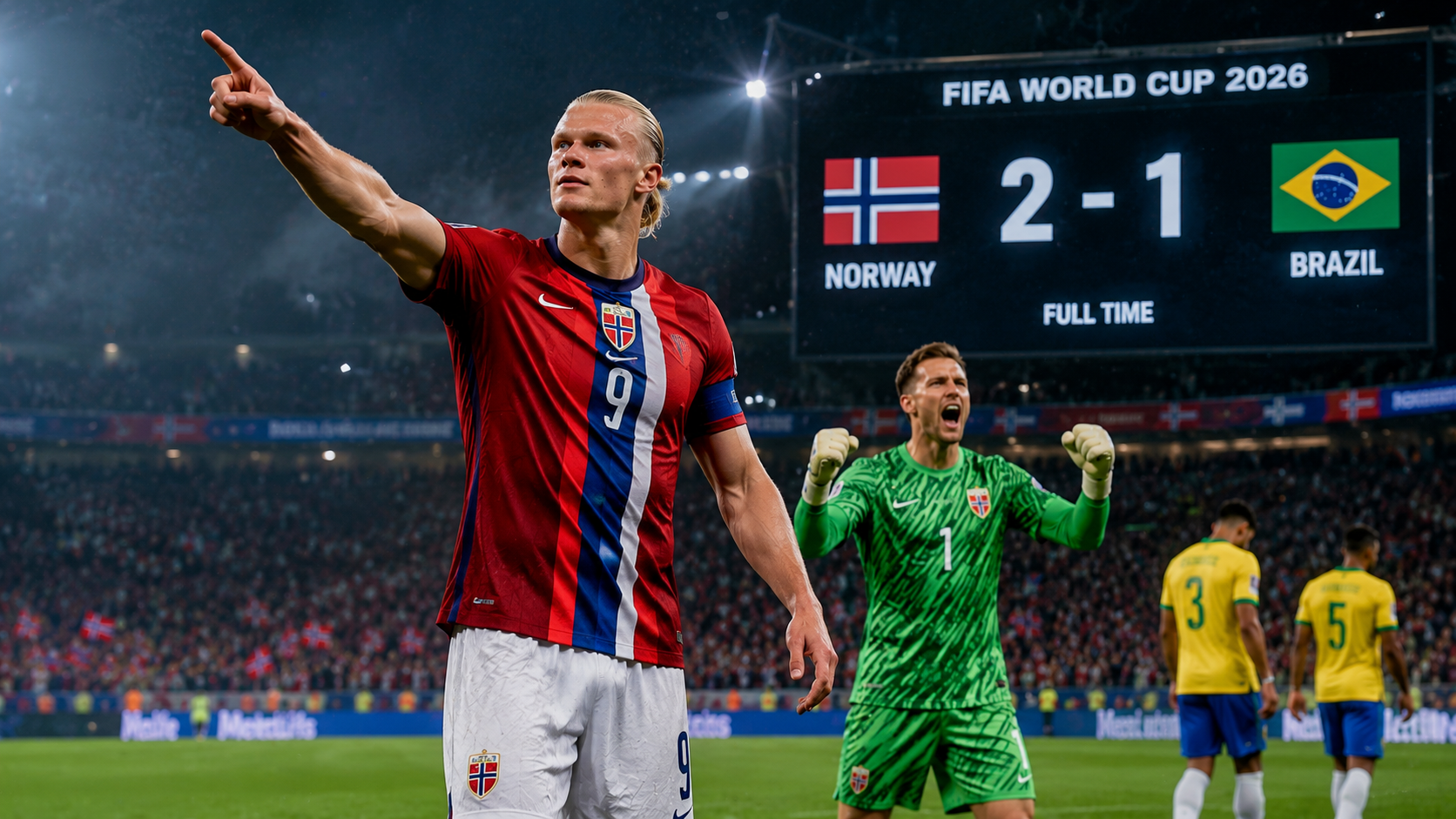
Norway vs Brazil: Norway Rewrite Their Football History
For decades, Brazil have entered every FIFA World Cup carrying the weight of expectation that comes with being the competition’s most successful nation. Norway, by contrast, has rarely been considered a genuine contender on football’s biggest stage.
That contrast made their Round of 16 meeting one of the tournament’s most compelling fixtures.
When the final whistle sounded, Norway had secured a famous victory that earned them a place in the FIFA World Cup quarter-finals for the first time. While Erling Haaland’s goals ultimately decided the contest, the result reflected far more than individual brilliance. It showcased a disciplined defensive display, intelligent game management, and a tactical approach that consistently frustrated one of international football’s traditional powerhouses.
The outcome immediately joined the list of memorable World Cup upsets, demonstrating once again that success in modern international football depends as much on collective organisation as on individual talent.
Why This Victory Matters Beyond One Match
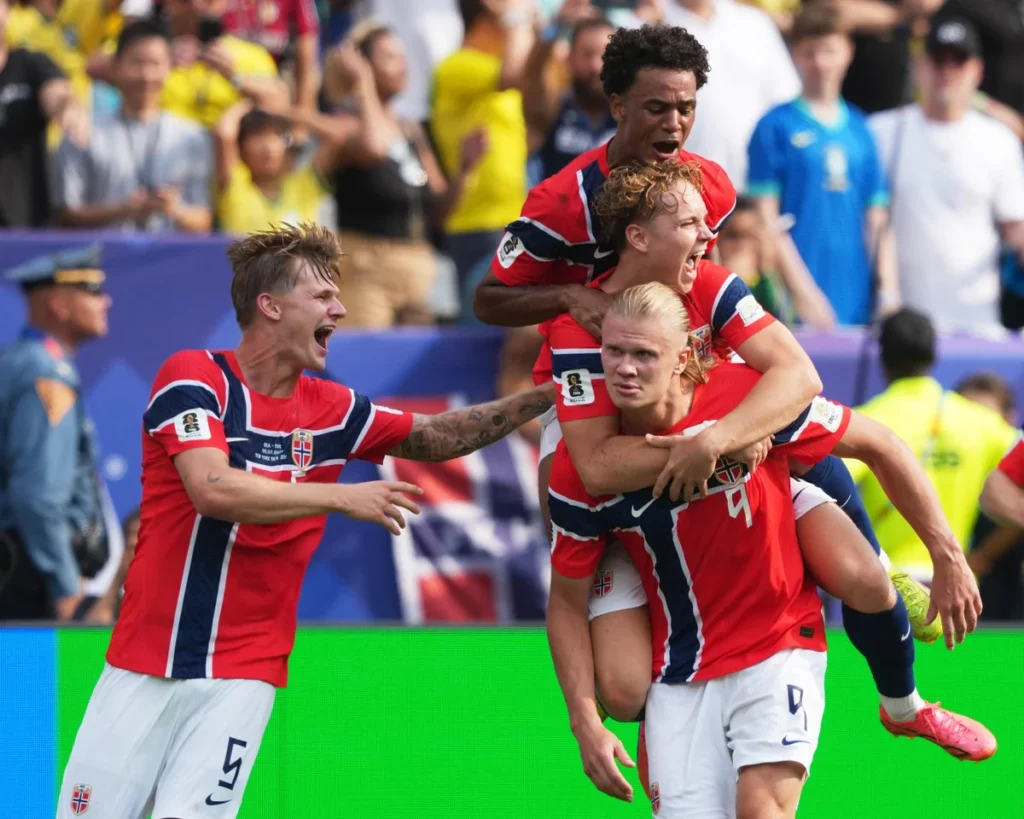
World Cup tournaments often produce results that reshape football narratives.
Some victories are remembered simply because of the scoreline. Others become defining moments because they alter perceptions about an entire generation of players.
Norway’s victory belongs firmly in the second category.
Reaching the quarter-finals represents a landmark achievement for Norwegian football. It signals the continued development of a national team that has gradually combined experienced leadership with emerging talent capable of competing against elite opposition.
For Brazil, the defeat carries very different significance.
As five-time world champions, expectations extend beyond reaching the knockout stages. Every elimination invites questions about tactical preparation, squad balance, and the ability to convert individual quality into tournament success.
While one defeat cannot define an entire footballing era, knockout football rarely offers second chances.
A Match Decided by Fine Margins
Matches between evenly matched opponents are frequently decided by isolated moments rather than sustained dominance.
This contest followed that familiar pattern.
Both teams entered with different tactical priorities.
Norway appeared comfortable remaining compact without the ball before looking to exploit attacking transitions and Erling Haaland’s physical presence.
Brazil sought to use technical quality and attacking movement to stretch Norway’s defensive shape, creating opportunities through patient build-up play.
The balance between these contrasting approaches remained largely intact throughout much of the contest.
Rather than becoming an open attacking spectacle, the game evolved into a contest of discipline, concentration and decision-making.
Those qualities eventually proved decisive.
The Early Turning Point
One of the defining moments arrived early when Brazil received an opportunity from the penalty spot.
In matches of this magnitude, converting such chances often changes the tactical landscape entirely.
Had Brazil taken the lead, Norway would almost certainly have been forced to abandon their measured defensive structure in pursuit of an equaliser.
Instead, Norway’s goalkeeper produced a crucial save that preserved parity and injected confidence into his teammates.
Just as importantly, it maintained Norway’s tactical plan.
Keeping the score level allowed them to remain patient rather than chasing the game.
That sequence illustrated one of football’s enduring truths: goalkeepers influence tournaments just as much as prolific forwards.
World Cups are filled with iconic saves that become every bit as memorable as spectacular goals.
Defensive Organisation Laid the Foundation
Although headlines naturally focused on Haaland’s finishing, Norway’s success rested on their organisation off the ball.
Modern elite football demands coordinated pressing, disciplined positioning and collective awareness.
Norway demonstrated each of those qualities.
Rather than committing excessive numbers forward, they maintained defensive balance, limited space between midfield and defence, and forced Brazil into increasingly difficult attacking situations.
Every successful clearance, interception and recovery reduced Brazil’s rhythm.
As the match progressed, frustration appeared to grow while Norway’s confidence steadily increased.
This defensive discipline created the platform from which decisive attacking moments eventually emerged.
Haaland Delivered When It Mattered Most
Elite forwards are often judged not by the number of chances they receive but by how effectively they convert decisive opportunities.
Haaland once again demonstrated why he remains among world football’s most feared strikers.
His movement inside the penalty area, timing of attacking runs and composure in front of goal illustrated qualities that have defined his career at both club and international level.
Rather than forcing difficult attempts, he waited for opportunities created through Norway’s structured attacking play.
When those moments arrived, he finished with authority.
The performance reinforced an important lesson seen throughout World Cup history.
Tournament football frequently belongs to players capable of remaining patient before delivering decisive contributions at exactly the right moment.
Norway’s Patience Turned Defence into Attack
One of the clearest lessons from the match was that disciplined defending does not mean abandoning attacking ambition. Norway demonstrated how a well-organised team can absorb pressure without losing the ability to create decisive opportunities.
Rather than chasing possession for its own sake, Norway focused on maintaining shape, reducing gaps between the defensive and midfield lines, and limiting Brazil’s opportunities to play through central areas. Every successful defensive sequence became the starting point for a controlled transition forward.
This measured approach required discipline from every player. Midfielders tracked runners, defenders resisted the temptation to step out unnecessarily, and attackers remained prepared to exploit the spaces left behind whenever Brazil committed players forward.
The strategy demanded patience. Instead of forcing attacks, Norway waited until the right moments to move the ball quickly into dangerous areas.
That patience ultimately paid off.
Five Moments That Changed the Match
Although football matches are decided over 90 minutes or more, there are often a handful of defining incidents that shape the final outcome. In this contest, several moments stood above the rest.
1. Brazil’s Missed Opportunity
Brazil’s failure to convert an early penalty proved to be more than a missed chance on the scoreboard.
Scoring first in knockout football frequently alters the tactical landscape. An early Brazilian lead could have forced Norway to abandon its disciplined defensive structure in search of an equaliser, creating additional space for Brazil’s attacking players.
Instead, Norway remained level and retained confidence in its original game plan.
2. Goalkeeping Under Pressure
The penalty save represented a turning point not only because it denied Brazil the lead but also because it reinforced Norway’s belief that they could compete with one of the tournament favourites.
Goalkeepers often become the foundation of memorable World Cup campaigns. A crucial save at the right moment can influence the mentality of an entire team.
3. Breaking the Deadlock
As the match entered its closing stages, Norway finally converted sustained discipline into reward.
The opening goal demonstrated effective teamwork rather than individual brilliance alone. The attacking move combined intelligent movement, accurate delivery and clinical finishing, allowing Norway to capitalise on one of the limited clear opportunities created during the match.
4. Haaland’s Clinical Finishing
Great forwards separate themselves by making difficult moments appear routine.
When the opportunity for Norway’s second goal arrived, Haaland displayed the composure expected of one of the world’s leading strikers. Rather than rushing the finish, he executed it with precision, effectively placing Norway within touching distance of a historic victory.
5. Brazil’s Late Response
Brazil eventually found the net through a stoppage-time penalty, but the goal arrived too late to alter the outcome.
It served as a reminder that elite teams rarely stop competing, even when facing elimination, but it could not undo Norway’s disciplined performance across the rest of the contest.
Why Brazil Struggled to Impose Their Game
Brazil entered the knockout stage carrying the expectations of a nation that has won the FIFA World Cup five times.
However, tournament football often exposes even the strongest teams when they are unable to dictate the rhythm of a match.
Norway’s compact defensive shape reduced the spaces that Brazil typically exploits through quick combinations and creative movement in the attacking third.
Instead of allowing Brazil to play at their preferred tempo, Norway repeatedly interrupted attacking momentum through disciplined positioning and collective pressing.
The result was a contest in which Brazil enjoyed periods of possession but found it increasingly difficult to create clear-cut scoring opportunities.
Football analysts have long argued that possession alone does not determine success. Knockout matches are frequently decided by efficiency in both penalty areas, and Norway proved superior in those decisive moments.
Haaland Continues to Lead Norway’s Golden Generation
For several years, Erling Haaland has been regarded as the face of modern Norwegian football.
His performances at club level established him among the game’s elite forwards, but success with the national team carries a different significance. International tournaments provide players with the opportunity to shape the sporting identity of an entire nation.
Against Brazil, Haaland once again demonstrated the qualities that have made him one of football’s most influential attackers. His movement, physical presence and ability to convert pressure into goals highlighted why Norway has increasingly built its attacking strategy around his strengths.
Yet the victory should not be viewed as the achievement of a single player.
Norway’s progress reflects the contribution of an organised squad capable of combining defensive discipline with attacking efficiency. Haaland supplied the finishing touch, but the platform for success came from the team’s collective effort.
A Historic Result in Norwegian Football
Reaching the FIFA World Cup quarter-finals represents a landmark achievement for Norway.
Beyond advancing in the tournament, the victory carries symbolic importance for a football nation that has often competed in the shadow of Europe’s traditional powers.
The result also adds another remarkable chapter to Norway’s history against Brazil. Across multiple meetings at the senior international level, Norway has maintained an unbeaten record against one of football’s most decorated nations, reinforcing one of the sport’s most unusual head-to-head records.
Historical comparisons inevitably followed the final whistle, with many observers recalling Norway’s famous victory over Brazil at the 1998 FIFA World Cup. While different generations produced those results, both victories underline Norway’s ability to rise to the occasion against elite opposition.
What This Means for the Rest of the Tournament
Norway’s qualification for the quarter-finals changes the conversation surrounding the tournament.
Teams that may previously have viewed Norway as outsiders will now recognise them as genuine contenders capable of eliminating established favourites. Confidence gained from defeating Brazil could become one of Norway’s greatest assets as the competition progresses.
For Brazil, attention will inevitably shift from the result itself to broader questions about the future. Knockout exits often prompt reviews of tactical approaches, squad development and long-term planning.
Any discussion about individual futures, including speculation surrounding senior players, should remain guided by official statements rather than assumption.
Regardless of what follows, this Round of 16 encounter will be remembered as one of the defining matches of the 2026 FIFA World Cup—a reminder that disciplined organisation, patience and clinical finishing can overcome even the weight of footballing history.
Lessons for Modern International Football
Norway’s victory offered several broader lessons that extend beyond a single knockout match.
First, defensive organisation remains one of the most valuable assets in tournament football. While possession statistics and attacking flair often dominate pre-match discussions, disciplined positioning and collective teamwork continue to determine outcomes when margins are narrow.
Second, elite goalkeepers remain capable of changing the course of major competitions. A crucial penalty save can influence momentum as much as a spectacular goal, reinforcing the importance of experience and composure under pressure.
Third, patience is increasingly becoming a defining characteristic of successful international teams. Norway resisted the temptation to abandon their tactical identity, trusted their structure, and capitalised when opportunities finally arrived.
These principles have been evident throughout previous World Cups and continue to shape success at the highest level.
African and Nigerian Perspective
Although the fixture involved two European and South American nations, its significance extends to football audiences across Africa, including Nigeria.
African football continues to place growing emphasis on tactical organisation, player development and structured coaching. Norway’s performance provides another example that collective discipline can offset differences in reputation and historical pedigree.
For Nigerian supporters, the match also serves as a reminder that international football has become increasingly competitive. Traditional powerhouses can no longer rely solely on history or individual brilliance to progress deep into tournaments. Teams that combine tactical preparation with efficient execution are increasingly capable of producing memorable results.
The expanding influence of players competing in Europe’s top leagues has also contributed to narrowing the gap between established football giants and emerging contenders.
What Comes Next
For Norway, the immediate focus shifts to preparing for the quarter-finals, where the level of competition will become even more demanding. Confidence gained from eliminating Brazil could prove invaluable, but maintaining concentration will be essential against another elite opponent.
Brazil, meanwhile, faces a period of reflection. Tournament eliminations often trigger assessments of squad composition, coaching strategies and long-term development priorities. Any decisions regarding players, coaching staff or future direction will depend on official announcements rather than immediate post-match reactions.
Regardless of the next chapter, this contest has already secured its place among the defining stories of the 2026 FIFA World Cup.
Conclusion
The Norway vs Brazil Round of 16 clash will be remembered not simply because one of football’s most successful nations was eliminated, but because it demonstrated how preparation, resilience and disciplined execution can reshape expectations on the world’s biggest stage.
Erling Haaland’s goals deservedly attracted global attention, yet the victory rested on a collective performance built around defensive organisation, intelligent game management and belief in a clear tactical identity. Norway combined those qualities to achieve the country’s first-ever FIFA World Cup quarter-final appearance and to preserve its remarkable unbeaten record against Brazil.
For Brazil, the defeat marks another reminder of the unforgiving nature of knockout football, where a handful of decisive moments can overshadow months of preparation.
As the tournament continues, Norway will carry momentum, confidence and renewed belief that they can challenge any opponent. Whether this victory ultimately becomes the foundation of an even greater World Cup campaign remains to be seen, but its place in Norwegian football history is already secure.
Recommended Coverage
Brazil’s Prison Reading Programme Draws Global Interest
Explore another major story from Brazil examining how an innovative prison rehabilitation programme attracted international attention.
Legal Battles That Shaped Modern Brazilian Politics
Understand the political developments that have influenced Brazil in recent years through a review of landmark legal cases involving former presidents.
World Cup 2026 Produces More Knockout Surprises
Read more about other dramatic upsets that have reshaped the 2026 FIFA World Cup knockout stage.
About the Author