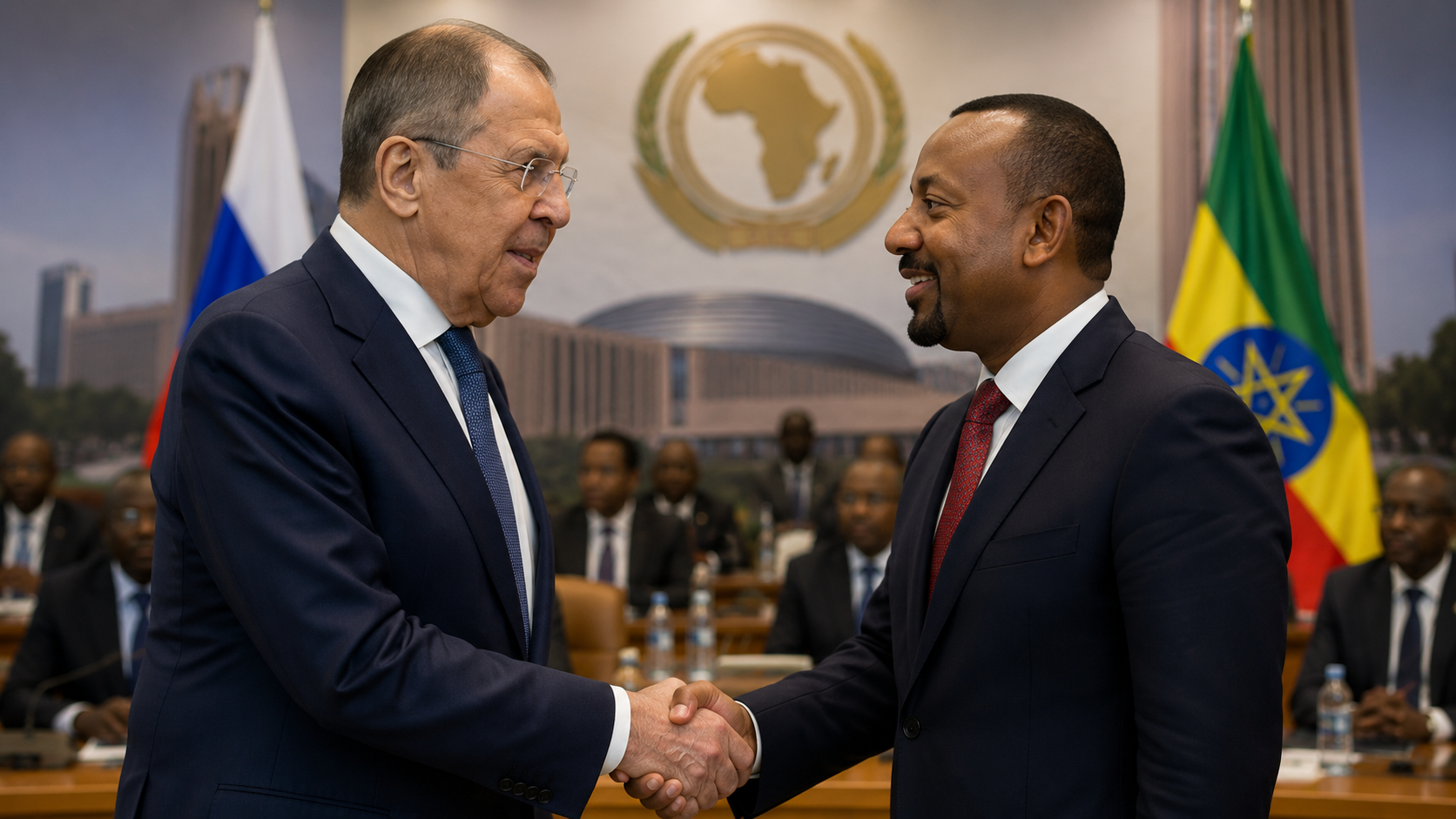
Russian Foreign Minister Sergey Lavrov meets Ethiopian leaders in Addis Ababa during talks focused on strengthening diplomatic ties, economic cooperation, nuclear energy and Russia's long-term strategy across Africa.
Russia Africa Strategy Deepens With Ethiopia Tour
Russia has launched a renewed diplomatic push to strengthen its influence across Africa, choosing Ethiopia as the starting point of Foreign Minister Sergey Lavrov’s latest multi-nation tour. The visit, which began in Addis Ababa on Monday evening, July 6, underscores Moscow’s growing emphasis on expanding political partnerships, energy cooperation and economic ties with African nations at a time when the continent is attracting increasing attention from major global powers.
Lavrov’s visit goes beyond routine diplomacy. It signals Russia’s intention to deepen long-term engagement with Africa through strategic investments, support for institutional reforms and broader cooperation with countries that are becoming increasingly influential on the global stage. Ethiopia’s status as the headquarters of the African Union (AU), its membership of the BRICS bloc and its position as one of East Africa’s largest economies make it a natural gateway for Russia’s continental ambitions.
According to reports from Africanews and other international media, Lavrov held high-level discussions with African Union Commission Chairperson Mahmoud Ali Youssouf while preparing for bilateral meetings with Ethiopian Prime Minister Abiy Ahmed and Foreign Minister Gedion Timothewos. The discussions covered issues ranging from United Nations reform to nuclear energy, trade expansion and preparations for the third Russia–Africa Summit scheduled for later this year.
The visit comes as international competition for political and economic partnerships in Africa continues to intensify. Alongside China, the United States, the European Union, Turkey, India and Gulf nations, Russia has increasingly sought to position itself as a reliable partner for African governments looking to diversify their diplomatic and economic relationships.
Why Ethiopia Is Central to Russia Africa Strategy
Choosing Ethiopia as the opening destination of Lavrov’s African tour carries significant geopolitical importance.
Unlike many African capitals, Addis Ababa occupies a unique position in continental diplomacy. It hosts the headquarters of the African Union, making it the primary venue where major international powers engage collectively with African leadership. By beginning the tour there, Russia sends a message that it seeks engagement not only with individual governments but also with Africa’s continental institutions.
Ethiopia’s international profile has also risen following its admission into the BRICS grouping, joining an expanding bloc that seeks greater influence in global finance, trade and governance. Moscow views Ethiopia as an increasingly strategic partner capable of strengthening Russia’s outreach to East Africa and the wider continent.
The country also possesses one of Africa’s fastest-growing populations and significant long-term infrastructure needs. These factors present opportunities for foreign investment in energy generation, mining, industrial development and transport projects—all sectors where Russian companies have expressed interest.
For Moscow, strengthening relations with Ethiopia provides both symbolic and practical advantages. It allows Russia to reinforce ties with a nation that plays an active role in African diplomacy while opening new avenues for commercial cooperation.
Diplomacy Takes Centre Stage
One of the key objectives of Lavrov’s visit is advancing diplomatic cooperation between Russia and African institutions.
His meeting with African Union Commission Chairperson Mahmoud Ali Youssouf focused on reforms aimed at increasing Africa’s representation within global decision-making structures, particularly the United Nations Security Council.
African leaders have long argued that the continent remains underrepresented despite accounting for more than a billion people and playing an increasingly important role in international affairs. Calls for permanent African representation on the Security Council have gathered momentum over recent years.
Russia has repeatedly voiced support for giving African nations a stronger role within international institutions. During the Addis Ababa discussions, both sides also coordinated preparations for the third Russia–Africa Summit, expected to bring together political leaders, government officials and business representatives from across the continent later this year.
Such summits have become important platforms for discussing investment, infrastructure, education, security cooperation and trade agreements between Russia and African states.
Russia Expands Economic Partnerships
Beyond diplomatic engagement, economic cooperation remains one of the most significant pillars of Russia’s African strategy.
Officials from both countries are expected to explore ways of increasing bilateral trade while creating opportunities for Russian companies to participate in Ethiopia’s mining, extractive and metallurgical industries.
Africa’s abundant reserves of critical minerals—including gold, platinum, lithium and rare earth elements—have become increasingly valuable as global demand grows for materials used in renewable energy technologies, electronics and advanced manufacturing.
Ethiopia possesses considerable untapped mineral resources, and expanding cooperation in exploration and industrial development could benefit both countries if future agreements are reached.
Trade discussions are also expected to examine opportunities for technology transfer, industrial partnerships and investment mechanisms that could strengthen Ethiopia’s manufacturing capacity while creating new commercial opportunities for Russian businesses.
As competition for Africa’s natural resources intensifies, countries seeking long-term partnerships are increasingly combining investment proposals with diplomatic engagement, infrastructure support and technology cooperation.
Russia appears determined to remain an active participant in that evolving landscape.
Russia Africa Strategy and Ethiopia’s Nuclear Energy Ambitions
Among the most closely watched issues during Lavrov’s visit is the proposed partnership to develop a large-scale nuclear power plant in Ethiopia. If the project moves forward as envisioned, it would represent one of the most significant examples of Russian technological cooperation in Africa’s energy sector.
Officials discussed advancing plans for a nuclear facility that is projected to be completed within the next decade. While specific financing arrangements, construction schedules and technical details have not yet been publicly disclosed, the proposal reflects Ethiopia’s determination to diversify its energy sources and meet rising electricity demand driven by rapid population growth and industrial development.
Ethiopia has made substantial investments in renewable energy, particularly hydropower, including the Grand Ethiopian Renaissance Dam (GERD). However, energy experts have long argued that sustained economic expansion will require a broader mix of power sources capable of supporting manufacturing, mining, urbanization and digital infrastructure.
For Russia, exporting nuclear technology has become an important element of its international engagement. By offering expertise in nuclear engineering, reactor construction and technical training, Moscow seeks to strengthen long-term partnerships that extend beyond traditional trade and diplomacy. Such projects typically involve decades of cooperation in areas such as maintenance, workforce development and technology transfer, making them strategically valuable for both parties.
If implemented successfully, the proposed nuclear project could help Ethiopia improve energy security, reduce future electricity shortages and support its ambitions to become a regional manufacturing and industrial hub. At the same time, any project of this scale would require careful planning, regulatory oversight, environmental safeguards and substantial financial investment.
BRICS Cooperation Adds a New Dimension
Another important pillar of the discussions is Ethiopia’s growing role within the BRICS bloc, which has expanded its membership in recent years to include several emerging economies.
Ethiopia’s inclusion in BRICS has elevated its international profile and created fresh opportunities for cooperation with member states such as Russia. During the Addis Ababa meetings, officials reviewed ways to strengthen strategic alignment within the grouping, particularly in trade, investment and multilateral coordination.
For Russia, closer engagement with Ethiopia through BRICS supports broader efforts to deepen economic relationships outside traditional Western-led financial systems. For Ethiopia, participation in the bloc provides additional avenues for attracting investment, accessing development financing and expanding international trade partnerships.
Although the long-term outcomes of these discussions remain to be seen, BRICS continues to serve as an increasingly important platform for countries seeking greater influence in global economic governance.
Africa’s Growing Strategic Importance
Lavrov’s visit also highlights a broader reality: Africa has become one of the world’s most strategically significant regions for international diplomacy.
The continent’s youthful population, abundant natural resources, expanding consumer markets and increasing political influence have attracted heightened interest from major global powers. Governments from Asia, Europe, the Middle East and the Americas have all intensified engagement with African nations through investment, infrastructure development, security cooperation and diplomatic outreach.
Russia’s latest diplomatic initiative reflects this wider trend. Rather than focusing solely on political relationships, Moscow is increasingly pursuing comprehensive partnerships that combine economic investment, energy cooperation, education, technology and institutional dialogue.
This evolving approach mirrors similar strategies adopted by other international actors competing to strengthen their presence across Africa.
Implications for Africa and Nigeria
For African countries, growing interest from multiple global powers presents both opportunities and challenges.
On one hand, increased competition for partnerships can create new sources of investment, infrastructure financing, technology transfer and employment. Governments may also benefit from having a wider range of diplomatic and economic partners, enabling them to negotiate agreements that better align with national development priorities.
On the other hand, analysts caution that African leaders will need to carefully balance relationships with competing international partners while ensuring that major projects deliver sustainable economic benefits and protect national interests.
For Nigeria, developments such as Lavrov’s Ethiopia visit are particularly noteworthy. As Africa’s largest economy and one of the continent’s most influential diplomatic actors, Nigeria closely monitors shifts in international engagement across Africa. Increased Russian involvement in sectors such as energy, mining and infrastructure may influence future regional partnerships and investment trends that could also affect West African economies.
What Comes Next?
Lavrov’s meetings with Ethiopian Prime Minister Abiy Ahmed and Foreign Minister Gedion Timothewos are expected to further define the scope of cooperation between the two countries. Discussions on nuclear energy, mining, trade and diplomatic coordination could lay the groundwork for future agreements, although any formal commitments will depend on subsequent negotiations and implementation plans.
Attention will also turn to the upcoming third Russia–Africa Summit, where leaders are expected to review progress on existing partnerships and explore new areas of collaboration. The summit is likely to serve as an important indicator of how Russia intends to expand its engagement with African nations in the years ahead.
Whether through diplomacy, economic investment or energy cooperation, Ethiopia’s selection as the first stop on Lavrov’s African tour underscores its growing importance in Russia’s continental strategy. The visit demonstrates that Moscow views Africa not merely as a region for bilateral engagement, but as a key partner in shaping future geopolitical and economic relationships.
As global competition for influence across Africa continues to evolve, the partnerships forged today could play a significant role in determining the continent’s economic development, diplomatic leverage and strategic position in the decades to come.
Recommended Coverage
Putin-Xi Meeting Highlights Growing China-Russia Power Alliance
Discover how Russia’s partnership with China is reshaping global alliances and influencing its growing engagement across Africa. It provides valuable context to Moscow’s broader foreign policy strategy.
Somaliland Recognition Reshapes Horn of Africa Politics
Explore how political shifts in the Horn of Africa are transforming regional diplomacy and why East Africa is becoming an increasingly important arena for global powers.
G7 Summit 2026 Dominated by Iran, Ukraine Talks
See how the world’s leading economies are responding to today’s geopolitical challenges and how developments in Europe and the Middle East intersect with Russia’s expanding diplomatic outreach in Africa.
About the Author