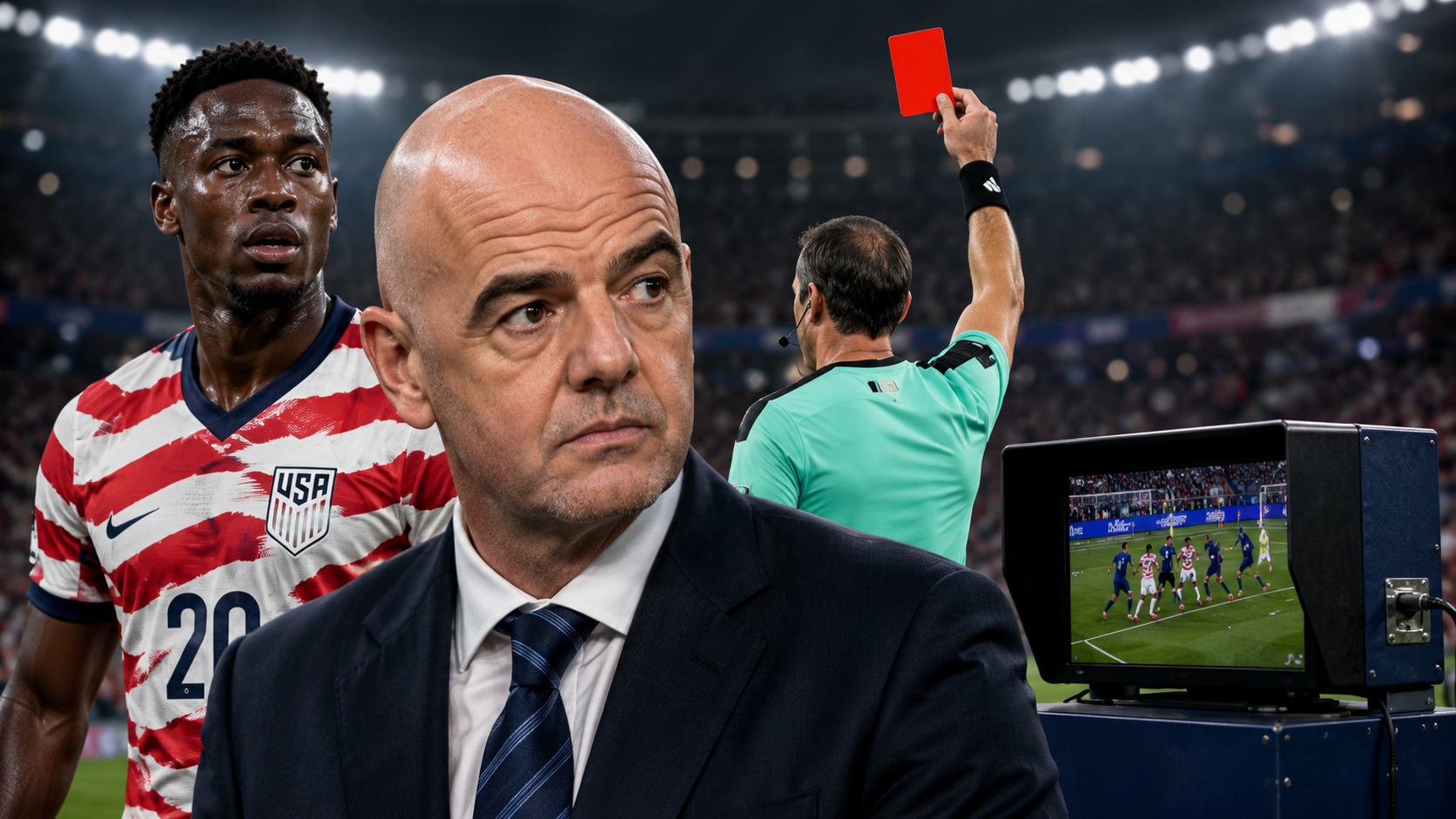
FIFA Disciplinary Controversy Deepens at World Cup
Questions Over Football Governance Grow as Balogun Decision and Argentina VAR Dispute Put FIFA Under Intense Scrutiny
The FIFA disciplinary controversy surrounding the 2026 FIFA World Cup has developed into one of the tournament’s defining stories, with football’s governing body facing mounting criticism over its handling of disciplinary decisions, refereeing standards and allegations of political influence. What began as the suspension of United States striker Folarin Balogun has evolved into a wider debate about transparency, consistency and the credibility of football’s global regulatory system.
The FIFA disciplinary controversy has rapidly become one of the defining issues of the 2026 FIFA World Cup, prompting renewed debate over transparency, consistency and accountability in football governance.
The controversy intensified after FIFA deferred Balogun’s automatic one-match suspension following a direct appeal reportedly made by United States President Donald Trump to FIFA President Gianni Infantino. The decision, made under Article 27 of the FIFA Disciplinary Code, has drawn criticism from football administrators, former FIFA officials and national associations who argue that the governing body created the impression that political pressure can influence disciplinary outcomes.
The situation became even more contentious after Egypt formally challenged refereeing decisions during its Round of 16 defeat to Argentina, raising fresh concerns about the consistency of Video Assistant Referee (VAR) interventions and the application of football’s Laws of the Game.
Rather than remaining isolated incidents, both controversies have converged into a broader discussion about FIFA’s governance structure at the world’s biggest football tournament.
FIFA Disciplinary Controversy Puts Governance Under the Spotlight
International football has long relied on strict disciplinary procedures to protect fairness and sporting integrity. Automatic suspensions for red cards are generally regarded as one of the clearest and least controversial provisions in FIFA competitions, leaving little room for subjective interpretation.
Balogun’s dismissal during the United States’ match against Bosnia and Herzegovina initially appeared straightforward. After receiving a straight red card for a challenge involving contact with an opponent’s ankle, the Arsenal forward was automatically ruled out of the Americans’ next World Cup fixture under FIFA regulations.
However, events took an unexpected turn when reports emerged that President Donald Trump personally contacted FIFA President Gianni Infantino to request that the decision be reviewed. Shortly afterwards, FIFA announced that it would suspend implementation of Balogun’s mandatory one-match ban rather than cancelling the red card itself.
The move allowed Balogun to remain eligible for the United States’ Round of 16 encounter against Belgium while placing the suspension on hold for one year.
Although the United States eventually lost 4-1 to Belgium, the result did little to quiet criticism surrounding the process that led to Balogun’s reinstatement. Instead, attention shifted from the player to FIFA’s disciplinary framework and whether its rules had been applied consistently.
Many observers believe the FIFA disciplinary controversy extends beyond Folarin Balogun’s individual case and reflects broader concerns about how exceptional disciplinary decisions are handled during major international tournaments.
Why the FIFA Disciplinary Controversy Centres on Article 27
At the heart of the controversy lies Article 27 of the FIFA Disciplinary Code, a provision that allows FIFA’s judicial bodies to suspend the implementation of disciplinary sanctions under certain circumstances.
Unlike a successful appeal that overturns a referee’s decision, Article 27 does not erase the original offence. Instead, it postpones the execution of the punishment, effectively placing the sanction on probation.
In Balogun’s case, FIFA did not invalidate the red card. Rather, it deferred the mandatory suspension for one year, meaning the punishment could still be activated if the player commits another qualifying offence during that period.
Supporters of the decision argue that the provision exists precisely to allow FIFA flexibility when exceptional circumstances arise. Critics, however, contend that the article offers broad discretionary powers without clearly defining the standards required to justify such an intervention.
Because Article 27 does not compel FIFA to publish detailed legal reasoning each time it is invoked, opponents say it leaves too much room for inconsistent interpretation, especially in high-profile tournaments where political attention is intense.
The debate has therefore shifted beyond Balogun himself and towards whether FIFA’s disciplinary framework contains loopholes capable of undermining public confidence in its neutrality.
Critics Say Political Influence Risks Damaging FIFA’s Credibility
The reaction from football stakeholders has been swift and, in many cases, unusually outspoken.
Several football authorities questioned whether the decision blurred the traditional separation between political leadership and independent sporting governance.
Former FIFA President Sepp Blatter reportedly criticised the move, while the Royal Belgian Football Association and UEFA were among those expressing concern that political intervention had created an uncomfortable precedent for future disciplinary cases.
Although governing bodies have occasionally faced lobbying from governments throughout football history, critics argue that publicly acknowledged intervention during an ongoing FIFA World Cup presents a different level of institutional challenge.
For many observers, the controversy is less about Balogun’s individual case than about maintaining confidence that every nation, regardless of political influence or global stature, competes under the same disciplinary standards.
That perception is particularly important during a World Cup, where every disciplinary decision can alter the trajectory of a nation’s campaign and influence the tournament’s competitive balance.
Egypt’s VAR Complaint Adds Another Layer to FIFA’s Challenges
As attention remained focused on the Balogun case, another controversy quickly emerged following Argentina’s victory over Egypt in the Round of 16.
The Egyptian Football Association submitted a formal complaint after a VAR review ruled out what would have been Egypt’s second goal of the match.
According to the complaint, officials identified a minor foul that allegedly occurred roughly twenty seconds before the ball reached the net. The decision overturned the goal despite the lengthy sequence of play separating the original incident from the scoring opportunity.
Egyptian officials also questioned other refereeing decisions, including alleged missed penalty appeals and what they described as inconsistent disciplinary action throughout the match.
The controversy has fuelled broader discussions about the consistency of VAR implementation, particularly when lengthy reviews revisit incidents occurring well before a goal is scored.
Critics have also pointed to earlier tournament decisions involving Argentina, arguing that similar incidents involving other players received different disciplinary outcomes. While such claims continue to generate debate among supporters and analysts, they remain contested and have not been independently established by FIFA.
For the governing body, the accumulation of disciplinary disputes and refereeing complaints has shifted public attention away from football itself and towards the administration of the competition, placing renewed emphasis on transparency, consistency and trust in decision-making.
As the FIFA disciplinary controversy continues to dominate headlines, pressure is mounting on football’s governing body to demonstrate that its disciplinary processes remain independent, transparent and consistently applied.
Historical Precedents Show FIFA Has Faced Similar Crises Before
While the Balogun case has attracted extraordinary global attention, it is not the first time political influence or controversial officiating has raised questions about football’s governance. History shows that FIFA and previous World Cup tournaments have periodically faced accusations that administrative decisions, external pressure or refereeing controversies affected competitive fairness.
Perhaps the closest historical comparison dates back to the 1962 FIFA World Cupin Chile.
Brazilian star Garrincha received a red card during the semi-final against Chile after kicking an opposing defender. Under normal disciplinary procedures, the dismissal should have ruled him out of the final against Czechoslovakia.
However, reports from the period indicate that Brazilian Prime Minister Tancredo Neves appealed directly for Garrincha to be allowed to play. During the subsequent disciplinary proceedings, the assistant referee whose report formed the basis of the case was unavailable after leaving Chile before the hearing. FIFA ultimately cited insufficient evidence and cleared Garrincha to feature in the final, where Brazil successfully retained the World Cup.
Although the legal circumstances differ from the Balogun decision, both incidents continue to be referenced whenever questions arise over whether extraordinary interventions can alter disciplinary outcomes at football’s biggest tournament.
Political Influence Has Shadowed Previous World Cups
Beyond the Garrincha episode, football historians frequently cite two tournaments where political influence became inseparable from sporting competition.
During the 1934 FIFA World Cup, Italian dictator Benito Mussolini was widely accused of using state influence to shape aspects of the tournament as Italy secured the championship. Although historians continue to debate the extent of direct interference, controversial refereeing decisions from that competition remain among football’s most discussed historical controversies.
Similarly, the 1978 FIFA World Cup in Argentina unfolded under military rule. One of the tournament’s enduring controversies centred on Argentina’s decisive 6-0 victory over Peru—a result that enabled the hosts to reach the final at Brazil’s expense. Allegations of political pressure surrounding the fixture have persisted for decades, although many aspects remain disputed.
These examples demonstrate why modern football authorities are particularly sensitive to any perception that politics may influence sporting administration.
Controversial Officiating Has Also Tested FIFA’s Credibility
Questions surrounding refereeing consistency are likewise not new.
The2002 FIFA World Cup, jointly hosted by South Korea and Japan, remains one of the most controversial tournaments in modern football history. South Korea advanced to the semi-finals after matches against Italy and Spain that featured several disputed officiating decisions, including disallowed goals and controversial dismissals.
Although FIFA rejected allegations of deliberate bias, the tournament generated years of debate over refereeing standards and accelerated calls for technological reforms aimed at improving decision-making.
Ironically, many of those reforms eventually contributed to the introduction of the Video Assistant Referee (VAR) system. Yet the controversy surrounding Argentina’s victory over Egypt illustrates that technological assistance has not eliminated disagreements over interpretation or consistency.
Instead, modern debates increasingly focus on how VAR is applied rather than whether it should exist.
Understanding the Rules Behind the FIFA Disciplinary Controversy
Much of the criticism directed at FIFA stems from the interaction between several provisions contained within the FIFA Disciplinary Code and the 2026 FIFA World Cup Regulations.
Under Article 66.4 of the FIFA Disciplinary Code and Article 10.5 of the tournament regulations, any player shown a direct or indirect red card automatically serves a suspension in the next match.
Meanwhile, Article 9.6 generally prevents teams from appealing a referee’s factual decisions made during play, reinforcing the principle that on-field judgments should remain final.
The controversy emerged because FIFA relied on Article 27, which permits disciplinary bodies to suspend the implementation of certain sanctions rather than overturning them outright.
Supporters argue that the provision provides flexibility for exceptional circumstances.
Critics counter that Article 27 contains few publicly defined criteria explaining when such discretion should be exercised. They also note that FIFA is not required to publish detailed legal reasoning for every decision, making it difficult for supporters, players and national associations to assess whether similar cases are being treated equally.
FIFA also cited Article 25, which allows disciplinary authorities to consider broader circumstances when determining sanctions. While legally permissible under FIFA’s framework, the reliance on discretionary powers has intensified calls for greater transparency in future disciplinary rulings.
Why the Controversy Matters Beyond One Tournament
The debate surrounding the FIFA disciplinary controversy extends well beyond the outcome of individual matches.
Football’s global popularity depends heavily on public confidence that competitions are administered fairly and independently. Whenever disciplinary decisions appear inconsistent—or are perceived to have been influenced by political considerations—the credibility of the governing institution inevitably comes under greater scrutiny.
For players, coaches and national associations, predictable disciplinary standards provide certainty during high-pressure tournaments.
For supporters, confidence in officiating strengthens belief that results are determined primarily by performances on the pitch rather than administrative decisions behind closed doors.
Commercial stakeholders also have an interest in maintaining trust. Sponsors, broadcasters and tournament partners invest billions of dollars in FIFA competitions partly because the World Cup represents the highest standard of international football governance. Prolonged controversies risk diverting attention away from the sport itself.
For African football, including Nigeria, Egypt’s complaint has also highlighted the importance of transparent officiating standards that apply equally to every participating nation, regardless of footballing stature or commercial influence. Egypt’s formal complaint to FIFA
Looking Ahead: Calls for Greater Transparency
As the 2026 FIFA World Cup progresses, pressure is likely to remain on FIFA to explain how its disciplinary procedures are interpreted and applied in future cases.
Several football administrators and analysts have argued that greater transparency—particularly regarding the legal reasoning behind exceptional disciplinary decisions—would help reinforce confidence in the governing body’s independence.
Others believe FIFA may eventually face renewed calls to clarify the scope of Article 27, publish more comprehensive disciplinary explanations and establish clearer standards governing when sanctions may be deferred.
Whether such reforms emerge after the tournament remains uncertain.
What is already evident, however, is that the Balogun decision and the Argentina-Egypt VAR controversy have shifted international debate beyond individual matches and toward broader questions about accountability, governance and institutional credibility.
Conclusion
The FIFA disciplinary controversy has emerged as one of the defining governance challenges of the 2026 FIFA World Cup, raising fundamental questions about fairness, transparency and the independence of football’s disciplinary system.
The decision to defer Folarin Balogun’s automatic suspension under Article 27, combined with Egypt’s formal objections over refereeing in its defeat to Argentina, has fuelled international debate about consistency, transparency and the balance between regulatory discretion and sporting fairness.
History shows that football has weathered similar governance controversies before, from Garrincha’s reprieve in 1962 to refereeing disputes in 2002. Yet each episode has reinforced the same lesson: the credibility of the world’s most prestigious tournament depends not only on the quality of football played on the pitch but also on the integrity of the institutions responsible for administering it.
For African football, including Nigeria, Egypt’s complaint has also highlighted the importance of transparent officiating standards that apply equally to every participating nation, regardless of footballing stature or commercial influence. Nigeria’s World Cup challenge
Recommended Coverage
Egypt Demands FIFA Investigation After Refereeing Controversy
Discover why Egypt formally challenged FIFA over controversial refereeing decisions and how the complaint intensified concerns about VAR consistency and tournament integrity. It provides essential background to one of the biggest disputes of the 2026 World Cup.
World Cup 2026 Quarterfinals Set as Co-Hosts Exit
See how the knockout stage unfolded after the latest round of dramatic results and which nations remain in the race for football’s biggest prize. The report also explains how recent controversies have shaped the tournament narrative.
2026 FIFA World Cup: Messi and Mbappé Rewrite History
While FIFA battles off-field criticism, football’s biggest stars continue making history on the pitch. Explore the record-breaking performances and defining moments that have captivated fans throughout the tournament.
About the Author