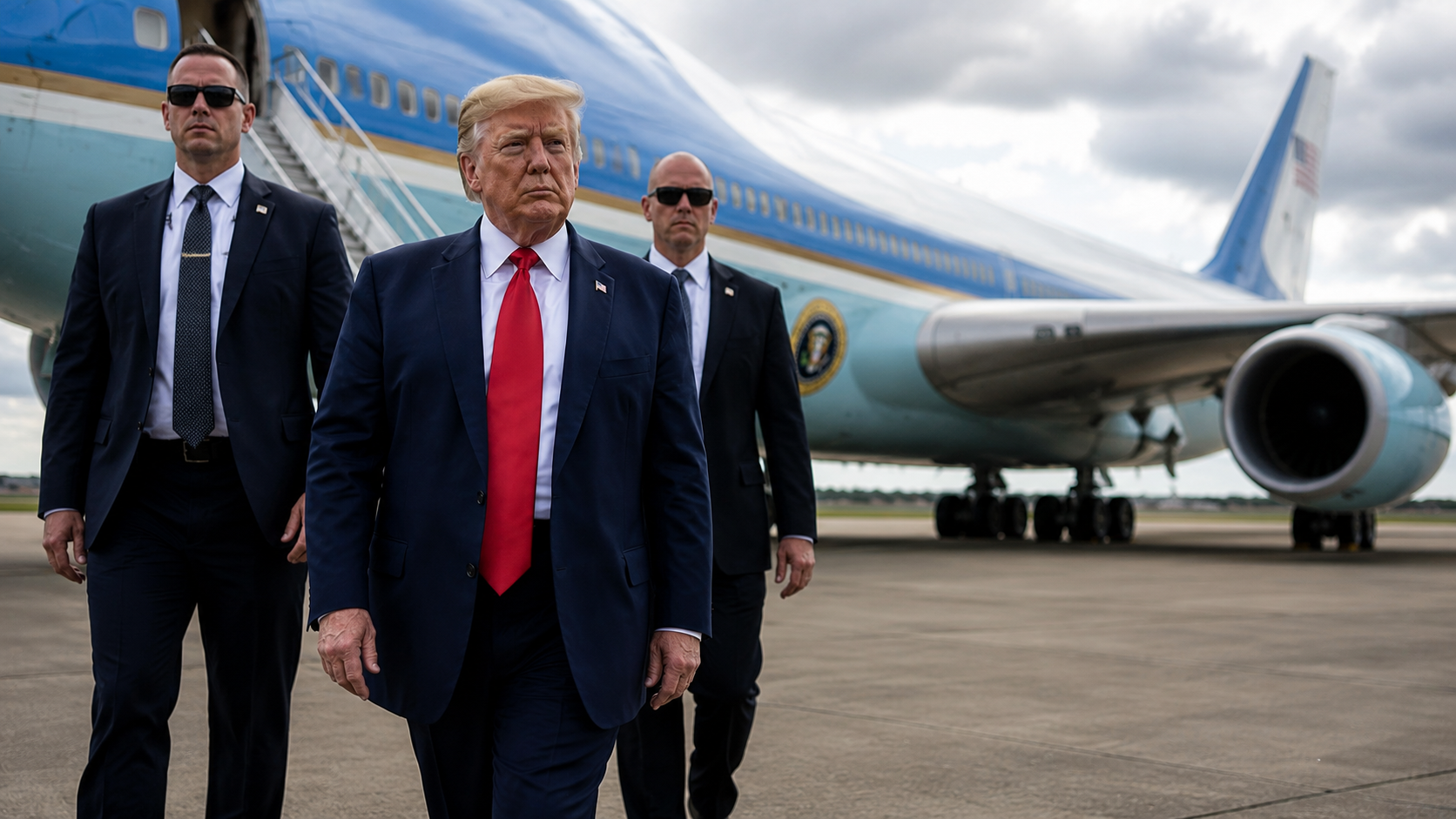
Trump Iran Threat Sparks Heightened Security Measures After Fresh Intelligence
The Trump Iran threat has returned to the centre of international attention after US President Donald Trump disclosed that fresh intelligence pointed to an alleged active Iranian plot targeting his life, prompting enhanced security measures during his return to Washington from a NATO summit. The development, which reportedly involved intelligence shared by Israel and precautionary action by the US Secret Service, underscores the persistent tensions between Washington and Tehran and raises new questions about regional stability, diplomatic relations and global security.
Fresh Intelligence Prompts Heightened Security
The latest developments emerged after President Donald Trump told reporters aboard Air Force One that he remained a primary target for Iran, stating, “They want to take out the US leader – me.” He added that he was “on every single one of their lists,” suggesting that US intelligence agencies had received new information indicating a renewed threat against him.
According to the information provided, Israeli intelligence reportedly shared fresh assessments with the United States concerning what was described as an active Iranian assassination plot. While officials have not publicly disclosed the specific intelligence behind the assessment, the reported warning was considered serious enough to trigger additional security precautions.
Rather than treating the incident as another exchange of hostile rhetoric between Washington and Tehran, US security officials reportedly acted quickly to minimize any potential risks surrounding the president’s international travel.
The incident illustrates how intelligence-sharing among allies remains central to protecting senior government officials, particularly during periods of heightened geopolitical tension.
Why Trump’s Travel Arrangements Changed
One of the most notable developments involved an unexpected change to Trump’s return flight.
According to the primary report, the US Secret Service advised the president to avoid travelling aboard his recently acquired Qatari-gifted aircraft after it landed in Britain. Instead, Trump reportedly boarded another aircraft for the journey back to Washington as a precautionary security measure.
Although authorities have not indicated that any immediate operational threat existed against the aircraft itself, security experts generally note that presidential travel protocols often change whenever new intelligence suggests even a potential risk.
Such decisions are rarely made lightly.
Every presidential trip involves months of planning, advance security assessments, intelligence coordination and cooperation among domestic and foreign security agencies. Any last-minute change usually reflects a reassessment of potential vulnerabilities rather than confirmation that an attack is imminent.
The White House has not released additional operational details surrounding the reported security adjustments, referring questions regarding the threat assessment back to Trump’s public comments.
The Role of Intelligence Cooperation
The reported Israeli intelligence warning highlights the increasingly close security cooperation between Washington and Jerusalem on matters relating to Iran.
For decades, both countries have shared intelligence covering terrorism, regional military activities, missile development and threats against senior officials.
Security analysts have long described Israel as one of America’s most significant intelligence partners in the Middle East because of its extensive surveillance capabilities and regional networks.
Although neither government has publicly released evidence supporting the latest allegations, intelligence cooperation often involves classified information that remains inaccessible to the public in order to protect sources and ongoing operations.
In high-risk situations involving national leaders, governments frequently choose caution over disclosure, particularly where revealing operational details could compromise future intelligence gathering.
Trump Iran Threat Reflects Years of Escalating Hostility
The latest Trump Iran threat cannot be viewed in isolation.
Instead, it forms part of a much longer history of confrontation that has shaped US-Iran relations for years.
Tensions reached one of their highest points in January 2020 when a US drone strike ordered during Trump’s first presidency killed Iranian General Qassem Soleimani, commander of the Islamic Revolutionary Guard Corps’ Quds Force, near Baghdad International Airport.
Washington described Soleimani as responsible for planning attacks against American personnel and interests throughout the Middle East.
Iran strongly condemned the operation, describing it as an act of aggression and promising retaliation.
Since then, Iranian officials have repeatedly accused Trump and senior members of his former administration of responsibility for Soleimani’s death.
Iranian leaders have consistently maintained that accountability remains a national objective, although the methods and scope of any intended response have often remained unclear.
It is against this historical backdrop that reports of renewed assassination threats continue to attract serious attention from US security agencies.
A Long Shadow Over US-Iran Relations
Relations between Washington and Tehran have remained strained for more than four decades.
Major areas of disagreement continue to include:
- Iran’s nuclear programme.
- Regional military influence.
- Sanctions imposed by the United States.
- Support for armed groups across the Middle East.
- Maritime security in the Persian Gulf.
- Ballistic missile development.
- Cybersecurity and intelligence operations.
Successive US administrations have adopted varying approaches toward Iran, ranging from diplomatic negotiations to economic sanctions and military deterrence.
Trump’s presidency marked one of the most confrontational periods in recent history after the United States withdrew from the Joint Comprehensive Plan of Action (JCPOA), commonly known as the Iran nuclear agreement, in 2018.
The withdrawal led to renewed sanctions and significantly increased tensions across the region.
For Tehran, Soleimani’s killing became one of the defining moments in that deterioration.
For Washington, concerns over Iranian-backed regional activities have continued to shape foreign policy long after Trump’s first administration ended.
Trump Warns of Severe Consequences
As reports of the alleged assassination threat gained attention, Trump responded with some of his strongest public remarks on Iran in recent months.
Speaking aboard Air Force One, the US president warned that any successful attempt on his life would provoke overwhelming American retaliation. He declared that such an attack would result in military action capable of “wiping Iran off the face of the earth,” reinforcing the administration’s message that threats against US leaders would carry severe consequences.
The comments immediately drew international attention because of their unusually direct language.
While presidents have historically warned adversaries against targeting American officials, Trump’s remarks reflected the high level of concern surrounding the reported intelligence and demonstrated the administration’s determination to project military strength.
Observers note that such statements are intended not only for domestic audiences but also for foreign governments, serving as deterrence against potential hostile actions.
Iran’s Rhetoric Continues to Escalate
The reported intelligence emerged alongside increasingly confrontational messaging from Iranian officials and state media.
According to the source material, Iranian state-run broadcasters revisited previous assassination discussions while defence officials reiterated that Tehran would defend itself “with full force” against any American military action. Iranian Defence Minister Aziz Nasirzadeh was among those issuing renewed warnings as tensions remained elevated.
Although such rhetoric has become familiar during periods of heightened confrontation, analysts caution that inflammatory statements from either side can increase the risk of diplomatic misunderstandings or unintended escalation.
Public declarations by political leaders often influence military readiness, intelligence assessments and regional security planning, even when they are not accompanied by immediate operational action.
The White House Maintains a Cautious Response
Despite Trump’s public comments, the White House has adopted a more restrained communication strategy.
Officials have declined to elaborate on the reported intelligence, referring inquiries back to the president’s own remarks rather than providing additional details about the threat assessment.
This approach is consistent with longstanding security practice.
Governments rarely disclose classified intelligence concerning active threats against heads of state because doing so could reveal intelligence sources, surveillance capabilities or ongoing investigations.
For security professionals, limiting public discussion can also reduce the likelihood of compromising protective operations.
Consequently, many questions remain unanswered, including:
- The precise nature of the alleged plot.
- Whether arrests or disruptions have occurred.
- The timeline associated with the reported intelligence.
- Whether allied governments have adopted additional security measures.
At the time of reporting, those details had not been made public.
Why This Matters Beyond the United States
Although the alleged threat directly concerns the American president, its implications extend well beyond Washington.
Any significant deterioration in US-Iran relations has the potential to influence:
- Global energy markets.
- International shipping routes.
- Diplomatic negotiations.
- Military deployments across the Middle East.
- Counter-terrorism cooperation.
- International financial markets.
The Persian Gulf remains one of the world’s most strategically important regions for oil exports and maritime trade.
Periods of heightened military tension have historically resulted in increased shipping insurance costs, volatile oil prices and heightened investor uncertainty.
Governments around the world therefore monitor developments involving Washington and Tehran closely because even isolated incidents can have far-reaching economic consequences.
Why Africa and Nigeria Are Watching Closely
For African countries, including Nigeria, developments between the United States and Iran are more than distant geopolitical events.
Fluctuations in Middle East security often influence global crude oil prices, which can significantly affect government revenues in oil-producing nations.
Nigeria, Africa’s largest oil producer, has previously experienced both economic gains and market instability during periods of international conflict affecting global energy supplies.
Beyond energy markets, escalating tensions could also influence:
- Aviation routes.
- Shipping logistics.
- International trade.
- Foreign investment.
- Currency markets.
- Inflationary pressures linked to fuel costs.
Although there is currently no indication that the reported threat directly affects Africa, policymakers across the continent continue to monitor Middle East developments because of their indirect economic impact.
Security Around World Leaders Has Become Increasingly Complex
The reported precautions surrounding Trump’s journey also illustrate broader changes in how governments protect national leaders.
Modern security planning now extends beyond physical protection.
Protective agencies increasingly integrate:
- Artificial intelligence-assisted intelligence analysis.
- Satellite surveillance.
- Cybersecurity monitoring.
- Electronic communications intelligence.
- Counter-drone technologies.
- International intelligence-sharing networks.
Threats against political leaders have become more sophisticated, often involving digital planning, encrypted communications and cross-border coordination.
Consequently, agencies such as the US Secret Service continuously adapt security protocols based on evolving intelligence rather than waiting for threats to materialise.
The reported aircraft change demonstrates how even routine presidential travel can be rapidly adjusted when new information becomes available.
Global Attention Turns to the Next Phase
The reported Trump Iran threat has once again placed one of the world’s most volatile geopolitical relationships under intense international scrutiny.
Although the alleged assassination plot remains based on intelligence assessments that have not been publicly disclosed in full, the reported decision to tighten security around President Donald Trump demonstrates how seriously US authorities are treating the information. The aircraft change during Trump’s return from the NATO summit, combined with intelligence reportedly shared by Israel, reflects the level of caution that accompanies any credible threat against a sitting American president.
At the same time, the episode highlights how quickly security concerns can evolve into broader diplomatic and strategic challenges.
Threats against national leaders rarely exist in isolation. They often influence military planning, intelligence cooperation, diplomatic engagement and public messaging, particularly when they involve rival states with a long history of confrontation.
Can Diplomacy Prevent Further Escalation?
Despite the increasingly confrontational rhetoric exchanged by both sides, many foreign policy observers argue that diplomatic engagement remains the most effective path to reducing the risk of unintended conflict.
History has shown that periods of heightened hostility between Washington and Tehran have often alternated with attempts at dialogue, indirect negotiations and confidence-building measures through international intermediaries.
While no new diplomatic initiative has been announced in connection with the latest reports, governments across Europe, the Middle East and other regions are expected to monitor developments closely.
Preventing miscalculation remains a central concern.
When intelligence warnings, military preparedness and strong political statements occur simultaneously, even a misunderstanding has the potential to trigger wider regional consequences.
Intelligence Sharing Will Remain Critical
One of the most significant aspects of this development is the role of intelligence cooperation.
The reported sharing of information by Israeli intelligence underscores the importance of close collaboration between allied nations in identifying and responding to emerging security threats.
Modern intelligence partnerships extend far beyond military operations. They now encompass:
- Counter-terrorism.
- Cybersecurity.
- Financial intelligence.
- Satellite surveillance.
- Aviation security.
- Protection of senior government officials.
As global threats become increasingly transnational, governments are placing greater emphasis on early warning systems and rapid information exchange to prevent attacks before they occur.
Whether the reported intelligence ultimately leads to additional security measures or diplomatic responses remains to be seen, but it illustrates how international partnerships continue to shape national security decisions.
Media Responsibility During Developing Security Stories
The reported assassination threat also highlights the responsibility of news organisations when covering sensitive national security matters.
Developing intelligence stories often contain information that cannot immediately be verified independently because much of the evidence remains classified.
Responsible journalism therefore requires clear attribution, careful language and a distinction between confirmed facts, official statements and ongoing assessments.
In this case:
- Trump publicly confirmed that he had been informed of an alleged threat.
- Reports indicate Israeli intelligence shared fresh information with US authorities.
- The White House has not released additional operational details beyond referring questions to Trump’s public remarks.
- The specific intelligence supporting the reported plot has not been publicly disclosed.
As investigations and intelligence assessments continue, further official statements may provide greater clarity regarding the nature and credibility of the alleged threat.
What Happens Next?
Several key developments will determine how this story evolves in the coming days and weeks:
- Whether US intelligence agencies release additional information about the alleged plot.
- Whether Iran formally responds to the latest allegations beyond existing public statements.
- Any further security adjustments surrounding President Trump’s domestic and international travel.
- Possible diplomatic reactions from US allies and international organisations.
- The impact of the developments on broader US-Iran relations and regional security.
For now, much remains uncertain.
No additional operational details have been released regarding the alleged assassination plot, and authorities have not publicly disclosed evidence supporting the reported intelligence.
Nevertheless, the enhanced security measures and strong rhetoric from both Washington and Tehran indicate that tensions remain high.
Conclusion
The latest Trump Iran threat serves as a reminder that the relationship between the United States and Iran remains one of the most consequential fault lines in international politics.
Beyond the immediate concerns surrounding presidential security, the episode reflects the broader challenges facing governments as they navigate intelligence warnings, military deterrence and diplomatic engagement in an increasingly complex global security environment.
For policymakers, investors and citizens alike, the coming weeks will be closely watched for signs of either renewed diplomacy or further escalation.
As more information becomes available, the focus will remain not only on the safety of political leaders but also on the wider implications for Middle East stability, international cooperation and global peace.
Recommended Coverage
Trump Iran Strike Delay Sparks Fears of Wider Middle East Crisis
Understand how earlier military decisions involving Donald Trump shaped today’s security concerns and heightened tensions across the Middle East. Explore the events that laid the groundwork for the latest developments.
US-Iran Strategy Timeline Reveals Contradictions
Discover the key turning points that have defined the complex relationship between Washington and Tehran. This in-depth timeline explains why mistrust between both nations continues to fuel global uncertainty.
Iran-US Peace Deal Signals End to Months of Conflict
Could diplomacy still prevent another major crisis? Read how previous peace efforts attempted to reduce tensions and what they reveal about the prospects for future US-Iran relations.
About the Author