Lassa Fever Nigeria: Why Deaths Are Rising Despite Medical Response
Nigeria’s battle against Lassa fever has entered a more alarming phase as health authorities report a sharp increase in deaths despite sustained disease surveillance and emergency response efforts. The latest figures from the Nigeria Centre for Disease Control and Prevention (NCDC) show that the disease has claimed 221 lives, while the Case Fatality Rate (CFR) has climbed to 24 percent, significantly higher than the corresponding period in 2025.
The outbreak has now spread across 23 states and 111 Local Government Areas (LGAs), underscoring the continued challenge of containing one of West Africa’s most persistent viral diseases. According to the NCDC, delayed hospital visits, high treatment costs, poor environmental sanitation and low public awareness remain major factors behind the worsening fatality rate.
Rather than simply reflecting a growing number of infections, the latest data reveal a broader public health concern: people are still arriving at hospitals too late, while many communities continue to struggle with the environmental conditions that allow the virus to spread. These realities suggest that Nigeria’s fight against Lassa fever is no longer only about responding to outbreaks but also about strengthening prevention, improving access to healthcare and encouraging earlier treatment.
The latest Lassa fever Nigeria data released by the NCDC suggests that reducing deaths will depend as much on early diagnosis and community awareness as on emergency medical response.
As reported by Premium Times, the latest epidemiological report indicates that while response activities remain active nationwide, reducing fatalities will require stronger community participation alongside government intervention.
Health officials say the Lassa fever Nigeria outbreak remains one of the country’s most significant infectious disease challenges because of its wide geographic spread and persistent seasonal outbreaks.
Lassa Fever Nigeria Becomes More Deadly
Although Lassa fever has remained endemic in Nigeria for decades, this year’s outbreak has become notably more lethal.
The current Lassa fever situation in Nigeria has raised fresh concerns among public health experts, who warn that improving survival rates will require earlier treatment and stronger disease prevention efforts.
According to the NCDC’s epidemiological report for Week 26, the disease has resulted in 221 confirmed deaths, with a 24 percent case fatality rate, compared with 18.7 percent during the same period last year. The increase means that nearly one in every four confirmed patients has died, making the outbreak one of the deadliest in recent years.
Health experts often view the Case Fatality Rate as an important indicator of how effectively patients are being diagnosed and treated. A rising CFR may point to delayed diagnosis, barriers to healthcare access or severe disease progression before treatment begins.
While the overall number of confirmed infections remains a critical measure of disease spread, the increase in fatalities has become the more pressing concern because it highlights weaknesses that extend beyond infection control.
Experts believe the Lassa fever Nigeria response must increasingly focus on prevention, community education and rapid diagnosis rather than relying solely on emergency interventions after infections occur.
The latest surveillance data also recorded 31 new confirmed cases during the reporting week, compared with 22 cases the previous week, indicating that transmission continues despite ongoing containment efforts.
Five States Remain the Centre of the Outbreak
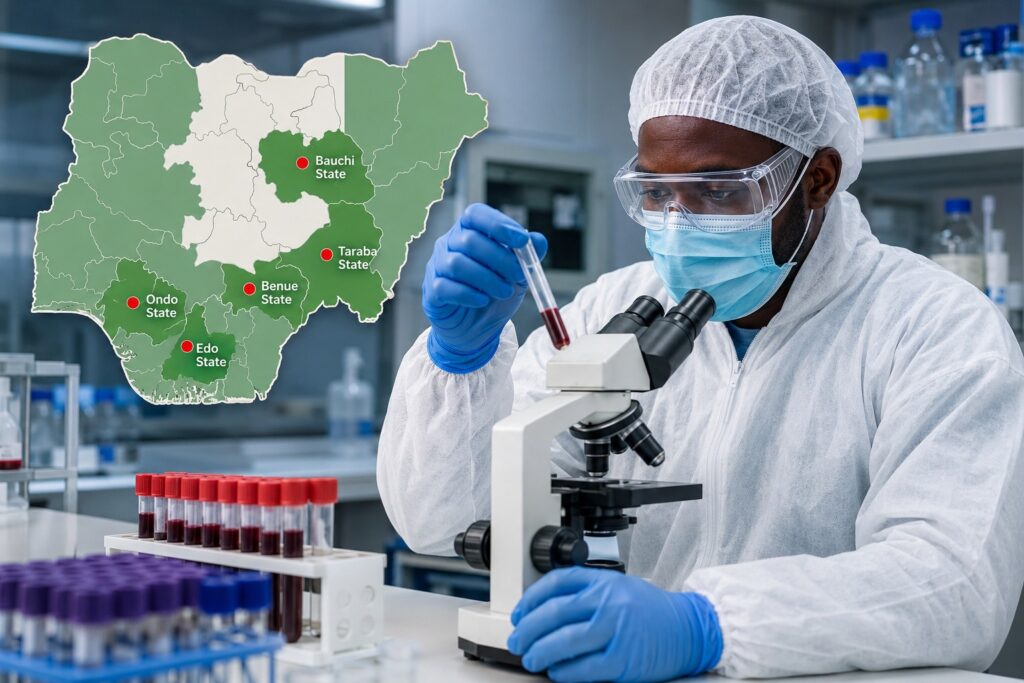
Although confirmed cases have been recorded across much of Nigeria, infections remain heavily concentrated in a handful of states.
According to the NCDC, approximately 85 percent of all confirmed infections originated from just five states:
- Ondo State
- Bauchi State
- Taraba State
- Edo State
- Benue State
Among these states:
The concentration of cases in these states highlights how the Lassa fever outbreak in Nigeria continues to place significant pressure on local healthcare systems and disease surveillance teams.
- Ondo accounts for approximately 30 percent of confirmed infections.
- Bauchi follows with 26 percent.
- Taraba contributes 14 percent.
- Edo records 9 percent.
- Benue accounts for 6 percent.
The remaining 15 percent of confirmed cases are distributed across other affected states.
This geographical concentration allows public health authorities to focus surveillance, laboratory testing, contact tracing and public education where they are needed most. However, experts caution that the presence of confirmed infections in 23 states demonstrates that Lassa fever is no longer confined to traditional hotspots alone.
Population movement, trade, environmental conditions and varying levels of healthcare access continue to influence the disease’s spread beyond historically affected communities.
Young Adults Continue to Record the Highest Infection Rates
The latest epidemiological data also reveal a consistent demographic trend.
Individuals between 21 and 30 years of age remain the most affected population group.
The demographic pattern seen in the Lassa fever Nigeria outbreak also underscores the potential economic impact, as many affected individuals belong to the country’s most productive age group.
However, confirmed infections have been recorded across an extremely wide age range—from one-year-old children to adults aged 93 years—demonstrating that the disease can affect virtually anyone exposed to the virus.
The NCDC also reported that infections remain almost evenly distributed between males and females, with a male-to-female ratio of approximately 1:0.9.
Public health specialists note that the high number of infections among economically active adults could have wider social and economic consequences. Adults within this age bracket often represent the most productive segment of the workforce, meaning illness can affect household incomes, workplace productivity and local economies, particularly in rural farming communities where exposure to rodents may be more common.
Why Are More Nigerians Dying from Lassa Fever?
Perhaps the most important finding in the latest report is not simply the number of infections, but why fatalities continue to increase despite ongoing response efforts.
According to the NCDC, several interconnected challenges are contributing to the country’s rising death toll.
Among the most significant are:
- Delayed presentation of patients at healthcare facilities.
- Poor health-seeking behaviour.
- High cost of medical treatment.
- Inadequate environmental sanitation.
- Low public awareness in high-risk communities.
- Continued infections among healthcare workers.
These factors combine to reduce the chances of successful treatment, particularly because Lassa fever responds best when diagnosed early.
The agency also disclosed that one healthcare worker contracted the infection during the latest reporting week, highlighting the continuing occupational risks faced by frontline medical personnel.
The infection of healthcare workers serves as an important reminder that strict infection prevention and control measures remain essential within hospitals and clinics, particularly when patients present with symptoms that could resemble malaria, typhoid fever or other common tropical illnesses.
As the Lassa fever Nigeria outbreak continues, health authorities are urging Nigerians to seek medical care immediately after symptoms appear, improve household sanitation and support efforts to reduce contact with disease-carrying rodents.
Recommended Coverage
Bundibugyo Ebola Outbreak Puts Nigeria on High Alert
As Nigeria battles rising Lassa fever deaths, discover why health authorities are also closely monitoring the Ebola outbreak in neighboring countries and what it means for national preparedness.
Ebola Outbreak Spreads Across DRC and Uganda
Explore how another deadly viral disease is testing healthcare systems in Central Africa and the lessons it offers for preventing future outbreaks across the continent.
Congo Ebola Outbreak Highlights Africa’s Health System Struggles
Learn why recurring disease outbreaks continue to challenge African healthcare systems and why stronger surveillance, early detection and community awareness remain critical to saving lives.
About the Author