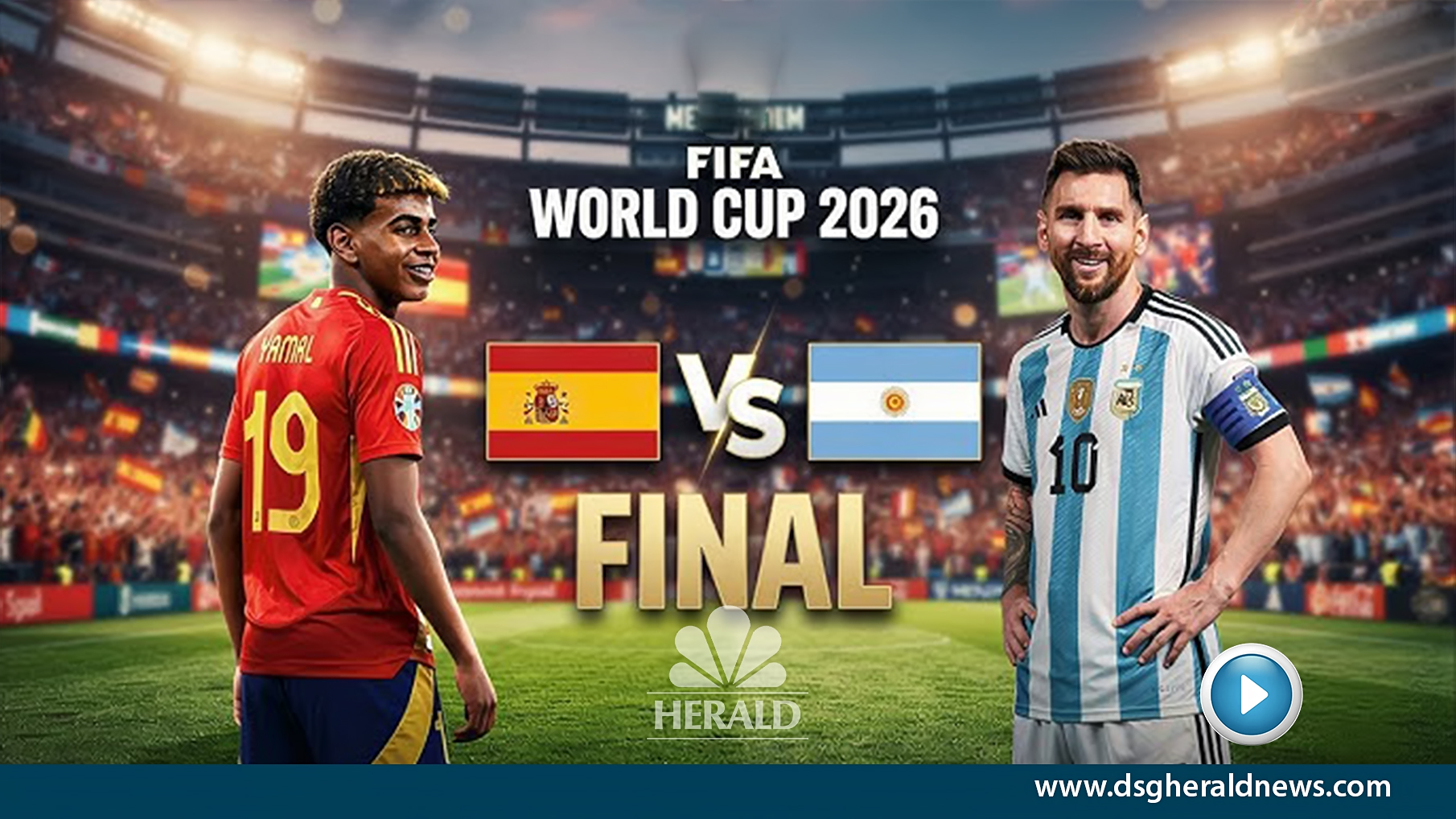
2026 World Cup Final: Messi Chases History as Spain Targets a New Era
Argentina and Spain prepare for a historic showdown as Lionel Messi seeks a fairytale World Cup farewell while Europe’s newest football powerhouse aims to begin another golden era.
Football reaches its grandest stage on Sunday as defending champions Argentina face reigning European champions Spain in the 2026 World Cup Final at MetLife Stadium in New Jersey. Scheduled to kick off at 3:00 p.m. Eastern Time (8:00 p.m. West Africa Time), the match brings together two outstanding teams whose journeys have defined this tournament in contrasting yet equally compelling ways.
For Argentina, the occasion offers the opportunity to become the first nation since Brazil in 1962 to successfully defend the FIFA World Cup. For Spain, it is a chance to claim only the second World Cup title in the country’s history while confirming that its latest generation of stars is ready to dominate international football.
Above all, however, the final has become synonymous with one man—Lionel Messi. At 39, the Argentine captain is widely expected to make his final appearance at a FIFA World Cup, giving football supporters around the world one last opportunity to witness one of the sport’s greatest players competing on its biggest stage.
Yet standing between Messi and another historic triumph is a fearless Spanish side led by teenage sensation Lamine Yamal, whose rise has symbolised the country’s remarkable football renaissance. The encounter is therefore more than a battle for the trophy; it is also a meeting between football’s greatest modern legend and one of its brightest emerging stars.
Why the 2026 World Cup Final Matters
Every FIFA World Cup final carries enormous significance, but this year’s contest possesses several storylines that elevate it beyond a routine championship match.
First, there is the possibility of witnessing history. Argentina has an opportunity to achieve something no country has managed for more than six decades by defending the World Cup title. Such an achievement would strengthen the team’s place among football’s greatest international dynasties.
Spain, meanwhile, hopes to add a second World Cup crown to the European Championship it captured in 2024. Success would confirm that Spanish football has successfully rebuilt itself following the decline of the generation that dominated world football between 2008 and 2012.
The final also reflects two contrasting football philosophies.
Argentina has relied on attacking efficiency, creativity and individual brilliance throughout the tournament, producing the competition’s most prolific attack with 19 goals. Spain, by contrast, has built its campaign on tactical discipline, exceptional organisation and defensive consistency, conceding only one goal in seven matches.
The clash therefore promises more than entertainment. It represents an examination of whether attacking freedom or defensive structure ultimately prevails on football’s biggest occasion.
Lionel Messi’s Last World Cup?
Few players have transformed football quite like Lionel Messi.
Across more than two decades, the Argentine captain has collected virtually every major honour available in club football before finally completing his international career by lifting the FIFA World Cup in Qatar in 2022.
Now, four years later, he returns to the final with another opportunity to leave an even more extraordinary legacy.
While Messi has not officially confirmed his retirement from international football after this tournament, widespread expectations suggest Sunday’s final could mark his last World Cup appearance. That possibility has added emotional weight to an event that already carries immense sporting importance.
Victory would allow Messi to conclude his World Cup career with consecutive titles—an achievement that would further strengthen arguments placing him among the greatest footballers in history.
Defeat, however, would not diminish what has already become one of football’s most remarkable careers. Instead, it would close the final chapter of an era that inspired millions of supporters across continents.
Regardless of the outcome, the match is likely to be remembered as one of the defining moments of Messi’s legendary journey.
Spain’s New Generation Has Arrived
While much of the global conversation focuses on Messi, Spain enters the final with every reason to believe this could become its defining night.
The European champions have quietly produced one of the tournament’s most balanced performances, combining disciplined defending with intelligent possession football and rapid transitions.
Much of that success has centred on 19-year-old Lamine Yamal, whose creativity, pace and confidence have made him one of the tournament’s standout performers.
His emergence symbolises a broader transformation within Spanish football.
Rather than relying solely on possession, modern Spain combines technical excellence with greater vertical attacking play, quicker movement and improved defensive organisation.
The result has been one of the competition’s most complete teams.
Their ability to control possession while limiting opponents’ scoring opportunities explains why they have conceded only once throughout the tournament.
For many observers, this final represents not merely Spain’s pursuit of another trophy but the beginning of another golden football generation.
Experience Versus Youth
One of the most fascinating aspects of this 2026 World Cup Final is the contrast between experience and youthful ambition.
Argentina enters the match with several players who have already experienced the pressure of winning football’s biggest prize.
Goalkeeper Emiliano Martínez has repeatedly demonstrated composure under pressure, while defenders Cristian Romero and Lisandro Martínez provide leadership at the back. Midfielders Rodrigo De Paul, Enzo Fernández and Alexis Mac Allister bring balance, energy and technical quality to the centre of the pitch.
Up front, Messi continues to dictate attacking rhythm through intelligence rather than pace, while Julián Álvarez provides relentless movement and finishing ability.
Spain’s squad, however, represents the future.
Led by Rodri in midfield, supported by Dani Olmo, Fabián Ruiz and Yamal, Spain combines youthful creativity with experienced tactical leadership.
This mixture has enabled Spain to remain composed throughout the tournament despite facing increasingly difficult opponents.
Sunday’s final therefore becomes more than a contest between two nations.
It is also a contest between football experience and football’s next generation.
Five Key Battles That Could Decide the Final
Great finals are often determined by individual duels across the pitch rather than overall statistics.
Several tactical battles may ultimately decide who lifts the trophy.
1. Lionel Messi vs Rodri
Spain’s midfield anchor will likely shoulder much of the responsibility for limiting Messi’s influence between the lines.
If Rodri succeeds in reducing Messi’s time on the ball, Spain’s defensive structure becomes significantly stronger.
Conversely, even brief moments of space could allow Messi to produce the decisive pass or finish that has defined his career.
2. Lamine Yamal vs Nicolás Tagliafico
Yamal’s pace and dribbling present one of Spain’s biggest attacking threats.
Argentina’s experienced left-back must balance defensive discipline with avoiding unnecessary fouls in dangerous areas.
3. Rodri vs Enzo Fernández
Control of midfield often determines major finals.
Both players excel at dictating tempo, recovering possession and launching attacks.
Whichever midfielder dominates central areas could shape the rhythm of the entire match.
4. Julián Álvarez Against Spain’s Centre-Backs
Álvarez’s relentless pressing and intelligent movement constantly disrupt defensive organisation.
Spain’s central defenders must remain disciplined throughout ninety minutes.
5. Goalkeepers Under Pressure
Emiliano Martínez has developed a reputation for producing decisive performances in high-pressure matches, particularly during penalty shootouts.
Spain’s Unai Simón has similarly demonstrated calmness throughout the tournament.
If the match extends beyond regulation time, both goalkeepers could become decisive figures.
Predicted Lineups: Familiar Faces Set for the Biggest Stage
Both teams are expected to enter the 2026 World Cup Final with near-full-strength squads, giving their coaches the luxury of selecting from their strongest available players. Barring any late fitness concerns, the probable starting lineups reflect the consistency both nations have shown throughout the tournament.
Spain (4-2-3-1)
Goalkeeper
- Unai Simón
Defenders
- Pedro Porro
- Pau Cubarsí
- Aymeric Laporte
- Marc Cucurella
Midfielders
- Rodri
- Fabián Ruiz
Attacking Midfield
- Lamine Yamal
- Dani Olmo
- Álex Baena
Striker
- Mikel Oyarzabal
Spain’s likely approach will revolve around patient possession, pressing high when the opportunity arises, and using Rodri’s composure to control the tempo.
Argentina (4-4-2 / 4-1-3-2)
Goalkeeper
- Emiliano Martínez
Defenders
- Nahuel Molina
- Cristian Romero
- Lisandro Martínez
- Nicolás Tagliafico
Midfielders
- Leandro Paredes
- Rodrigo De Paul
- Enzo Fernández
- Alexis Mac Allister
Forwards
- Lionel Messi
- Julián Álvarez (with Lautaro Martínez another attacking option)
Argentina is expected to rely on defensive organisation before transitioning quickly through its experienced midfield, allowing Messi and Álvarez to exploit spaces behind Spain’s defence.
Nigeria Kickoff Time and Viewing Interest
Football supporters across Nigeria are expected to follow the match in huge numbers.
The 2026 World Cup Final kicks off at:
- 8:00 PM (West Africa Time)
- Sunday, July 19, 2026
- Venue: MetLife Stadium, New Jersey, United States
For Nigerian audiences, the timing is particularly favourable, allowing families, viewing centres and football fans to watch the final during prime evening hours.
Major international football finals traditionally generate some of the highest television audiences in Nigeria, reflecting the country’s deep passion for the sport.
World Cup Prize Money Adds More Incentive
Beyond prestige, national pride and sporting immortality, the World Cup final also carries significant financial rewards.
FIFA distributes prize money throughout the tournament based on teams’ final positions, ensuring both finalists receive substantial earnings. While financial incentives rarely outweigh the importance of winning the World Cup itself, they contribute to football development programmes, federation budgets and player bonuses.
For Argentina, retaining the trophy would represent not only another historic sporting achievement but also reinforce its position among football’s elite nations.
Spain, meanwhile, would combine World Cup success with recent European Championship triumphs, strengthening its football brand on and off the pitch.
More Than a Trophy: A Battle of Football Philosophies
One reason this final has attracted enormous worldwide attention is the contrast in playing styles.
Argentina has built its campaign around attacking flair, individual creativity and clinical finishing.
Spain has relied on disciplined positional play, intelligent pressing and remarkable defensive consistency.
These contrasting approaches reflect two successful but different football identities.
Should Argentina prevail, many analysts will point to experience, attacking efficiency and decisive moments from world-class players.
If Spain lifts the trophy, the victory will reinforce the value of tactical discipline, collective teamwork and youth development.
Either outcome is likely to influence coaching philosophies well beyond this tournament.
The Global Significance of the Final
Every World Cup final resonates far beyond the competing nations.
The event is watched by hundreds of millions of people worldwide, bringing together supporters from diverse cultures through a shared passion for football.
The 2026 edition also carries added significance as the first World Cup hosted across three North American countries and one of the largest tournaments in FIFA history.
According to the supplied source material, this final is also set to feature the first American-style halftime entertainment show at a FIFA World Cup final, underlining the tournament’s expanding global entertainment appeal.
The occasion therefore represents not only a football championship but also a showcase of sport, culture and international cooperation.
Why Nigerian Fans Are Closely Watching
Although Nigeria did not reach the tournament’s latter stages, interest in the final remains exceptionally strong.
Many Nigerian supporters have long admired Lionel Messi, while others are fascinated by Spain’s exciting young talents led by Lamine Yamal.
The match also provides valuable lessons for African football.
Both finalists demonstrate the importance of long-term youth development, coaching continuity and tactical evolution.
For football administrators across Africa, including Nigeria, the success of Argentina and Spain offers important insights into building sustainable national teams capable of competing consistently at the highest level.
Prediction: Can Experience Overcome Structure?
Predicting a World Cup final is rarely straightforward.
Spain enters the match having displayed the tournament’s most consistent defensive performances, while Argentina possesses arguably the competition’s most dangerous attack.
The supplied source material notes that analytical projections from the Opta Supercomputer give Spain a slight statistical edge, with bookmakers also favouring the European champions by a narrow margin.
However, statistics alone rarely determine football finals.
Argentina’s experience in high-pressure situations and the presence of Lionel Messi provide intangible advantages that cannot easily be measured.
Spain, on the other hand, has demonstrated maturity beyond its years throughout the competition.
If the match remains level entering the closing stages, individual brilliance or a single defensive mistake may ultimately separate the two sides.
A closely contested encounter extending into extra time—or even penalties—would surprise few observers.
Legacy Will Be Decided in New Jersey
Whatever the outcome, the 2026 World Cup Final is already assured of a place in football history.
For Argentina, victory would secure consecutive World Cup titles for the first time since Brazil achieved the feat more than six decades ago.
For Spain, success would confirm the arrival of another golden generation capable of dominating international football.
For Lionel Messi, the match represents one final opportunity to leave football’s biggest stage with another unforgettable triumph.
For Lamine Yamal, it could mark the beginning of a career that shapes the sport for years to come.
That contrast—between a legendary icon seeking the perfect farewell and a rising superstar chasing his first global crown—is what makes this final more than just another football match.
It is a symbolic passing of the torch between generations.
Regardless of who lifts the trophy at MetLife Stadium, football will witness the end of one remarkable chapter and, perhaps, the beginning of another.
Conclusion
The 2026 World Cup Final brings together two outstanding teams, contrasting football philosophies and compelling personal stories in what promises to be one of the defining sporting events of the year.
Argentina arrives with the confidence of defending champions and the inspiration of Lionel Messi’s extraordinary career, while Spain seeks to crown a new generation that has impressed with discipline, tactical intelligence and fearless football.
As millions of fans—including countless supporters across Nigeria—tune in, the final offers more than the chance to win the world’s biggest football trophy. It is an opportunity to witness history, celebrate excellence and appreciate a contest that could shape football’s future for years to come.
Whether it ends with Argentina retaining the title or Spain reclaiming world supremacy, the 2026 World Cup Final is poised to deliver a fitting conclusion to a tournament that has captivated audiences around the globe.
About the Author