Tinubu Performance Review: Progress, Pain and the Reality Facing Nigerians
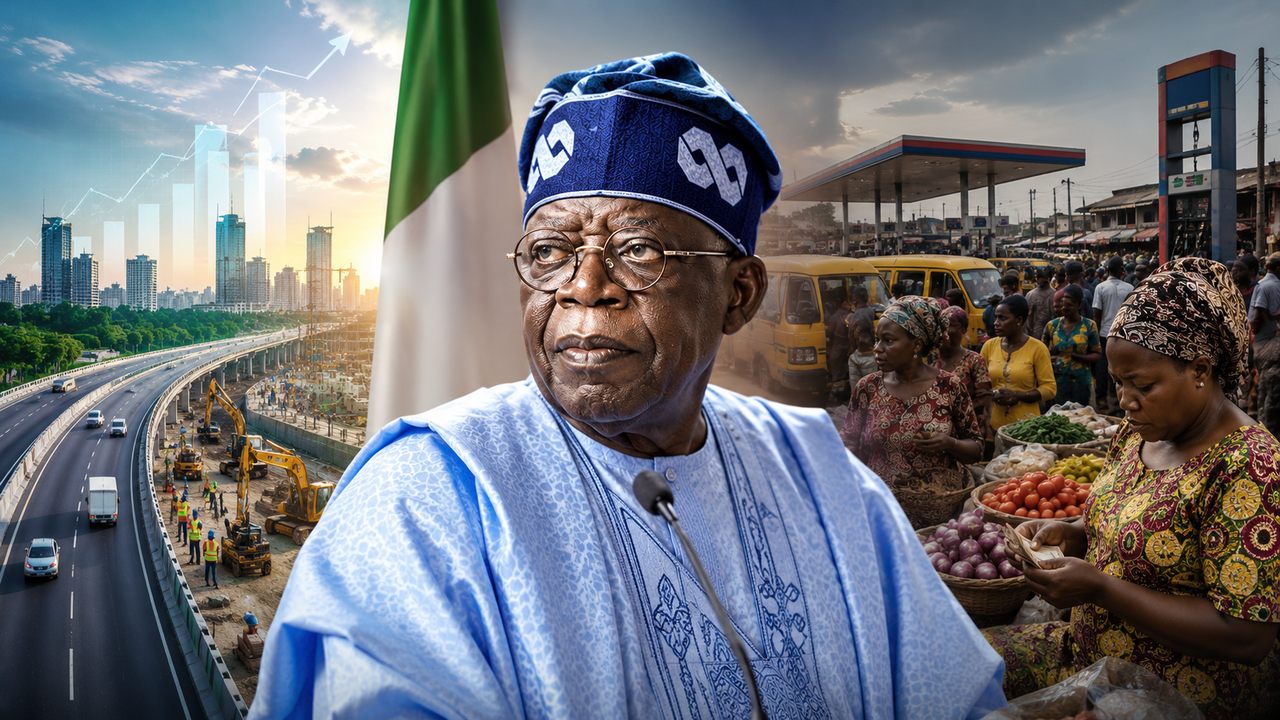
More than three years after President Bola Ahmed Tinubu assumed office, Nigeria’s story is one of sweeping reforms, measurable policy achievements and continuing hardship. While the government points to stronger public finances, infrastructure projects and institutional reforms as evidence that the economy is being rebuilt, millions of Nigerians continue to judge the administration by rising food prices, declining purchasing power and persistent insecurity. This DSG Herald News analysis examines both realities, exploring what has changed since May 2023, where progress has been recorded, where major challenges remain and what these developments could mean for Nigeria’s future.
Nigeria’s Two Different Realities
Few Nigerian administrations have generated as much debate within their first term as that of President Bola Ahmed Tinubu.
Since taking office on 29 May 2023, the administration has pursued one of the country’s most ambitious programmes of economic restructuring, arguing that decades of difficult decisions could no longer be postponed.
Supporters see these reforms as necessary corrections to structural weaknesses that had accumulated over many years.
Critics, however, argue that the speed and implementation of those reforms have imposed severe hardship on ordinary Nigerians, many of whom continue to struggle with inflation, high transportation costs and declining living standards.
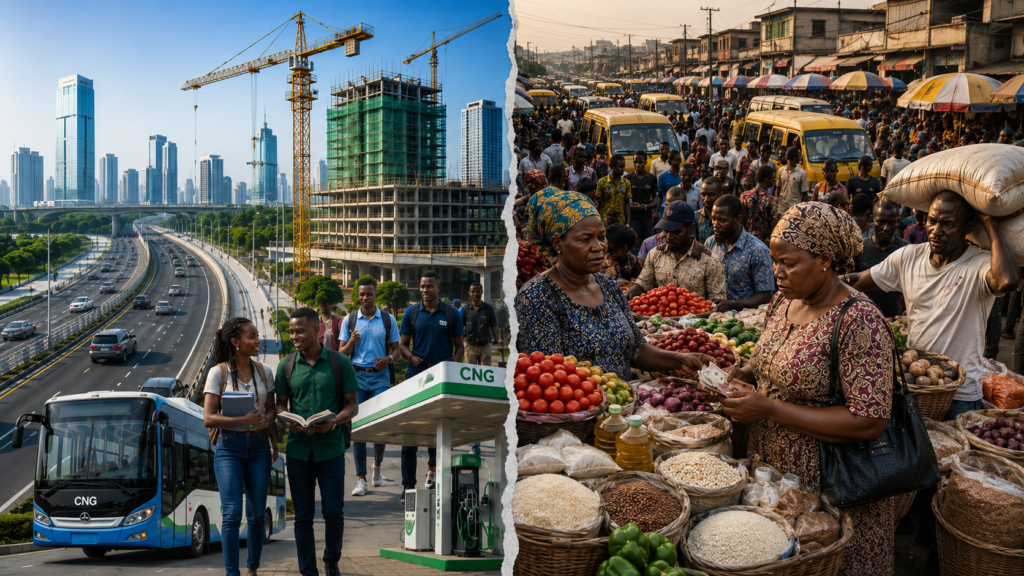
The result is a country living through two different experiences at the same time.
One is reflected in macroeconomic indicators.
Government officials cite improved revenues, stronger foreign reserves, expanding infrastructure projects, tax reforms, student loan programmes and consumer credit initiatives as signs that Nigeria’s long-term economic foundations are improving.
The other reality is visible in homes, markets and workplaces.
Families continue to face higher food prices.
Small businesses struggle with operating costs.
Workers find that salaries purchase less than they once did.
Security concerns remain a daily reality in several parts of the country.
Rather than existing in opposition, these two realities coexist.
Understanding President Tinubu’s performance therefore requires examining both the measurable policy outcomes and the lived experiences of Nigerians.
The Economy Tinubu Inherited
Any assessment of the administration begins with the economic conditions that existed before President Tinubu took office.
By May 2023, Nigeria faced several longstanding structural challenges.
Heavy Fuel Subsidy Costs
For years, successive governments acknowledged that petrol subsidies consumed enormous public resources.
According to the source material, the Tinubu administration argued that continuing the subsidy regime was financially unsustainable because it diverted funds that could otherwise support infrastructure, healthcare, education and social development.
Multiple Exchange Rates
Nigeria also maintained several foreign exchange windows.
Officials argued that these different exchange rates encouraged arbitrage, discouraged investment and placed continued pressure on foreign reserves.
Fiscal Constraints
Government revenues remained limited relative to expenditure.
Debt servicing consumed a significant share of public income, leaving little fiscal space for development spending.
International financial institutions had repeatedly highlighted the need for broader revenue reforms and stronger fiscal management.
Inflation and Security
Inflationary pressures were already affecting households before the change in administration.
Food prices had risen, agricultural production was disrupted by insecurity in several regions and electricity shortages continued to constrain businesses.
Supporters of the administration therefore argue that many of today’s economic challenges cannot be viewed independently of those inherited structural weaknesses.
Critics counter that the pace of reform intensified the hardship many Nigerians experience today.
The Administration’s Reform Agenda
Within weeks of taking office, President Tinubu introduced several landmark economic reforms.
Many had been recommended for years by economists and international financial institutions but were considered politically difficult.
Fuel Subsidy Removal
The immediate removal of petrol subsidies became the defining policy of the administration’s first days.
Government officials argued that subsidy payments consumed trillions of naira annually while encouraging inefficiency and cross-border smuggling.
According to official explanations, eliminating the subsidy would free resources for investment in infrastructure, healthcare, education and targeted social programmes.
The immediate consequence, however, was a sharp increase in petrol prices that affected transportation costs and contributed to broader inflation across the economy.
Foreign Exchange Liberalisation
The administration also unified Nigeria’s foreign exchange market.
Officials maintained that allowing the naira to trade more freely would improve transparency, reduce arbitrage and encourage investment.
The transition nevertheless contributed to significant currency depreciation and higher import costs before signs of market stabilisation began to emerge.
Tax Reform
Tax reforms aimed to simplify compliance, broaden the revenue base and reduce dependence on borrowing.
Government officials describe these measures as essential for long-term fiscal sustainability.
Student Loans and Consumer Credit
The Nigerian Education Loan Fund (NELFUND) became one of the administration’s flagship social programmes.
According to government figures referenced in the source material, more than one million students have benefited from tuition and upkeep support since the programme became operational.
Other initiatives include CreditCorp, presidential loan schemes and support programmes for micro, small and medium-sized enterprises.
Local Government Autonomy
Another significant institutional reform involved pursuing financial autonomy for local government councils through a landmark Supreme Court judgment.
Supporters argue that, if fully implemented, the reform could strengthen grassroots development and improve service delivery.
Where the Government Says Progress Has Been Made
More than three years into President Bola Ahmed Tinubu’s administration, government officials argue that the difficult reforms introduced since May 2023 are beginning to produce measurable results.
While acknowledging that the transition has been challenging, the administration maintains that key economic indicators suggest Nigeria’s long-term economic foundations are becoming stronger.
Supporters contend that these improvements are not isolated achievements but evidence that structural reforms are gradually reshaping the country’s economy.
Stronger Public Finances
One of the administration’s central arguments is that fiscal reforms have significantly improved government revenue.
According to the source material, the removal of fuel subsidies and broader revenue measures have increased the amount of money available for distribution through the Federation Account Allocation Committee (FAAC).
Monthly allocations reportedly now exceed ₦2 trillion, giving state governments greater financial capacity to fund infrastructure projects, education, healthcare and other public services.
Government officials argue that stronger public finances will ultimately reduce dependence on borrowing while allowing greater investment in national development priorities.
However, many analysts note that higher allocations alone do not automatically translate into improved public services. The effectiveness of these increased revenues depends largely on how transparently and efficiently they are utilised by federal, state and local governments.
Foreign Reserves Show Improvement
The administration also points to Nigeria’s external reserves as an important indicator of improving macroeconomic management.
According to figures referenced in the source material, foreign reserves reportedly increased from approximately $3.99 billion at the beginning of the administration to around $50 billion by mid-2026.
Supporters argue that stronger reserves improve Nigeria’s ability to meet international financial obligations, stabilise the foreign exchange market and enhance investor confidence.
Although ordinary Nigerians may not immediately experience the benefits of higher reserves, economists generally view healthy external reserves as an important measure of economic resilience.
Economic Growth Returns
Government figures cited in the source material indicate that Nigeria recorded approximately 4 percent GDP growth during 2025, with projections suggesting continued moderate expansion into 2026.
Officials interpret these figures as evidence that the economy has begun recovering from years of structural weaknesses.
Supporters argue that sustained economic growth creates opportunities for increased investment, higher productivity and long-term employment generation.
Critics, however, caution that GDP growth alone does not necessarily reflect improvements in household welfare, particularly if inflation continues to outpace income growth.
Infrastructure Spending Accelerates
Infrastructure development remains one of the administration’s most visible policy priorities.
According to government reports referenced in the source material, more than 440 road projects are currently underway across Nigeria.
These include:
- Major federal highways.
- Strategic transport corridors.
- Bridge construction.
- Extensive road projects within the Federal Capital Territory.
Government officials argue that improved transport infrastructure will reduce logistics costs, stimulate commerce and enhance national productivity over time.
For many supporters, these visible construction projects demonstrate that savings from economic reforms are beginning to finance long-term national assets.
Expanding Access to Education
Among the administration’s flagship social programmes is the Nigerian Education Loan Fund (NELFUND).
According to government figures cited in the source material, more than one million Nigerian students have received tuition and upkeep support since the programme became operational.
Officials argue that expanding access to higher education will improve human capital development and provide greater opportunities for young Nigerians despite current economic pressures.
Supporters describe NELFUND as one of the administration’s most tangible social investments because it directly benefits students who might otherwise struggle to finance tertiary education.
Consumer Credit and MSME Support
The administration has also introduced programmes designed to improve household access to finance and stimulate economic activity.
These include:
- CreditCorp initiatives.
- Presidential loan schemes.
- Grants for micro, small and medium-sized enterprises.
Government officials argue that expanding consumer credit and business financing will encourage entrepreneurship, increase production and create employment opportunities over time.
Supporters believe these programmes will become increasingly important as broader economic reforms mature.
Energy Transition Through CNG
Another area highlighted by government is the promotion of Compressed Natural Gas (CNG) as an alternative to petrol.
According to the source material, more than 100,000 vehicles have reportedly transitioned to CNG.
Officials argue that wider adoption could reduce transport costs, lessen dependence on imported fuel products and strengthen Nigeria’s energy security.
The administration also points to increased oil production and improved protection of energy infrastructure as evidence that reforms within the petroleum sector are beginning to yield positive results.
Where Nigerians Still Feel the Pain
While government officials emphasise macroeconomic improvements, many Nigerians continue to evaluate the administration through their daily economic experiences.
For millions of households, the most immediate reality remains the rising cost of living.
The Cost-of-Living Crisis
The removal of petrol subsidies and the liberalisation of the foreign exchange market triggered substantial increases in transportation costs and the prices of goods and services.
Because fuel plays a central role in Nigeria’s transport and distribution systems, higher petrol prices quickly affected nearly every sector of the economy.
Food transportation became more expensive.
Manufacturing costs increased.
Retail prices rose.
Businesses passed many of these additional costs to consumers.
Although government officials maintain that inflationary pressures have begun to ease, many households continue to report that food, transport, rent and essential commodities remain far beyond what they can comfortably afford.
Declining Purchasing Power
One of the administration’s most persistent criticisms concerns household purchasing power.
The depreciation of the naira significantly increased the cost of imported goods and industrial raw materials.
Businesses faced higher production costs while consumers encountered rising prices across multiple sectors.
For many salaried workers, income growth has failed to keep pace with inflation.
Although the national minimum wage was increased to ₦70,000, labour organisations and several economists argue that inflation has substantially reduced its practical impact on household welfare.
Pressure on Small Businesses
Nigeria’s small and medium-sized enterprises continue to face significant operational challenges.
Business owners report rising fuel expenses, expensive logistics, foreign exchange volatility and increasing production costs.
According to the source material, many businesses have responded by:
- Reducing production.
- Delaying expansion.
- Cutting staff.
- Closing operations entirely.
Many entrepreneurs acknowledge that while structural reforms may eventually produce long-term benefits, the immediate adjustment period has placed enormous pressure on business survival.
Poverty and Food Security
Concerns about poverty remain central to public debate.
The source material references estimates cited by opposition groups suggesting that approximately 139 million Nigerians, representing about 60 percent of the population, live below the national poverty line.
Although these figures remain politically contested, they reflect broader concerns regarding unemployment, food affordability and declining living standards.
The administration has attempted to address these issues through:
- Cash transfer programmes.
- Student loans.
- Consumer credit.
- MSME grants.
Critics argue, however, that these interventions have not yet reached enough vulnerable households to offset the broader effects of inflation and rising living costs.
Electricity Remains a Challenge
Reliable electricity continues to be one of Nigeria’s longstanding development challenges.
Government officials highlight investments in gas infrastructure, electricity generation and hydropower projects.
Nevertheless, businesses and households across many parts of the country continue to report inconsistent electricity supply.
As a result, many firms remain heavily dependent on private generators, increasing production costs and reducing competitiveness.
Although CNG offers a potentially cheaper transport alternative, nationwide infrastructure remains under development and adoption continues gradually.
Security Challenges Persist
Security remains one of the administration’s most complex policy areas.
Government officials report intensified military operations, improved intelligence coordination and successful operations against insurgents and bandits.
However, according to the source material, kidnapping, farmer-herder conflicts, banditry and isolated terrorist attacks continue to affect several regions.
Many Nigerians therefore judge security not by official operational reports but by conditions within their own communities.
For many citizens, lasting improvements in safety remain essential before broader economic progress can be fully realised.
What Independent Experts Say
Assessing President Tinubu’s performance requires looking beyond both government statements and opposition criticism.
Independent analysts generally agree on one point:
The administration has introduced some of Nigeria’s most significant structural economic reforms in decades.
However, they also recognise that these reforms have imposed substantial short-term costs on households.
A Mixed Assessment
According to the source material, independent organisations including RTC Advisory have broadly assessed the administration’s overall performance within a range of 55 to 65 percent.
These assessments acknowledge meaningful progress in macroeconomic restructuring while also highlighting continuing concerns over inflation, poverty, security and household welfare.
Rather than describing the administration as either a clear success or failure, independent observers generally present a more nuanced picture.
Support for Structural Reforms
International financial institutions have generally supported the direction of several major reforms.
Fuel subsidy removal, exchange-rate liberalisation and fiscal reforms broadly align with recommendations previously made by institutions such as the International Monetary Fund (IMF) and the World Bank, according to the source material.
These organisations have long argued that correcting structural distortions is necessary for sustainable long-term economic growth.
At the same time, they emphasise that difficult reforms should be accompanied by strong social protection programmes capable of protecting vulnerable households during periods of economic transition.
The Implementation Question
Independent observers also stress that sound economic policy alone cannot guarantee improved living standards.
Much depends on implementation.
Several questions remain central to ongoing public debate:
- Are fiscal savings being spent efficiently?
- Are increased government revenues improving public services?
- Are social intervention programmes reaching intended beneficiaries?
- Are state governments using larger FAAC allocations for meaningful development rather than recurrent expenditure?
The answers to these questions may ultimately determine whether the administration’s reforms achieve their intended objectives.
The Central Debate
Many economists therefore frame Nigeria’s current policy debate differently.
The central issue is no longer whether difficult reforms were necessary.
Instead, the more important question has become whether those reforms have been implemented in ways that adequately protect ordinary Nigerians during the transition.
That distinction continues to shape national discussions about President Tinubu’s performance.
For many analysts, the ultimate success of the administration will depend not only on improved fiscal indicators but also on whether those improvements translate into lower inflation, stronger purchasing power, better employment opportunities and greater public confidence in the years ahead.
Has Tinubu Delivered on His Campaign Promises?
As President Bola Ahmed Tinubu moves deeper into his first term, public opinion increasingly focuses on a practical question: Has the administration delivered on the promises that formed the foundation of its reform agenda?
The answer depends largely on which indicators are used.
Supporters emphasise structural reforms, fiscal improvements and institutional changes.
Critics focus on the day-to-day realities experienced by ordinary Nigerians.
The evidence presented in the source material suggests a mixed picture.
Fuel Subsidy Removal — Implemented
Perhaps the most immediate campaign commitment fulfilled by the administration was the removal of the long-standing petrol subsidy.
The policy was implemented immediately after President Tinubu assumed office in May 2023.
Government officials argue that ending the subsidy has released significant fiscal resources previously consumed by subsidy payments.
However, the reform also triggered sharp increases in fuel prices, transportation costs and inflation, making it one of the administration’s most controversial decisions.
Supporters regard the policy as economically necessary.
Critics acknowledge the need for reform but argue that its social consequences were insufficiently managed.
Foreign Exchange Reform — Implemented
The administration also carried out its commitment to reform Nigeria’s foreign exchange market.
Multiple exchange-rate windows were unified, and the naira was allowed to trade more freely.
Government officials describe the reform as essential for improving transparency, reducing arbitrage and attracting investment.
The transition nevertheless resulted in significant currency depreciation before showing signs of stabilisation, increasing the cost of imports and placing additional pressure on businesses and consumers.
Government Revenue — Partly Achieved
The administration reports substantial improvements in public revenue through tax reforms, stronger revenue mobilisation and higher Federation Account Allocation Committee (FAAC) distributions.
According to the source material, these reforms have strengthened government finances.
The remaining challenge lies in ensuring that increased revenues produce visible improvements in healthcare, education, infrastructure and other essential public services.
Infrastructure Expansion — In Progress
Infrastructure remains one of the administration’s most visible achievements.
Government reports indicate that more than 440 road projects are underway nationwide.
While these projects demonstrate significant public investment, many remain under construction, and regional disparities continue to shape public perception of their impact.
Education Access — Largely Achieved
The Nigerian Education Loan Fund (NELFUND) has become one of the administration’s most widely recognised social initiatives.
Government figures cited in the source material indicate that more than one million students have benefited from tuition and upkeep support.
Questions remain regarding the programme’s long-term financial sustainability and whether graduates will find sufficient employment opportunities after completing their studies.
Social Welfare — Partly Achieved
The administration has introduced multiple intervention programmes, including:
- Conditional cash transfers.
- Consumer credit initiatives.
- CreditCorp.
- MSME grants.
- Student loans.
These programmes represent significant policy initiatives.
However, critics argue that their overall coverage remains too limited relative to the scale of economic hardship affecting millions of Nigerians.
Local Government Reform — Partly Achieved
Through a landmark Supreme Court judgment, the administration pursued financial autonomy for local government councils.
Supporters regard this as one of the most important governance reforms undertaken during the administration.
Full implementation across Nigeria’s states, however, remains under close public observation.
Security — Mixed Progress
Government officials report operational successes against insurgents and criminal groups through intensified military operations and improved intelligence coordination.
Nevertheless, kidnapping, communal violence, banditry and farmer-herder conflicts continue to affect several parts of the country.
For many Nigerians, improvements in security will ultimately be measured not by official statistics but by their ability to live, travel and conduct business safely.
Looking Beyond Politics: What the Evidence Suggests
One of the most striking features of the debate surrounding President Tinubu’s administration is that both supporters and critics frequently rely on credible evidence.
They simply prioritise different indicators.
Government officials focus on:
- Foreign reserve growth.
- GDP expansion.
- Infrastructure investment.
- Public revenue.
- Tax reforms.
- Student financing.
- Institutional reforms.
Critics focus on:
- Food inflation.
- Transportation costs.
- Household purchasing power.
- Poverty.
- Business closures.
- Security.
- Everyday living conditions.
Both perspectives can exist simultaneously.
Economic history shows that structural reforms often involve adjustment periods during which macroeconomic indicators improve before households begin experiencing tangible benefits.
Likewise, continuing hardship does not automatically mean reforms are ineffective; it may simply indicate that the benefits have not yet filtered through the wider economy.
This distinction lies at the heart of the Tinubu administration’s legacy.
Its success will ultimately depend not only on fiscal stability but also on whether ordinary Nigerians begin experiencing measurable improvements in their daily lives.
What Comes Next?
As political attention gradually shifts toward Nigeria’s next general election, public expectations are also evolving.
The debate is no longer centred on whether reforms have been introduced.
That question has largely been settled.
Instead, Nigerians increasingly ask a more immediate and practical question:
When will these reforms improve everyday life?
Many economists argue that the next phase of the administration should focus less on announcing additional reforms and more on delivering measurable outcomes.
1. Inflation Must Fall
For most Nigerians, inflation remains the defining economic issue.
Although macroeconomic indicators may point towards greater fiscal stability, rising prices continue to reduce purchasing power and weaken consumer confidence.
Lower inflation would:
- Improve household welfare.
- Reduce business costs.
- Restore consumer confidence.
- Strengthen investment.
For many citizens, falling food prices will represent a more meaningful sign of progress than improvements in GDP or foreign reserves.
2. Growth Must Create Employment
Positive GDP growth alone is insufficient.
Economic expansion must generate:
- Sustainable jobs.
- Higher incomes.
- Stronger SMEs.
- Greater productivity.
- Investment beyond the oil sector.
Inclusive growth will determine whether ordinary Nigerians genuinely experience the benefits of ongoing reforms.
3. Social Protection Must Expand
Although programmes such as NELFUND, CreditCorp, cash transfers and MSME support have expanded, many analysts believe they require broader coverage and more effective targeting.
Improved digital payment systems, stronger beneficiary databases and greater accountability could ensure assistance reaches households most affected by rising living costs.
4. Security Remains Essential
Economic development depends heavily on security.
Farmers require safe access to farmland.
Businesses require secure transport corridors.
Manufacturers require reliable logistics.
Communities require confidence that lives and property are protected.
While government officials report operational successes, many Nigerians continue to assess security based on what they experience within their own communities.
5. Delivering Results Before 2027
As the next election cycle approaches, public attention is likely to focus increasingly on measurable outcomes rather than policy announcements.
Key indicators that could shape public perception include:
- Lower inflation.
- Stable exchange rates.
- Affordable food prices.
- Improved electricity supply.
- Better security.
- Higher employment.
- Completion of major infrastructure projects.
- Continued improvements in education and healthcare.
These practical outcomes are likely to influence both public confidence and future political debates.
Final Assessment: Progress and Pain Can Exist Together
President Bola Ahmed Tinubu’s administration cannot easily be described as either an outright success or an outright failure.
Instead, it represents one of the most ambitious—and most controversial—periods of economic restructuring in Nigeria’s democratic history.
Supporters argue that difficult reforms became unavoidable after years of structural imbalances.
They point to:
- Fuel subsidy removal.
- Foreign exchange liberalisation.
- Tax reforms.
- Expanded student financing.
- Stronger public revenues.
- Major infrastructure projects.
- Institutional reforms.
Critics argue that these same policies have imposed severe costs on ordinary Nigerians.
They highlight:
- Inflation.
- Declining purchasing power.
- Business closures.
- Rising living costs.
- Persistent insecurity.
The evidence presented throughout this analysis suggests that both perspectives contain important elements of truth.
Macroeconomic indicators point towards stronger fiscal management and institutional reform.
At the same time, millions of Nigerians continue to experience genuine economic hardship that government interventions have not yet fully alleviated.
Ultimately, President Tinubu’s legacy will not be determined solely by GDP growth, foreign reserve figures or government revenue statistics.
History is more likely to judge this administration by questions that ordinary Nigerians ask every day:
- Can families afford food more easily?
- Are businesses growing?
- Is inflation under control?
- Are communities becoming safer?
- Are young people finding meaningful opportunities?
The answers to these questions will ultimately determine whether the Tinubu administration is remembered as the beginning of a lasting economic transformation or as a period marked by prolonged national sacrifice.
Recommended Coverage
Nigeria’s Economy: The Tinubu Administration — Progress or Crisis?
Go beyond the headlines with a deeper examination of Nigeria’s economic reforms, inflation, growth and the competing narratives surrounding President Tinubu’s economic agenda.
FAAC Allocation Hits ₦2.257 Trillion in April
Discover why record FAAC allocations have become central to the government’s reform narrative and what increased revenue means for states, development projects and public services.
Tinubu’s Poverty Programme: Can It Reduce Poverty?
Explore one of the biggest tests facing the administration—whether its social intervention programmes can ease hardship and improve the lives of millions of Nigerians.
About the Author