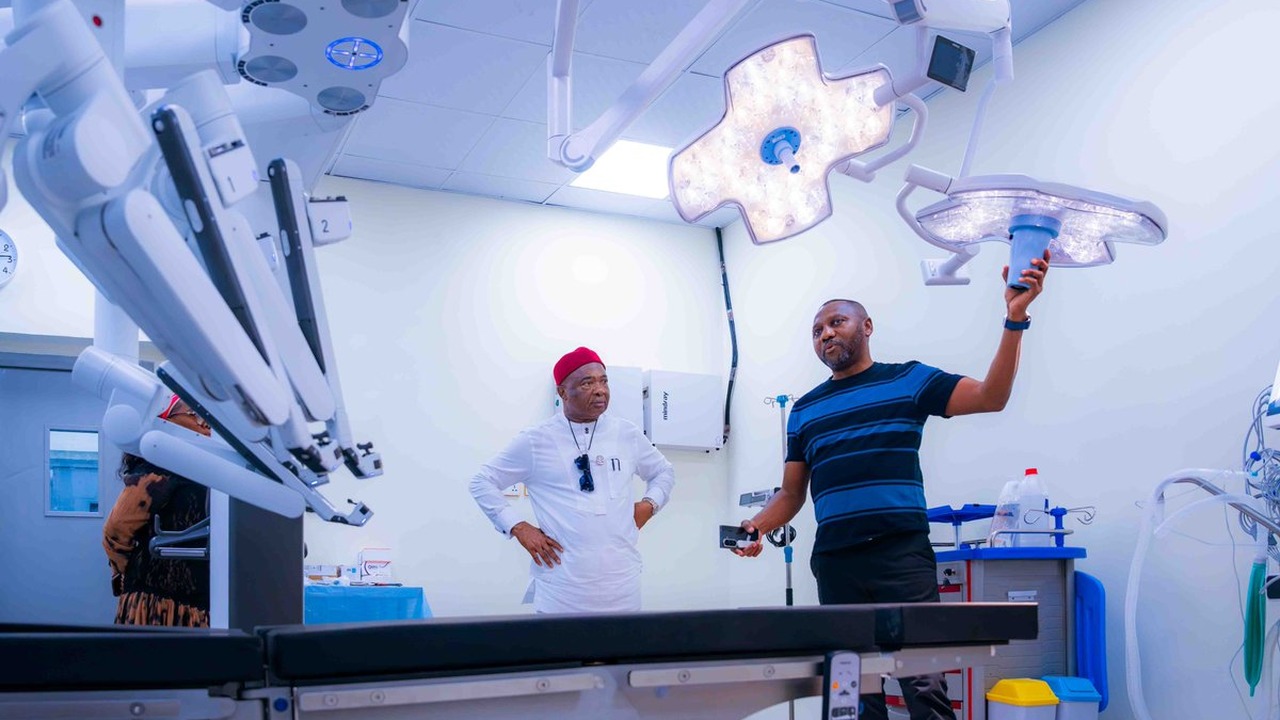
The robotic surgical system at the Imo Robotics and Oncology Centre in Owerri, where Imo State recently performed its first robotic-assisted surgery.
Imo Robotic Surgery: Can Owerri Become a New Alternative to Medical Treatment Abroad?
There is a moment when a healthcare project stops being about buildings, equipment and promises and starts becoming about something much more difficult to measure: whether an ordinary patient can actually benefit from it.
That moment arrived in Imo State on August 21, 2026.
At the Imo Robotics and Oncology Centre within the Imo Specialist Hospital Complex in Umuguma, Owerri, a team of Nigerian and international medical specialists performed the state’s first robotic-assisted surgery.
The operation involved localised prostate cancer and was led by Professor Kingsley Ekwueme, a UK-based consultant robotic and laparoscopic surgeon and an indigene of Imo State.
The procedure was described as a success.
For Imo, it was a significant technological and medical milestone.
But the more interesting story begins after the celebration.
Because the arrival of robotic surgery in Owerri raises a question that goes far beyond the operating theatre:
Can advanced healthcare in Imo eventually become accessible enough to give Nigerians one less reason to travel abroad for specialised treatment?
That question becomes even more important when the robotic centre is viewed alongside another part of Imo’s healthcare experiment — the state’s health insurance system.
And this is where a conversation DSG Herald News had with the head of the Imo State Health Insurance Agency more than a year ago becomes relevant.
From Healthcare Infrastructure to Patient Care
The first robotic-assisted operation matters because it changes the status of the Imo Robotics and Oncology Centre.
Before the procedure, the centre represented infrastructure, investment and ambition.
After the procedure, it had demonstrated that its technology could be incorporated into actual patient treatment.
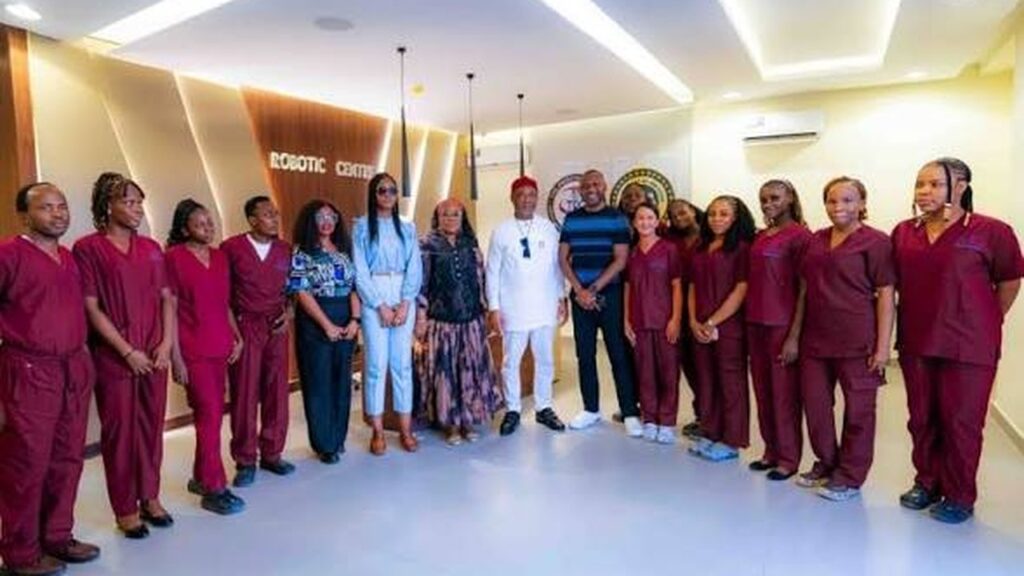
That is an important distinction.
Across healthcare systems, acquiring sophisticated equipment is one thing. Building the human expertise, clinical systems and financial structure necessary to use that equipment consistently is another.
Imo is now entering that second phase.
The state has said the robotics centre is intended to expand access to specialised treatment, strengthen cancer and urological care, encourage specialist training and international collaboration, and reduce the need for Nigerians to travel abroad for advanced medical treatment.
The first operation therefore represents more than a technological demonstration.
It is the first visible test of whether the infrastructure can become a functioning healthcare institution.
And that leads directly to the question of access.
The Robot Is Here. But Who Can Reach It?
There is an important difference between having advanced healthcare and having accessible advanced healthcare.
A robotic surgical system can provide sophisticated capabilities inside an operating theatre.
But a patient outside that theatre still needs to be able to reach it.
That means affordability.
It means insurance.
It means trained doctors.
It means referral systems.
It means diagnostics.
It means trust.
And it means a healthcare system capable of supporting patients before, during and after treatment.
This is why a conversation I had in July 2025 suddenly feels relevant to the robotic-surgery story of 2026.
At the time, DSG Herald News visited the office of the Imo State Health Insurance Agency and interviewed its Executive Secretary and CEO, Dr. Uchenna Ewelike.
The subject was not robotic surgery.
It was something more fundamental:
How do you make healthcare available to people who cannot afford it?
WATCH: DSG Herald News Interview With Dr. Uchenna Ewelike
DSG Herald News interviewed Dr. Uchenna Ewelike, Executive Secretary/CEO of the Imo State Health Insurance Agency, in July 2025 about Imo Care, healthcare access and the agency’s approach to covering residents.
That interview provides useful context for understanding the next stage of Imo’s healthcare ambition.
[READ:Imo Care: How Free Healthcare Is Changing Lives in Imo State]
What Imo Care Revealed About the Access Problem
During that interview, Dr. Ewelike described Imo Care as a people-focused healthcare programme designed to extend access across the state’s 27 Local Government Areas.
According to the information he provided during the interview, more than 2.7 million residents had been enrolled under the programme, while more than 438,000 medical cases had been managed.
Those numbers were presented not simply as statistics, but as evidence of an attempt to take healthcare into communities.
Pregnant women.
Children.
Pensioners.
Low-income families.
People living in rural communities.
The underlying philosophy was straightforward: healthcare should not become inaccessible simply because someone cannot afford the bill.
Dr. Ewelike expressed that principle in blunt terms:
“Health is not a privilege—it’s a right.”
It is a philosophy that becomes particularly interesting when placed next to the arrival of robotic surgery.
Because the challenge changes when healthcare becomes more sophisticated.
It is one thing to make basic or emergency care accessible.
It is another thing to make highly specialised cancer treatment accessible.
That is the bridge between Imo Care and Imo robotic surgery.
The ₦15,000 Figure Needs to Be Understood Correctly
There is another detail from that 2025 interview that deserves attention because it can easily be misunderstood in the current conversation.
The figure of ₦15,000 was discussed in relation to the Imo Care insurance model.
For people in the informal sector, Dr. Ewelike explained that enrollees contributed ₦15,000 per year, while civil servants, pensioners and some of the most vulnerable groups were enrolled at no cost to them under the arrangements described in the interview.
That means the ₦15,000 should not be interpreted as the cost of medical treatment.
It was the annual enrolment contribution for the informal sector under the model described by the agency.
And one example from the interview showed why that distinction matters.
Dr. Ewelike spoke about a woman who needed a Caesarean section and was initially faced with a bill of approximately ₦1.1 million.
Because she was enrolled in Imo Care, the woman paid the reported ₦15,000 enrolment fee, while the scheme covered the remaining cost.
That is the basic idea behind health insurance at its most useful:
the patient does not have to carry the full financial weight of an unexpected medical emergency alone.
Now transfer that principle to robotic surgery.
The question becomes much harder.
Can Insurance Bridge the Gap to Robotic Surgery?
The arrival of robotic surgery creates an entirely different level of healthcare conversation.
The technology is sophisticated.
The specialists are highly trained.
The infrastructure is expensive.
The procedures are complex.
And patients may require extensive diagnostic and post-operative care.
So when officials talk about making advanced healthcare more accessible, the crucial question is not simply whether the technology exists.
It is:
How will patients pay for it?
Will insurance cover robotic-assisted procedures?
Which patients will qualify?
What conditions will be covered?
How much will patients contribute?
What happens when the cost of treatment exceeds what an insurance package can reasonably absorb?
The reports surrounding the first robotic-assisted operation do not answer all of those questions.
And that is important.
It would be premature to suggest that the existence of the robotics centre automatically makes robotic cancer treatment affordable for the average Imo resident.
What can be established is that the state already has an insurance mechanism whose stated purpose includes reducing the financial barriers to healthcare.
The next challenge is whether that mechanism can effectively connect with the state’s most advanced forms of medical treatment.
The Medical Tourism Question
This is where the story moves beyond Imo.
Nigeria has for years faced the challenge of patients travelling abroad when they believe certain specialised procedures, expertise or facilities are unavailable domestically.
The Imo Robotics and Oncology Centre has been presented as part of an effort to change that equation.
The state government has said the facility is intended to reduce the need for Nigerians to travel abroad for specialised treatment and retain more healthcare expenditure within Nigeria.
That is an ambitious proposition.
But it should be treated as an objective, not as an accomplished fact.
The first robotic operation does not prove that medical tourism has been reduced.
It proves that Imo now has another domestic option for specialised surgical care.
Whether that option can become a genuine alternative will depend on what happens next.
Patients will have to trust the centre.
Doctors will have to maintain expertise.
The technology will have to remain operational.
Treatment will have to be financially accessible.
And the centre will need to demonstrate consistent clinical performance.
The difference between a headline-making facility and a transformative healthcare institution lies in those details.
Owerri’s Opportunity Is Bigger Than Imo
There is also a regional dimension to what is happening.
The centre is located in Umuguma, Owerri, but its significance need not end at Imo’s borders.
If the facility develops a strong reputation for specialised treatment, patients from other parts of Southeast Nigeria could potentially seek care there rather than travelling much farther.
That could gradually change the direction of healthcare movement in the region.
Instead of patients leaving the Southeast in search of advanced care, a portion of that movement could begin coming towards Owerri.
But that transformation will not happen simply because a robotic system has been installed.
Patients do not travel for equipment.
They travel for confidence in outcomes.
They want doctors they trust.
They want reliable hospitals.
They want transparent costs.
They want access to follow-up care.
And they want to know that the same level of treatment will still be available tomorrow.
That is why the sustainability of the centre may ultimately matter more than the novelty surrounding its first operation.
The Robot Cannot Work Alone
There is another fact buried within the official celebration that deserves more attention.
The robot is not the surgeon.
It is a tool.
The expertise remains human.
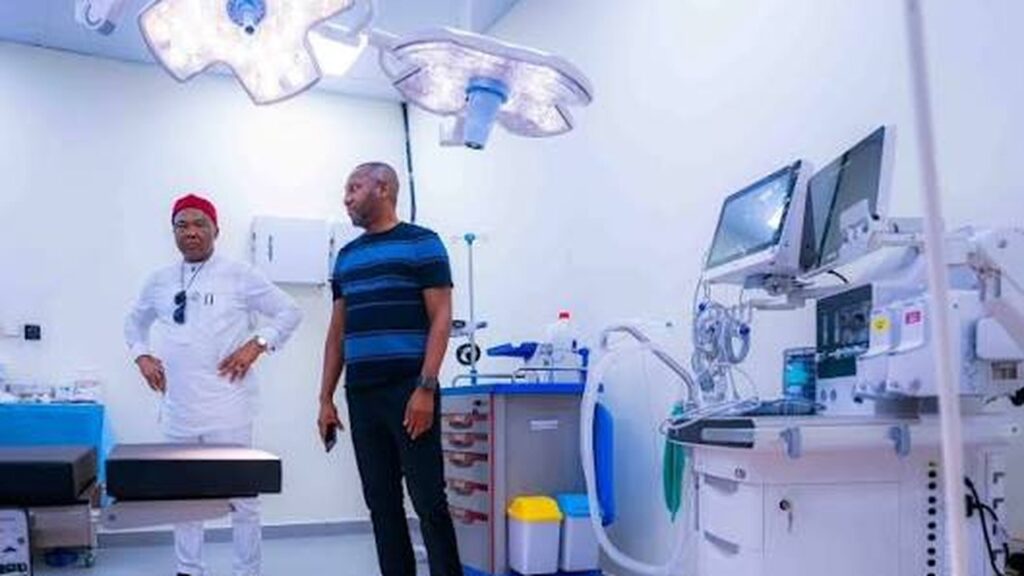
Professor Kingsley Ekwueme led the first procedure alongside Nigerian and international specialists, bringing specialist knowledge into the new facility.
But the long-term question is what happens to that expertise after the first operation.
Can local surgeons be trained?
Can nurses and technicians develop the necessary skills?
Can international collaboration become continuous knowledge transfer rather than occasional intervention?
Can Imo develop a permanent ecosystem around robotic and specialised medicine?
Governor Hope Uzodimma highlighted this issue precisely when he said:
“Equipment must be matched with competence, and technology must be matched with training.”
That may be one of the most important statements surrounding the project.
Because if the goal is to reduce dependence on treatment abroad, then simply importing technology is not enough.
Nigeria must also retain the knowledge required to operate it.
What Imo Care Can Teach the Robotics Centre
This is where the 2025 Imo Care experience becomes particularly relevant.
The lesson from the insurance programme is that healthcare transformation is not simply about what government builds.
It is about how people interact with the system.
According to the information provided by Dr. Ewelike during the DSG Herald News interview, Imo Care had been operating across all 27 Local Government Areas, with accredited providers reaching communities across the state’s electoral wards.
The agency also described systems for monitoring healthcare providers and responding to complaints from patients who were denied services.
That kind of infrastructure may seem unrelated to robotic surgery.
It is not.
A patient undergoing complex cancer treatment needs more than an operating theatre.
They need a pathway.
They need diagnosis.
They need referral.
They need financing.
They need treatment.
They need follow-up.
They need somewhere to turn when something goes wrong.
In other words, advanced medicine needs a healthcare system around it.
The robot may be the most visible component.
The less visible components may determine whether the technology actually changes lives.
From One Patient to a Healthcare Ecosystem
The first robotic-assisted surgery involved one patient.
But the ambition surrounding the centre is much larger.
The reports describe the facility as combining robotic surgical capabilities with oncology services and as a platform for specialist training and international collaboration.
That means its potential impact should not be measured only by the number of operations performed.
It could also be measured by:
- How many specialists are trained.
- How many patients gain access to specialised treatment.
- How effectively insurance supports care.
- How many procedures can be sustained locally.
- How much specialist knowledge remains within Nigeria.
- How much healthcare expenditure can be retained domestically.
- How much confidence patients develop in local treatment.
These are longer-term measurements.
And they are far more meaningful than the excitement surrounding the first operation.
The Real Test Begins After the Headlines
There is a tendency with major healthcare announcements to celebrate the arrival of technology as though technology itself represents transformation.
But technology is only an opportunity.
The transformation happens when people can use it.
That is why Imo’s first robotic-assisted surgery should be seen as a beginning rather than a conclusion.
The state has demonstrated that it can establish a facility and perform a robotic-assisted procedure.
The next stage is harder.
It must demonstrate that advanced care can be delivered consistently.
It must show that expertise can be developed locally.
It must clarify how patients will access and finance treatment.
It must maintain the equipment.
And it must determine how the state’s health insurance architecture can interact with increasingly sophisticated medical services.
The answers will not come from one operation.
They will come from years of patient outcomes, professional development, affordability and institutional sustainability.
The Bigger Question Is Not About the Robot
Perhaps that is the most important way to understand what happened in Umuguma on August 21.
The story is not really about a robot.
It is about a healthcare system attempting to move from access to basic care towards access to advanced care.
In 2025, the conversation around Imo Care was about whether a woman facing a ₦1.1 million emergency could receive treatment without carrying that financial burden alone.
In 2026, the conversation has moved into another territory.
Can a patient requiring highly specialised robotic surgery receive that treatment without having to leave Nigeria?
Those are different questions.
But they belong to the same healthcare story.
One is about financial access.
The other is about technological and specialist access.
And ultimately, both come down to the same thing:
Can the healthcare system reach the person who needs it?
Imo Has Opened the Door. Now Comes the Test
The first robotic-assisted surgery has given Imo something it did not have before: demonstrated experience in using this technology in actual patient care.
That is significant.
But the real measure of success will not be the machine.
It will be the patients.
It will be the specialist doctors trained in Imo.
It will be the families that do not have to travel thousands of kilometres for treatment.
It will be the patient who can afford care because insurance has helped bridge the financial gap.
It will be the trust built when people discover that sophisticated treatment can be delivered at home.
And it will be the ability of the system to keep delivering that care long after the first operation has disappeared from the headlines.
The robot has arrived in Owerri.
The bigger challenge now is to make sure access catches up with technology.
If Imo succeeds, the significance of that first operation could extend far beyond one hospital, one patient or one state.
It could become part of a broader Nigerian story about whether advanced healthcare can increasingly be delivered at home — by Nigerian institutions, supported by Nigerian expertise, and made accessible to the people who need it.
The machine has started working.
Now the healthcare system has to prove it can work for the people.
WATCH THE ORIGINAL DSG HERALD NEWS INTERVIEW
DSG Herald News Interviewed Dr. Uchenna Ewelike, CEO of the Imo State Health Insurance Agency
In July 2025, DSG Herald News sat down with Dr. Uchenna Ewelike to examine how Imo Care was being used to expand healthcare access across Imo State.
The interview provides important background to the question now confronting the state’s robotic healthcare programme: how do you make sophisticated healthcare accessible to ordinary people?
Watch the full interview with Dr. Uchenna Ewelike on Imo Care, healthcare access, insurance and the experiences behind the programme.
Recommended Coverage
Imo Care: How Free Healthcare Is Changing Lives in Imo State
Before Imo introduced robotic surgery, another healthcare question was already being tackled: how can ordinary residents afford treatment?
Read our earlier report on Imo Care to see how the state’s health insurance model is attempting to bridge that gap.
Nigeria’s Economy — The Tinubu Administration: Progress or Crisis?
Advanced healthcare means little if patients cannot afford to access it. But Nigeria’s wider economic reality is shaping what families can spend on healthcare.
Explore our broader look at the Nigerian economy and the pressures influencing household decisions.
Tinubu Poverty Programme: Can It Reduce Poverty?
For millions of Nigerians, the biggest healthcare barrier is not the absence of technology—it is the ability to pay when illness strikes.
Read how Nigeria’s wider poverty-reduction efforts are attempting to address the financial pressures facing vulnerable families.
About the Author