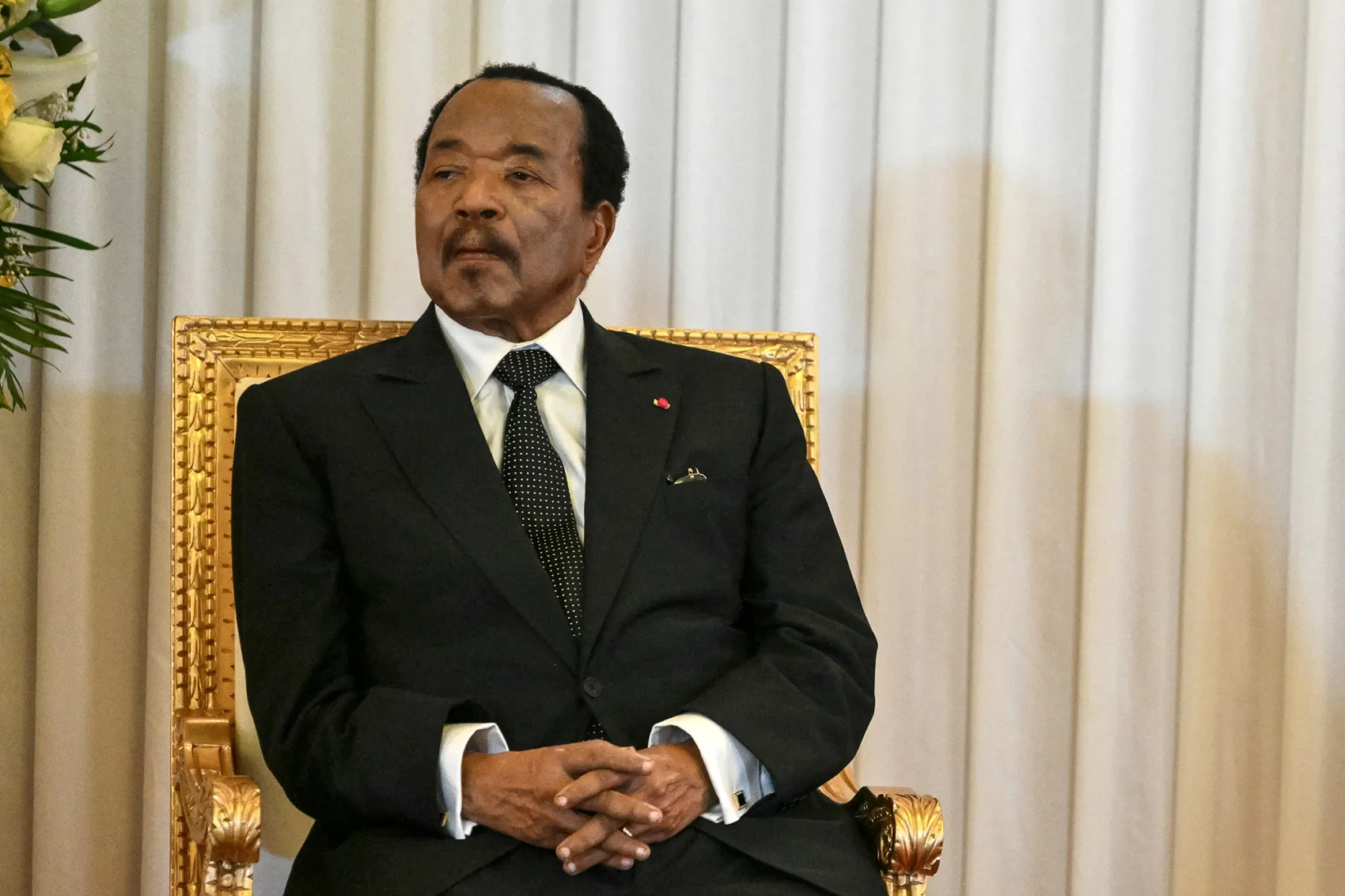
Cameroon’s President Paul Biya has returned to Yaoundé after 73 days abroad, ending an unusually long absence that had intensified debate over presidential authority, government continuity and the country’s eventual political transition. The 93-year-old leader arrived at Nsimalen International Airport on Thursday, August 20, from Geneva, Switzerland, where he had stayed since June 7 on what his office described as a brief private trip.
Biya’s return closes the immediate question of where the world’s oldest serving head of state had been. But it does not necessarily close the larger political conversation his absence exposed.
For more than two months, his prolonged stay abroad generated speculation about his health and capacity to govern, while opposition figures questioned how effectively Cameroon was being administered in his absence. The episode also placed renewed attention on a more consequential issue: how power will eventually be transferred after more than four decades of Biya’s rule.
That question has become particularly significant because Cameroon amended its Constitution in April 2026 to restore the office of vice-president. Under the new framework, the vice-president is appointed by the president and becomes the successor in the event of a presidential vacancy caused by death, resignation or permanent incapacity.
Biya has returned. The succession question, however, remains part of Cameroon’s political future.
Paul Biya Returns to Yaoundé After 73 Days
Biya arrived in Yaoundé aboard a chartered flight from Geneva, accompanied by First Lady Chantal Biya.
He left Cameroon on June 7, with his office initially describing the journey as a private stay in Europe. More than 10 weeks later, he returned to the capital, where supporters of the ruling Cameroon People’s Democratic Movement gathered to welcome him.
The president was seen waving from his vehicle as he travelled from the airport towards the Etoudi Unity Palace.
The return followed one of the longest recorded periods Biya has spent outside Cameroon since becoming president in 1982.
That fact alone made the latest trip different from his previous stays abroad, particularly his frequent visits to Geneva.
Biya’s travels to Switzerland have long attracted public attention. His latest absence was different because of its duration and because it occurred against a backdrop of heightened political uncertainty following his re-election to an eighth term in 2025.
The government maintained that the president remained in charge of state affairs.
Opposition figures, however, used the prolonged absence to question whether the country’s highly centralised political system could function effectively when the president was physically away for such an extended period.
That disagreement became one of the defining political features of the episode.
Why Biya’s Absence Became a Political Issue
Presidential travel is not unusual. What made Biya’s latest absence politically significant was the combination of its length, the president’s age and the concentration of political authority around the presidency.
Biya is 93 and has governed Cameroon since 1982. His presidency has therefore lasted longer than the adult lives of a large proportion of the country’s population.
According to the reports supplied for this story, more than 70 percent of Cameroon’s population of almost 30 million people is below the age of 35.
That demographic reality creates an unusual contrast.
A large majority of Cameroonians have known only one president.
For younger citizens, the Biya presidency is not simply one chapter in the country’s political history. It represents much of the political system they have experienced throughout their lives.
That helps explain why an extended presidential absence can become more than a question about travel.
It becomes a question about institutions.
Who makes the major decisions when the president is away?
Who speaks with authority on behalf of the presidency?
How does the system respond if an absence becomes permanent rather than temporary?
And, ultimately, what mechanism determines who governs Cameroon after Biya?
These questions existed before the latest Geneva stay. But the 73-day absence brought them back into public focus.
Opposition Calls Cameroon an “Autopilot” State
The political response to Biya’s absence was sharply divided.
Opposition politicians criticised the length of the president’s stay abroad and argued that the country lacked effective presidential leadership.
Some described Cameroon as operating on “autopilot”, while others questioned whether an institutional vacuum had developed around the presidency.
The criticism reflected a wider frustration among sections of the opposition with the concentration of power around Biya.
But the government and ruling-party figures rejected the suggestion that Cameroon had been left without leadership.
James Fame Ndongo, a senior ruling-party figure and higher education minister, dismissed claims of a power vacuum and maintained that Biya continued to oversee state affairs.
That disagreement is important because it reveals two competing interpretations of the same political system.
The government position is that presidential authority does not disappear simply because the president is abroad.
The opposition position is that an unusually long absence by a president whose powers are heavily concentrated in the presidency creates legitimate questions about accountability and decision-making.
Biya’s return has therefore resolved the immediate physical absence, but it has not erased the institutional debate.
The Succession Question Has Changed
One of the most important developments surrounding Cameroon’s political future occurred before Biya returned.
In April 2026, Parliament approved a constitutional amendment restoring the office of vice-president, a position that had been abolished in 1972. The reform was presented by supporters as a mechanism for strengthening institutional continuity.
The change is particularly significant because it establishes a clearer succession mechanism than the arrangement described in older reporting.
Under the amended framework, the vice-president is appointed by the president rather than elected separately by voters. If the presidency becomes vacant because of death, resignation or permanent incapacity, the vice-president assumes the presidency and completes the remainder of the presidential term.
That means the constitutional architecture surrounding succession has now changed.
The question is no longer simply what happens if Cameroon suddenly loses its president.
It is also about who will occupy the newly restored office that sits directly within the succession framework.
As of the reporting used for this article, there had been no verified appointment of a vice-president.
This point is especially important because false claims circulated online in April alleging that Biya had appointed his son, Franck Emmanuel Biya, as vice-president. AFP Fact Check found the purported decree to be fabricated, while Cameroonian officials confirmed that no vice-president had been appointed at the time.
The absence of a verified appointment means speculation about potential successors should not be presented as fact.
Why the Vice-Presidency Matters
The restoration of the vice-presidency changes the political conversation in Cameroon because it provides a formal constitutional position linked to presidential succession.
Supporters of the reform argue that such an arrangement can strengthen continuity and reduce uncertainty if the presidency becomes vacant.
Critics see a different problem.
Because the president controls the appointment of the vice-president, opponents have questioned whether the arrangement creates an orderly succession mechanism or simply transfers significant succession power to the sitting president.
Reuters reported that the April reform was approved by Parliament by a large majority and that the vice-president would be appointed and dismissed by the president. The reform was presented by its supporters as a measure designed to ensure continuity, while opposition voices criticised the concentration of power involved in the appointment process.
That tension lies at the heart of the succession debate.
A succession system needs to answer two questions.
First, who takes over?
Second, how is that person chosen?
Cameroon’s constitutional reform provides an answer to the first question.
The second remains politically contested because the vice-president is appointed by the president rather than elected alongside the president.
That distinction could become increasingly important as Cameroon considers its political future.
Biya’s Long Rule Shapes the Debate
To understand why succession has become such a sensitive issue, it is necessary to consider the length of Biya’s presidency.
He came to power in 1982 after succeeding Ahmadou Ahidjo.
More than four decades later, he remains president.
His political longevity has been reinforced by constitutional changes. In 2008, Parliament removed presidential term limits, allowing Biya to continue seeking re-election.
He won an eighth term in the October 2025 presidential election, a result that was disputed by opposition figures and followed by protests.
The political environment surrounding that election matters because Biya’s latest absence did not occur during a period of political calm.
It came after a contested electoral cycle and amid wider questions about the country’s political direction.
The return of the president therefore cannot be separated entirely from the larger debate over what happens when his exceptionally long presidency eventually comes to an end.
Cameroon’s Young Population and an Ageing Presidency
Perhaps the most striking feature of Cameroon’s political landscape is the contrast between its ageing president and its young population.
Biya is 93.
More than 70 percent of Cameroon’s population is under 35, according to figures cited in the supplied reports.
This creates a generational divide that extends beyond politics.
Many young Cameroonians have grown up in a country where the same individual has occupied the presidency throughout their lives.
That reality shapes expectations about political change, economic opportunity and institutional renewal.
The frustrations surrounding Biya’s long tenure are also connected to broader security and economic challenges.
Cameroon continues to face an insurgency linked to Boko Haram in the Far North, while separatist conflict has persisted in the English-speaking Northwest and Southwest regions.
The country has also faced economic difficulties and concerns about limited opportunities for younger citizens.
These problems cannot be attributed to a single factor or resolved simply through a change of leadership.
But they help explain why the question of political transition carries such importance.
For many young Cameroonians, succession is not an abstract constitutional issue.
It is connected to the question of whether the country’s political system can produce a different future.
The Economic Dimension of Political Uncertainty
The direct economic effect of Biya’s 73-day absence is difficult to quantify from the available reporting.
There is no evidence in the supplied material that the absence caused a specific economic crisis or market disruption.
The more important economic issue is therefore institutional confidence.
Governments, investors and businesses depend on predictable decision-making.
When political authority is concentrated heavily around one office, uncertainty surrounding that office can become a wider governance concern.
Africa Confidential reported that Biya’s prolonged absence had contributed to concerns over delayed decision-making in Yaoundé and the unresolved question of the vice-president.
That does not mean Cameroon’s economy stopped functioning while Biya was abroad.
It means that questions about the continuity of executive decision-making can become relevant to the broader investment and governance environment.
For Cameroon, which is one of Central Africa’s major economies and a key regional state, institutional predictability matters beyond its borders.
Political stability affects confidence in public administration, long-term investment decisions and the ability of governments to implement policy consistently.
The succession debate is therefore not only about who eventually occupies the presidency.
It is also about whether the institutions around that presidency are strong enough to provide continuity.
A Return That Does Not End the Debate
Biya’s supporters were visibly pleased to see him return.
For the government, his arrival reinforces the message that the president remains active and in control.
For the opposition, however, the episode has already served another purpose: it has exposed what critics regard as vulnerabilities in Cameroon’s political structure.
That is why the return should not be interpreted simply as the conclusion of the story.
The 73-day absence was the event.
The succession question is the longer story.
The president is physically back in Yaoundé, but the political system still has to address questions about continuity, institutional resilience and eventual transition.
The April constitutional reform was an attempt to provide a clearer mechanism for succession.
Yet because the vice-president is appointed by the president, rather than elected independently, debate over the legitimacy and political implications of the arrangement is unlikely to disappear.
What Happens After the Biya Era?
The most consequential question surrounding Paul Biya may ultimately have little to do with his latest trip to Geneva.
It is what happens after his presidency.
Cameroon has experienced decades of political continuity under one leader.
The challenge ahead will be ensuring that the eventual transition does not become a period of institutional uncertainty or political confrontation.
The restored vice-presidency is now part of that conversation.
So are the Constitutional Council, Parliament, the Senate, political parties and the wider electoral system.
The effectiveness of those institutions will matter when the country eventually faces a genuine transfer of power.
The question is not necessarily whether Biya will leave office tomorrow.
There is no evidence in the current reporting that he has announced such a plan.
The issue is whether Cameroon is prepared for the day when a transition becomes unavoidable.
That is a question every long-running political system eventually has to confront.
Cameroon’s Political Future Beyond One President
Biya’s return provides an opportunity for Cameroon to move beyond the immediate controversy surrounding his absence and focus on the institutional questions underneath it.
The country now has a constitutional mechanism for a vice-president, although the office remains unfilled according to the reporting available for this story.
It also has a political system shaped by more than four decades of one-party dominance and presidential centralisation.
The next phase of Cameroon’s political history will test whether those institutions can manage change peacefully and predictably.
For neighbouring African states, the issue carries wider relevance.
Across the continent, questions about presidential longevity, constitutional amendments and succession have repeatedly shaped political stability.
Cameroon’s experience will therefore be watched beyond Yaoundé.
Its eventual transition could provide an important test of whether constitutional mechanisms are strong enough to manage the departure of a leader who has dominated national politics for more than 40 years.
Biya Is Back, but the Bigger Question Remains
Paul Biya’s return has ended a 73-day absence that generated intense speculation and political criticism.
He is back in Yaoundé.
Supporters have welcomed him.
The government has rejected claims that Cameroon was without effective leadership.
But the episode has also highlighted a question that will remain long after the headlines about his Geneva stay fade.
How will Cameroon manage the political transition beyond Paul Biya?
The April restoration of the vice-presidency has provided a formal constitutional route for succession, but the political debate surrounding how that office is filled remains significant.
Biya’s return therefore marks the end of one uncertainty, not necessarily the end of the larger debate.
After more than four decades at the centre of Cameroon’s political system, the question of what comes next is becoming increasingly difficult to separate from the question of Biya himself.
For Cameroon, the challenge will be to ensure that when that next chapter eventually arrives, the country’s institutions are prepared to carry the state forward.
Recommended Coverage
About the Author