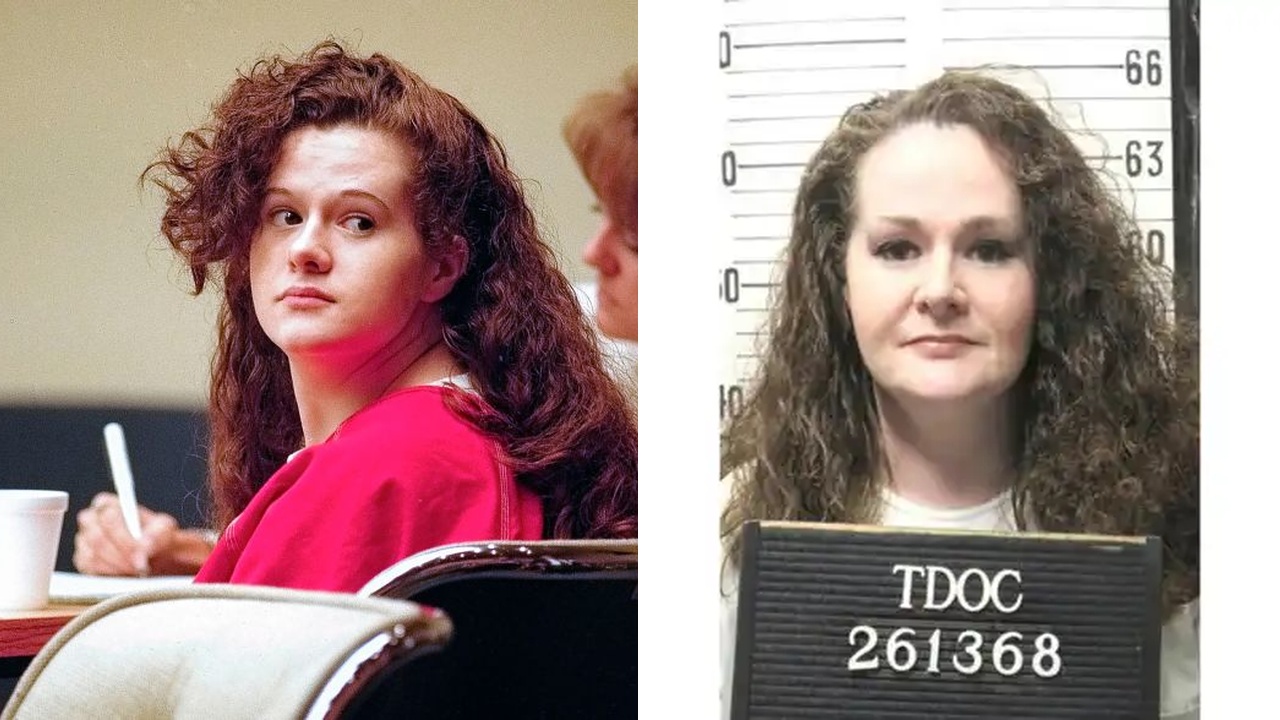
Christa Pike Execution: What Happened and What Comes Next
Christa Pike remains alive after Tennessee officials administered two doses of pentobarbital during an attempted lethal injection on Wednesday, September 30, 2026, leaving the 50-year-old death-row inmate in critical condition, triggering an independent investigation and prompting Tennessee Governor Bill Lee to halt the state’s remaining executions for the year.

The failed Christa Pike execution has become an extraordinary case in the modern history of capital punishment in the United States. Pike was sentenced to death in 1996 for the 1995 murder of 19-year-old Colleen Slemmer, a killing committed when Pike was 18. She was scheduled to become the first woman executed in Tennessee in more than 200 years.
Instead, the execution chamber became the scene of a prolonged medical and procedural failure.
Pike’s lawyers said she was given two doses of the lethal-injection drug pentobarbital but remained alive. She was eventually taken by ambulance to hospital, where her lawyers said she was receiving lifesaving care and remained in critical condition.
The episode has left several questions unanswered. How did the execution fail after two doses of the state’s lethal drug? What exactly happened during the period when witnesses could no longer see inside the chamber? Why does Tennessee’s execution protocol specify a second dose if the first fails but apparently does not clearly establish what happens if the prisoner remains alive afterward?
Those questions now sit at the centre of a third-party review ordered by Lee.

1. What happened during the Christa Pike execution?
The execution had already been delayed by a last-minute legal battle before the lethal injection began.
Pike’s execution was initially scheduled for 10 a.m. Wednesday at Riverbend Maximum Security Institution in Nashville. An appeals court issued a stay roughly an hour before the scheduled execution, citing concerns about whether allegations of childhood sexual abuse had been fully considered during her sentencing.

Tennessee officials appealed to the U.S. Supreme Court.
The Supreme Court later cleared the way for the execution to proceed. The court’s conservative majority did not explain its order, while three liberal justices dissented, saying Pike’s claims warranted closer consideration.
By the evening, media witnesses were allowed to observe the execution from a separate room.
According to the account reported by The Associated Press, the curtains to the execution chamber were raised at about 7:27 p.m. Pike was strapped to a gurney and delivered what were described as her final words.
But the procedure did not proceed as expected.
Witnesses reported that Pike remained awake after the first dose and complained about the sensation in her arm. She reportedly asked prison officials whether her arm was supposed to feel the way it did.
Her lawyer, Randy Spivey, later said the execution team had spent about an hour attempting to establish an intravenous line.
Spivey said he counted at least seven needles used in Pike’s left arm alone, including one that appeared bent after being removed.
A second dose of pentobarbital was subsequently administered.
Pike appeared to lose consciousness, but witnesses continued to hear her breathing and snoring.
According to the AP account, the second dose had been administered by approximately 8:26 p.m. Pike could still be heard snoring behind the closed curtain until the microphone was cut off at about 8:53 p.m.
The media witnesses were then instructed to leave.
What happened behind that curtain remains one of the most significant unanswered elements of the case.
2. Why did two lethal doses fail?
At present, the supplied reports do not establish a definitive medical explanation for why Pike survived the administration of two doses of pentobarbital.
That distinction matters.
Tennessee’s Department of Correction said it followed every step of the state’s established execution protocol, which had been approved by the attorney general’s office.
The state’s protocol calls for a secondary set of drug syringes if the inmate is not deceased after the first set.
But the protocol reportedly does not spell out what should happen if the prisoner remains alive after the second set.
That gap is likely to be one of the issues examined by the independent review.
The state said the lethal-injection chemical specified in its protocol had consistently been effective and that the protocol did not authorize additional procedures beyond those carried out.
Pike’s lawyers, however, described the experience as an episode of unnecessary agony and argued that the execution violated her constitutional protection against cruel and unusual punishment.
Those positions represent two fundamentally different descriptions of the same event.
The state maintains that its personnel followed the established procedure.
Pike’s legal team argues that what happened demonstrates a failure in that procedure.
The investigation will have to determine what occurred medically and operationally before those competing interpretations can be resolved.
Tennessee’s execution protocol is now under scrutiny
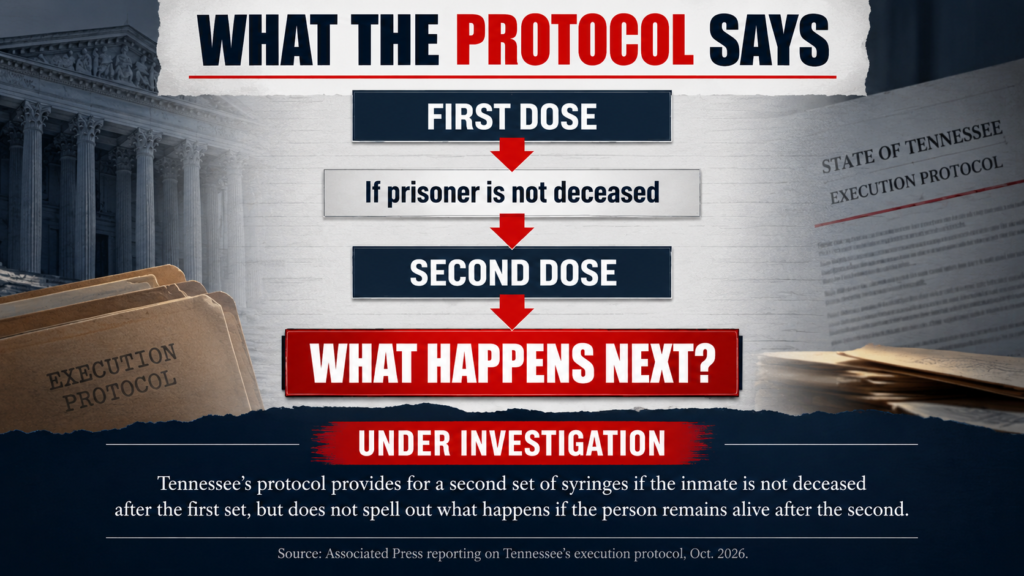
The Christa Pike execution has exposed a particularly important procedural problem: what happens when a state has a protocol for a failed first dose but encounters a failure after the second?
According to the supplied AP report, Tennessee’s procedure was changed in 2024, when the state moved from a three-drug lethal-injection sequence to the single drug pentobarbital.
The change came after the state abruptly halted the planned execution of Oscar Smith in 2022 and acknowledged that it had failed to ensure that its lethal-injection drugs were properly tested.
Pike’s case therefore does not occur in isolation.
It follows an earlier execution failure in Tennessee in May 2026, when officials attempted to execute Tony Carruthers. That execution was called off after medical personnel were unable to establish an intravenous line for administering pentobarbital. Carruthers received a one-year reprieve.
The difference between the two cases is significant.
In Carruthers’ case, the problem was establishing access for the lethal drug.
In Pike’s case, the state successfully administered two doses, according to her lawyers and the court filings cited in the source reports, yet Pike remained alive.
That makes the investigation especially important because it must examine not only the administration of the drugs but the entire chain of events surrounding the execution.
3. What happened after the second dose?
The period following the second injection is one of the least transparent parts of the episode.
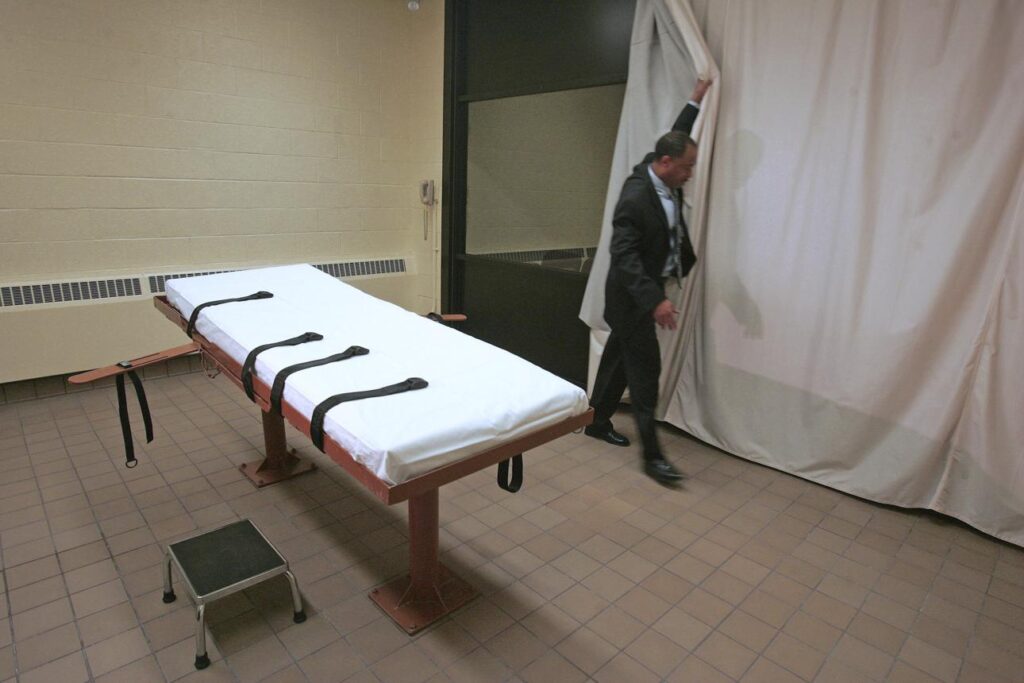
Pike’s lawyers said witnesses were kept in a room behind a closed curtain after the second dose.
Spivey said it was clear that Pike was still breathing but that observers had no way of knowing what was happening inside the chamber.
He questioned when, or whether, medical professionals began assisting Pike.
The public account therefore contains a significant information gap between the administration of the second dose and Pike’s eventual transfer to hospital.
That gap does not establish wrongdoing by itself.
But it does mean that the independent investigation will be important in reconstructing the sequence.
A central question will be whether the execution team acted according to written procedures at every stage and whether those procedures adequately addressed the situation that developed.
The Tennessee Department of Correction has maintained that its personnel followed the state’s lawful and established protocol.
Governor Lee, meanwhile, has acknowledged that there are unresolved questions.
“There are a lot of questions,” Lee said while announcing the investigation, adding that Tennessee residents deserved answers.
The governor has not, according to the supplied reporting, specified who will conduct the independent review.
4. Why did Governor Bill Lee halt Tennessee’s executions?
Lee ordered a comprehensive third-party review after the failed execution and halted the state’s remaining executions for 2026.

The decision affects the planned December 3 execution of convicted murderer Gary Sutton.
The governor said carrying out a lawfully imposed sentence is among the state’s most serious responsibilities and that Tennesseans expect executions to be carried out in a manner that is legal, constitutional and effective.
The pause does not amount to an abolition of the death penalty in Tennessee.
Rather, it creates a temporary halt while officials examine what happened during Pike’s execution attempt.
That distinction is important because Tennessee remains a death-penalty state, and Lee has continued to defend capital punishment as the penalty determined by the state’s electorate for certain serious crimes.
The investigation will therefore take place within an existing legal framework that permits executions while seeking to determine whether the state’s current procedures are adequate.
5. What happens to Christa Pike now?
Pike’s immediate future is uncertain.
Her lawyers have asked for her death sentence to be commuted and said they are examining other legal options.
The immediate priority, however, is her medical condition.
Her lawyer said Pike was alive and receiving lifesaving treatment but that her prognosis was not yet known. The supplied NPR report also said it remained unclear whether she had suffered brain damage.
Because the available reports do not provide a definitive medical prognosis, the consequences of the failed execution cannot yet be fully assessed.
The legal consequences could also depend on the findings of the independent review and subsequent court proceedings.
Pike’s lawyers have argued that the execution attempt itself created a new constitutional issue, particularly because they contend that she experienced unnecessary suffering.
Whether courts accept that argument remains unresolved.
For now, the failed execution has created a situation in which a prisoner who was legally sentenced to death remains alive after the state attempted to carry out that sentence.
6. Who is Christa Pike?
Pike was 18 when she participated with her then-boyfriend, Tadaryl Shipp, in the killing of Slemmer in Knoxville in January 1995.
The victim was 19.
According to the AP account, prosecutors said Pike feared Slemmer was attempting to take her boyfriend. Pike and Shipp lured Slemmer to a wooded area, where Pike attacked her with a box cutter and a large piece of asphalt.
Shipp admitted carving a pentagram into Slemmer’s body.
The killing became associated with the “satanic panic” of the 1980s and 1990s, when fears surrounding alleged satanic activity influenced public discussion of some criminal cases.
Pike did not deny committing the killing.
She was sentenced to death in 1996, while Shipp received life imprisonment with the possibility of parole because he was 17 when the crime occurred and therefore was not legally an adult.
Pike’s age at the time of the murder became an important part of the legal and clemency debate surrounding her execution.
Her supporters argued that the state should consider her age, mental illness and allegations of severe childhood sexual abuse.
The supplied AP report says Pike was diagnosed with bipolar disorder and post-traumatic stress disorder after the killing.
Those issues formed part of the legal arguments made by her defence team before the execution.
7. Why the case has reopened the death-penalty debate
The immediate issue is the failed execution, but the episode has inevitably reopened a broader debate over capital punishment in the United States.
The supplied NPR report notes that public attitudes toward the death penalty have shifted over time. A Gallup poll cited in that report found that 52% of Americans favoured the death penalty in 2025.
Executions have also continued across the United States.
According to the NPR material supplied for this report, 47 people were executed nationwide in 2025, the highest number since 2009. Methods varied by state, although lethal injection remained the dominant method.
The debate has also expanded beyond lethal injection.
Some states have used firing squads or nitrogen inhalation, while opponents of those methods have raised concerns about the potential for suffering.
The Christa Pike case adds another dimension: not simply whether capital punishment should exist, but whether the procedures used to carry it out can reliably produce the intended result while meeting constitutional requirements.
That distinction is likely to remain important as Tennessee examines what happened.
The victim’s family remains part of the story
Any examination of the failed execution also has to account for the family of Colleen Slemmer.
Slemmer’s mother, May Martinez, travelled to Tennessee expecting to witness the execution of the woman convicted of killing her daughter.
She had waited decades for the sentence to be carried out.
Before the execution, Martinez described the pain of remembering what her daughter experienced during the attack.
After the execution failed, the supplied BBC report quoted Martinez describing the event simply as “a mess.”
Her position illustrates one of the central tensions surrounding capital punishment.
For victims’ families, an execution can represent the completion of a legal sentence after years or decades of waiting.
For opponents of capital punishment, the state’s attempt to deliberately end a prisoner’s life remains unacceptable regardless of the crime.
The Pike case places those competing perspectives alongside a separate question: what should happen when the state attempts to carry out a death sentence and the procedure fails?
Tennessee’s political debate is already changing
The failed execution has also entered Tennessee’s political debate.
U.S. Sen. Marsha Blackburn, a Republican candidate for Tennessee governor, described the situation as tragic but argued that the state should replace lethal injection with the electric chair.
Democratic candidate Jerri Green criticised that position and called for a moratorium on future executions.
These are political positions rather than established findings about the execution itself.
The independent investigation is expected to address the factual and procedural questions. Political candidates are separately using the episode to argue for different approaches to capital punishment.
The distinction is important because the investigation must determine what actually happened, while political debate concerns what policy Tennessee should adopt afterward.
Those are related but separate questions.
What the investigation will need to establish
The state’s independent review could become the defining next chapter of the Christa Pike execution.
Among the questions raised directly or indirectly by the supplied reports are:
How long did it take to establish intravenous access?
How many attempts were made?
Why did the first administration fail to produce the expected result?
What precisely happened after the second dose?
What medical intervention, if any, occurred inside the execution chamber?
When was the decision made to stop the execution?
What did the written protocol require at each stage?
What did the protocol require if the prisoner remained alive after the second dose?
Were all personnel following the same established procedures?
Did the state’s switch to single-drug pentobarbital in 2024 contribute to the circumstances now under review?
Not all of these questions can be answered from the information currently available.
That is precisely why Tennessee has ordered an independent review.
The wider significance of the Christa Pike execution
The failed Christa Pike execution has moved beyond the question of one prisoner and one execution chamber.
It has placed Tennessee’s lethal-injection procedures under scrutiny, interrupted the state’s execution schedule and created new legal questions for Pike’s defence team.
It has also highlighted a difficult contradiction in the mechanics of capital punishment.
The state must establish procedures that are sufficiently controlled to carry out a death sentence lawfully and consistently. Yet the Pike case demonstrates that even a procedure designed around a supposedly lethal drug can produce an unexpected outcome.
The state’s response will therefore matter beyond Pike herself.
If the review identifies procedural failures, Tennessee could face pressure to change its execution protocols. If investigators conclude that the team followed the existing protocol but that the protocol itself was inadequate, the state could face a different policy question.
And if the review finds that the execution was conducted according to established procedures without identifying a clear cause for Pike’s survival, uncertainty could remain.
For Pike, however, the consequences are immediate.
Her lawyers are seeking clemency and considering further legal action. Her medical condition remains a central unknown. And Tennessee has suspended its remaining executions while officials attempt to establish exactly what went wrong.
What comes next
The next stage of the Christa Pike execution story will not be another scheduled execution date.
It will be the investigation.
Tennessee has paused the remaining executions planned for 2026 while Governor Lee’s administration seeks answers about what happened inside the Riverbend execution chamber.
Pike’s lawyers will continue pursuing legal options, including their request that her death sentence be commuted.
The state will have to determine whether its execution procedures remain adequate, while courts may eventually be asked to consider the constitutional implications of an execution attempt that left the prisoner alive after two doses of pentobarbital.
The case also leaves Tennessee facing a broader policy debate over the future of lethal injection and capital punishment.
For now, the most important facts are straightforward: Christa Pike survived the attempted execution; she was taken to hospital in critical condition; Tennessee has halted its remaining executions for the year; and an independent review is expected to examine what happened.
The answers to the unanswered procedural questions will determine what comes next for Pike, for Tennessee’s execution system and potentially for the state’s approach to capital punishment.
About the Author



