Introduction
This Africa news review examines four consequential developments reported during the 24-hour period ending on 29 October 2026. They range from a fatal offshore drilling disaster in Gabon to a new cooperation framework between Russia and the African Union Commission, renewed scrutiny of South Africa’s anti-corruption reforms, and a proposed multibillion-dollar investment in African mining.
The developments involve different countries, institutions and industries. They do not share a single cause, but they raise important questions about accountability, institutional credibility, economic opportunity and the implementation of public commitments.
In Gabon, the recovery of three bodies following the sinking of the Prospector 5 drilling rig marked a significant development in the search for missing workers. In Moscow, a new action plan established a framework for Russia–Africa cooperation between 2027 and 2029. South Africa faced renewed concerns about the sustainability of its financial-governance reforms, while mining investor Appian Capital Advisory outlined plans to allocate approximately US$2 billion to Africa.
The significance of these developments depends on the evidence behind them. A diplomatic agreement does not automatically guarantee implementation, a warning does not constitute a formal regulatory decision, and a proposed investment does not mean the money has already been deployed.
Gabon drilling rig disaster: Three bodies recovered as two remain missing

Three bodies were recovered following the sinking of the Prospector 5 offshore drilling rig off Gabon, while two people remained missing, according to Reuters reporting published on 29 October 2026.
The rig had 115 people aboard. According to the reported figures, 110 people had been accounted for safe, while five were initially unaccounted for. The recovery of three bodies marked an important development in the ongoing search operation.
The incident occurred on 24 October at approximately 8:37 p.m. local time in the Dussafu Marine licence area, during preparations for a planned offshore drilling campaign.
BW Energy reported that the rig lost stability during jacking operations and subsequently sank. Borr Drilling owned and operated the rig, which had been contracted to support BW Energy’s offshore operations. Drilling had not yet begun when the incident occurred.
The cause of the sinking remained unresolved
Although the recovery of three bodies represented a significant development, important questions remained unanswered at the close of the reporting period.
The information available did not establish the identities of those recovered or the circumstances surrounding the two people still missing. The reported loss of stability described the sequence of events but did not, by itself, establish the underlying technical cause.
The available evidence also did not establish negligence by any company or individual. Determining responsibility would require a formal investigation, relevant operational records and evidence about the procedures followed before and during the incident.
The immediate priorities included continuing the search, identifying the recovered bodies through appropriate procedures, communicating with affected families and establishing the circumstances of the disaster.
Environmental and operational questions
BW Energy said production at the MaBoMo facility had been shut down under standard procedure during the drilling preparations. The company also reported that the facility and its related equipment had not been damaged and that no harmful substances had accidentally been discharged into the sea from that facility.
These statements should be understood as company reports. The information reviewed did not establish that an independent environmental assessment had ruled out every possible consequence of the rig’s sinking.
The disaster has relevance for African countries with offshore oil and gas industries, including Nigeria. It highlights the importance of effective safety oversight, emergency preparedness, rescue arrangements and clear accountability.
However, one incident in Gabon does not establish a continent-wide safety failure. A broader assessment would require evidence about inspection systems, operating standards, emergency response capabilities and regulatory oversight in the individual countries concerned.
At the close of the review period, the cause of the sinking and the question of liability remained unresolved. Further search updates, official identifications and investigation findings would be necessary to establish what happened and whether corrective action was required.
Russia–Africa summit: A new cooperation framework faces the implementation test
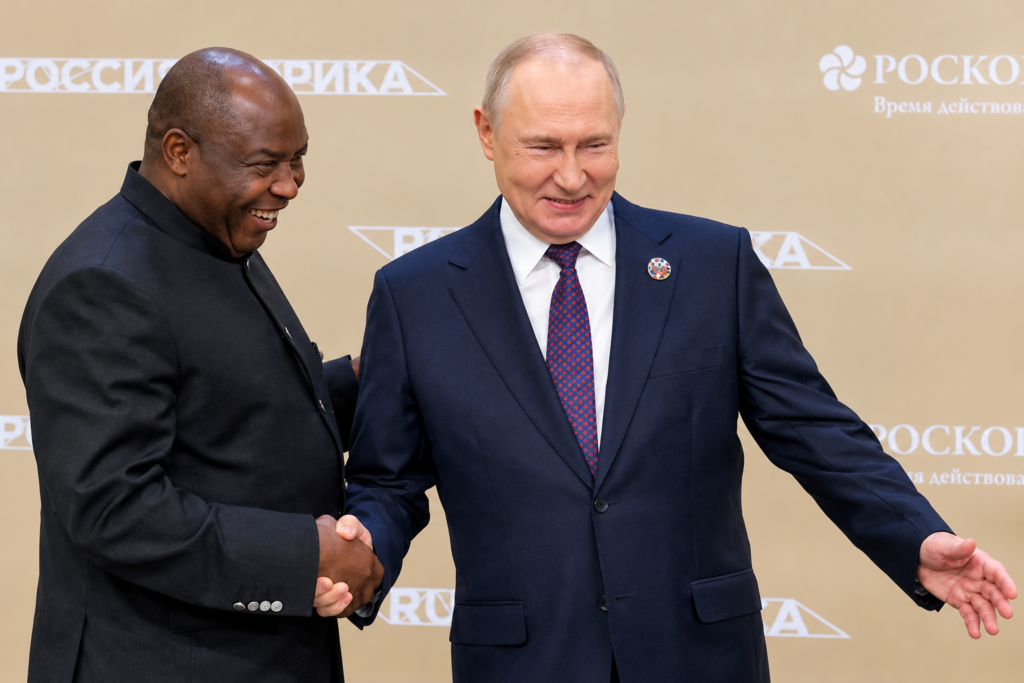
The third Russia–Africa Summit opened in Moscow on 28 October 2026, bringing together representatives from 48 African countries and approximately 20 leaders, according to Associated Press reporting.
Russian President Vladimir Putin used the gathering to promote closer relations with African partners and a stronger African role in international institutions.
One of the most concrete developments was the signing of the African Union Commission–Russian Federation Action Plan for 2027–2029.
African Union Commission Chairperson Mahmoud Ali Youssouf and Russian Foreign Minister Sergey Lavrov signed the framework, which the African Union Commission said covers 19 areas of cooperation. These include peace and security, science and technology, agriculture, health, education, trade, investment and climate-related cooperation.
What the action plan establishes
The agreement establishes a formal framework for future engagement. Its breadth, however, does not demonstrate that every proposed activity has secured funding, that projects have been approved or that implementation schedules are already in place.
The African Union Commission stated that the framework does not create rights or obligations under international law. Its practical implications therefore depend on the full action-plan text and any subsequent implementation arrangements.
The summit took place amid competition among global powers for diplomatic, commercial and strategic relationships across Africa. Yet African countries have different economic needs, security concerns and diplomatic priorities. Participation in the summit does not mean that every country has signed identical agreements or endorsed every position expressed by the host government.
Measuring the benefits for African countries
For African institutions and citizens, the practical test is whether diplomatic engagement produces measurable benefits.
Agricultural cooperation could matter if it improves productivity or market access. Scientific and educational collaboration could be valuable if it expands research, training and technical capacity. Trade and investment arrangements could create opportunities if they support viable businesses, employment and public revenue.
These outcomes cannot be assumed before implementation is demonstrated.
The African Union Commission’s involvement gives the action plan an institutional dimension, but its framework is not equivalent to an agreement independently signed by every African Union member state.
For Nigeria, the summit raises broader questions about trade, investment, diplomacy and continental cooperation. The information reviewed does not establish a specific new Nigerian financial commitment or a separate Nigerian project arising from the gathering.
The next measures of progress include the publication of the complete action plan, the identification of projects, confirmation of budgets, designation of implementing bodies and establishment of monitoring arrangements.
The summit has produced a cooperation framework. Whether it delivers practical benefits will depend on what the parties implement.
South Africa’s anti-corruption challenge puts financial credibility under scrutiny
South Africa faced renewed questions about its anti-corruption efforts after Business Leadership South Africa warned that weaknesses in enforcement and the criminal-justice system could expose the country to further scrutiny by the Financial Action Task Force, known as FATF.
Reuters reported the warning on 28 October 2026.
The concern follows an important milestone in October 2025, when FATF announced that South Africa had completed its action plan and was no longer subject to increased monitoring, a process commonly associated with the organisation’s grey list.
However, the latest warning does not mean South Africa has been formally returned to that list. Any change in status would require an official FATF decision.
Reform scores reveal different areas of progress
Business Leadership South Africa’s latest reform assessment reportedly gave anti-corruption reform a score of 51.2, unchanged during the July–September quarter.
Its overall reform score, by contrast, increased from 71.3 to 72.5.
The figures suggest that the organisation’s broader reform assessment and its specific anti-corruption measure are moving differently. They belong to Business Leadership South Africa’s own tracking exercise and are not FATF ratings.
The underlying issue is whether progress made through a formal reform programme can be sustained through effective enforcement.
Financial-crime enforcement involves more than passing laws or opening investigations. It also depends on institutional independence, the ability to prosecute cases, the recovery of criminal assets and the disruption of organised criminal networks.
The report raises concerns in these areas. A fuller assessment would require the tracking methodology, official statistics and responses from the relevant authorities.
Why FATF scrutiny matters
Financial credibility can influence how banks, international counterparties and businesses assess risks when dealing with a country. Nevertheless, the consequences of any future FATF action would depend on the formal decision, the applicable rules and the risk assessments made by individual institutions.
The warning alone does not establish that new restrictions have been imposed or that every business and household will experience a particular consequence.
There is also a wider African context. FATF announced in October 2025 that Nigeria and several other countries had also been removed from increased monitoring. South Africa’s subsequent performance, however, cannot be used to infer Nigeria’s current status or prospects. Each country’s position must be assessed through its own official records and enforcement evidence.
The key distinction remains between a warning from a business organisation and a formal regulatory decision. Further FATF updates, statements from South African authorities and verifiable information about investigations, prosecutions and asset recovery would help establish the country’s position.
At the close of the review period, South Africa’s challenge was to demonstrate that its financial-governance reforms were being sustained through enforcement rather than relying on the completion of a reform plan alone.
African mining investment: Appian plans US$2 billion allocation amid policy concerns
Mining investor Appian Capital Advisory announced plans to allocate approximately US$2 billion to Africa as part of a proposed global investment programme worth between US$5 billion and US$7 billion over the next 12 to 24 months, according to Reuters.
Reuters reported the plan on 28 October 2026, citing comments from the company’s chief executive, Michael Scherb.
Appian invests in minerals including gold, copper, zinc and rare earths. Scherb identified Morocco, Namibia and Botswana as attractive jurisdictions, while saying the company was assessing opportunities in Ghana, Côte d’Ivoire, Mauritania and Senegal.
The company also expressed concern that unpredictable policy changes and permitting conditions could discourage investors or influence where capital is deployed, a concern also described by bne IntelliNews.
A proposed allocation, not completed investment
The distinction between an investment plan and completed spending is central to understanding the announcement.
The proposed US$2 billion allocation is not evidence that the money has already been invested. The information reviewed does not establish that every project has been approved, that each named country will receive a defined share or that a complete schedule of committed and prospective funds has been published.
Nevertheless, the announcement highlights a policy challenge facing mineral-producing countries across Africa.
Governments seek to capture greater value from natural resources through royalties, taxation, local participation and, in some cases, domestic processing. Investors, meanwhile, need clarity about licensing procedures, fiscal terms and regulatory requirements before committing capital to projects that may take years to develop.
These objectives are not necessarily incompatible. Transparent and predictable rules can help investors make long-term decisions while giving governments a consistent basis for collecting public revenue, enforcing environmental standards and protecting local interests.
The question is whether regulations are clear, consistently applied and capable of balancing investment with the public interest.
Investment must translate into economic benefits
The eventual value of mining investment depends on more than the headline figure. It depends on whether projects reach production, how many jobs they create, how much tax and royalty revenue is collected, what local businesses gain and whether communities are protected from environmental harm.
Mineral extraction does not automatically produce industrialisation. Local processing also requires suitable infrastructure, reliable electricity, skilled workers, financing and commercially viable markets.
Appian’s assessment reflects one investor’s perspective. It is not an independent verdict on the regulatory environment of every African country. Its concerns should be considered alongside official laws, permitting timelines and independent sector data.
For Nigeria, the announcement raises broader questions about attracting capital into the solid-minerals sector while ensuring that communities and the wider economy benefit. However, the information reviewed does not establish that Appian has committed funds to a Nigerian project under this proposed allocation.
The next evidence to watch includes named projects, formal agreements, regulatory approvals, financing arrangements and actual disbursements. Employment, local processing, tax revenue and environmental safeguards will also be important measures of success.
At the close of the review period, the announcement signalled potential investment interest, but the amount ultimately deployed and the benefits delivered to host countries remained to be established.

Conclusion: Accountability and delivery will determine what comes next
The developments in this Africa news review reveal different tests of accountability, institutional credibility and economic opportunity.
In Gabon, the cause of the rig disaster and the circumstances surrounding the missing workers remained unresolved. In Moscow, the Russia–Africa action plan established a framework whose value will depend on implementation and measurable results. In South Africa, a warning about anti-corruption enforcement renewed scrutiny of financial-governance reforms without constituting a formal FATF decision. In mining, Appian’s proposed allocation highlighted potential investment interest, but actual spending and economic benefits remained unconfirmed.
These developments do not form a single continental crisis or share one cause. Their common lesson is the importance of distinguishing verified events from intentions, warnings from formal decisions, and announcements from outcomes.
The next phase of reporting must follow the evidence: investigation findings, diplomatic implementation, verifiable enforcement results and confirmed investment projects.
Africa’s changing political and economic landscape cannot be understood from announcements alone. The consequences of decisions—and the institutions responsible for delivering them—remain central to understanding the continent’s future.
RECOMMENDED ARTICLES
1. Global News Analysis: Elections, AI and Investment
Explore major global developments, from Brazil’s presidential election and political change in Serbia to an AI copyright lawsuit and Audi’s planned US investment. This analysis examines what the available evidence establishes—and what remains uncertain.
Category: Global News Analysis
2. Africa News Review: Ebola Preparedness, Regional Security and Political Accountability
Read about Uganda’s Ebola-related precautions, Algeria’s approved military deployment to Niger, Somalia’s political dialogue and a deadly road crash in Kenya. The report examines public safety, regional cooperation and the need to verify official actions.
Category: Africa News Review
3. Nigeria Daily News Review: State Police, Inflation, Ebola and 2027 Politics
Catch up on Nigeria’s latest developments in security reform, economic policy, public health, cybercrime enforcement and preparations for the 2027 elections. Discover what has been reported, what remains unresolved and what Nigerians should watch next.
Category: Nigeria News Review
4. Global News Review: October 19–25, 2026
Review the major international developments from the week and understand the political, economic and technological issues shaping the global agenda. This weekly roundup offers a broader perspective on the events and decisions making headlines around the world.
Category: Global Weekly Review
5. Africa News Review: Ebola Concerns, Conflict, Power Challenges and Political Decisions
From public-health concerns and conflict-related civilian risks to infrastructure ambitions and political decisions, this Africa review explores the developments influencing the continent. It separates reported claims from established facts and examines what needs to happen next.
Category: Africa Weekly Review
6. Nigeria’s Week in Review: Election Politics, Economic Pressure, Security Reform and Floods
Get a wider view of Nigeria’s week, including President Bola Tinubu’s campaign launch, labour tensions, economic uncertainty, proposed state-police reform, public-health concerns and flooding. The review explains the issues behind the headlines and the evidence needed to assess government responses.
Category: Nigeria Weekly Review
About the Author