
Nnani Adaobi Marian, a 23-year-old Nigerian medical graduate, travelled back to Kharkiv, Ukraine, to collect the degree she had spent years working toward. Instead of celebrating one of life’s biggest milestones, she became another civilian casualty of the Russia-Ukraine war after suffering critical injuries in a Russian airstrike on June 29. She died on July 5, 2026, despite intensive medical treatment in both Ukraine and Germany, turning what should have been a joyful graduation into a heartbreaking reminder of how armed conflict continues to shatter ordinary lives beyond the battlefield.
Her death has resonated across Nigeria and Ukraine, not only because of its tragic timing—just one day before her graduation ceremony—but also because it highlights the growing vulnerability of international students who continue to pursue education in regions affected by war.
Who Was Nnani Adaobi Marian?
To many people who knew her, Nnani Adaobi Marian represented the determination and resilience shared by thousands of Nigerian students pursuing higher education abroad.
She enrolled at Kharkiv National Medical University in 2020 with the ambition of becoming a medical doctor. Like many international students whose studies were disrupted by Russia’s full-scale invasion of Ukraine in 2022, Marian had to adapt quickly to circumstances far beyond her control.
Rather than abandoning her education, she continued her studies remotely from Azerbaijan, demonstrating remarkable commitment despite the uncertainties created by the conflict. Years of perseverance eventually brought her to the threshold of graduation—a milestone that symbolized not only academic achievement but also personal sacrifice.
Her decision to return briefly to Kharkiv was driven by a simple objective: to receive the physical diploma she had earned after years of study.
Instead, the journey ended in tragedy.
Her story has since become one of the most poignant examples of how global conflicts continue to affect civilians whose only goal is to build better futures through education.
Why Nnani Adaobi Marian Returned to Kharkiv
By mid-2026, Kharkiv remained one of Ukraine’s most frequently targeted cities despite continued efforts to restore normal life in many sectors, including higher education.
For graduating students, universities sought to preserve important academic traditions where circumstances allowed. Marian therefore made the difficult decision to return from Azerbaijan, where she had been studying remotely, to participate in graduation activities and collect her official medical degree.
The trip represented the culmination of years of sacrifice.
Like countless Nigerian families, hers had invested significant financial resources and emotional support into overseas education. Completing medical school was expected to open opportunities for postgraduate training, professional practice and service to society.
Returning to Kharkiv was not simply about attending a ceremony.
It was about closing one chapter of life and beginning another.
Sadly, that transition never came.
Instead, her return placed her directly in the path of one of the latest aerial attacks linked to the continuing Russia-Ukraine conflict.
The circumstances surrounding her death have reignited discussions about the difficult choices faced by students whose universities operate in conflict zones. While many institutions have adopted hybrid or remote learning arrangements, graduation ceremonies, laboratory requirements and official documentation often still require physical attendance.
For students nearing the completion of years of study, deciding whether to return can become an impossible balance between academic necessity and personal safety.
A Medical Journey Marked by Excellence
Beyond the tragic circumstances of her death, Marian’s academic record reflected a young professional preparing for a promising medical career.
Since enrolling in 2020, she steadily built a profile that extended beyond classroom performance.
According to her university, she successfully completed international medical internships at:
- University of Cambridge in the United Kingdom in 2024.
- Biruni University in Türkiye in 2025.
These opportunities exposed her to diverse healthcare systems and advanced clinical environments, strengthening both her academic credentials and practical medical experience.
Such international placements are highly competitive and often reserved for students who demonstrate strong academic performance, discipline and professional potential.
Kharkiv National Medical University later described Marian as an outstanding member of its academic community, praising not only her intelligence but also her compassion and commitment to helping others.
Those qualities, the university noted, reflected the values expected of future physicians—professionals entrusted with protecting life regardless of nationality or background.
Ironically, the career she spent years preparing for was cut short before she could begin serving patients.
Her story therefore represents more than the loss of an individual student; it marks the loss of years of education, personal ambition and the future contributions she might have made to healthcare both in Nigeria and internationally.
A Story That Resonates Beyond One Family
Every year, thousands of Nigerians travel overseas to study medicine, engineering, technology and other professional courses, viewing international education as a pathway to broader opportunities.
Marian’s experience underscores an uncomfortable reality: global conflicts increasingly affect students who are not participants in war but whose lives are nevertheless shaped by its consequences.
Her death has therefore become symbolic of a broader humanitarian issue—the risks faced by civilians pursuing education in unstable regions.
While governments and universities continue to explore ways of protecting international students, Marian’s final journey serves as a sobering reminder that academic ambition can sometimes collide with the unpredictable realities of armed conflict.
For many Nigerians following the story, the tragedy is not only that a young doctor lost her life, but that she lost it at the very moment her years of determination were about to be rewarded.
How the Russian Airstrike Changed Everything
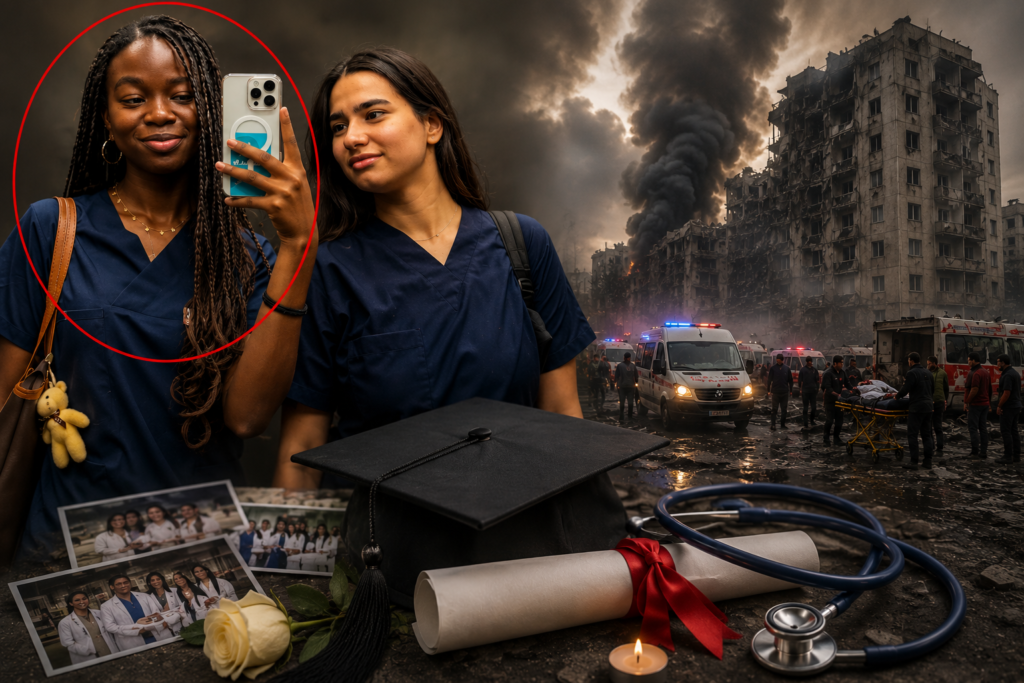
The events that ended Nnani Adaobi Marian’s life unfolded on June 29, 2026, when Russian forces launched guided aerial bombs targeting Kharkiv’s Kholodnohirskyi district, one of the areas that has repeatedly experienced attacks since Russia’s full-scale invasion of Ukraine began.
According to information released by Ukrainian authorities, Marian was walking with her close friend, Fatima Huseynova, on their way to a graduation photoshoot when an explosion occurred nearby.
The outing was intended to celebrate years of academic sacrifice.
Instead, it became the final chapter of two young lives preparing to enter the medical profession.
Fatima died instantly at the scene.
Marian survived the initial blast but sustained life-threatening injuries that required emergency medical intervention.
Doctors at a local hospital fought to stabilize her condition before she was transferred to Germany for specialist treatment, reflecting the severity of the injuries she suffered.
Despite the combined efforts of medical teams in Ukraine and Germany, Marian died on Sunday, July 5, 2026.
The tragedy illustrates the indiscriminate impact of modern warfare, where civilians carrying out ordinary daily activities—including students preparing for graduation—can suddenly become victims of military attacks.
For many observers, the timing has become one of the most heartbreaking aspects of the story.
After years of studying through disruption, adapting to remote education and overcoming the uncertainty of war, Marian came within a single day of receiving the qualification she had worked tirelessly to earn.
Kharkiv National Medical University Pays Tribute
Following confirmation of her death, Kharkiv National Medical University released an emotional tribute remembering Marian as an exceptional student and a valued member of its international academic community.
The university praised her:
- Academic excellence
- Dedication to medicine
- Strong work ethic
- Compassion toward others
- Positive contribution to campus life
The institution noted that Marian exemplified the qualities expected of future medical professionals and expressed profound sorrow that she would never have the opportunity to begin the career she had spent years preparing for.
Universities often become second homes for international students living thousands of kilometres away from their families. Consequently, Marian’s death was mourned not only as the loss of a graduate but also as the loss of a respected member of a diverse academic community brought together through education.
Her death has also drawn renewed attention to the emotional burden carried by universities operating during wartime, where institutions must continue educating students while navigating persistent security threats.
Official Responses Focus on Human Loss
Although news of Marian’s death spread rapidly across Nigerian media and social media platforms, official reactions initially came primarily from Ukrainian institutions.
The Kharkiv Regional Prosecutor’s Office expressed condolences to Marian’s family and confirmed that doctors in both Ukraine and Germany had made extensive efforts to save her life following the attack.
Meanwhile, SPRAVDI, Ukraine’s Strategic Communications Centre, documented the incident as part of its efforts to highlight the human cost of continued aerial bombardments affecting civilians, including foreign nationals living and studying in Ukraine.
As of the information contained in the source material, the Nigerian government had not issued an official public statement regarding Marian’s death. That absence became a talking point among many Nigerians online, with calls for greater official engagement when citizens abroad are caught up in international crises.
While it remains unclear whether a formal response will follow, the incident has reignited discussions about the role of governments in supporting citizens studying overseas during periods of armed conflict.
The Wider Challenge Facing Nigerian Students Abroad
Marian’s death extends beyond the tragedy experienced by one family.
It raises broader questions about the welfare of Nigerian students enrolled in countries facing armed conflict or political instability.
For decades, thousands of Nigerians have pursued higher education overseas, attracted by internationally recognised qualifications and specialised professional training. Ukraine, before the war, became one of the leading destinations for Nigerian students seeking affordable medical education.
When the conflict escalated in 2022, many students evacuated while others continued their programmes remotely or relocated temporarily to neighbouring countries.
Marian’s academic journey reflected that reality.
She continued studying from Azerbaijan while waiting for the opportunity to complete the final administrative requirements of her degree.
Her decision to return demonstrates the difficult choices many international students face when universities require physical attendance for graduation ceremonies, documentation or clinical obligations.
Although remote learning has expanded significantly since the outbreak of the war, not every academic process can be completed virtually.
That practical reality sometimes forces students to weigh educational goals against personal security.
The Human Cost of War Beyond the Battlefield
Modern conflicts are often measured through military statistics, territorial changes and diplomatic negotiations.
Yet behind those headlines are deeply personal stories that rarely receive sustained attention.
Marian’s death illustrates how wars reshape lives far beyond combat operations.
She was not a soldier.
She was not involved in military activity.
She was a graduating medical student preparing for a professional career dedicated to saving lives.
Her story joins countless others involving teachers, engineers, researchers, journalists and students whose futures have been interrupted by violence.
For humanitarian organisations and international observers, such incidents reinforce the importance of protecting civilians and educational institutions during armed conflicts, principles recognised under international humanitarian law.
While those protections remain the subject of ongoing international debate, tragedies such as Marian’s continue to remind the world that civilian lives remain among the conflict’s greatest losses.
What Happens Next?
The death of Nnani Adaobi Marian is likely to remain significant for several reasons.
First, it has become one of the most widely discussed recent cases involving a Nigerian citizen affected by the Russia-Ukraine war.
Second, it may prompt renewed conversations about emergency support mechanisms for Nigerians studying abroad, particularly in regions experiencing armed conflict.
Finally, it serves as another reminder that the consequences of the Russia-Ukraine war extend well beyond Europe, touching families, educational institutions and communities across Africa and the wider world.
For Marian’s relatives, classmates and friends, however, the broader geopolitical implications cannot erase the personal loss.
What should have been remembered as the beginning of a promising medical career has instead become a story of unfulfilled potential—a dream interrupted just before it could become reality.
Recommended Coverage
Vivian Chilaka Death Sparks Questions as Family Awaits Answers
Another heartbreaking story involving a promising Nigerian medical student whose death has raised difficult questions and drawn widespread public attention.
G7 Summit 2026 Dominated by Iran, Ukraine Talks
Explore how world leaders are responding to escalating conflicts and the diplomatic efforts shaping the future of the Russia-Ukraine war.
Russia-Ukraine Air Attacks Intensify Amid Ceasefire Uncertainty
Gain deeper context on the continued aerial bombardments across Ukraine and why civilians remain vulnerable despite ongoing ceasefire discussions.
Conclusion
The story of Nnani Adaobi Marian is not solely about a life lost in war. It is about years of perseverance, academic excellence and personal sacrifice that were overtaken by violence at the very moment success seemed within reach. As the Russia-Ukraine conflict continues to affect civilians from many nations, her death stands as a powerful reminder that the consequences of war are measured not only in military outcomes, but also in the futures that are never allowed to unfold.
About the Author