America at 250: Historic Independence Celebrations Overshadowed by Extreme Weather and Political Divide
The US 250th Anniversary is being marked across the United States with nationwide celebrations commemorating two and a half centuries since the country declared its independence. Yet what was intended to be a defining moment of national unity has unfolded against the backdrop of record-breaking temperatures, weather-related disruptions and an increasingly visible political divide over how the historic milestone should be celebrated.
Communities across the country have organised parades, concerts, naval displays, fireworks and public gatherings to honour the nation’s 250-year journey. However, dangerous heat conditions exceeding 100 degrees Fahrenheit (38 degrees Celsius) in parts of the country, together with forecasts of severe thunderstorms, have forced organisers to delay, modify or cancel several events.

At the same time, two separate national initiatives, America250, established by Congress as a nonpartisan commemorative programme, and the White House-backed Freedom 250 campaign, have highlighted differing visions of how America should present one of the most significant anniversaries in its modern history.
Rather than being remembered solely for spectacular fireworks and patriotic celebrations, the anniversary has become a reflection of the multiple challenges confronting the United States in 2026, from climate-related disruptions to political polarisation and evolving debates over national identity.
US 250th Anniversary Reflects More Than a National Celebration
National anniversaries often serve as moments for countries to reflect on their past while projecting confidence about the future. The United States has celebrated previous milestone anniversaries, including its Bicentennial in 1976, as opportunities to reinforce national identity and civic pride.
The 250th anniversary, officially known as the Semiquincentennial, carries even greater historical significance. The word combines Latin roots meaning “half of five hundred,” marking 250 years since the signing of the Declaration of Independence in 1776.
For historians, the occasion represents more than a symbolic birthday. It provides an opportunity to assess how the United States has evolved politically, economically and socially over two and a half centuries.
Since gaining independence, the country has transformed from thirteen colonies into the world’s largest economy and one of its most influential military and diplomatic powers. Along that journey, however, America has also experienced civil war, economic crises, social justice movements, global conflicts and recurring political divisions.
The anniversary therefore arrives at a time when many Americans continue to debate what national unity should look like in an increasingly diverse and politically polarised society.
Those broader questions have become almost as prominent as the celebrations themselves.
Extreme Heat Alters Celebrations Across the Country
While organisers spent years preparing commemorative activities, nature has emerged as one of the biggest influences on this year’s programme.
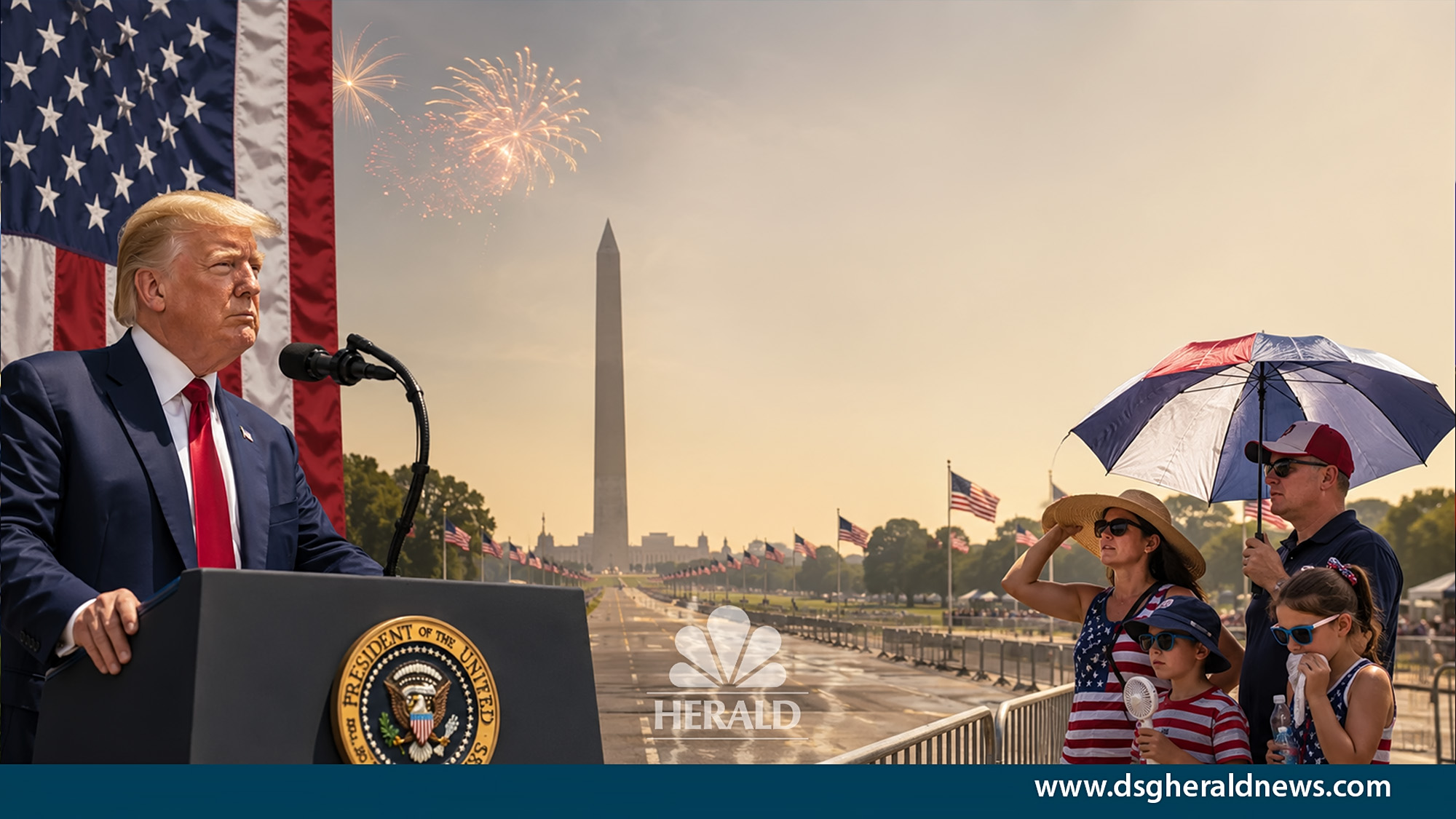
Large sections of the eastern United States have been affected by an intense heat wave, with temperatures climbing above 100°F (38°C) in some locations. Emergency officials warned that prolonged exposure could present serious health risks for spectators, volunteers and security personnel attending outdoor events.
The weather has forced authorities to rethink logistics for celebrations involving hundreds of thousands of participants.
Among the most significant changes was the cancellation of Washington, D.C.’s main Independence Day parade after officials determined that the extreme temperatures posed unacceptable safety risks.
Although the parade was cancelled, organisers confirmed that other signature events—including military flyovers and the widely anticipated Salute to America fireworks display on the National Mall—would proceed as planned.
The fireworks programme has been promoted as the largest in American history, underscoring organisers’ determination to preserve the symbolic importance of the national celebration despite adverse weather conditions.
Elsewhere, local authorities across states including New Jersey, Pennsylvania and Colorado also revised event schedules as meteorologists warned of a combination of dangerous heat and evening thunderstorms.
Numerous neighbourhood block parties, fireworks displays and community festivals were either delayed, shortened or cancelled altogether.
The widespread adjustments demonstrate how increasingly extreme weather events are becoming a growing operational challenge for organisers of large-scale public gatherings—not only in the United States but around the world.
Climate Challenges Are Becoming Part of National Celebrations
Although Independence Day festivities traditionally focus on patriotism and public celebration, this year’s anniversary has also highlighted the growing influence of climate conditions on civic life.
Large public events now require increasingly sophisticated emergency planning, particularly during periods of prolonged heat.
Public health agencies routinely advise organisers to provide cooling stations, free drinking water, medical teams and shaded rest areas during major outdoor gatherings. These measures have become increasingly common as summer temperatures continue to test infrastructure designed decades ago under different climate conditions.
The disruptions witnessed during the US 250th Anniversary illustrate how weather resilience is becoming an important consideration for governments planning future national commemorations.
From Europe to Asia and Africa, governments are increasingly integrating climate risk assessments into major public events, recognising that extreme weather can affect public safety, transportation systems and emergency services.
The United States’ experience this year reflects a broader global trend rather than an isolated incident.
Two National Celebrations, Two Different Narratives
Beyond the weather, another defining feature of this year’s anniversary has been the existence of two prominent national commemorative initiatives.
On one side is America250, the official congressional programme established on a bipartisan basis to coordinate educational projects, cultural exhibitions and nationwide commemorations marking America’s 250-year history.
The initiative has focused largely on historical education, civic engagement and community participation, seeking to present the anniversary as a shared national milestone regardless of political affiliation.
Alongside that effort is Freedom 250, a White House-backed initiative that has adopted a more overtly presidential profile.
President Donald Trump is leading high-profile celebrations centred on the National Mall, including a major public rally and the Great American State Fair, one of the administration’s flagship anniversary events.
Organisers delayed the fair’s opening by two hours because of the extreme heat, reflecting the broader logistical challenges affecting celebrations nationwide.
The existence of these parallel commemorations has attracted significant public attention, with supporters viewing them as complementary expressions of patriotism while critics argue they reflect the increasingly partisan environment surrounding major national events.
The contrasting approaches have reinforced broader debates about national identity, civic symbolism and the role of political leadership during historic anniversaries.
For many observers, the celebrations have become not only a reflection on America’s past but also an illustration of the differing visions competing to shape its future.
US 250th Anniversary Events Continue Despite Disruptions
Despite the cancellation of several public gatherings and adjustments to schedules, organisers have pressed ahead with many of the country’s flagship events, underscoring a determination to ensure that the US 250th Anniversary remains a defining national occasion.
In Washington, D.C., military aircraft were scheduled to conduct ceremonial flyovers over the National Mall, while the much-anticipated Salute to America fireworks display was expected to illuminate the nation’s capital later in the day.
The decision to proceed with these landmark events reflects the symbolic importance attached to the anniversary. For many Americans, Independence Day celebrations are not merely recreational occasions but expressions of national history, civic identity and democratic continuity.
Security agencies and event organisers have also had to balance public safety with public expectations, implementing measures to address the dual challenges of extreme temperatures and large crowds.
The result has been a nationwide celebration that has adapted rather than surrendered to difficult conditions.
Trump’s Freedom 250 Programme Draws National Attention
Among the most closely watched events is President Donald Trump’s participation in the Freedom 250 initiative.
The president is hosting a major rally alongside the Great American State Fair on the National Mall, positioning the White House-backed programme as a central feature of the anniversary celebrations.
Organisers delayed the opening of the fair by approximately two hours because of the intense heat, illustrating how weather conditions have influenced even the highest-profile events.
The president’s involvement, however, has attracted political scrutiny as well as public interest.
Critics argue that the anniversary should remain above partisan politics and have questioned whether presidential campaign-style appearances risk overshadowing what many regard as a shared national milestone.
Much of that criticism intensified following President Trump’s speech delivered at Mount Rushmore on the eve of the anniversary, during which he warned that “American identity is under threat.”
Supporters interpret the remarks as a call to strengthen patriotism and preserve traditional national values.
Opponents, meanwhile, contend that introducing politically charged rhetoric into a landmark historical commemoration risks deepening existing divisions rather than fostering unity.
The contrasting reactions illustrate how national commemorations increasingly unfold within broader political debates, particularly during periods of heightened public polarisation.
America250 and Freedom 250 Represent Different Approaches
Although both initiatives celebrate the same historical milestone, their structures and objectives differ significantly.
America250 was established through Congress to coordinate educational programmes, historical exhibitions and nationwide community participation leading up to the Semiquincentennial.
Its mission has largely focused on encouraging civic engagement while highlighting the country’s historical development over the past two and a half centuries.
By comparison, Freedom 250 has emerged as a White House-supported initiative featuring presidential appearances, large-scale public events and patriotic celebrations organised around the administration’s vision for the anniversary.
The coexistence of these programmes has generated discussion about whether America benefits from multiple commemorative platforms or whether competing initiatives dilute the symbolic unity often associated with landmark national anniversaries.
Regardless of political opinion, both programmes have succeeded in drawing widespread public attention to an anniversary that has been years in planning.
New York Hosts One of the Largest Maritime Celebrations
While Washington remains the symbolic centre of national celebrations, New York City has staged one of the most visually significant events of the anniversary.
Vice President JD Vance formally opened local festivities aboard the USS Kearsarge, marking the beginning of the Sail4th 250 naval parade.
The procession features nearly 50 historic tall ships alongside dozens of naval vessels from international partners navigating New York Harbour before passing the Statue of Liberty.
The maritime display carries historical significance beyond its visual appeal.
The harbour has long served as one of America’s principal gateways for immigration, international commerce and naval operations.
Passing beneath the Statue of Liberty, the vessels provide a symbolic reminder of the country’s longstanding relationship with international trade, diplomacy and migration.
For many spectators, the event links America’s revolutionary origins with its continuing global influence.
The participation of foreign naval vessels also reflects ongoing international partnerships and the diplomatic dimension of commemorating major national milestones.
Music, Entertainment and Media Extend the Celebration Nationwide
Beyond official ceremonies, entertainment remains an important component of the anniversary programme.
Major concerts are taking place across several American cities, bringing together artists representing different musical traditions and generations.
Among the scheduled performances are:
- Christina Aguilera in Philadelphia.
- Mary J. Blige in New York.
- The Smashing Pumpkins alongside country music star Chris Stapleton at the Los Angeles Coliseum during America’s Block Party.
These performances reflect the cultural diversity that characterises contemporary America.
Rather than concentrating festivities solely in Washington, organisers have encouraged celebrations across multiple states, reinforcing the anniversary as a nationwide event rather than a federal ceremony alone.
Media organisations are also playing a major role in extending public participation.
ABC News is broadcasting a continuous 24-hour programme titled “Disney Celebrates America,” documenting celebrations taking place across all 50 states.
Such extensive coverage allows millions of viewers unable to attend events in person to participate virtually, reinforcing the anniversary’s national reach.
Continuous broadcasting also reflects how major national commemorations have evolved in the digital age.
Unlike previous generations that relied primarily on local participation, modern audiences increasingly experience national events through television, online streaming and social media platforms.
This transformation has broadened public access while also increasing scrutiny, commentary and real-time public engagement.
What the Anniversary Says About America Today
Every national anniversary inevitably becomes more than a remembrance of the past.
It also serves as a reflection of the country’s present condition.
The US 250th Anniversary illustrates a nation that remains capable of organising celebrations on an extraordinary scale while simultaneously confronting complex domestic challenges.
Several themes have emerged throughout the commemorations.
Resilience.
Despite dangerous weather conditions, organisers have adapted programmes rather than abandoning them altogether.
Political diversity.
Competing commemorative initiatives demonstrate differing interpretations of patriotism and national identity.
Cultural inclusiveness.
The wide variety of performers, regional celebrations and community events reflects the country’s demographic and cultural diversity.
Institutional continuity.
The anniversary reinforces the enduring significance of constitutional governance and democratic institutions established after independence.
Taken together, these elements present a portrait of a nation that continues to celebrate its achievements while openly debating its future.
Rather than diminishing the anniversary, those debates may illustrate one of the defining characteristics of American democracy: the ability to publicly contest ideas while maintaining longstanding national traditions.
Why the Story Matters Beyond the United States
Although centred on America, the US 250th Anniversary has international significance.
The United States remains one of the world’s leading economic, diplomatic and military powers.
Its national celebrations therefore attract global attention from governments, investors, international organisations and media outlets.
For African countries including Nigeria the anniversary also highlights the importance of longstanding diplomatic, trade and educational ties with the United States.
Thousands of Nigerian students continue to study in American universities, while bilateral cooperation spans healthcare, security, technology, entrepreneurship, agriculture and investment.
Political developments within the United States frequently influence global financial markets, foreign policy decisions and international security arrangements.
Consequently, the symbolism surrounding the anniversary extends beyond domestic celebrations.
The event also offers an opportunity for other democracies to reflect on how nations commemorate their histories while managing contemporary political differences, economic pressures and environmental challenges.
In that sense, America’s 250th Independence anniversary is not only a national celebration but also a global moment of historical reflection.
US 250th Anniversary: Looking Beyond the Celebrations
As fireworks illuminate skylines and commemorative events continue across the United States, the US 250th Anniversary also invites reflection on what comes next.
Major national anniversaries are often measured not only by the scale of their celebrations but by the conversations they inspire. For the United States, reaching 250 years since the Declaration of Independence is an opportunity to examine how the nation has changed and how it intends to navigate the decades ahead.
The anniversary arrives at a time when the country is confronting significant policy debates on economic competitiveness, immigration, technological innovation, energy security, public health and climate resilience. While these issues extend beyond the scope of Independence Day festivities, they are part of the broader national context in which the celebrations take place.
The combination of historic commemorations, weather-related disruptions and political debate illustrates that national milestones rarely occur in isolation. Instead, they often become moments when a country’s achievements and challenges are viewed side by side.
For policymakers, historians and citizens alike, the Semiquincentennial may ultimately be remembered not only for parades, concerts and fireworks, but also for prompting renewed discussion about America’s next chapter.
Lessons for Other Democracies
The events surrounding the US 250th Anniversary also offer broader lessons for countries worldwide.
First, they demonstrate the importance of long-term planning for national commemorations. Organising events of this scale requires coordination among federal, state and local authorities, security agencies, emergency services, cultural institutions and private organisations.
Second, the weather-related disruptions highlight the growing need for resilience planning. As extreme climate events become more frequent in many regions, governments may increasingly need to incorporate contingency measures into major public celebrations to protect participants while preserving important national traditions.
Third, the anniversary underscores the role of public dialogue in democratic societies. Differing interpretations of patriotism, history and national identity have been evident throughout the celebrations. While opinions vary, the ability to express competing perspectives remains a defining feature of democratic systems.
These observations are not unique to the United States. Many countries preparing to mark significant national milestones face similar questions about inclusion, public participation, historical interpretation and the balance between tradition and contemporary realities.
African and Nigerian Perspective
For audiences across Africa, the anniversary carries relevance beyond its ceremonial importance.
The United States remains a key partner for many African nations in areas such as trade, education, healthcare, technology, security cooperation and entrepreneurship. Developments in Washington often influence international markets, development programmes and diplomatic priorities that affect countries across the continent.
Nigeria, in particular, maintains longstanding relations with the United States through commercial partnerships, educational exchanges, investment and security cooperation. Thousands of Nigerians study, work or conduct business in the U.S., while American companies continue to play a role in sectors including energy, finance, information technology and manufacturing.
The anniversary therefore provides an opportunity for African observers to consider how democratic institutions evolve over time and how countries commemorate their national histories while adapting to changing political, economic and environmental realities.
It also highlights the importance of preserving historical memory. National anniversaries often encourage younger generations to engage with their country’s founding principles, constitutional development and civic responsibilities an objective that resonates beyond American borders.
Conclusion
The US 250th Anniversary has become more than a celebration of America’s independence. It has evolved into a snapshot of a nation balancing history with present-day realities.
Extreme heat and severe weather have altered schedules and forced cancellations in several communities, reminding organisers of the increasing impact of environmental conditions on large public events. At the same time, parallel commemorative initiatives, public debate and differing political interpretations have highlighted the diversity of perspectives surrounding one of the country’s most significant milestones.
Yet despite these challenges, millions of Americans continue to participate in parades, concerts, naval displays, community gatherings and fireworks, demonstrating the enduring importance of Independence Day as a symbol of national identity.
As the United States marks 250 years since the Declaration of Independence, the anniversary serves not only as a tribute to the nation’s past but also as a moment to reflect on its future. How America addresses political differences, strengthens democratic institutions, prepares for climate-related challenges and continues to shape its role on the global stage will likely define the legacy of its next quarter millennium as much as the celebrations marking this historic occasion.
Recommended Coverage
Trump’s NATO Exit Proposal Raises Global Security Questions
Explore how debates surrounding U.S. foreign policy under President Donald Trump could reshape international security alliances and America’s global leadership.
US Judge Halts White House Ballroom Project
Read about the legal dispute surrounding a proposed White House construction project and what it means for the administration’s domestic agenda.
China–Africa Trade Deal Reshapes Global Alliances
Discover how expanding China–Africa economic cooperation is influencing global trade, diplomacy and the strategic environment in which the United States operates.
About the Author