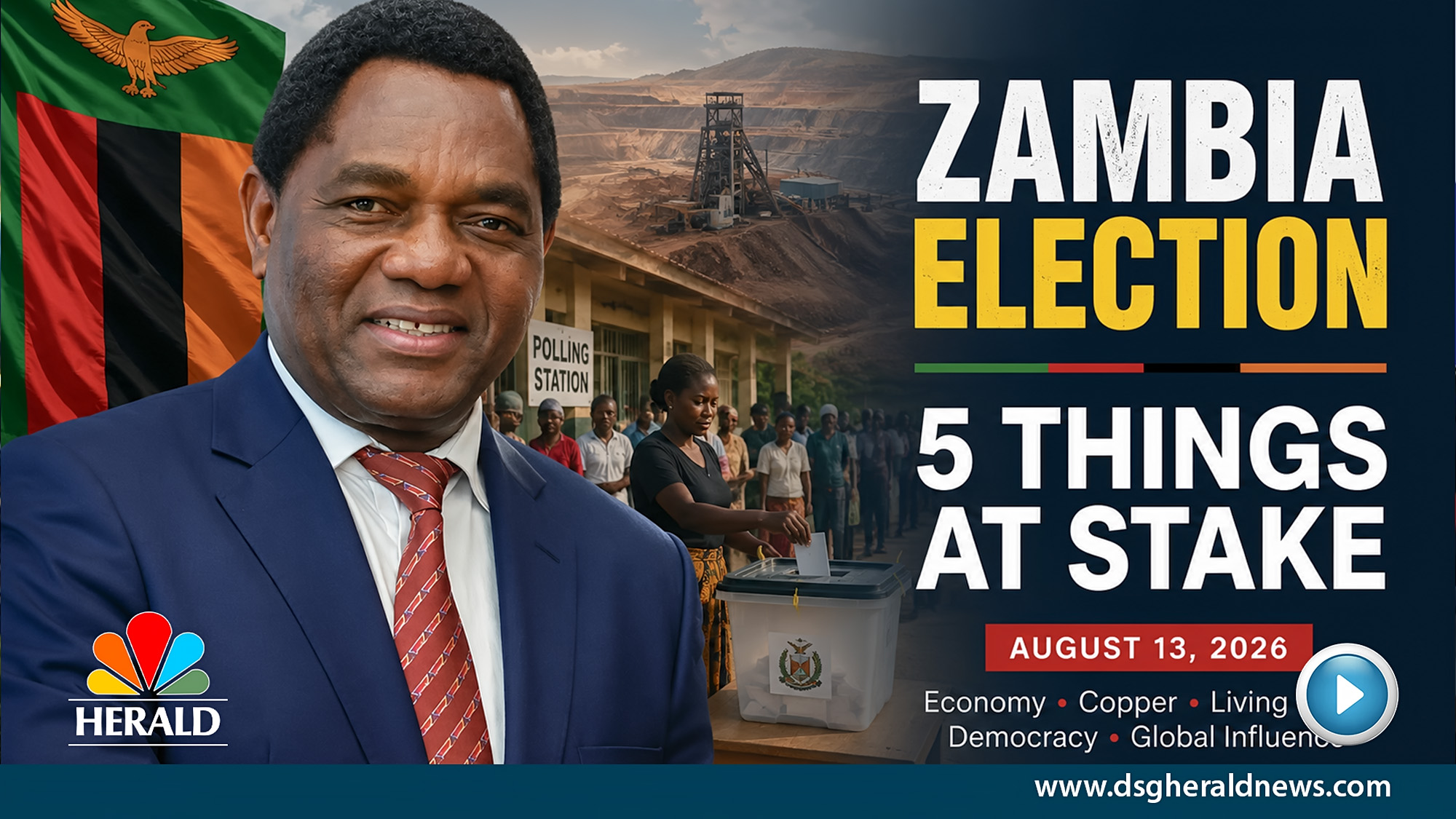
Zambia’s August 13 presidential election will test Hakainde Hichilema’s economic reforms, copper ambitions and democratic record as voters weigh national progress against everyday hardship.
ZAMBIA is heading into a consequential presidential election on Thursday, August 13, with President Hakainde Hichilema seeking a second term in a contest that has become a broader referendum on the country’s economic direction, political institutions and place in the global critical-minerals race.
Hichilema’s first term has produced significant economic changes. Zambia has completed a major debt-restructuring process, restored confidence among international lenders and recorded a substantial improvement in several macroeconomic indicators. The International Monetary Fund said in January that Zambia had completed the final review of its 38-month Extended Credit Facility programme, while stressing that continued fiscal discipline and reform would remain essential.
Yet the economic recovery has not removed the pressures confronting households.
The election therefore presents a central dilemma: can Hichilema persuade voters that the difficult reforms of his first term are laying the foundation for better living standards, or will economic hardship outweigh improvements in the country’s financial position?
The answer will have consequences beyond the presidency.
Zambia is Africa’s second-largest copper producer and copper accounts for roughly 70 percent of its export earnings. The government wants to increase annual copper production to three million metric tonnes, while international investors are watching whether promised investments can become actual mines and sustained production.
At the same time, Zambia’s reputation as one of Southern Africa’s more stable democracies is facing renewed scrutiny.
Here are five major issues at stake in Thursday’s vote.
1. Zambia Presidential Election Will Test Hichilema’s Economic Reforms
The most immediate question surrounding the Zambia presidential election is whether voters believe Hichilema’s economic strategy has delivered enough progress.
When Hichilema took office in 2021, Zambia was emerging from a severe sovereign debt crisis. The country had defaulted on its external debt in 2020 and subsequently entered a prolonged restructuring process involving official and private creditors.
His administration made debt restructuring and macroeconomic stabilization central to its economic programme.
The IMF completed its final review of Zambia’s Extended Credit Facility arrangement in January 2026, saying the programme had supported reforms aimed at restoring macroeconomic stability, strengthening resilience and promoting sustainable growth. The Fund projected real GDP growth of 5.8 percent for 2026 and said Zambia’s medium-term outlook depended on continued mining investment, stronger electricity generation, agriculture and fiscal discipline.
The World Bank has similarly described Zambia as having achieved greater macroeconomic resilience while warning that important risks remain.
Its latest economic assessment says real GDP growth reached 3.8 percent in 2025 and that inflation had fallen to 7.1 percent by March 2026. It also noted improvements in the kwacha and fiscal position, while identifying electricity shortages and the country’s continued dependence on mining as major constraints.
These figures provide Hichilema with a strong argument.
But elections are rarely decided by macroeconomic indicators alone.
Reuters reported in July that the election was shaping up as a referendum on Hichilema’s economic record, with many households still feeling squeezed despite the country’s recovery. The report noted that annual inflation had fallen to 6.5 percent in June, its lowest level in more than eight years, but that economic pressure remained a major political issue.
That creates the central expectation gap confronting the president.
International lenders can point to stabilization, debt restructuring and fiscal reforms. Voters may instead judge the government by the price of food, household income, employment opportunities and access to reliable electricity.
That difference between economic recovery on paper and economic relief at household level may be one of the defining themes of Thursday’s election.
The IMF has also acknowledged that fiscal pressures increased during 2026, including pressures linked to pre-election spending and other expenditure overruns. Discussions on a successor IMF-supported programme are expected to resume with the incoming government after the election.
A Hichilema victory would therefore provide a political mandate for continued reform.
A defeat would raise questions about whether Zambia’s voters are demanding a different balance between fiscal discipline, public spending and immediate economic relief.
2. The Future of Zambia’s Copper Economy Is on the Ballot
The second major stake in the Zambia presidential election is the future of the country’s copper industry.
Copper is not simply another export commodity for Zambia. It is the backbone of the national economy.
Reuters estimates that copper generates around 70 percent of Zambia’s export earnings, while the mining industry accounts for a significant share of national output and government revenue. The sector has attracted more than $10 billion in investment since the 2021 election, according to Zambia’s Chamber of Mines.
The government’s ambition is considerably larger than simply maintaining current production.
Zambia wants to increase annual copper output to three million metric tonnes over the longer term.
The objective is tied to a wider transformation taking place in the global economy.
Copper is essential to electric vehicles, electricity networks, renewable-energy infrastructure and other technologies associated with the global energy transition. As governments and companies invest heavily in electrification, demand for the metal has increased.
That places Zambia in an increasingly strategic position.
But ambition is not the same as production.
The country needs new mines, exploration, infrastructure, electricity and investment to achieve the three-million-tonne target. Reuters reported that mining companies are seeking stronger incentives for exploration, local processing, infrastructure development and additional power generation. Industry executives estimate that Zambia could need at least 2,000 megawatts of additional capacity to support major expansion.
This makes the election particularly important for investors.
A predictable policy environment could encourage companies to commit capital to long-term projects that may take years before generating substantial production.
A major policy shift could have the opposite effect.
The issue is not simply whether Zambia wants more copper. It is how the country intends to extract, process and benefit from its mineral wealth.
That includes questions around mining taxation, local content, exploration licences, domestic processing and the participation of Zambian businesses in the mining supply chain.
Reuters reported that investors are watching whether the current pipeline of foreign investment can be converted into actual production gains and whether reforms to the mining environment will encourage further exploration.
The election will therefore be watched closely by the mining industry.
For Zambia, the opportunity is enormous. But so is the challenge of ensuring that a copper boom translates into jobs, public revenue, infrastructure and broader economic development rather than simply higher export figures.
3. Cost of Living Could Decide Whether Economic Progress Feels Real
The third stake is perhaps the most immediate for ordinary voters: whether economic reforms are improving everyday life.
This is where the political debate becomes particularly difficult for Hichilema.
The government’s economic indicators have improved in several areas, but households do not experience GDP growth or debt restructuring directly.
They experience the economy through food prices, electricity bills, transport costs, wages and employment.
Recent reporting from Zambia has highlighted the importance of the cost of living as the campaign approaches its final stage. Africanews reported on August 10 that the economy had become the central battleground, with the cost of living emerging as a leading concern among voters.
Electricity is particularly important.
Zambia’s economy has suffered from serious power constraints, while drought-related pressures have exposed the vulnerability of a system heavily dependent on hydropower.
The World Bank has identified electricity supply as one of the most important constraints on Zambia’s future economic growth. It says addressing the power sector is critical not only for households but also for manufacturing, mining, private-sector investment and job creation.
That creates a difficult political equation.
The government can argue that stabilizing the economy and repairing public finances require patience.
Opposition politicians can argue that citizens should not have to wait indefinitely for the benefits of reform.
The difference is crucial.
Economic stabilization is normally a long-term process. Elections operate on a much shorter timetable.
This means Thursday’s vote will provide a political judgment on whether the pace of improvement is fast enough for voters.
For Hichilema, the challenge is to connect the technical language of economic reform with the lived experience of citizens.
Debt restructuring may improve Zambia’s financial position.
Lower inflation may strengthen household purchasing power over time.
Mining investment may eventually create jobs and public revenue.
But voters will ultimately ask whether those improvements are reaching them now.
That is why the cost-of-living question could prove more politically powerful than many of the government’s headline economic achievements.
4. Zambia’s Democratic Reputation Is Also Being Tested
The fourth major stake is political rather than economic.
For decades, Zambia has been regarded as one of Southern Africa’s more stable democratic systems, with a history of transfers of power through elections.
Hichilema himself became the beneficiary of that democratic system when he defeated Edgar Lungu in 2021.
But the political environment surrounding the 2026 election has attracted greater scrutiny.
Opposition figures have accused the government of restricting political activity and narrowing the space for dissent. Hichilema’s administration has denied those allegations.
Reuters reported in July that opposition groups had accused the government of restricting campaigning and suppressing political dissent, while also noting that Hichilema rejected those accusations.
The concerns extend beyond campaigning.
Chatham House has highlighted questions surrounding Zambia’s electoral framework, including changes to parliamentary representation, constituency boundaries and candidate nomination requirements.
The think tank argues that the election will test whether Hichilema can maintain Zambia’s democratic reputation while resisting pressure to tilt the political environment in favour of his governing party.
It also points to concerns surrounding cyber legislation and freedom of expression.
The stakes are therefore larger than the question of who wins.
A credible election could reinforce Zambia’s reputation as a relatively stable democratic state and strengthen investor confidence.
A heavily disputed process could weaken that reputation.
The timing of election results will also matter.
Delays, allegations of irregularities or political violence could intensify mistrust even if the final result is accepted.
That is why domestic and international observers will have an important role in assessing the credibility of the process.
For Hichilema, there is a particular historical irony.
He spent years in opposition presenting himself as a champion of democratic competition. His rise to power was itself evidence that political change through elections remained possible in Zambia.
The challenge now is to demonstrate that the democratic system remains credible when his own party is the incumbent.
The best outcome for the president would therefore not simply be another electoral victory.
It would be a victory accompanied by confidence in the institutions that delivered it.
5. Zambia’s Global Position Is Growing Because of Copper
The fifth stake extends beyond Zambia’s borders.
The Zambia presidential election is taking place at a time when the country’s mineral resources have acquired greater strategic importance.
The global transition toward electric vehicles, renewable energy and expanded electricity networks is increasing attention on minerals such as copper.
Zambia therefore occupies an unusual position.
It is a relatively small economy by global standards, but it possesses a resource that major industrial economies increasingly need.
That gives Lusaka greater leverage in its international relationships.
Hichilema has pursued stronger relationships with Western governments and international institutions while maintaining important economic ties with China.
Chatham House describes Zambia as a country that has revived relationships with key Western partners while maintaining links with China and the wider African continent. It has also described Zambia as important to global debates around critical minerals, debt diplomacy and African diplomacy.
China remains especially significant.
The country has long been an important economic partner for Zambia, including through mining, infrastructure and financing.
At the same time, Western governments and companies have increased their interest in Zambia’s mineral resources.
This creates opportunities, but also requires careful diplomacy.
Zambia does not necessarily have to choose between Beijing and Western capitals.
Its previous approach under Hichilema has been described as a form of “positive neutrality”, seeking relationships with multiple international partners rather than aligning exclusively with one geopolitical bloc.
The election could influence how that strategy develops.
A continuation of Hichilema’s government would likely provide greater policy continuity for the international partners that have invested in Zambia’s current economic direction.
A change of government could lead to different priorities, including changes in mining policy, economic partnerships or the balance between domestic control and foreign investment.
But whichever government emerges will face the same basic reality: Zambia’s mineral wealth gives it an opportunity to negotiate from a stronger position, but only if the country can build the infrastructure, institutions and human capacity required to capture more value from its resources.
Why Zambia’s Election Matters Beyond Zambia
The significance of Thursday’s vote extends beyond Lusaka.
Across Africa, governments are confronting a difficult combination of debt pressure, demands for economic growth, infrastructure shortages, unemployment and growing international competition for natural resources.
Zambia offers a particularly important case study because its recent experience brings many of these challenges together.
The country moved from sovereign default toward debt restructuring and macroeconomic stabilization.
It is now trying to convert that stabilization into stronger growth.
At the same time, it wants to expand copper production dramatically and attract international capital without losing control of its strategic resources.
And it must do all of this while maintaining democratic institutions.
For other African economies, including Nigeria, the lesson is significant.
Macroeconomic reform can restore confidence among international lenders and investors, but political durability ultimately depends on whether citizens experience meaningful improvements in their daily lives.
Resource-rich economies face a similar challenge.
Having minerals in the ground does not automatically produce prosperity. Governments must create the infrastructure, electricity supply, regulatory certainty, skilled workforce and institutions needed to turn mineral wealth into broad economic opportunity.
That is one reason Zambia’s copper ambitions deserve attention well beyond Southern Africa.
The Election’s Economic and Political Balancing Act
The central tension of Thursday’s vote can therefore be reduced to two competing questions.
Has Hichilema’s government done enough to convince voters that its difficult reforms are working?
And:
Can Zambia continue its economic transformation without weakening the democratic institutions that make that transformation sustainable?
There is evidence for both sides of the argument.
The IMF has recognized significant progress in macroeconomic stabilization and debt management. The World Bank has also identified improvements in growth, inflation and fiscal performance.
But the same institutions continue to identify structural vulnerabilities.
Zambia remains exposed to debt risks, electricity shortages, climate shocks and dependence on mining.
The country’s poverty challenge also remains substantial. The IMF’s January assessment put the poverty rate at 64.3 percent based on the 2022 measure used in its country data, while the World Bank has emphasized that stronger and more inclusive growth is required if economic gains are to translate into meaningful poverty reduction.
That means the election cannot be reduced to a simple choice between “reform” and “no reform”.
The real debate is about what comes next.
Can fiscal discipline be maintained while more resources reach vulnerable households?
Can Zambia attract billions of dollars into mining while ensuring greater domestic value addition?
Can copper production increase without worsening electricity shortages?
Can the country maintain investor confidence while strengthening democratic accountability?
And can Zambia use its growing importance in the critical-minerals market to negotiate better economic outcomes for its people?
These are the questions that will remain after the votes are counted.
What Happens After August 13?
Whatever the result, the next government will inherit a demanding economic agenda.
If Hichilema wins a second term, investors will look for continuity in economic policy, progress on mining investment and a credible path toward another IMF-supported programme.
The president would also face pressure to demonstrate that economic reforms can produce more visible improvements in household welfare.
The mining industry will expect continued progress on exploration, licensing, infrastructure, power supply and local participation.
The opposition, meanwhile, will remain an important part of the political system, particularly if the election is closely contested.
If there is a change in government, investors will be watching closely for signs of policy continuity.
The incoming administration would have to balance campaign promises with Zambia’s debt obligations, international commitments and the need to preserve investor confidence.
That would make the transition itself an important test.
For Zambia, the ideal outcome is not simply a clear electoral winner.
It is a political settlement that allows the country to continue economic reform while strengthening democratic institutions and ensuring that the benefits of growth become more visible to ordinary citizens.
Five Things to Watch on Election Day
As voters go to the polls on Thursday, five issues will provide the clearest lens through which to understand the result:
- Economic reform: Do voters reward Hichilema’s macroeconomic record?
- Cost of living: Has economic stabilization translated into enough household relief?
- Copper: Will Zambia’s ambitious mining expansion continue on its current trajectory?
- Democracy: Will the election reinforce or weaken Zambia’s democratic reputation?
- Global influence: How will Zambia balance its relationships with China, Western partners and other international investors?
The answer to each question will shape what comes next.
Conclusion: More Than a Vote on Hichilema
The Zambia presidential election is ultimately a vote on the direction of a country trying to move beyond a debt crisis while positioning itself at the centre of the global energy transition.
Hichilema can point to significant progress in debt restructuring, macroeconomic stabilization and renewed investor confidence. His government has also placed Zambia’s copper resources at the heart of a strategy designed to attract investment and expand production.
But voters are not judging an economic spreadsheet.
They are judging the economy they experience.
That is the political challenge facing Hichilema.
If voters conclude that the sacrifices associated with reform are beginning to produce meaningful benefits, the president could receive a mandate to continue his programme.
If they conclude that national economic improvements have failed to translate into sufficient relief for households, the election could become a warning that stabilization alone is not enough.
The democratic dimension is equally important.
Zambia’s international reputation was built not simply on economic policy, but on the ability of its institutions to allow political power to change hands through credible elections.
Thursday’s vote will therefore test both sides of Hichilema’s legacy.
Can he deliver economic transformation while preserving the democratic credibility that helped bring him to power?
That may be the most important question of Zambia’s 2026 presidential election.
Recommended Coverage
Africa Media Convention Pushes Press Freedom Agenda
Africa Media Convention 2026 coverage
Press freedom is an important part of the wider democratic question facing Zambia as political space and freedom of expression come under scrutiny.
Ethiopia Election Crisis Raises Questions for African Democracy
Ethiopia election crisis and national unity
The Ethiopian experience provides useful regional context for understanding how electoral disputes and political divisions can affect democratic stability.
Ivory Coast Election Body Faces Reform Pressure
Ivory Coast election body reform coverage
Ivory Coast offers another African example of why the independence and credibility of electoral institutions matter beyond election day.
Southern Africa Faces Pressure as Funding Cuts Hit UN Operations
UN and WFP funding pressures in Southern Africa
The report provides additional regional context on the economic and humanitarian pressures facing Southern African countries.
About the Author