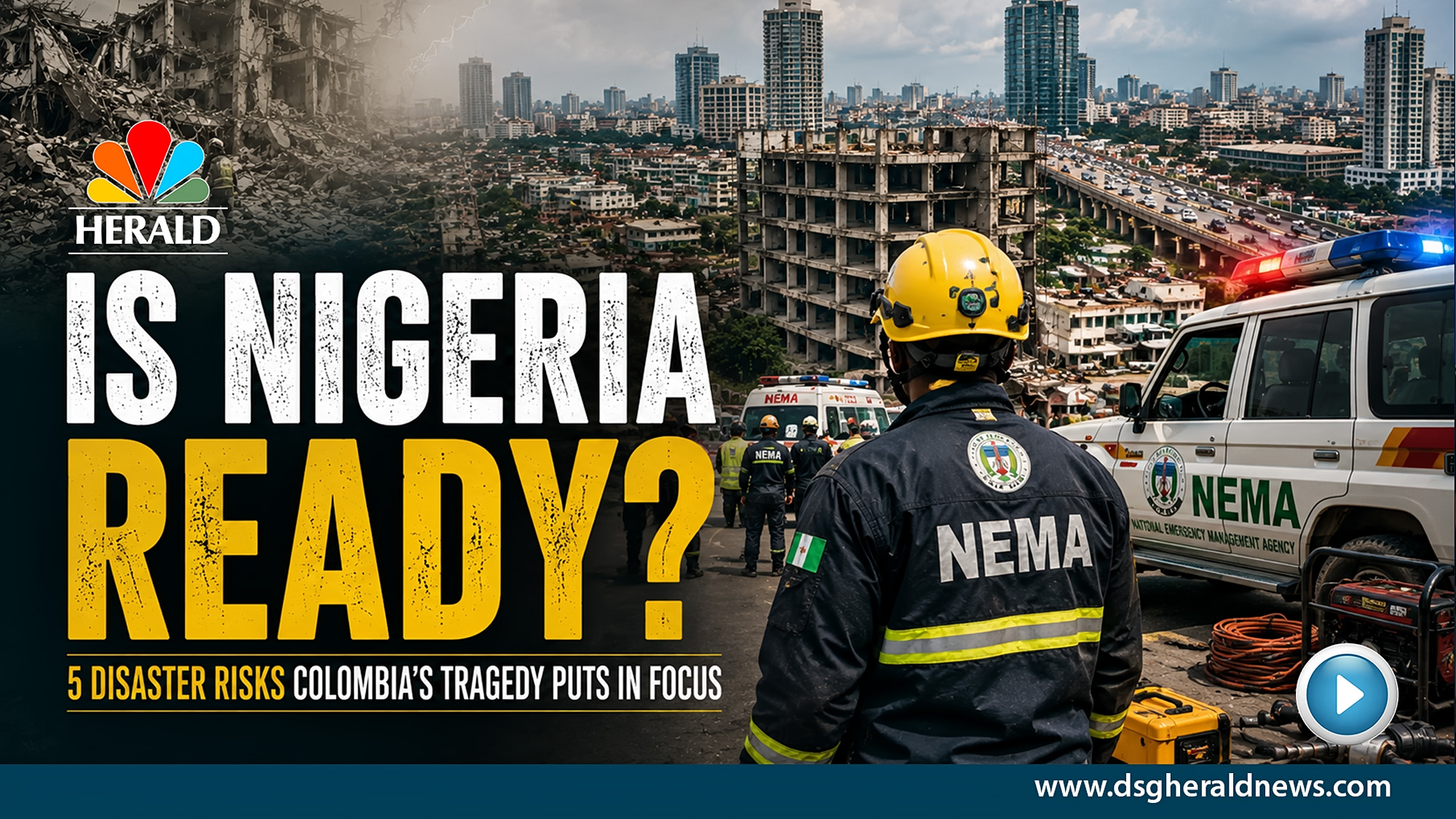
Colombia’s deadly earthquake has killed at least 111 people and injured 87, but the disaster carries a warning that extends far beyond South America. For Nigeria, the more important question is not whether the country is facing an earthquake, but whether its buildings, emergency systems, cities and communities are prepared when a major disaster strikes.
The magnitude 7.4 earthquake struck western Colombia on Monday, affecting cities including Cali, Pereira, Quibdo and Manizales. Buildings collapsed, communications were disrupted, and rescue teams searched through rubble for people feared trapped.
The scale of the destruction has once again demonstrated a basic reality of disaster management: the consequences of a catastrophe are often determined long before the disaster itself occurs.
That is why Nigeria’s disaster risks deserve closer attention.
Nigeria is not Colombia. The countries have different geographical conditions, different levels of exposure to natural hazards, and different disaster profiles. Colombia’s earthquake therefore should not be presented as evidence that Nigeria is about to experience a similar seismic event.
The lesson is broader.
Nigeria must ask whether it is prepared for a large-scale emergency that could simultaneously test buildings, roads, hospitals, telecommunications, emergency services, government agencies and ordinary communities.
And there are already warning signs.
A three-storey residential building collapsed in Lagos in June, killing nine people and leaving 27 others injured. Emergency teams from the Lagos State Emergency Management Agency, the National Emergency Management Agency, and the Lagos State Fire and Rescue Service participated in the rescue operation.
That incident was not an earthquake.
But it illustrates the same fundamental issue: when infrastructure fails, preparedness determines how effectively lives can be protected.
1. Nigeria Disaster Risks Begin With Building Safety
One of the clearest lessons from Colombia is the deadly relationship between structural failure and disaster.
When the earthquake struck, buildings collapsed across affected areas. In Cali, local officials reported at least 20 buildings had crumbled while hundreds more were damaged. Rescue workers and residents searched through rubble for survivors.
For Nigeria, the relevant warning is not necessarily about earthquake-resistant construction.
It is about structural safety generally.
Nigeria has experienced repeated building-collapse incidents, and the Lagos case provides a recent example. The building in Alakija, near the Lagos-Badagry Expressway in Satellite Town, was being used by residents and office workers and also housed businesses including cyber cafes, a photo studio and mobile-phone repair shops. Nine people died.
The cause of that collapse had not been determined in the supplied report.
However, the report identified rapid urbanisation, substandard construction materials and inadequate regulatory enforcement as longstanding concerns surrounding building collapses in Lagos. Governor Babajide Sanwo-Olu subsequently directed the Lagos State Building Control Agency to assess adjoining structures and enforce compliance with building codes.
That points to a larger disaster-preparedness question.
How resilient are the structures in which Nigerians live, work, study and conduct business?
Disaster preparedness cannot begin with ambulances arriving after a building has collapsed.
It begins with construction standards, inspections, enforcement and accountability.
A country may possess sophisticated rescue equipment, but the effectiveness of that equipment becomes much harder to realise when buildings are unsafe, access routes are blocked or neighbouring structures remain at risk.
For Nigeria, safer infrastructure is therefore not simply an urban-development issue.
It is a disaster-prevention strategy.
2. Nigeria’s Emergency Response Will Be Tested When Seconds Matter
The second major Nigeria disaster risk concerns what happens after an emergency begins.
NEMA’s own published material shows that Nigeria does have an established disaster-management architecture.
The agency says it is responsible for formulating disaster-management policies and coordinating plans and programmes for an efficient national response. Its listed infrastructure includes a Mission Control Centre, a geographic information system laboratory, mobile clinics, ambulances and search-and-rescue capability.
NEMA also identifies six zonal offices located in Jos, Kaduna, Maiduguri, Lagos, Port Harcourt and Enugu, designed to decentralise disaster management and facilitate quicker responses before action from its headquarters.
The agency also lists Disaster Response Units within military formations and describes a national disaster response plan setting out stakeholder responsibilities and a call-out system.
These structures matter.
But the existence of a response framework is not the same thing as proving that the country could comfortably manage a catastrophe affecting thousands of people simultaneously.
That is where the real preparedness question begins.
Can Nigeria scale up?
A small or geographically contained emergency is different from a disaster that simultaneously overwhelms several systems.
Imagine a major emergency affecting a densely populated urban area.
Roads could become obstructed.
Buildings could become inaccessible.
Hospitals could receive large numbers of casualties.
Electricity could be interrupted.
Telecommunications could become unreliable.
Emergency responders could struggle to reach affected areas.
The result would be a cascading emergency in which one problem creates another.
Building damage → blocked roads → delayed rescue → increased pressure on hospitals → communications difficulties → slower assistance.
That is why emergency preparedness must be measured not only by the presence of agencies, but also by their capacity to coordinate and operate under extreme pressure.
The Lagos building collapse offers a practical example of multi-agency response: LASEMA, NEMA and the Lagos State Fire and Rescue Service worked through the day and night before rescue operations concluded.
The lesson from Colombia is that the scale of a disaster can change everything.
The question Nigeria must continually ask is whether its emergency-response system can expand rapidly enough when the number of affected people rises dramatically.
3. Nigeria’s Growing Cities Could Turn One Disaster Into Many
Nigeria’s third major disaster risk is urban concentration.
The country’s major cities contain large populations, extensive infrastructure, businesses, transport networks and essential public services.
That concentration creates opportunity and economic activity, but it can also increase the consequences of a major emergency.
Lagos provides an obvious illustration.
The city contains dense residential and commercial districts alongside major transport corridors and rapidly developing areas. The Lagos building-collapse report describes the Alakija area as a densely populated residential and commercial district with ageing housing and small businesses serving a largely working-class population.
The question is therefore bigger than:
Could Nigeria experience an earthquake?
A more useful question is:
What happens when any major disaster strikes a densely populated Nigerian city?
The answer could involve several interconnected failures.
A damaged road can delay an ambulance.
A damaged hospital can reduce treatment capacity.
A telecommunications outage can make it harder for families to locate relatives.
An electricity failure can disrupt medical equipment and communications.
A damaged water system can create additional public-health concerns.
A transport disruption can prevent emergency workers, supplies and relief materials from reaching affected communities.
This is what makes urban disaster planning so important.
The greatest danger may not always be the initial event.
It can be the chain reaction that follows it.
4. Nigeria Disaster Risks Also Exist at Community Level
Government agencies cannot be everywhere at the same time.
That makes community preparedness an essential part of disaster management.
NEMA’s own published strategy recognises the importance of awareness generation. The agency describes public awareness as central to building a culture of sustainable resilience and says its disaster-risk-reduction approach places greater emphasis on prevention and mitigation rather than waiting for emergencies to happen.
That raises an important question for ordinary Nigerians:
Would people know what to do during the first few minutes of a major disaster?
The answer matters because the first response to an emergency often begins before professional rescuers arrive.
People may need to:
- Move away from dangerous structures.
- Help vulnerable family members reach safety.
- Identify safe assembly points.
- Provide basic first aid where appropriate.
- Avoid entering unstable buildings.
- Establish ways for family members to communicate.
- Follow instructions from emergency authorities.
- Report trapped or missing people through appropriate channels.
The point is not to turn every Nigerian into a professional emergency responder.
It is to build a population that understands basic preparedness.
That can reduce confusion during the crucial early stages of an emergency.
Colombia’s earthquake demonstrates how quickly communities can become involved in rescue efforts. The supplied report described residents forming human chains while helping search through debris and calling for heavy equipment.
Community resilience therefore deserves to be treated as part of national preparedness rather than an afterthought.
5. The Biggest Nigeria Disaster Risk May Be Preparing Too Late
The fifth and perhaps most important risk is a mindset that treats disaster management primarily as something that happens after disaster.
NEMA’s own material explicitly points toward a different approach.
Its disaster-risk-reduction strategy emphasises prevention and mitigation rather than simply waiting for the aftermath. It also identifies contingency stockpiling, search and rescue, stakeholder collaboration, training, awareness generation and decentralised response as components of its disaster-management approach.
That principle deserves to remain at the centre of Nigeria’s disaster policy.
Because once disaster strikes, many decisions have already been made.
A building has already been constructed.
A road has already been designed.
An emergency facility has already been positioned.
A community either has or does not have an evacuation plan.
Responders either have or do not have the equipment required.
Hospitals either have or do not have sufficient emergency capacity.
Communication systems either withstand the disruption or fail under pressure.
Preparation therefore determines how much damage can be prevented before the emergency reaches its peak.
Colombia Shows Why Preparedness Cannot Be an Afterthought
The Colombian earthquake offers a powerful example of how quickly a major disaster can overwhelm communities.
The earthquake struck at a depth of about 107 kilometres, according to the US Geological Survey information cited in the supplied report, yet its magnitude and location still produced significant damage across western Colombia. At least 21 aftershocks followed within hours.
In Cali, rescue teams and civilians searched through destroyed buildings.
In Pereira, authorities reported collapsed structures and continued searches for people feared trapped.
In Choco, communications problems complicated the flow of information from areas near the epicentre.
Airports in several western Colombian cities were temporarily suspended while engineers conducted structural inspections.
The response also demonstrated the importance of international assistance.
The United States announced $15.5 million in emergency assistance for shelter, food and other earthquake-response needs, while governments including El Salvador, Mexico and Chile offered assistance and rescue or medical support.
For Nigeria, that aspect of the crisis provides another lesson.
Major disasters rarely remain the responsibility of one institution.
They require governments, emergency agencies, security services, medical personnel, local communities and, where necessary, international partners to work together.
That requires planning before the emergency.
Nigeria Already Has a Disaster-Response Framework
It would be wrong to portray Nigeria as having no disaster-preparedness system.
The evidence supplied by NEMA shows the opposite.
The agency identifies:
- A Mission Control Centre for distress alerts and search-and-rescue coordination.
- A GIS facility for spatial information and disaster response.
- Mobile clinics positioned in Abuja, Kaduna, Lagos and Port Harcourt.
- Ambulances stationed in Abuja and the agency’s zonal offices.
- A search-and-rescue helicopter.
- Warehouses for contingency supplies.
- A Search and Rescue/Epidemic Evacuation Plan.
- Collaboration with security agencies.
- A National Disaster Response Plan.
- Training and capacity-building programmes.
- Disaster-risk-reduction initiatives.
- Six zonal offices.
- Disaster Response Units in military formations.
This is an important part of the story because effective journalism should not confuse preparedness challenges with the absence of preparedness structures.
Nigeria has institutions.
The harder question is whether those institutions have the capacity, equipment, coordination and public support necessary for the scale of disaster they might one day have to confront.
That is the accountability question that deserves continued attention.
Five Questions Nigeria Should Be Asking Now
Colombia’s tragedy provides an opportunity to move the national conversation from reaction to prevention.
Five questions stand out.
1. Are Nigerian buildings safe enough?
Building codes are only meaningful when they are properly implemented and enforced.
2. Can emergency agencies respond at scale?
A response system designed for individual incidents must also be capable of handling a large, complex emergency.
3. Are Nigerian cities planning for cascading emergencies?
Disasters can simultaneously affect roads, buildings, hospitals, communications, electricity and water.
4. Do communities understand basic disaster preparedness?
Public awareness can reduce confusion and improve resilience during the first critical moments.
5. Are prevention and mitigation receiving enough attention?
The cheapest disaster to manage is often the one whose consequences were reduced before it happened.
The Warning Is Bigger Than an Earthquake
Colombia’s earthquake should not be turned into a prediction about Nigeria.
There is no basis in the supplied material for claiming that Nigeria is facing an imminent earthquake.
The more responsible lesson is broader.
Disasters expose weaknesses that ordinary times can hide.
A building that has structural problems may appear normal until something goes wrong.
An emergency-response system may appear adequate until hundreds or thousands of people need help simultaneously.
A communication network may appear reliable until a crisis overwhelms it.
A community may appear prepared until residents suddenly need to know where to go, whom to call and how to protect vulnerable people.
That is why Nigeria disaster risks should be treated as a continuing public-policy issue rather than something discussed only after tragedy.
What Nigeria Can Do Before the Next Emergency
The answer does not necessarily require waiting for a catastrophic event to expose every weakness.
Nigeria can continue strengthening the areas its own disaster-management framework already identifies.
That means maintaining emergency equipment.
Training responders.
Improving coordination.
Strengthening public awareness.
Supporting disaster-risk reduction.
Improving structural oversight.
Maintaining contingency supplies.
Strengthening emergency medical capacity.
And ensuring that disaster planning reaches communities rather than remaining solely within government institutions.
The goal should not be to predict every possible disaster.
That is impossible.
The goal is to make the country more resilient when the unexpected happens.
Conclusion: The Real Test Comes Before Disaster
Colombia’s 111 deaths are first and foremost a human tragedy.
The earthquake destroyed buildings, separated families, disrupted communications and forced communities into an urgent search for survivors.
For Nigeria, the appropriate response is not fear.
It is preparation.
The country already has national and zonal disaster-management structures, emergency-response plans and specialised facilities. It also has experience responding to emergencies, including the recent Lagos building collapse.
But preparedness is never a finished project.
As Nigerian cities grow, infrastructure expands and populations become increasingly concentrated in urban areas, the consequences of a major emergency could become more complex.
The lesson from Colombia is therefore simple:
Nigeria should not wait for disaster to reveal what should have been fixed beforehand.
The real test of disaster preparedness does not begin when the buildings collapse.
It begins before they do.
And that is why the five Nigeria disaster risks highlighted by Colombia deserve attention now—not after the next emergency.
About the Author