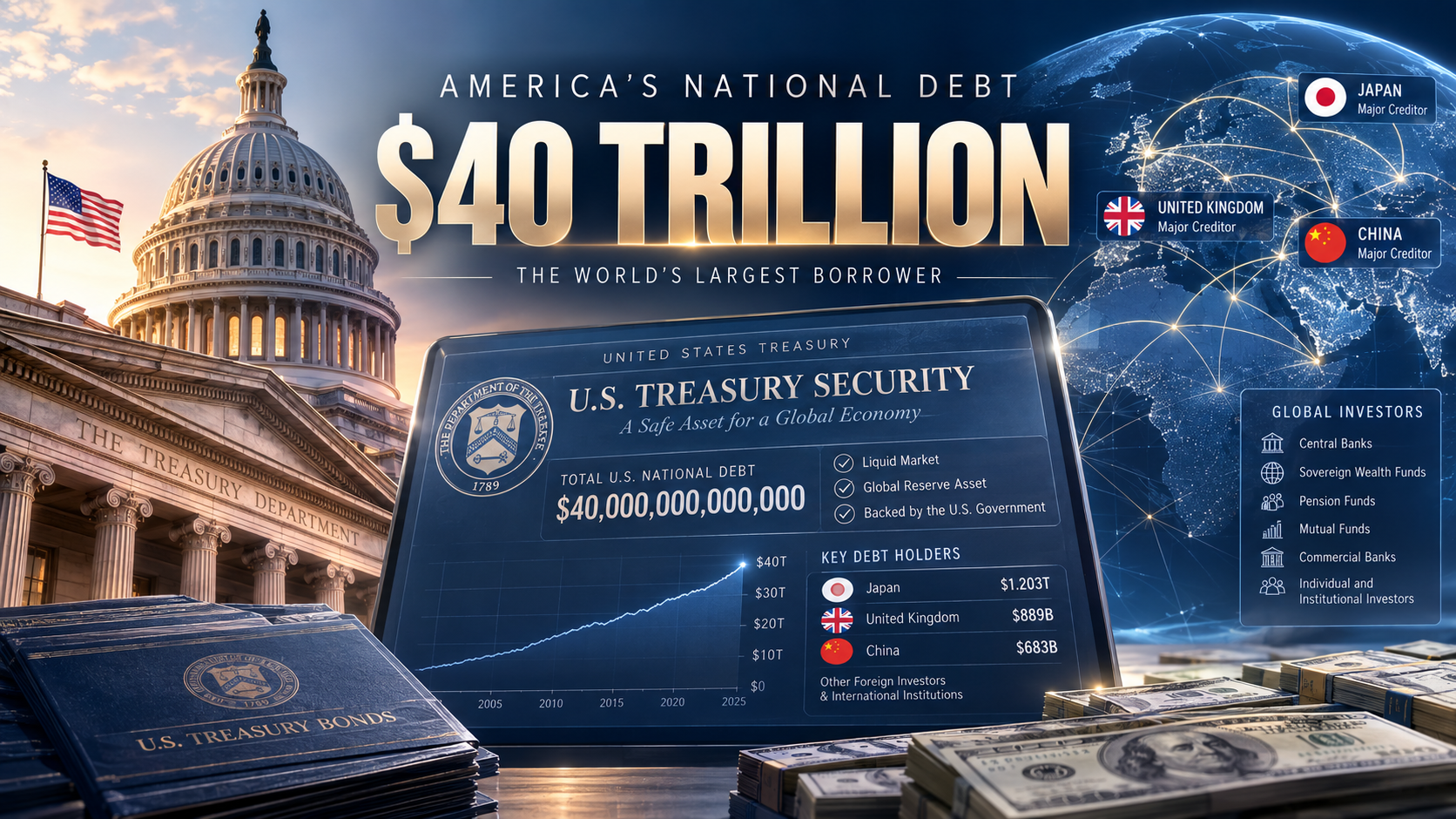
America’s $40 trillion debt has become a historic financial milestone, but the number itself is only the beginning of the story. Behind the enormous figure is a complex network of American investors, financial institutions, pension funds, the Federal Reserve, foreign governments and global investors that continue to finance Washington’s borrowing. The deeper question is why the United States keeps adding to the debt, how much that borrowing now costs and what it could mean for the American economy and the wider world.
The United States has crossed a threshold that once seemed almost impossible to imagine.
On Wednesday, August 19, total US government debt moved above $40 trillion, according to Treasury data. Reuters reported that the figure stood at about $40.3 trillion, comprising roughly $32.3 trillion in debt held by the public and about $7.8 trillion in intragovernmental holdings.
It is an extraordinary number, but it is also a misleading one if viewed without context.
The United States does not owe $40 trillion to one country. Nor is the entire amount owed to foreign governments. A substantial share of the debt is held within the United States itself, while foreign investors and governments hold another significant portion.
That distinction matters because the real story behind America’s $40 trillion debt is not simply the size of the bill. It is the financial system that makes such borrowing possible, the spending and revenue decisions that keep expanding the debt, and the growing cost of servicing it.
America’s $40 Trillion Debt Is More Than a Number
For decades, the United States has been able to borrow on a scale unmatched by most countries.
Its government issues Treasury securities to raise money when federal spending exceeds revenue. Investors buy those securities, providing Washington with the funds it needs while receiving interest in return.
That mechanism has helped finance wars, economic programmes, infrastructure, social benefits, emergency spending and responses to major crises.
The problem emerges when borrowing becomes persistent rather than temporary.
The US government has continued to run large budget deficits even outside periods of severe economic crisis. According to the Congressional Budget Office, the federal deficit is projected at about $1.9 trillion in fiscal 2026, while federal outlays are expected to reach $7.4 trillion against revenues of $5.6 trillion.
In simple terms, Washington is projected to spend substantially more than it collects.
The difference has to be financed.
And that means more borrowing.
This is the basic mechanism behind the expanding US national debt.
Who Are America’s Debt Holders?
The phrase “US debt holders” covers a much wider group than foreign governments.
The original source material identifies domestic holders including the Federal Reserve, mutual funds, pension funds, state and local governments, commercial banks and other corporate and individual investors. It puts publicly held debt at roughly $32 trillion and domestic holdings at about $21 trillion.
This means that a significant part of America’s borrowing is effectively woven into the domestic financial system.
Pension funds, for example, can hold Treasury securities as part of their investment portfolios. Banks can use government securities as financial assets. Mutual funds can hold them on behalf of millions of investors.
The Federal Reserve is another major holder.
The central bank buys and sells Treasury securities as part of its monetary-policy operations. Its holdings therefore form part of the wider relationship between government borrowing and the financial system.
This is why a discussion about US debt cannot simply be reduced to the question of how much America owes other countries.
America also owes a substantial amount to its own financial institutions, investors and government-linked entities.
That makes the debt both a government obligation and a major component of the financial assets held throughout the economy.
Why Do Foreign Governments Buy US Debt?
Foreign investors are nevertheless an important part of the story.
The US Treasury market has become one of the central pillars of the global financial system. Governments, central banks, financial institutions and private investors around the world buy Treasury securities for different reasons, including reserve management, investment and liquidity.
The source material identifies Japan, the United Kingdom and China among the largest foreign holders, with holdings in 2025 of about $1.203 trillion, $889 billion and $683 billion respectively.
But describing those countries simply as America’s “creditors” can obscure the nature of the relationship.
A country holding US Treasury securities does not necessarily mean it has lent money directly to the American government in the same way an individual might lend money to a neighbour.
Treasury securities are tradable financial assets.
Foreign investors purchase them because they can provide income and liquidity and because the US dollar remains central to international finance.
That creates a powerful relationship.
Washington needs investors willing to buy its debt.
Investors need deep and liquid markets in which they can hold and trade large amounts of capital.
For decades, the US Treasury market has provided that connection.
The Dollar Gives Washington an Extraordinary Advantage
One reason the United States has been able to sustain such enormous borrowing is the special role of the dollar.
The US dollar remains the dominant currency in global finance, international trade and official reserves. That creates demand for dollar-denominated assets, including US Treasury securities.
The result is a financing advantage that many other countries do not possess.
When governments in smaller economies borrow heavily, investors can quickly become concerned about whether those governments will be able to repay their debts or maintain the value of their currencies.
The United States operates from a very different position.
Its economy is enormous. Its financial markets are deep. Its currency has global reach. And US Treasury securities occupy a central position in international portfolios.
That does not mean Washington can borrow without limits.
It means the limits arrive differently.
Rather than an immediate inability to borrow, the pressure can appear through higher interest rates, greater financing costs, reduced fiscal flexibility and growing investor concern about the long-term direction of government finances.
That is where the current debt debate becomes more important.
Why Is America Borrowing So Much?
There is no single explanation.
Some of the debt accumulated during extraordinary periods.
The global financial crisis of 2007–09 forced governments to respond to a major economic downturn. More than a decade later, the COVID-19 pandemic produced another enormous wave of government spending.
The pandemic response in particular contributed significantly to the increase in US debt.
But the debt did not stop growing when the pandemic emergency ended.
The underlying imbalance between federal spending and revenue remained.
Social Security, Medicare, other mandatory programmes and interest payments all place substantial demands on the federal budget. At the same time, political pressure remains strong for tax relief, defence spending, infrastructure investment and other government programmes.
The result is a fiscal equation that has become increasingly difficult to balance.
The Congressional Budget Office says federal outlays are projected to rise from 23.3 percent of GDP in 2026 to 24.4 percent in 2036, driven partly by higher spending on Social Security, Medicare and net interest costs. Revenue, meanwhile, is projected at 17.5 percent of GDP in 2026 and 17.8 percent in 2036.
The numbers reveal the structural problem.
Washington is not merely dealing with an occasional spending surge. The government’s projected expenditure remains substantially above its projected revenue.
The gap requires borrowing.
The Political Problem Behind the Numbers
America’s debt is often presented as a battle between Republicans and Democrats.
Politics certainly matters.
Tax policy, government spending, entitlement programmes and defence budgets are all politically contested.
But the growth of the national debt has continued across administrations from both parties.
The supplied source shows that total debt has risen sharply since Donald Trump entered office in 2017, while the Biden administration also presided over a substantial increase.
The pandemic explains part of that rise.
But it does not explain everything.
The deeper problem is that neither party has found a politically easy formula for bringing federal spending and revenue into long-term balance.
That is why arguments about individual presidents can sometimes distract from the larger fiscal reality.
Presidents can influence the trajectory of the debt through tax and spending policies, but Congress ultimately controls taxation and federal spending through legislation.
The political system therefore has to confront a difficult choice.
Reducing the deficit means either collecting more money, spending less money or finding some combination of the two.
Every option has consequences.
Trump’s Tax Policies Add Another Layer to the Debate
Tax policy is one of the most contested parts of the American fiscal argument.
During his first presidency, Donald Trump signed the 2017 Tax Cuts and Jobs Act, which reduced the federal corporate tax rate from 35 percent to 21 percent.
The Trump administration later backed legislation that extended or made permanent significant elements of those earlier tax policies.
Supporters argue that lower taxes can encourage investment, business activity and economic growth.
Critics counter that tax cuts can widen deficits if the resulting economic growth does not generate enough additional revenue to offset the lost receipts.
The Congressional Budget Office has estimated that the 2025 reconciliation law would increase cumulative deficits by trillions of dollars over the 2025–2034 period, although its effects are influenced by changes in both taxes and spending.
The argument is therefore not simply about whether taxes should be higher or lower.
It is about whether the government can permanently sustain its spending commitments while collecting enough revenue to finance them.
That question becomes increasingly difficult as the debt grows.
The Cost of Borrowing Is Becoming the Bigger Concern
A country can carry a large debt without immediately experiencing a financial crisis.
The more important question is how much it must pay to maintain that debt.
Every Treasury security carries an interest obligation.
As older securities mature, the government must refinance them. If the prevailing interest rates are higher than when the original debt was issued, the cost of refinancing increases.
That is becoming increasingly important for Washington.
Reuters reported this week that investors have been demanding higher returns to lend to the US government, increasing the cost of refinancing existing debt and funding new deficits.
The pressure has also appeared in the long-term Treasury market.
The yield on 30-year US Treasury bonds recently reached about 5.337 percent, its highest level since 2007, before falling after the Treasury announced an expansion of its bond-buyback operations.
The Treasury said it would increase the size of certain buyback operations for longer-dated debt from $2 billion to at least $4 billion per transaction.
That move does not solve the underlying deficit problem.
Instead, it illustrates the growing sensitivity of the government bond market to borrowing costs and investor confidence.
Interest Payments Are Changing the Budget
This is perhaps the least visible part of America’s debt problem.
Most people see the $40 trillion headline.
Far fewer people think about the interest bill attached to it.
The Congressional Budget Office projects that net interest costs will rise significantly over the coming decade. Under its February 2026 baseline, net interest payments reach approximately $2.1 trillion in 2036, equivalent to 4.6 percent of GDP.
That creates a new pressure on the federal budget.
Money used to service debt cannot simultaneously be used for another government priority.
If interest payments continue rising, policymakers may eventually have less flexibility to respond to recessions, wars, emergencies or other unexpected events without borrowing even more.
That is why the interest bill may prove more important than the headline debt figure itself.
What Happens If Investors Become Less Comfortable?
The United States has benefited from enormous demand for its debt.
But investors are not required to accept any interest rate Washington chooses to offer.
If investors become more concerned about inflation, fiscal deficits or the future supply of Treasury securities, they can demand higher yields.
Higher yields increase the government’s cost of borrowing.
They can also affect the private economy because Treasury yields influence broader financial conditions.
Businesses may face higher financing costs.
Homebuyers can face higher mortgage rates.
Investors may reconsider how they allocate money between government bonds, equities and other assets.
The result can spread far beyond the Treasury market.
Reuters reported that higher long-term government bond yields are already being closely watched across major economies as investors assess debt, inflation and geopolitical risks.
The concern is therefore not that investors will suddenly stop lending to America tomorrow.
It is that Washington may gradually have to pay more for the privilege of borrowing.
How High Could America’s Debt Go?
The Congressional Budget Office’s projections provide a sobering picture.
Under its February 2026 baseline, federal debt held by the public is projected to rise from 101 per cent of GDP in 2026 to 120 per cent in 2036. That would be higher than the previous post-World War II record of 106 per cent of GDP reached in 1946.
The CBO projects that debt would continue rising beyond 2036, reaching about 175 percent of GDP by 2056 under its long-term assumptions.
These figures are projections, not predictions carved in stone.
Government policy can change.
Economic growth can surprise on the upside or downside.
Congress can alter taxes and spending.
Interest rates can move in unexpected directions.
But the projections show why the current trajectory has attracted increasing attention from economists and fiscal watchdogs.
The problem becomes harder to solve if policymakers wait.
Could America Face a Debt Crisis?
This is where careful language matters.
The fact that America’s debt has crossed $40 trillion does not mean the United States is already experiencing a debt crisis.
There is no automatic financial collapse attached to the number.
The United States remains the world’s largest economy and operates the world’s most important government bond market.
The concern is about the possibility of a deeper fiscal crisis if debt continues rising while the cost of servicing it consumes more government resources.
A genuine crisis could take many forms.
It could involve sharply higher borrowing costs, pressure on the dollar, weaker private investment, reduced government flexibility or difficult political choices over taxes and spending.
The consequences would depend on the circumstances.
That is why the phrase US debt crisis should be understood as a risk that policymakers and markets are watching, rather than a declaration that such a crisis has already arrived.
The Global Economy Cannot Easily Ignore America’s Debt
America’s debt problem would not remain confined to Washington if it became severe.
The US dollar is deeply integrated into global commerce.
US Treasury securities are held around the world.
Global banks, investment funds, pension systems and central banks interact with US financial markets.
A major disruption could therefore affect currencies, capital flows, borrowing costs and financial markets internationally.
For developing economies, the relationship can be particularly important.
When US interest rates and Treasury yields rise, global investors may find dollar assets more attractive.
Capital can move toward US markets and away from riskier emerging markets.
That can put pressure on currencies and make dollar-denominated borrowing more expensive.
For countries that rely heavily on imported goods, foreign investment or external financing, changes in global dollar conditions can become significant economic issues.
Why Nigeria Should Pay Attention
For Nigeria, the US debt story may initially appear distant.
It is not.
Nigeria operates within a global financial system in which the US dollar remains central to international trade, oil markets, foreign reserves and cross-border investment.
A sustained rise in US borrowing costs can affect the wider cost of capital.
Investors deciding where to place money compare opportunities across markets. If US Treasury securities offer higher returns with relatively low perceived risk, emerging-market assets may have to offer greater returns to remain competitive.
That can increase financing pressures for developing economies.
The effect is not automatic, and America’s $40 trillion debt does not directly determine Nigeria’s economic performance.
But the connection is important enough to watch.
For Nigerian businesses, investors and policymakers, the US Treasury market is part of the external financial environment in which decisions about currencies, borrowing and investment are made.
In that sense, the debt accumulating in Washington can eventually become part of the economic conversation in Lagos, Abuja and other financial centres across Africa.
Who Ultimately Pays for the Debt?
There is no single answer.
Some of the cost is paid through taxes.
Some is absorbed through government spending decisions.
Some is transferred through interest payments to the people and institutions holding Treasury securities.
And some of the burden can be pushed into the future.
That is the intergenerational dimension of the debate.
When governments borrow to finance today’s spending, future governments inherit the obligation to service that debt.
If economic growth remains strong, the burden can become easier to manage relative to the size of the economy.
If debt grows faster than the economy for a prolonged period, however, the choices can become increasingly uncomfortable.
Future lawmakers may face pressure to raise taxes, reduce spending or accept higher borrowing costs.
None of those decisions is politically simple.
The $40 Trillion Milestone Is a Warning Marker
America’s $40 trillion debt should therefore not be viewed as the end of a story.
It is a marker on a much longer fiscal journey.
The United States has extraordinary economic strengths. Its currency remains central to global finance, its Treasury market remains enormous and liquid, and investors continue to treat US government securities as critical financial assets.
Those advantages give Washington considerable room.
But they do not remove the arithmetic.
If spending consistently exceeds revenue, borrowing continues.
If borrowing continues, debt grows.
If debt grows, interest payments become increasingly important.
And if interest rates remain elevated, the cost of carrying that debt can rise faster than policymakers would like.
That is the chain that matters.
The Real Question Facing Washington
The most important question is therefore not simply who holds America’s debt.
It is whether Washington can bring the growth of borrowing into a sustainable relationship with the size of the American economy.
The Congressional Budget Office has made the direction clear under its current-law baseline: debt held by the public is projected to rise to 120 percent of GDP by 2036, while net interest costs continue increasing. The agency says lawmakers would need significant changes to tax and spending policies to put debt on a sustainable path, and that the size of the required adjustment grows the longer policymakers wait.
That leaves America facing choices that are economically difficult and politically uncomfortable.
Higher taxes could raise revenue.
Spending cuts could reduce deficits.
Economic growth could improve the government’s ability to carry debt.
A combination of these approaches could also be pursued.
But postponing the problem does not make the underlying mathematics disappear.
For now, the world continues to finance America.
Domestic investors continue to hold Treasury securities. Foreign governments continue to maintain dollar assets. The Federal Reserve remains deeply connected to the Treasury market. Businesses and financial institutions continue to use US government securities as foundational assets.
The system has enormous strength.
But the system is also becoming more expensive.
America’s $40 trillion debt is therefore not simply a story about a government owing money.
It is a story about a financial system that has allowed the United States to borrow on an extraordinary scale, a political system struggling to reconcile spending with revenue, and a global economy that remains deeply connected to the decisions made in Washington.
The number has crossed $40 trillion.
The more consequential question is what comes after it.
Because the real test of America’s financial strength will not be whether Washington can borrow another trillion dollars. It will be whether the country can eventually slow the borrowing before the cost of carrying the debt begins to constrain the choices of an entire generation.
About the Author