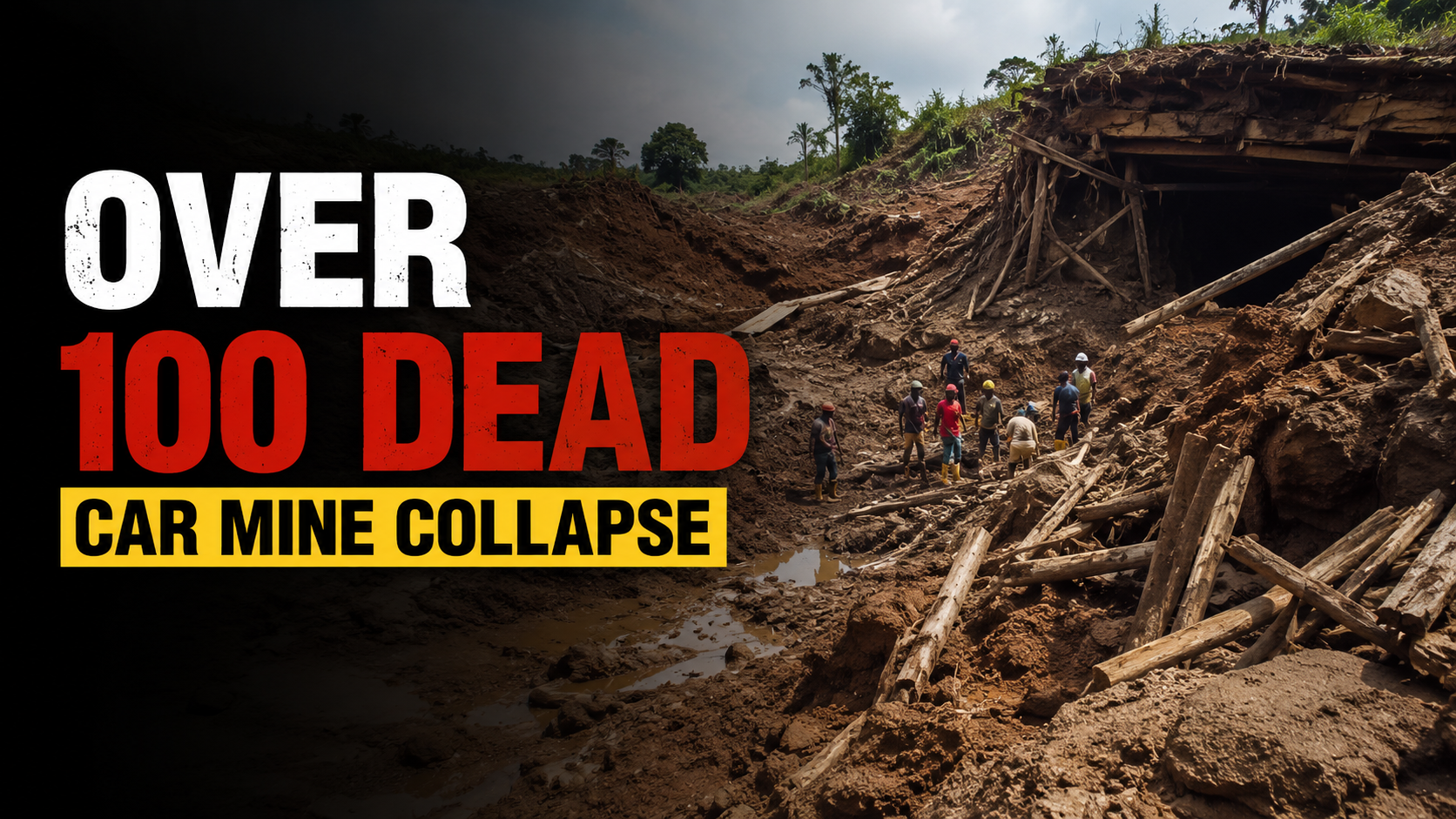
More than 100 people have died after an artisanal gold mine collapsed in Zamboye, western Central African Republic, near the border with Cameroon, with rescuers continuing to search through the rubble as authorities investigate what caused the disaster.
The collapse occurred on Tuesday at a low-tech mining site in Nana-Mambéré prefecture. More than 100 bodies have been recovered, according to local Red Cross volunteer Gervais Ganagoroh, while several other miners remain missing or trapped beneath the debris. (AP News)
The scale of the tragedy has turned attention beyond the immediate rescue operation to the dangerous conditions surrounding artisanal mining in the Central African Republic, where thousands of people depend on small-scale gold extraction despite limited safety protections.
The disaster is also unfolding in a border region where mining activity links communities in the Central African Republic and neighbouring Cameroon, adding a regional dimension to an already devastating accident.
Central African Republic Mine Collapse Leaves Rescue Operation Racing Against Time
The first reports from Zamboye indicated that dozens of miners had been killed. The reported toll subsequently rose sharply as rescuers and local residents recovered more bodies from the collapsed site.
By Thursday, hopes of finding additional survivors were fading, although recovery operations were continuing. Local workers said the response faced serious limitations, including inadequate equipment and expertise for an accident of such magnitude. (Laredo Morning Times)
Gervais Ganagoroh, who is participating in the relief effort, said the local Red Cross could not determine how many people remained buried.
The uncertainty means the more than 100 deaths reported so far may not represent the final toll.
Bertrand Be Yangué, a member of the Zamboye youth council, said several people remained missing or trapped beneath the rubble.
He described the loss in deeply human terms, saying many of the victims were young men and women who had gone to the mines in an attempt to support their families.
That detail is central to understanding the disaster. For many workers in impoverished mining communities, artisanal gold extraction is not simply an industrial activity. It is a source of income in places where formal employment opportunities are limited.
What Caused the Deadly Collapse?
Authorities believe the disaster was linked to the failure of several underground tunnels where miners were working.
The Baboua public prosecutor announced that a judicial investigation had been opened. The inquiry is expected to examine the circumstances surrounding the collapse and establish whether there were failures or violations connected to the operation of the mine.
That investigation could become important because the disaster occurred at a low-tech artisanal site where conventional industrial mining safeguards are often absent.
The distinction matters.
Industrial mines generally operate with engineered excavation plans, geological assessments, structural monitoring, regulated access and specialised emergency procedures. Artisanal operations can involve workers digging underground with far fewer resources and limited protective equipment.
When underground structures become unstable, miners may have little warning and even fewer options for escape.
In Zamboye, the result was catastrophic.
Why Artisanal Mining Is So Dangerous in CAR
The Central African Republic has substantial mineral resources, including gold and diamonds, but much of its small-scale mining activity takes place outside formal government control.
The supplied reporting describes thousands of people working in small-scale extraction, often without adequate protection.
This creates a difficult policy problem.
Mining provides livelihoods in communities where economic alternatives can be scarce. At the same time, informal operations can expose workers to tunnel collapses, landslides and other hazards.
The tragedy in Zamboye therefore raises a question that extends beyond one mining site: how can governments make artisanal mining safer without eliminating an important source of income for vulnerable communities?
Simply shutting down dangerous sites may not solve the underlying economic problem if workers have nowhere else to earn a living.
But allowing miners to operate without meaningful safety standards can leave communities exposed to precisely the kind of catastrophe now unfolding in Zamboye.
The challenge is therefore likely to involve regulation, enforcement, training, equipment and economic alternatives rather than a single intervention.
A Pattern of Deadly Mining Accidents
The latest Central African Republic mine collapse is particularly significant because it follows other fatal mining incidents reported in the country this year.
The supplied source says a collapse at the Be-Mbari gold mining site in June killed dozens of people. Seven people were reportedly killed by a landslide at a mine in Ngourroum in March, while another 20 died at Gordi in February.
The sequence puts the Zamboye disaster into a broader pattern.
These incidents are not necessarily identical. Different geological conditions, mining methods and circumstances may have contributed to each accident.
But their recurrence highlights the persistent risks associated with informal and poorly regulated extraction.
That is why the latest tragedy is more than a single day’s breaking news.
It is also a warning about a mining economy in which the demand for gold continues to attract workers into environments where safety systems may be weak.
The Human Cost Behind the Gold
The victims were not simply numbers in a death toll.
They were miners who had entered the site to earn money.
Bertrand Be Yangué’s description of workers seeking to support their families illustrates the economic pressures behind the activity. (Laredo Morning Times)
That reality complicates the discussion about artisanal mining.
Gold has economic value, but the people extracting it may have very little financial security themselves.
For young workers in rural communities, the choice may be between entering a dangerous mine or facing unemployment and poverty.
This creates a cycle that is difficult to break.
When gold prices or local demand make mining attractive, more workers can enter the sector. If government regulation remains weak, production can expand without a corresponding improvement in safety.
The economic benefit is then accompanied by a potentially enormous human cost.
The Zamboye collapse has exposed that imbalance in the most devastating way possible.
Cameroon Drawn Into the Aftermath
The location of the disaster adds another layer to the story.
Zamboye lies in western Central African Republic, close to the Cameroon border and within reach of Garoua-Boulai in eastern Cameroon.
The proximity means the consequences of the disaster are not confined neatly within one country’s borders.
Cameroonian authorities have indicated cooperation with their Central African counterparts in dealing with the aftermath. The region’s cross-border connections also matter because workers and communities around mining areas can move between neighbouring countries.
Reports have also indicated that some victims included people from neighbouring countries. (AP News)
That makes coordination important not only for rescue operations but also for identifying victims, assisting injured workers and notifying families.
For communities along the border, a disaster at a remote mining site can quickly become a cross-border humanitarian issue.
Why Rescue Efforts Are Proving Difficult
Recovering victims from a collapsed underground mine is inherently dangerous.
Rescuers must work around unstable earth and structures that may collapse again. Digging through rubble without appropriate equipment can expose rescue workers to the same hazards that killed the miners.
In Zamboye, local workers have complained that the response does not have enough equipment or expertise for a disaster of this scale. (Laredo Morning Times)
That limitation is particularly significant because the first hours and days after a collapse can be critical for people who may still be alive beneath the rubble.
The challenge is therefore not simply locating victims.
Rescuers must reach them without causing further collapses, while dealing with difficult terrain and the limited infrastructure of a remote artisanal mining area.
The continuing recovery operation will determine whether more survivors can be found and how many additional bodies can be recovered.
The Investigation Could Become a Test of Accountability
The judicial inquiry announced by the Baboua prosecutor could eventually provide answers to some of the most important questions surrounding the disaster.
Among them are:
- Who operated the mining site?
- Were the underground tunnels structurally safe?
- Were workers warned about possible instability?
- Were existing mining regulations followed?
- Were adequate safety measures available?
- Could the collapse have been prevented?
- Who should bear responsibility if negligence is established?
These questions matter because the outcome could influence how authorities respond to other artisanal mining operations.
If investigators identify preventable failures, the case could strengthen arguments for stricter regulation and enforcement.
If the investigation finds that the collapse resulted primarily from unpredictable geological conditions, the policy response could instead focus more heavily on improving geological assessments, monitoring and emergency preparedness.
At this stage, however, responsibility should not be assigned before the investigation is completed.
A Wider African Mining Safety Problem
Although the Zamboye disaster is specific to the Central African Republic, the underlying challenge is not unique to the country.
Artisanal and small-scale mining exists across Africa, providing employment and income to millions of people while also presenting significant environmental, labour and safety challenges.
The sector occupies an important place in many mineral-producing economies because it can provide livelihoods where formal industries have not created enough jobs.
That means governments face a delicate balance.
Over-regulation or sudden bans can push miners further underground and make activities harder to monitor.
Weak regulation, on the other hand, can allow unsafe working practices to continue.
The more sustainable approach is likely to involve bringing miners into a formal system where authorities can provide safety training, enforce minimum standards and improve access to safer technology.
The tragedy in Zamboye gives that debate a human face.
What the Disaster Means for the Central African Republic
The Central African Republic mine collapse comes at a time when the country’s mineral wealth remains an important part of its economic story.
Gold can generate income for miners, traders and communities, while also offering governments an opportunity to increase formal economic activity.
But when mining remains largely informal, much of that potential can be accompanied by weak oversight.
For the government, the disaster therefore creates pressure on several fronts.
There is an immediate responsibility to complete rescue and recovery operations and assist affected families.
There is also a longer-term responsibility to determine whether existing mining rules are adequate and whether authorities have the capacity to enforce them.
The government spokesman, Evariste Ngamana, expressed sympathy for victims’ families and said authorities were working to provide assistance.
Those measures are important in the immediate aftermath.
But the larger test will be whether the tragedy produces lasting changes in how dangerous artisanal mining sites are identified, regulated and monitored.
A Tragedy That Goes Beyond Zamboye
The deaths in Zamboye have once again placed the dangers of artisanal gold mining in the spotlight.
More than 100 people have died, according to the latest reports, and the number could still change as recovery operations continue. (AP News)
But the deeper significance of the disaster lies in what happens after the headlines disappear.
If the investigation establishes preventable failures, authorities will face pressure to act.
If miners continue working in similar conditions elsewhere, the possibility of another tragedy will remain.
And if communities continue depending on dangerous mining because they lack viable economic alternatives, regulation alone may not be enough.
The Central African Republic therefore faces a difficult choice: continue treating mine collapses as isolated emergencies, or confront the wider conditions that allow unsafe artisanal mining to flourish.
The Zamboye disaster has already demonstrated the cost of leaving that question unanswered.
For now, rescuers remain focused on the rubble, families are waiting for news of missing relatives, and investigators are beginning the search for answers.
But the ultimate measure of the tragedy will not only be the number of bodies recovered.
It will be whether the deaths lead to safer conditions for the people who continue to descend into the country’s gold mines in search of a livelihood.
About the Author