Gaza Peace Plan Hits Disarmament Deadlock
Israel’s demand for Hamas disarmament before any military withdrawal has exposed a fundamental sequencing dispute threatening to stall Trump’s Gaza peace initiative.
Israeli Prime Minister Benjamin Netanyahu has rejected the latest formulation of the Gaza peace plan, saying Israeli forces will not withdraw from the territory until Hamas is genuinely disarmed, according to the supplied reports. His position has placed a major obstacle in the path of the US-backed initiative, because Hamas has previously linked disarmament to an Israeli withdrawal and an end to hostilities.
The disagreement means the central challenge facing the peace process is no longer simply whether the parties support a roadmap. It is whether Israel, Hamas and their international mediators can agree on the order in which its most difficult commitments should be carried out.
Netanyahu said at a cabinet meeting that Israel rejects the 15-point document and that the Israeli military would continue to prevent threats against its forces and citizens until Hamas is genuinely disarmed.
Hamas, however, has said it remains committed to implementing the agreement and has called on mediators and guarantor countries to ensure that all parties comply with their commitments.
That leaves Washington facing a difficult diplomatic problem: how to reconcile an Israeli demand for complete disarmament with a Palestinian position that places Israeli withdrawal and an end to hostilities at the centre of the process.
The Gaza peace plan’s central problem
At the heart of the dispute is a question that appears straightforward but is politically and militarily complex:
Who moves first?
Israel’s position, as presented by Netanyahu, is that Hamas must surrender its weapons before Israeli forces withdraw.
The Israeli prime minister has stressed that he does not mean a limited or symbolic reduction in Hamas’ military capabilities. He has described the required outcome as genuine disarmament, including heavy and lighter weapons.
Hamas has taken a different position.
According to the supplied reports, the group has reaffirmed its commitment to the roadmap while maintaining conditions involving Israeli withdrawal and an end to hostilities.
That creates a circular problem.
Israel fears that withdrawing before Hamas is disarmed could allow the armed group to retain military capabilities and potentially rebuild its capacity.
Hamas, meanwhile, has argued that disarmament cannot be separated from the broader political and military arrangements governing Gaza.
For any peace initiative to succeed, the two positions would have to be converted into a sequence that both sides believe can protect their interests.
That is proving to be the most difficult part of the process.
Netanyahu’s position changes the political equation
Netanyahu’s rejection is significant because the Gaza peace plan has been presented as a US-backed effort to move the conflict towards a new political and security arrangement.
His public opposition therefore creates a challenge not only for Hamas but also for Washington.
The Israeli leader said Israel was discussing the issue with US officials and indicated that some American proposals were acceptable while others were not.
That suggests the disagreement has not necessarily ended communication between Washington and Jerusalem.
Instead, the dispute appears to have shifted into negotiations over the conditions under which the plan could be implemented.
Netanyahu is also operating under domestic political pressure.
The supplied reports say Israel is approaching elections later in the year and that members of his right-wing coalition have pushed for a tougher position on Gaza.
National Security Minister Itamar Ben Gvir has reportedly criticised the proposed arrangement, while Finance Minister Bezalel Smotrich welcomed Netanyahu’s decision to reject the plan.
That domestic pressure matters because any Israeli concession on Gaza could become a major political issue at home.
For Netanyahu, accepting a withdrawal before Hamas is fully disarmed could be portrayed by his political opponents as a security risk.
Rejecting the sequence, by contrast, allows him to emphasise Israel’s security demands.
Hamas faces its own strategic dilemma
Hamas also faces a difficult choice.
The group has said it remains committed to the roadmap, but the question of disarmament goes directly to its military and political position in Gaza.
A commitment to surrender weapons would represent a fundamental change in the group’s role.
At the same time, accepting disarmament without meaningful guarantees regarding Israeli withdrawal, the end of hostilities and Gaza’s future governance could expose Hamas to the risk of losing its military capabilities without securing the wider political objectives it has demanded.
This is why the wording of the agreement matters.
A statement that the parties support peace is not enough.
The agreement must specify:
- When disarmament begins.
- Which weapons are surrendered first.
- Who verifies the process.
- When Israeli forces withdraw.
- Who provides security during the transition.
- Who governs Gaza.
- How violations are handled.
- What happens if either side stops complying.
Without answers to those questions, a broad peace framework can remain politically attractive while being operationally difficult.
According to a BBC report, Netanyahu said Israeli forces would not withdraw until Hamas was genuinely disarmed.
Why sequencing matters so much
Peace agreements involving armed groups frequently depend on sequencing.
A party may be willing to make a concession if it knows what it receives in return and when that benefit will arrive.
The problem is that Israel and Hamas appear to attach different levels of importance to different stages of the process.
Israel’s priority is security.
For Netanyahu’s government, Hamas’ military capability is the central threat that must be addressed.
Hamas’ position, as described in the supplied reports, places greater emphasis on Israeli military withdrawal and the end of attacks.
The result is a classic implementation dilemma.
If Israel withdraws first, Israeli officials fear that Hamas could retain weapons.
If Hamas disarms first, Hamas could argue that it has surrendered its principal leverage before securing the promised political and military changes.
That is why an independent verification mechanism could become crucial.
The supplied reports say the proposed process was designed to be verifiable and reversible, with stages that could be stopped if necessary.
Such a mechanism could theoretically allow both sides to move incrementally rather than requiring one side to make an irreversible concession at the beginning.
The United States faces its own test
For Trump, the dispute carries particular political significance.
The Gaza initiative has been presented as one of his administration’s major diplomatic projects.
A successful agreement could strengthen Washington’s claim that it can broker difficult settlements in the Middle East.
But an agreement that cannot overcome the Israel-Hamas sequencing dispute would expose the limits of American leverage.
The United States has influence over Israel, but Washington also has to account for Israeli security concerns.
At the same time, any arrangement involving Hamas requires international mediators capable of communicating with the group and influencing its decisions.
That makes the implementation process inherently multilateral.
The Board of Peace described in the supplied material is intended to provide an international framework for the agreement.
But international structures can only operate effectively when the parties on the ground cooperate.
The diplomatic challenge therefore goes beyond designing institutions.
It is about persuading Israel and Hamas to accept a sequence neither side considers ideal.
The future of Gaza is bigger than disarmament
The dispute also raises a broader question: what happens to Gaza after the immediate security arrangements are settled?
The supplied reports describe a proposed transition towards technocratic Palestinian administration under international oversight.
That would represent a significant change from Hamas’ long-standing role in governing the territory.
But governance is only one component of the problem.
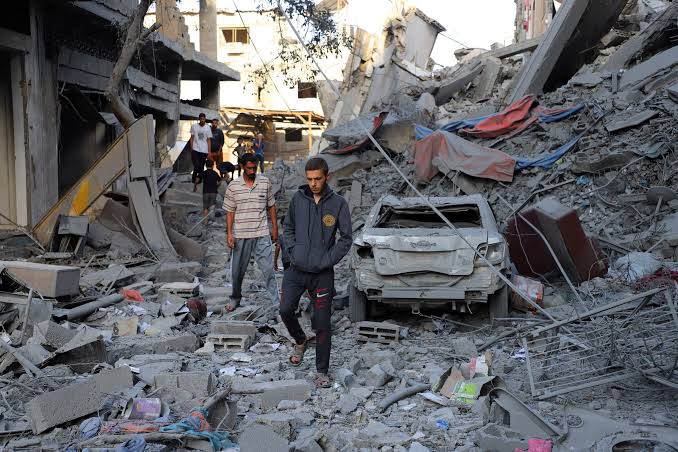
Gaza also faces enormous reconstruction needs after years of war.
The territory’s infrastructure, housing, health system and basic services have been severely affected by the conflict.
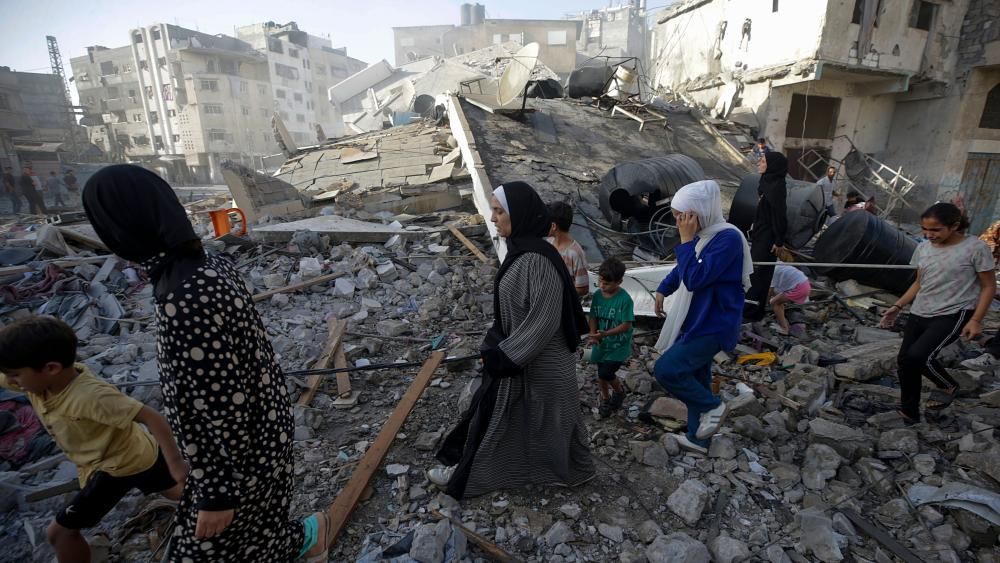
The supplied material says about 1.9 million people — around 90% of Gaza’s population — have been displaced during the war, citing the United Nations.
Any durable political arrangement would therefore have to address civilian life as well as military security.
A peace plan that successfully establishes a disarmament mechanism but fails to provide functioning governance and reconstruction would leave another source of instability unresolved.
The humanitarian stakes remain enormous
The political dispute is taking place against a devastating humanitarian backdrop.
According to the supplied reports, more than 73,000 people have been killed in Gaza since the war began in October 2023, based on figures from the territory’s health ministry.
The reports also say more than 1.9 million people have been displaced.
Those figures underscore why the implementation of any credible ceasefire or peace arrangement matters beyond the political calculations of governments and armed groups.
For civilians in Gaza, the practical questions are immediate.
Can violence stop?
Can displaced people return?
Can humanitarian assistance move consistently?
Can damaged homes and infrastructure be rebuilt?
Can Gaza develop a functioning administration?
And can a new security arrangement prevent another major war?
The answers depend partly on whether the political actors can convert the peace framework into an enforceable process.
Regional implications extend beyond Israel and Hamas
The consequences of the dispute would not be confined to Gaza.
Egypt, which borders Gaza, has a direct interest in the territory’s security and political future.
Other Arab states are also likely to be concerned about reconstruction, regional stability and the future of Palestinian governance.
The wider Middle East has already been shaped by the Gaza war.
A durable settlement could reduce one major source of regional tension and create space for broader diplomatic initiatives.
Failure, by contrast, could reinforce the cycle of violence and deepen mistrust between Israel, Palestinians and regional actors.
For the United States, that would also complicate its broader Middle East strategy.
Nigeria and Africa have an indirect stake
Although the dispute is taking place thousands of kilometres from Africa’s western coast, the outcome matters to African countries, including Nigeria, because the Gaza conflict has become a major issue in international diplomacy.
Nigeria routinely participates in multilateral discussions on international peace and security through the United Nations and other international institutions.
The Gaza crisis also has implications for debates across Africa about civilian protection, international law, humanitarian access and the role of external powers in conflict resolution.
For African governments, the larger lesson is that international peace initiatives require more than political announcements.
They require mechanisms capable of translating agreements into verifiable actions.
The Gaza case illustrates the difficulty of doing that when the parties to a conflict disagree over the order in which security and political concessions should occur.
Why the peace plan could still survive
Netanyahu’s rejection does not necessarily mean the diplomatic process is finished.
The supplied reports say Israeli and US officials are continuing discussions.
Hamas has also said it remains committed to the roadmap.
That leaves room for negotiations over implementation.
One possible route would be phased compliance.
Rather than demanding complete disarmament or complete withdrawal immediately, the parties could agree on measurable stages.
For example, specific categories of weapons or military infrastructure could be addressed first, followed by independently verified steps and corresponding Israeli redeployments.
The important principle would be reciprocity.
Each side would need to see evidence that the other side is fulfilling its commitments.
Such an arrangement would not eliminate mistrust.
But it could reduce the risk that either party believes it is surrendering everything before receiving anything in return.
The political clock is also running
Time may be one of the most important factors.
Netanyahu’s domestic political pressures mean that his room for compromise could be influenced by electoral calculations.
Hamas also faces pressure over its military future and its position in Gaza.
Trump, meanwhile, has a political interest in demonstrating progress on an initiative he has promoted as a major diplomatic achievement.
These pressures could either accelerate negotiations or make compromise more difficult.
Political leaders may become more willing to accept an agreement if they believe delay carries a greater cost.
But they may also become less willing to compromise if concessions threaten their political standing.
That makes the coming stages particularly important.
The real test is implementation
The Gaza peace plan is now facing a test that is common to many ambitious diplomatic agreements.
It is one thing to establish a framework.
It is another to persuade opposing parties to accept the practical steps required to implement it.
Israel wants security guarantees and genuine Hamas disarmament.
Hamas wants an end to hostilities and Israeli withdrawal.
The United States wants the broader roadmap to move forward.
International mediators want to prevent another breakdown.
Gaza’s civilians need an end to the destruction and a credible pathway towards reconstruction.
Those interests overlap in some areas but remain sharply divided in others.
That is why the current dispute should not be understood simply as another disagreement over a peace proposal.
It is a test of whether the parties can transform competing demands into a sequence of verifiable commitments.
Conclusion
The future of Trump’s Gaza peace plan may depend less on the wording of the overall roadmap than on the practical question of sequencing.
Israel says Hamas must genuinely disarm before Israeli forces withdraw.
Hamas has maintained its commitment to the roadmap while linking disarmament to broader conditions involving Israeli withdrawal and the end of hostilities.
Between those positions lies the central diplomatic challenge.
If mediators can develop a phased and independently verifiable process, the plan may still have a pathway forward.
If Israel and Hamas remain locked over who must make the first irreversible concession, the initiative risks becoming another diplomatic framework that cannot be translated into reality.
For Gaza, the consequences of that failure would extend far beyond diplomacy.
RECOMMENDED COVERAGE
The Historical Significance of Jerusalem: Roots of the Middle East Conflict
Before examining today’s Gaza peace deadlock, understand the historical tensions that have shaped the Israeli-Palestinian conflict.
This background explains why questions of territory, security and Palestinian statehood remain so difficult to resolve.
US Iran Strategy Timeline Reveals Policy Contradictions
Gaza cannot be viewed in isolation from the wider Middle East power struggle involving Washington and its regional rivals.
Explore how shifting US strategy in the region could influence the calculations surrounding Israel, Gaza and future negotiations.
G7 Summit 2026 Dominated by Iran, Ukraine Talks
The Gaza dispute is part of a much larger diplomatic landscape confronting Western leaders and their allies.
See how major global security crises are competing for diplomatic attention and shaping international responses to Middle East tensions.
About the Author