Tin Can Arms Seizure Raises 2027 Security Questions
The seizure of 399 fully assembled Jojef firearms at Tin Can Island Port in Lagos has put renewed attention on Nigeria’s ability to prevent illicit weapons from entering through major commercial gateways, with the Nigeria Customs Service warning that criminal networks could seek to exploit ports, borders and airports as the country approaches another major election cycle.
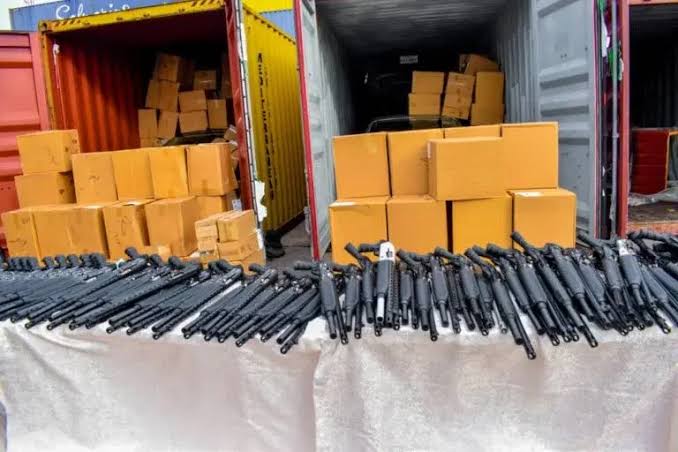
The Nigeria Customs Service said it completed the coupling and detailed examination of an intercepted shipment after initially discovering concealed crates containing firearm components. The subsequent examination established that the shipment contained 399 fully assembled firearms, alongside additional rifle parts.
For Nigeria, however, the significance of the Tin Can arms seizure extends beyond the number of firearms recovered.
It raises a broader security question: how effectively can the country prevent criminal networks from using legitimate trade infrastructure to move prohibited weapons into Nigeria?
That question becomes particularly important as the country moves closer to another major election cycle.
What happened at Tin Can Island Port?
According to reports based on information from the Nigeria Customs Service, officers at the Tin Can Island Port Command intercepted a container on August 6, 2026.
The shipment initially contained what Customs described as concealed crates of knocked-down components preliminarily identified as Jojef pump-action rifles.
After the seizure, Customs conducted a detailed examination and coupling process.
The result was the confirmation of 399 fully assembled firearms.
Additional components were also recovered, including frames, heat shields, trigger pins, pistons, locking lugs, charging handles, springs, trigger groups, foregrips or handguards, pistol grips and barrels.
The details matter because the seizure was not simply a case of officers discovering a single firearm concealed inside ordinary cargo.
The Customs account describes a shipment containing a substantial quantity of firearm components that, following examination and assembly, resulted in the identification of hundreds of complete firearms.
That is what makes the Tin Can arms seizure a significant border-enforcement story.
Why the 399 rifles matter
The immediate importance of the seizure is straightforward: hundreds of firearms that Customs says were being moved through a commercial port were intercepted before they could enter wider circulation.
But the larger security significance lies in what could happen when illicit weapons successfully pass through the country’s entry points.
Nigeria is already dealing with a range of security challenges in different parts of the country. Illegal firearms can increase the capacity of criminal networks and complicate efforts by security agencies to contain violence.
The seizure therefore represents both an enforcement success and a reminder of the continuing challenge.
The weapons were stopped.
But Customs’ own warning suggests that the networks attempting to move prohibited items may continue looking for opportunities.
That distinction is important.
A successful seizure demonstrates that enforcement can work. It does not, by itself, establish how many other illicit shipments may escape detection.
There is no evidence in the supplied reports to determine how many similar shipments have entered Nigeria undetected, and such a figure should not be assumed.
What can be established is that Customs believes criminal networks may attempt to exploit Nigeria’s major entry points.
Customs warning ahead of the election cycle
The political timing adds another layer to the story.
Customs Comptroller-General Bashir Adewale Adeniyi warned that criminal networks could seek to exploit Nigeria’s borders, ports and airports ahead of the next general elections. Multiple reports of the seizure carried that warning.
Adeniyi said Customs expected criminal elements to attempt to use the period of heightened political activity to move prohibited items into the country.
The warning does not establish that the seized firearms were intended for electoral violence.
That distinction is crucial.
Customs has not, in the reports reviewed for this story, publicly established who ordered the shipment, who was supposed to receive the firearms or what specific criminal operation the weapons were intended to support.
The connection to election security comes from the Customs chief’s assessment that criminal networks may attempt to exploit the country’s entry points during a major election cycle.
Therefore, the responsible interpretation is not that the 399 firearms were necessarily intended for elections, but that the seizure has become relevant to the wider security preparations surrounding the period.
The port-security challenge
The Tin Can arms seizure also highlights the difficult role played by Nigeria’s major ports.
Ports are designed to facilitate legitimate international commerce.
Every day, commercial cargo moves through Nigeria’s maritime gateways, connecting importers, exporters, manufacturers, distributors and consumers with international markets.
The security challenge is therefore one of balance.
Customs must facilitate legitimate trade while identifying cargo that may contain prohibited goods.
Nigeria Customs Service itself describes its mandate as including revenue collection, trade facilitation and border protection. Its current policy framework also highlights consolidation, collaboration and innovation, including the use of technology and data analytics.
That makes intelligence-led inspection increasingly important.
Not every container can simply be treated as suspicious.
Nor can every shipment receive the same level of physical examination without affecting the speed and cost of legitimate trade.
Modern Customs enforcement therefore depends heavily on risk assessment, intelligence and the ability to identify shipments requiring additional scrutiny.
The latest seizure illustrates why that balance matters.
A container can form part of an entirely legitimate commercial system while potentially being used to conceal prohibited goods.
Intelligence is becoming central to border enforcement
One of the clearest themes in Nigeria Customs’ own recent institutional messaging is the increasing importance of intelligence.
In January 2026, Customs Comptroller-General Adeniyi described intelligence as central to modern Customs operations, linking it to risk management, revenue protection, disruption of smuggling networks and national economic protection.
That approach is directly relevant to the latest seizure.
The effectiveness of border enforcement is not determined solely by the number of officers stationed at a port.
It also depends on what information reaches those officers, how quickly it is analysed and whether enforcement agencies can identify unusual cargo patterns before prohibited items reach the market.
The Customs Service has also emphasised technology and data analytics as part of its broader modernisation strategy.
That creates an important lesson from the Tin Can operation.
If intelligence helped Customs identify and examine the shipment, then the longer-term security value of the operation may extend beyond the confiscation itself.
Information obtained during investigations can potentially help authorities identify patterns, networks and future risks.
However, the available reports do not provide details of the intelligence that led directly to this particular interception.
That information was not specified.
Why inter-agency cooperation matters
Customs cannot address illicit arms trafficking alone.
The agency operates at the border, but the investigation of illegal weapons can involve several other security institutions.
In this case, Adeniyi identified cooperation with the National Centre for the Control of Small Arms and Light Weapons, under the Office of the National Security Adviser, as part of the response. The seized weapons are expected to be handed over to the centre after inventory and assessment.
That proposed handover reflects an important principle in arms-control enforcement.
The interception is only one stage.
Authorities must also preserve evidence, document the seizure, determine ownership and responsibility, trace the movement of the shipment where possible and pursue those responsible through the appropriate legal process.
The reports available for this story do not identify suspects connected to the shipment.
They also do not establish the origin of the firearms, the importer or the intended destination after arrival in Nigeria.
Those are important unanswered questions.
Until authorities release verified information, they should remain unanswered rather than being filled with speculation.
The wider Nigerian arms challenge
The Tin Can arms seizure comes against a wider backdrop of Nigerian efforts to remove illicit firearms from circulation.
On July 30, 2026, Reuters reported that Nigeria’s arms-control authorities announced the destruction of 2,819 illicit, obsolete and decommissioned firearms as part of a broader effort to reduce the availability of illegal weapons.
That development provides useful context.
The problem is not simply the movement of firearms across the border.
It is also what happens to illegal weapons after they enter the country.
Once firearms reach criminal networks, recovering them can become considerably more difficult.
This is why border interception has strategic importance.
Stopping a shipment at a port prevents the weapons from becoming another problem for police and other security agencies later.
The latest seizure therefore fits into a larger cycle of arms-control activity: interception at entry points, investigation, seizure, transfer to the relevant authority and, where legally appropriate, eventual destruction or other authorised disposal.
Tin Can Island and Nigeria’s maritime economy
There is also an economic dimension to the story.
Tin Can Island Port is part of Nigeria’s wider maritime trade infrastructure.
For legitimate businesses, port efficiency matters.
Delays, excessive inspections and uncertainty can increase costs for importers and exporters.
But security failures can create an even greater economic risk.
If criminal networks repeatedly exploit commercial gateways, authorities may respond with more intensive controls, increased inspections and additional compliance requirements.
That can affect the broader trading environment.
The challenge, therefore, is not to turn every commercial shipment into a security suspect.
It is to build a system capable of identifying high-risk cargo efficiently while allowing legitimate goods to move with minimal disruption.
That is where technology, intelligence and cooperation become particularly important.
The Nigeria Customs Service has publicly identified technology, data analytics and institutional collaboration as part of its modernisation priorities.
The success of such reforms will ultimately be judged not only by revenue collection but also by the ability to protect Nigeria’s borders without unnecessarily slowing legitimate commerce.
What the seizure says about 2027 security
The most politically sensitive part of the story is the connection to the approaching election cycle.
Nigeria’s elections generate intense political competition and require substantial security planning.
But the presence of a large number of firearms in an intercepted shipment does not automatically mean the weapons were destined for political actors or electoral violence.
There is currently no evidence in the supplied reports to make that claim.
What the Customs warning does establish is that the agency expects criminal networks to look for opportunities during a period when political activity increases.
That makes border security part of a wider election-security conversation.
Election security is often discussed in terms of policing polling units, protecting election officials, securing collation centres and preventing political violence.
Yet the security chain begins earlier.
If illicit weapons can be prevented from entering the country, security agencies may reduce the pool of weapons potentially available to criminal groups.
That is why port security deserves a place in the broader national conversation about election preparedness.
The unanswered questions
The seizure also leaves several important questions that authorities and investigators may eventually need to answer.
Who was behind the shipment?
The public reports reviewed for this story do not identify the individuals or organisation responsible.
Where did the firearms come from?
The available reports identify the firearms as Jojef weapons but do not establish their country of origin.
Who was supposed to receive them?
That has not been publicly established in the reports reviewed.
Was the shipment connected to an existing trafficking network?
Customs has referred to criminal networks and said it wants those behind the trafficking operation identified, but the reports do not provide evidence identifying a specific network.
How was the shipment detected?
The published reports describe the interception and examination but do not provide sufficient detail about the specific intelligence or screening process that triggered the intervention.
These questions should now form part of the investigation rather than becoming material for speculation.
The importance of following the weapons trail
For law-enforcement agencies, the value of a major seizure is not measured only by what is displayed at a press briefing.
The greater value can come from what investigators learn afterwards.
A shipment of this size potentially provides authorities with information about its documentation, movement and ownership.
If investigators can establish the chain behind the cargo, the operation could move from a successful interception to a broader disruption of an arms-trafficking network.
That is also why the proposed transfer to the National Centre for the Control of Small Arms and Light Weapons matters.
Customs has said the weapons will be handed over following inventory and assessment.
The next stage should therefore focus on accountability.
The public deserves to know whether arrests follow, whether prosecutions are initiated and whether investigators uncover links to other illegal shipments.
At the time of publication, the supplied reports do not establish those outcomes.
A test for Nigeria’s border-security strategy
The latest Tin Can arms seizure can therefore be viewed from two perspectives.
The first is the immediate enforcement success.
Customs detected and intercepted a shipment and subsequently confirmed 399 fully assembled firearms.
The second is the challenge revealed by the attempt itself.
Criminal networks are evidently interested in using commercial supply chains and entry points to move prohibited goods.
That makes border protection a continuing contest between enforcement agencies and those attempting to evade them.
Nigeria’s response will depend increasingly on intelligence, technology, cooperation and investigative capacity.
The Customs Service has already publicly identified these areas as important to its broader operational strategy.
But institutional policy becomes meaningful only when it produces measurable results.
The latest interception provides one such result.
The next test will be whether authorities can use the seizure to identify the people behind the shipment and prevent similar attempts.
What happens next?
The Nigeria Customs Service has indicated that the seized firearms will be transferred to the National Centre for the Control of Small Arms and Light Weapons after the inventory and assessment process.
The investigative dimension will be equally important.
Authorities will need to establish the ownership and intended destination of the weapons and determine whether the shipment forms part of a wider trafficking operation.
The public will also be watching to see whether suspects are identified and prosecuted.
For Nigeria’s ports, the episode offers another reminder that the country’s maritime gateways are not only economic assets.
They are also national-security front lines.
The challenge is to keep legitimate commerce moving while making it increasingly difficult for criminal networks to hide dangerous goods inside the enormous flow of international trade.
Conclusion: The real meaning of the Tin Can seizure
The Tin Can arms seizure is significant because 399 firearms were stopped before they could enter wider circulation.
But its larger importance lies in the questions that follow.
Can intelligence-led enforcement stay ahead of increasingly sophisticated trafficking networks?
Can Nigeria strengthen its ports without creating unnecessary barriers to legitimate trade?
Can Customs and other security agencies convert individual seizures into investigations that dismantle trafficking networks?
And can stronger border controls become part of Nigeria’s broader preparation for a politically sensitive election cycle?
Those questions cannot be answered by the seizure alone.
What is clear is that the discovery has provided another warning about the importance of Nigeria’s entry points in the fight against illicit weapons.
Customs has demonstrated that such shipments can be detected and intercepted.
The next measure of success will be whether the authorities can follow the trail beyond the container, identify those responsible and ensure that the weapons never reach the criminal networks for which they may have been intended.
For Nigeria, that is where a major seizure becomes more than a headline.
It becomes a test of the country’s wider security system.
RECOMMENDED COVERAGE
Tinubu Security Strategy Targets Terror With AI
Nigeria is investing in intelligence, surveillance and AI to confront evolving security threats. See how this new strategy could change the way the country detects and responds to danger.
Boko Haram Attack Chad Exposes Security Gaps
The fight against illegal weapons does not stop at Nigeria’s borders. Explore how porous frontiers and cross-border militant networks continue to create security gaps across the region.
Nigeria Security Crisis: Reps Push State Police, Forest Guards
The seizure of hundreds of firearms raises a bigger question: is Nigeria’s current security architecture strong enough? Explore the proposals reshaping the country’s fight against insecurity.
About the Author