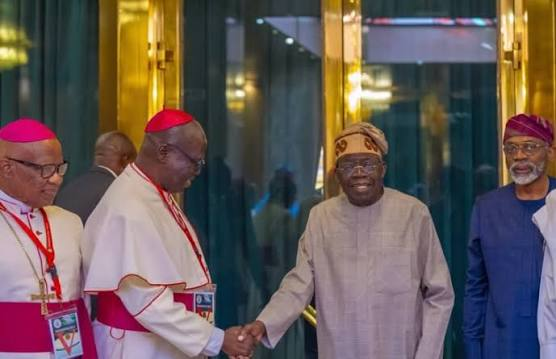
Tinubu Catholic Bishops Clash Over Nigeria’s Reality After Private Meeting
A public disagreement between Nigeria’s Presidency and the Catholic Bishops has evolved into a wider national debate about governance, accountability and whether official claims of progress match the daily experiences of ordinary citizens.
ABUJA, Nigeria — What began as a private audience between President Bola Ahmed Tinubu and leaders of the Catholic Bishops’ Conference of Nigeria (CBCN) has rapidly developed into one of the country’s most significant public exchanges between political authority and religious leadership in recent years. The disagreement now stretches far beyond the walls of the Presidential Villa, opening a broader conversation about governance, transparency, economic reforms, national security and public confidence in government.
Rather than remaining an internal discussion between the nation’s political leadership and one of its most influential Christian bodies, the meeting entered public discourse after Cardinal John Onaiyekan, Archbishop Emeritus of Abuja, discussed aspects of the closed-door engagement during a televised interview. His comments prompted a robust response from senior presidential advisers, who defended President Tinubu’s handling of national affairs while questioning whether confidential discussions should have been publicly disclosed.
The exchange has attracted attention not simply because two respected institutions disagree, but because it highlights a deeper question confronting many democracies: Who best reflects the realities experienced by citizens—the government responsible for managing the state, or influential civil society and religious leaders who speak on behalf of communities?
That question now sits at the centre of a debate extending beyond personalities, touching on leadership, accountability and the relationship between government and society.
Tinubu Catholic Bishops Meeting: What Happened Behind Closed Doors?
The controversy stems from a meeting held at the Presidential Villa in Abuja, where President Tinubu received a delegation from the Catholic Bishops’ Conference of Nigeria following the bishops’ plenary session.
The delegation was led by Archbishop Lucius Iwejuru Ugorji, President of the Catholic Bishops’ Conference of Nigeria and Archbishop of Owerri. Also present were several prominent Catholic leaders, including Cardinal John Onaiyekan, Archbishop Emeritus of Abuja, Bishop Matthew Hassan Kukah of the Diocese of Sokoto and Archbishop Matthew Man-Oso Ndagoso, among others.
The meeting itself reflected a long-standing tradition in Nigeria, where religious institutions periodically engage political leaders on issues affecting national development. Such meetings often provide opportunities for faith leaders to present concerns arising from their interactions with communities across the country.
According to information released after the meeting, the bishops used the opportunity to present what they described as an honest assessment of the country’s current condition. Their concerns focused on several key issues affecting Nigerians.
Among them were:
- Persistent insecurity across several regions.
- Rising economic hardship.
- Inflation and declining purchasing power.
- Pressure on public healthcare.
- Challenges within the education sector.
- Electoral credibility and democratic governance.
- Religious freedom in parts of northern Nigeria.
The bishops reportedly drew attention to the continued impact of kidnapping, banditry and violent attacks affecting communities, including members of the clergy. They also expressed concern over increasing living costs, arguing that many households were finding it increasingly difficult to meet basic needs.
Their message was presented as part of what they described as their moral responsibility to speak on issues affecting both Catholics and the wider Nigerian population.
Tinubu Catholic Bishops: President Tinubu’s Response
President Tinubu did not dismiss the concerns raised during the meeting. Instead, according to official accounts from the Presidency, he acknowledged that Nigeria continues to face serious economic and security challenges while defending the direction of his administration’s reforms.
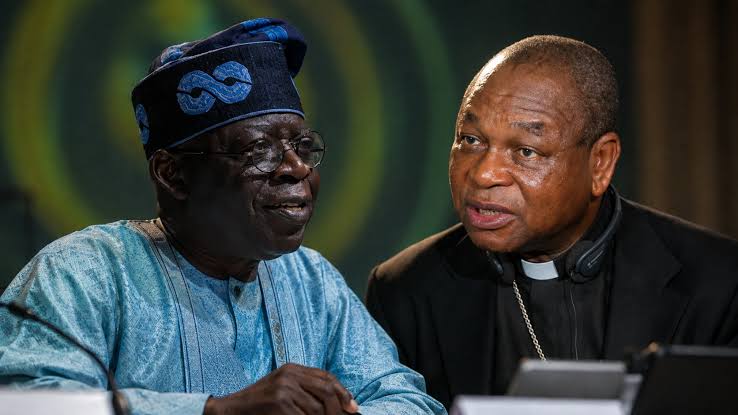
The President reportedly argued that many of the country’s current difficulties predated his administration and required difficult policy decisions to place the economy on a more sustainable path.
Among the issues he highlighted were:
- Ongoing security operations against criminal groups.
- Expansion plans for the Nigerian Armed Forces.
- Continued investment in security infrastructure.
- Economic reforms designed to stabilize public finances.
- Greater collaboration with stakeholders, including religious organisations.
Tinubu also acknowledged the historical role played by the Catholic Church in education and healthcare, reaffirming his administration’s willingness to continue engaging with faith-based institutions on national development.
Although both sides appeared to have exchanged views candidly during the meeting, there was little indication at the time that the engagement would become the focus of national controversy.
That changed only after details of the discussions entered the public domain.
When a Private Conversation Became a National Story
The situation changed significantly after Cardinal John Onaiyekan granted a television interview discussing the substance of the private meeting. As reported by Punch, the Cardinal said the bishops believed they had a duty to present an honest assessment of the conditions facing Nigerians, even though President Tinubu disagreed with parts of their evaluation.
During the interview, the Cardinal explained that the bishops had deliberately chosen to present what they considered an accurate picture of conditions facing Nigerians rather than offering what he described as a more favourable assessment. He said the document presented to President Tinubu reflected extensive consultations within the Catholic Bishops’ Conference and represented the collective position of the institution rather than the opinion of a few individuals.
According to the Cardinal, the bishops had no political ambitions but believed they had a responsibility to speak honestly about the challenges confronting ordinary Nigerians.
He also stated that President Tinubu disagreed with many of the bishops’ conclusions regarding the country’s economic situation, maintaining instead that his administration’s policies were producing positive results.
Perhaps most significantly, Onaiyekan suggested that the bishops believed they had offered the President a perspective different from what he might ordinarily receive from some advisers and political associates.
Those remarks quickly became the centre of public discussion, transforming what had been a routine stakeholder meeting into a national conversation about governance, communication and leadership.
Why the Interview Changed the Story
Meetings between presidents and major religious organisations are not unusual in Nigeria. Many occur without extensive public disclosure beyond official communiqués or photographs.
In this case, however, Cardinal Onaiyekan’s detailed public reflections introduced an entirely new dimension.
The focus was no longer simply on what the bishops had told the President.
Instead, public attention shifted toward several broader questions:
- Should confidential discussions between national leaders and religious figures remain private?
- Can participants publicly interpret private conversations afterward?
- Does transparency outweigh diplomatic confidentiality?
- What responsibilities accompany privileged access to the country’s highest political office?
These questions soon became almost as significant as the original issues of insecurity and economic hardship raised during the meeting.
The Presidency would soon respond directly, arguing that while disagreement is a normal part of democratic engagement, confidentiality and mutual respect should also guide such high-level interactions.
The Presidency’s Case: Why Officials Rejected the Bishops’ Assessment
Following Cardinal John Onaiyekan’s television interview, the Presidency moved quickly to defend President Bola Tinubu’s handling of the meeting and the broader direction of his administration. According to Premium Times, presidential spokesman Temitope Ajayi said the bishops were entitled to express their views but argued that their assessment represented one perspective rather than an unquestionable account of Nigeria’s situation.
Temitope Ajayi, Senior Special Assistant to the President on Media and Publicity, argued that while the Catholic Bishops were entitled to present their views, their assessment represented one perspective rather than an unquestionable account of Nigeria’s situation. According to Ajayi, President Tinubu listened patiently during the meeting before responding point by point to the concerns raised.
Ajayi maintained that the administration acknowledged the country’s ongoing economic and security difficulties but believed measurable progress had been made in stabilising public finances and improving governance.
Among the achievements highlighted by the Presidency were:
- Improved fiscal stability across many states.
- More consistent payment of salaries and pensions in several parts of the country.
- Continuing security operations against armed groups.
- Economic reforms aimed at restoring long-term financial sustainability.
- Expanded investments in national security.
The Presidency also argued that governing Nigeria requires balancing competing national interests with limited resources, making difficult decisions unavoidable.
Officials maintained that reforms should not be judged solely by present hardships but also by whether they create conditions for future stability.
A Difference in Perspective, Not Necessarily Facts
One of the Presidency’s central arguments was that public perception and government assessment do not always rely on the same information.
Ajayi stated that President Tinubu receives regular intelligence briefings and operational reports covering security, economic trends and governance. According to him, these briefings provide information unavailable to the general public and therefore shape a broader assessment of national conditions.
From the Presidency’s perspective, acknowledging continuing challenges does not prevent government from recognising improvements already achieved.
Officials argued that:
- Security gains may not always dominate daily news headlines.
- Economic reforms often produce benefits gradually rather than immediately.
- Fiscal improvements can exist alongside continued hardship.
- National progress should be assessed using multiple indicators rather than isolated experiences.
The administration therefore rejected suggestions that disagreement with the bishops amounted to ignoring the realities confronting ordinary Nigerians.
Instead, it maintained that both sides were looking at the same country through different lenses.
Why Confidentiality Became a Major Issue
Beyond disagreements over Nigeria’s economy and security, another issue emerged that became almost as controversial as the original meeting itself.
The Presidency questioned whether details from a private engagement between the President and senior religious leaders should have been discussed publicly shortly afterwards.
Ajayi argued that confidential meetings depend on mutual trust and respect, suggesting that participants should preserve the dignity of such engagements once they conclude. He criticised Cardinal Onaiyekan’s public account of the discussions, saying it was inappropriate for one participant to offer a personal interpretation of what had been intended as a private conversation.
That criticism introduced a constitutional and ethical debate extending well beyond the immediate political disagreement.
Questions quickly emerged, including:
- Does confidentiality strengthen honest dialogue?
- Should influential public figures disclose discussions involving matters of national importance?
- Where should transparency end and discretion begin?
There is no universally accepted answer to these questions, and democracies often approach them differently depending on legal traditions, political culture and institutional practice.
The Bishops’ Perspective: Speaking as a Moral Voice
While the Presidency defended its record, the Catholic Bishops maintained that their intervention was motivated by pastoral responsibility rather than political ambition.
According to Cardinal Onaiyekan, the document presented to President Tinubu represented extensive consultation within the Catholic Bishops’ Conference of Nigeria. He emphasised that the bishops had no intention of competing for political office but believed they had a duty to speak honestly about conditions affecting Nigerians.
The concerns they raised reflected issues frequently discussed across the country, including:
- Rising food prices.
- Persistent inflation.
- Insecurity affecting communities.
- Pressure on family incomes.
- Challenges facing healthcare.
- The future of democratic governance.
The bishops argued that these concerns should not be interpreted as partisan criticism but as part of their broader social responsibility.
Throughout Nigeria’s history, religious organisations have frequently spoken on issues extending beyond theology, particularly where questions of justice, welfare and national development are concerned.
A Long History of Church–State Engagement
The current disagreement is not without historical context.
Successive Nigerian governments have regularly engaged religious organisations, recognising their influence across education, healthcare, humanitarian services and community development.
Likewise, major Christian and Muslim organisations have historically commented on:
- Elections.
- Constitutional reforms.
- Human rights.
- Security challenges.
- Corruption.
- Economic policy.
- National unity.
These interventions have sometimes generated public debate, particularly when religious leaders have criticised government policies or expressed concern over national direction.
The latest exchange between the Tinubu administration and the Catholic Bishops therefore reflects an established tradition of civic engagement rather than an entirely new development.
What distinguishes this episode is the intensity of the public discussion that followed a meeting originally expected to remain private.
Public Accountability Versus Diplomatic Confidentiality
The controversy has highlighted two democratic values that occasionally come into tension.
On one hand is public accountability.
Many citizens believe influential institutions—including religious bodies—should openly communicate concerns affecting society, especially when those concerns involve governance, security and economic welfare.
On the other hand is confidential diplomacy.
Private meetings often allow participants to exchange candid views without concern that every statement will later become part of public debate.
Supporters of confidentiality argue that such privacy encourages honest conversations and more constructive engagement.
Supporters of greater transparency counter that when discussions concern issues affecting millions of citizens, public understanding strengthens democratic accountability.
Neither position automatically invalidates the other.
Instead, the debate reflects competing principles that democratic societies continue to balance.
Why This Story Resonates Beyond Politics
The strong public interest generated by this disagreement is about more than personalities or political messaging.
For many Nigerians, the conversation touches everyday experiences.
Families continue to navigate:
- Rising living costs.
- High transportation expenses.
- Inflationary pressure.
- Employment uncertainty.
- Security concerns in several regions.
Against that backdrop, public discussions about whether the country is improving naturally attract widespread attention.
The Presidency argues that reforms require time before their full benefits become widely felt.
The bishops contend that many citizens are still struggling despite those assurances.
Both positions have become part of a wider national conversation about expectations, leadership and the pace of change.
The debate therefore reflects not only differing assessments of government performance but also differing interpretations of how progress should be measured.
Tinubu Catholic Bishops: Where Both Sides Agree
Despite the sharp public exchanges that followed the meeting, there are several areas where the Presidency and the Catholic Bishops appear to share common ground.
Neither side disputes that Nigeria faces significant national challenges.
Both acknowledge:
- The need to improve national security.
- The importance of restoring economic stability.
- The necessity of creating opportunities for ordinary Nigerians.
- The value of continued dialogue between government and civil society.
- The importance of preserving Nigeria’s democratic institutions.
Where they differ is not over whether challenges exist, but over how severe those challenges remain, how much progress has been achieved, and how that progress should be communicated to Nigerians.
Those differences explain why the discussion has generated such intense public interest.
Analysis Box
Where Both Sides Agree
✔ Nigeria continues to face serious national challenges.
✔ Security remains a major priority.
✔ Economic reforms are necessary.
✔ Government and stakeholders should continue engaging each other.
✔ Democratic institutions must remain strong.
Analysis Box
Where They Disagree
The Catholic Bishops
- Many Nigerians are experiencing worsening hardship.
- Insecurity remains deeply concerning.
- Citizens are yet to experience sufficient benefits from reforms.
- Government should pay greater attention to realities at community level.
The Presidency
- Economic reforms are beginning to produce measurable results.
- Fiscal stability has improved.
- Security agencies have recorded important gains.
- Government possesses broader intelligence beyond public reporting.
- Long-term reforms require patience before full benefits become widely visible.
Why This Debate Matters Beyond Today’s Headlines
Political disagreements are common in democratic societies.
What makes this episode especially significant is that it involves two institutions that command substantial public confidence in different ways.
The Presidency derives its authority from democratic elections and constitutional responsibility.
The Catholic Bishops derive moral influence from decades of pastoral leadership, community engagement, education and healthcare services across Nigeria.
When these two voices publicly disagree about the condition of the nation, the discussion naturally extends beyond politics.
It becomes a debate about:
- Public confidence.
- Institutional credibility.
- Leadership.
- National direction.
- Citizens’ lived experiences.
For many Nigerians, the central question is not simply who won the argument.
It is whether public policy is producing improvements that are increasingly visible in everyday life.
That question is likely to remain part of Nigeria’s national conversation long after this particular disagreement fades from the headlines.
What This Could Mean Ahead of 2027
Although neither the Catholic Bishops’ Conference nor the Presidency framed their exchange as an electoral issue, the discussion inevitably carries political significance.
As Nigeria moves closer to another election cycle, debates surrounding:
- Cost of living.
- Inflation.
- Employment.
- Security.
- Governance.
- Public trust.
are expected to become even more prominent.
Religious organisations, professional associations, labour unions and civil society groups have historically contributed to national conversations on these issues. Their assessments often shape public discourse, even when they do not directly participate in electoral politics.
At the same time, incumbent governments naturally seek to demonstrate measurable progress and defend policy decisions they believe are laying the foundation for long-term development.
This dynamic is a normal feature of democratic societies, where competing interpretations of national progress coexist and are tested in the court of public opinion.
The Broader Lesson for Nigerian Democracy
Beyond the personalities involved, this episode illustrates an important characteristic of democratic governance.
Healthy democracies create space for disagreement between governments and influential institutions without preventing continued engagement.
The fact that the Catholic Bishops were able to present their concerns directly to the President reflects one aspect of democratic participation.
Similarly, the Presidency’s decision to publicly defend its policies reflects another.
The challenge is ensuring that such exchanges remain respectful, evidence-based and focused on solving national problems rather than deepening divisions.
Constructive disagreement, when conducted responsibly, can strengthen democratic institutions by encouraging accountability and wider public participation.
Conclusion
The meeting between President Bola Tinubu and the Catholic Bishops’ Conference of Nigeria was intended to provide an opportunity for dialogue on the country’s most pressing challenges. Instead, it has become one of the most closely watched public debates between government and religious leadership in recent times.
At the heart of the disagreement lies a simple but profound question: How should Nigeria’s progress be measured?
The Presidency argues that reforms are gradually stabilising the economy, strengthening public finances and improving security, even if the benefits are not yet fully felt by every citizen. The Catholic Bishops, meanwhile, contend that the hardship experienced by many Nigerians remains too severe to justify such optimism.
Neither perspective alone captures the full complexity of governing Africa’s most populous nation. Government data, policy outcomes and institutional assessments are essential to evaluating progress. Equally important are the lived experiences of citizens whose daily realities often shape public confidence more than economic indicators or official briefings.
Ultimately, the significance of this story extends beyond a disagreement between the Presidency and senior Catholic leaders. It highlights the continuing importance of dialogue between government and society, the need for transparency balanced with responsible confidentiality, and the enduring role of institutions in holding one another accountable within a constitutional democracy.
Whether Nigerians view the exchange as evidence of healthy democratic engagement or a widening gap between official narratives and public experience, one conclusion is difficult to avoid: conversations about governance, accountability and national progress are likely to remain central to Nigeria’s political landscape in the years ahead.
Recommended Coverage
Nigeria’s Economy: The Tinubu Administration — Progress or Crisis?
Are President Tinubu’s economic reforms beginning to deliver results, or are Nigerians still bearing the burden? Explore our in-depth analysis of the policies shaping the country’s economic future.
What Pope Leo XIV’s Africa Tour Reveals
Discover how the Catholic Church continues to shape conversations on leadership, justice and development across Africa. See why its influence extends far beyond the pulpit.
Nigeria Political Realignment Deepens as NDC Rises
Nigeria’s political landscape is changing rapidly beyond the ruling party and opposition. Understand the shifting alliances that could reshape the country’s democratic future.
About the Author