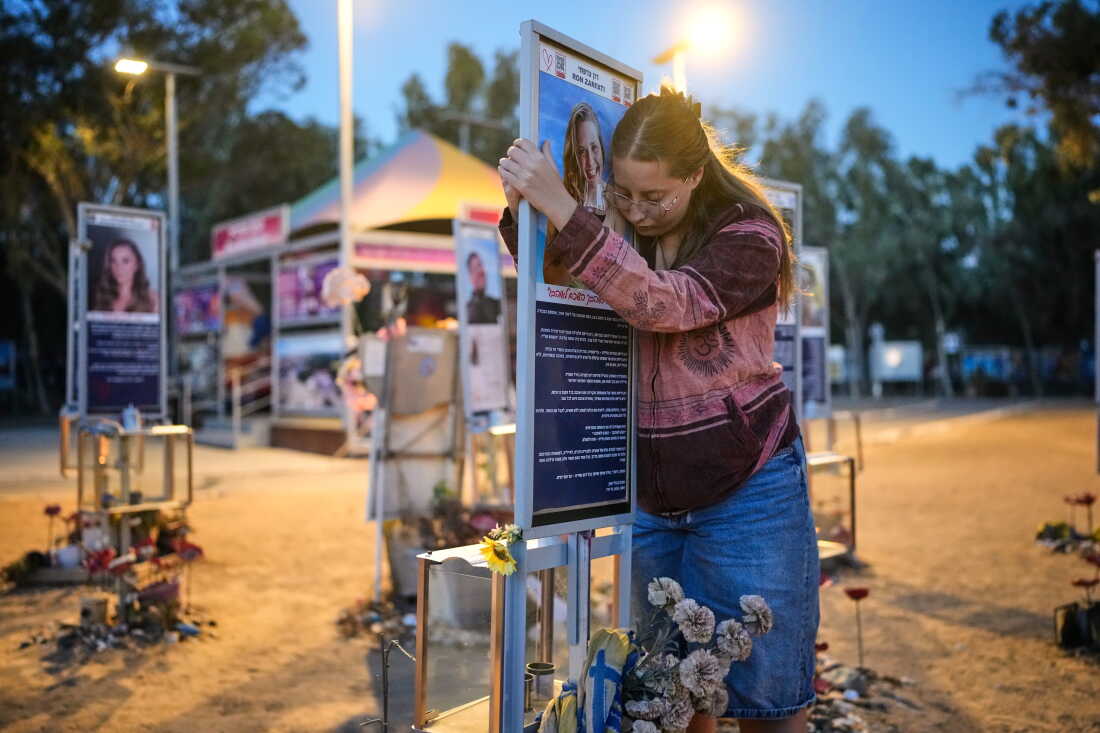
Raz Zarfati, sister of Ron Zarfati who was killed in the Oct. 7, 2023, Hamas attack on Israel, attend a memorial marking the third anniversary of the attack at the Nova music festival site near Kibbutz Reim, southern Israel, Wednesday, Oct. 7, 2026. (AP Photo/Ohad Zwigenberg)
Three years after the October 7 attack that killed about 1,200 people in Israel and led to the capture of 251 hostages, the immediate hostage crisis has ended, but the conflict it unleashed has not reached a clear political conclusion. Israel is marking the anniversary amid demands for accountability over the security failures of 2023, while Gaza remains devastated by a war that has killed tens of thousands of Palestinians and displaced much of the territory’s population.
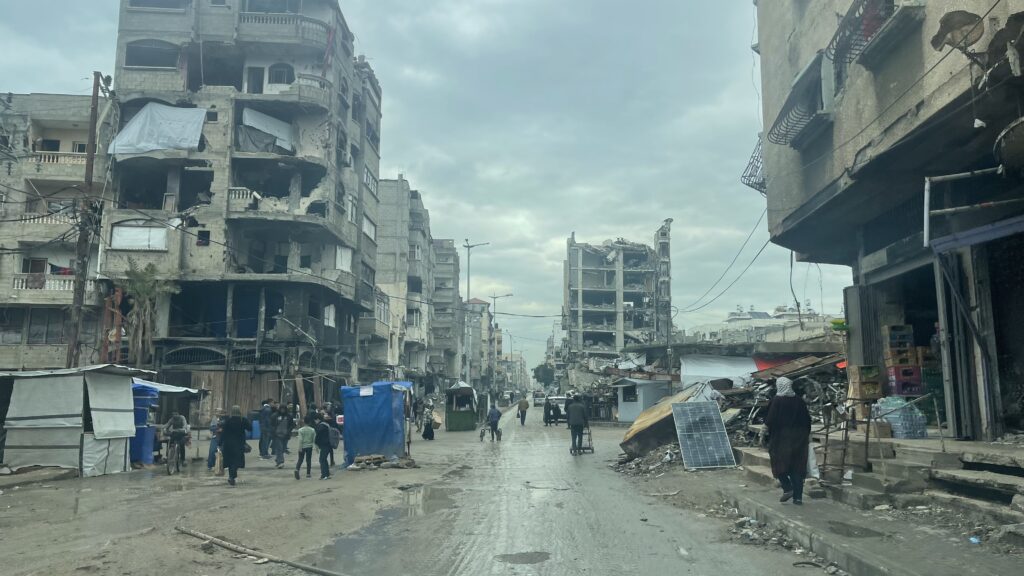
The anniversary is therefore more than a commemoration of a single day. It has become a measure of how profoundly the October 7 attack changed Israel, Gaza and the wider Middle East — and how much remains unresolved three years later. The supplied source material describes continuing Israeli strikes despite a ceasefire, an unsettled debate over Gaza’s future, political uncertainty in Israel and persistent fears among Palestinians about displacement.
The result is a conflict whose military phases have repeatedly changed, but whose fundamental political questions remain difficult to settle.
The October 7 Attack Changed the Region
The October 7 attack began shortly after sunrise on October 7, 2023, with a barrage of rockets followed by the breach of Israel’s border by thousands of Hamas-led militants.
According to the supplied source, an estimated 6,000 militants crossed into Israel through multiple points, using vehicles, motorcycles and, in some cases, paragliders. They attacked military positions and nearby communities, including kibbutzim along the Gaza border. At Nir Oz, 41 people were killed and 76 were kidnapped, according to the source material.
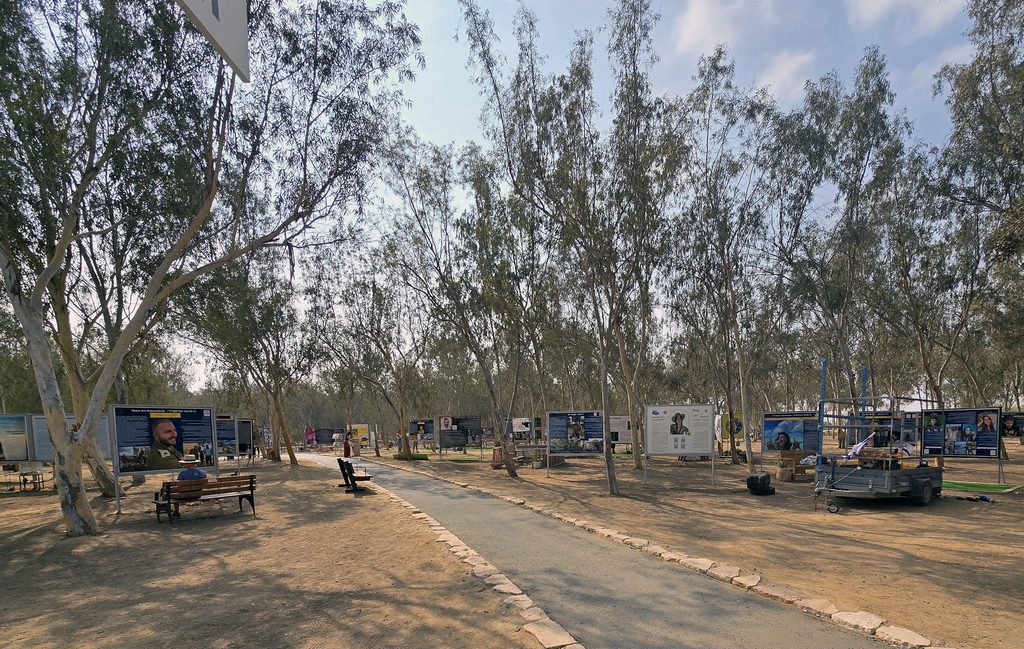
The Nova music festival became another major site of the assault. An Israel Defense Forces investigation cited in the source found that 378 people were killed there and 44 were taken hostage. Survivors described hiding for hours as gunmen moved through the festival area and surrounding roads.
Across the wider attack, about 1,200 people were killed and 251 were taken hostage. The scale and shock of the assault transformed Israeli security calculations and triggered the military campaign in Gaza.
For additional background and continuing reporting on the attack and its aftermath, see BBC’s coverage of the October 7 attack and its aftermath.
Three years later, the memory of that day remains central to Israeli public life. Memorial ceremonies have been held at locations including Kfar Aza and the site of the Nova festival, while families continue to commemorate relatives whose lives ended on October 7.
For many Israelis, the attack remains inseparable from a second question: how could such a large-scale assault happen despite Israel’s extensive military and intelligence capabilities?
That question has become one of the most politically consequential parts of the October 7 aftermath.
The Hostage Story Has Reached Its Final Chapter — But Not the War
The hostage crisis became one of the defining features of the conflict.
Of the 251 people captured during the October 7 attack, the supplied BBC material says 168 were freed or rescued while 83 were killed. The remains of the last Israeli hostage, Master Sgt Ran Gvili, were recovered in January 2026.
That means the third anniversary is the first in which Israeli families are marking October 7 without relatives still being held hostage in Gaza.
The end of the hostage chapter has enormous emotional significance. Families who spent years living with uncertainty now know the fate of their loved ones. Former hostages can begin rebuilding their lives, while families of those who died continue to deal with grief and trauma.
Yet the return of the last hostage has not produced a corresponding resolution to the broader conflict.
Instead, it has removed one of the most immediate issues from negotiations while leaving the more difficult questions in place: What happens to Hamas? Who governs Gaza? What security arrangements will protect Israel? Who reconstructs Gaza? And what political framework, if any, can prevent another war?
Those questions explain why the October 7 attack continues to shape events long after the hostage issue has been settled.
Israel’s Unresolved Accountability Debate
Inside Israel, the anniversary has also become a reckoning over the country’s security failure.
The source material says Israel has yet to establish an independent state inquiry into what went wrong before and during the attack. Several senior defence and security officials have resigned or been dismissed, but the absence of a full independent inquiry remains a major point of frustration among victims’ families and anti-government groups.
Prime Minister Benjamin Netanyahu has rejected blame for the security breach and resisted calls for an independent investigation, according to the supplied reporting.
That dispute has political consequences.
The anniversary falls only 20 days before Israel’s first election since the attack, according to the source. A poll cited by the Israel Democracy Institute found that 68 percent of Jewish Israelis considered the events of October 7 either a very central or fairly central factor in deciding which party to support.
The political debate therefore extends beyond responsibility for one intelligence failure. It encompasses the government’s handling of the war, the hostage negotiations, relations with the United States, Gaza policy and the country’s longer-term security strategy.
The October 7 anniversary has consequently become both a national memorial and a political dividing line.
For families demanding answers, commemoration is not necessarily enough. They want to know who failed, why warnings did not prevent the attack and whether institutional changes will make a similar breach less likely.
Those questions are likely to remain central to Israel’s political debate.
Gaza Became the Other Defining Legacy
The consequences of the Israel Gaza war have been catastrophic for Palestinians.
The supplied sources report that more than 74,000 Palestinians have been killed in Gaza since the war began, according to the Hamas-run Ministry of Health. The figures do not distinguish between civilians and combatants.
The source also reports that around 80 percent of structures in Gaza have been damaged or destroyed and that more than 1.9 million people — about 90 percent of the territory’s population — have been displaced, many repeatedly. It says about 1.2 million people were living in tents or makeshift shelters.
The broader source material gives a higher range of more than 74,000 to more than 81,400 Palestinian deaths, illustrating that casualty totals vary between reports and periods of measurement. For publication, the lower figure cited by the supplied BBC and other source material is used here with attribution rather than treating the different estimates as interchangeable.
The physical destruction is only one part of the crisis.
Homes, schools, universities, hospitals, roads, water systems and other infrastructure have been damaged or destroyed. Families have repeatedly moved in search of safety, while access to food, clean water and medical treatment has remained severely restricted.
The humanitarian consequences will extend far beyond the end of active fighting.
Even if a stable ceasefire holds, rebuilding homes is only one part of recovery. Gaza will also need functioning public institutions, schools, hospitals, utilities, businesses and housing. The economic and social costs of rebuilding a territory whose infrastructure has been extensively damaged will be measured over years rather than months.
The October 7 Aftermath Is Still Shaping Gaza’s Future
For Palestinians, the war’s legacy is increasingly tied to a question of whether Gaza will remain their home.
The supplied BBC material describes repeated displacement as a defining feature of life in Gaza. Mohammed Emad al-Din, a father of two from Gaza City, told the BBC that he had been displaced five times since October 7 and feared that the destruction could ultimately force Palestinians outside the territory.
The source also reports conversations with Palestinian officials and political figures who believe that large-scale displacement remains a real concern.
Whether such fears materialise is an unresolved political question rather than an established outcome.
But the concern itself matters because reconstruction cannot be separated from the question of who controls Gaza, who owns destroyed property, where displaced people return and what security arrangements will govern the territory.
A rebuilding programme without political agreement could therefore remain vulnerable to another cycle of violence.
A Ceasefire Has Not Produced a Final Settlement
The October 7 aftermath has entered another phase under the ceasefire and peace negotiations surrounding Gaza.
The October 2025 US-brokered ceasefire halted major fighting, but it did not resolve the fundamental disagreement between Israel and Hamas over weapons, troop withdrawals and Gaza’s future governance.
The source says Israel has insisted that Hamas must fully disarm before Israeli forces withdraw, while Hamas has supported a phased process but has rejected disarmament while Israeli attacks continue.
That deadlock reveals the difference between stopping a war and resolving it.
A ceasefire can reduce the intensity of fighting. It can enable hostage exchanges, humanitarian assistance and negotiations. But it does not automatically determine who governs, who provides security, who controls territory or how political disputes will be settled.
The supplied source reports that more than 1,400 Palestinians were killed in Gaza after the October 2025 ceasefire, according to Gaza health authorities, while Israel reported five soldiers killed during the same period.
Another source passage gives a figure of more than 1,460 Palestinians killed since the ceasefire. Because the supplied material contains different totals from different reporting points, DSG Herald News should retain attribution rather than present the numbers as a single independently verified count.
The continuing violence demonstrates why the phrase “post-war” remains difficult to apply.
Gaza’s Governance Remains One of the Hardest Questions
The future administration of Gaza is another unresolved consequence of the war.
Hamas’ civilian administrative structures have been severely weakened, according to the supplied source, while proposals for a technocratic administration have struggled to move from planning to implementation.
That leaves a fundamental problem: a territory cannot be sustainably rebuilt without institutions capable of providing security, public services, law enforcement and basic administration.
But governance cannot be treated as a purely technical exercise.
Any future authority will have to contend with Palestinian political legitimacy, Israeli security demands, international involvement and the question of Hamas’ future role.
A governance arrangement imposed without broad acceptance could struggle to maintain authority. At the same time, leaving Gaza without functioning institutions risks prolonging instability, criminality and humanitarian suffering.
This is one reason the October 7 attack continues to have consequences far beyond the original battlefield.
The Conflict Has Become a Regional Problem
The war did not remain confined to Gaza.
The supplied source describes the conflict as having developed into a wider regional confrontation involving Lebanon, Syria, Iran and armed groups operating across the region.
That regionalisation changed the strategic significance of October 7.
The attack initially appeared to be an assault centred on southern Israel and Gaza. Its consequences, however, affected calculations across the Middle East, including the relationships between Israel, Iran and regional armed groups.
For neighbouring countries, the conflict has raised concerns over escalation, refugees, trade, energy security and political instability.
For the United States and European governments, it has created a difficult balance between supporting Israel’s security, responding to humanitarian concerns and trying to prevent a wider regional war.
For African countries, including Nigeria, the conflict carries a different but still important significance.
African governments have generally viewed the conflict through the lenses of international law, Palestinian statehood, humanitarian protection and diplomatic relations. The war has also exposed divisions within the international system over how consistently major powers apply international humanitarian and legal principles.
Nigeria’s position is particularly relevant because the country maintains relationships with Israel, Arab states, the United States and wider African diplomatic institutions.
For Nigerian audiences, therefore, the significance of the conflict extends beyond the Middle East. It is part of a larger debate about international law, sovereignty, civilian protection and the ability of multilateral institutions to prevent prolonged wars.
The Economic Cost Will Outlast the Battlefield
The Israel Gaza war has also created an enormous reconstruction challenge.
The supplied source estimates medium-term recovery costs at $35.2 billion, with long-term infrastructure stabilisation expected to exceed $71.4 billion over the following decade.
These figures illustrate the scale of the challenge, but reconstruction will not simply involve replacing damaged buildings.
A functioning recovery would require housing, hospitals, schools, electricity, water systems, sanitation, roads, communications infrastructure and economic activity.
It would also require security.
Investors and international donors are unlikely to commit resources on the scale required without confidence that reconstruction will not simply be destroyed by another conflict.
That creates a difficult cycle: political stability is needed for reconstruction, while reconstruction is needed to create the economic and social conditions that can support stability.
The longer that cycle remains unresolved, the greater the long-term cost.
The Legal and Diplomatic Fallout
The war has also generated significant international legal and diplomatic consequences.
The supplied source refers to genocide allegations against Israel and to arrest warrants issued by the International Criminal Court for Prime Minister Benjamin Netanyahu. These are highly consequential legal developments, but the underlying claims and proceedings should be described with precise attribution rather than presented as uncontested findings. Israel and the United States have rejected allegations that Israel’s conduct amounts to genocide.
The dispute has contributed to a broader deterioration in relations between Israel and parts of the international community.
It has also intensified arguments over whether existing international institutions have sufficient authority to enforce humanitarian and international law when major powers disagree.
For countries in Africa and elsewhere in the Global South, the issue has become part of a wider debate about whether the international system applies the same standards consistently to different states.
That diplomatic dimension may prove to be one of the most enduring legacies of the conflict.
The Human Cost Cannot Be Reduced to Numbers
Statistics describe the scale of the war, but they cannot fully capture its human consequences.
In Israel, families continue to mourn people killed on October 7 and to live with memories of communities attacked in a matter of hours.
At the Nova festival site, memorials have become places where survivors and relatives confront the trauma of a day that remains deeply embedded in Israeli society. The supplied reporting describes bereaved families and former hostages continuing to experience profound psychological effects.
In Gaza, repeated displacement has produced a different but equally profound form of uncertainty.
Families have lost homes, livelihoods and community infrastructure. Children have spent formative years surrounded by war. Medical systems have struggled under extraordinary pressure.
The result is a generation whose experience of the conflict will influence the politics and social attitudes of the region for decades.
That makes the consequences of October 7 larger than military calculations.
They are also social, cultural and generational.
Three Years Later, the Central Questions Remain
The third anniversary brings a striking contradiction into focus.
One chapter has ended.
The hostages are no longer being held in Gaza.
But the larger story remains unresolved.
Israel still faces questions about how its security system failed on October 7 and whether an independent investigation will establish accountability.
Gaza still faces the consequences of extraordinary destruction, displacement and humanitarian need.
The future political structure of Gaza remains uncertain.
The question of Hamas’ disarmament remains unresolved.
The political relationship between Israel and the Palestinians remains unsettled.
And the wider region continues to carry the consequences of a conflict that expanded beyond Gaza.
These unresolved issues explain why the October 7 anniversary cannot be treated simply as a date on the calendar.
It is now a reference point for a wider transformation in Middle Eastern politics.
What Happens After the October 7 Aftermath?
The next phase will depend on whether the parties can convert a fragile ceasefire into a durable political framework.
That would require more than stopping airstrikes.
It would require credible security arrangements, a workable system of governance in Gaza, reconstruction, humanitarian access, protection for civilians and a political process capable of addressing the underlying Israeli-Palestinian conflict.
The scale of that challenge should not be underestimated.
The war has created deep distrust on both sides. Thousands of families have lost relatives. Entire communities have been destroyed. Political positions have hardened. Regional powers have become more deeply involved.
Any future settlement will therefore have to deal not only with territory and security but also with memory.
For Israelis, October 7 represents mass death, hostage-taking and a catastrophic security failure.
For Palestinians, the war that followed represents mass death, displacement and destruction on an extraordinary scale.
A sustainable political settlement will have to recognise that both narratives now shape the conflict’s future.
The Legacy of October 7 Is Still Being Written
Three years after the October 7 attack, the most important conclusion may be that the consequences of the day cannot yet be fully measured.
The immediate attack lasted hours.
Its political consequences have lasted three years.
Its humanitarian consequences will last much longer.
The destruction in Gaza cannot be rebuilt quickly. The trauma among Israeli families cannot be erased by the recovery of the final hostage. The political disputes surrounding the security failure cannot simply disappear with another election. And a ceasefire cannot by itself resolve the fundamental disagreement over Gaza’s future.
The anniversary therefore marks neither a clean ending nor a simple continuation of the war.
It marks an unresolved transition.
Israel is still determining what October 7 means for its security, politics and national identity. Palestinians in Gaza are trying to determine whether they can rebuild their lives and remain on their land. Regional governments are calculating the wider geopolitical consequences. International institutions continue to face questions over law, accountability and enforcement.
The October 7 aftermath has consequently become bigger than the original attack.
It is now part of the political and historical landscape of the Middle East.
And until the questions of security, accountability, governance, reconstruction and political settlement are addressed, the legacy of October 7 will remain unfinished.
Recommended Coverage
1. Gaza War Crimes and International Law: Why Israel Faces Growing Legal Pressure
This coverage provides additional context on the international legal debate surrounding the Israel-Hamas war and the questions of accountability raised by the conflict.
2. African Nations Reject Gaza Resettlement Plans
The story provides an African perspective on proposals affecting the future of Gaza and the question of Palestinian displacement.
3. Hamas in Gaza: The Politics and Human Cost of the Israel-Hamas War
This article provides further background on Hamas, Gaza’s political environment and the human consequences of the conflict.
4. Gaza Peace Plan Faces New Israel-Hamas Deadlock
This coverage examines the negotiations and political disagreements that continue to complicate efforts to turn a ceasefire into a durable settlement.
CONCLUSION
Three years after the October 7 attack, the war has entered a different phase but has not produced a definitive ending. The hostages have been accounted for, yet the political, humanitarian and security consequences remain.
The anniversary is therefore not simply a moment to remember what happened on October 7, 2023. It is an opportunity to examine what the attack changed, what the subsequent war destroyed and why so many of its defining questions remain unanswered.
The October 7 attack began a chapter that transformed Israel, Gaza and the wider Middle East.
Three years later, that chapter is still being written.
About the Author



