Paramount-Warner Bros Merger: The $111bn Risk Behind Skydance
The Paramount-Warner Bros merger has created a new entertainment giant with the scale to reshape Hollywood, but the real test begins after the deal itself. By bringing together Paramount and Warner Bros Discovery’s film, television, streaming and media assets, Skydance has inherited an extraordinary collection of brands and franchises — as well as debt, integration challenges, cost pressures and questions over the future direction of some of its most influential businesses. Pasted text
The transaction combines entertainment properties that reach hundreds of millions of viewers and consumers around the world. Warner Bros, HBO, CNN, CBS and Paramount now sit within the same corporate structure, alongside globally recognised franchises including Harry Potter, Game of Thrones, The Lord of the Rings, Indiana Jones, Mission: Impossible and Shrek. Pasted text
But size alone does not guarantee success.
For Skydance leadership, the immediate challenge is turning an enormous collection of intellectual property, production operations, television networks and streaming assets into a company capable of generating sustainable profits without damaging the creative businesses that made those assets valuable in the first place.
That makes the Paramount-Warner Bros merger more than a Hollywood deal.
It is a test of whether greater scale can still work in an entertainment industry undergoing one of its most disruptive transformations.
A New Power Centre in Hollywood
The merger creates a company with an unusually broad entertainment footprint.
On the film side, Paramount and Warner Bros bring together decades of production history and enormous libraries of intellectual property. On television, the combined group inherits CBS, Warner Bros Television and a range of cable and entertainment networks. Streaming adds another strategic dimension, while CNN introduces a global news operation and CBS adds one of America’s most prominent broadcast news organisations.
The significance of the combination lies partly in the breadth of its portfolio.
The new company is not dependent on a single entertainment format.
It can produce films, television series and other forms of content, distribute them through multiple channels and exploit established franchises across different platforms.
That creates opportunities for greater coordination.
It also creates a management problem of extraordinary scale.
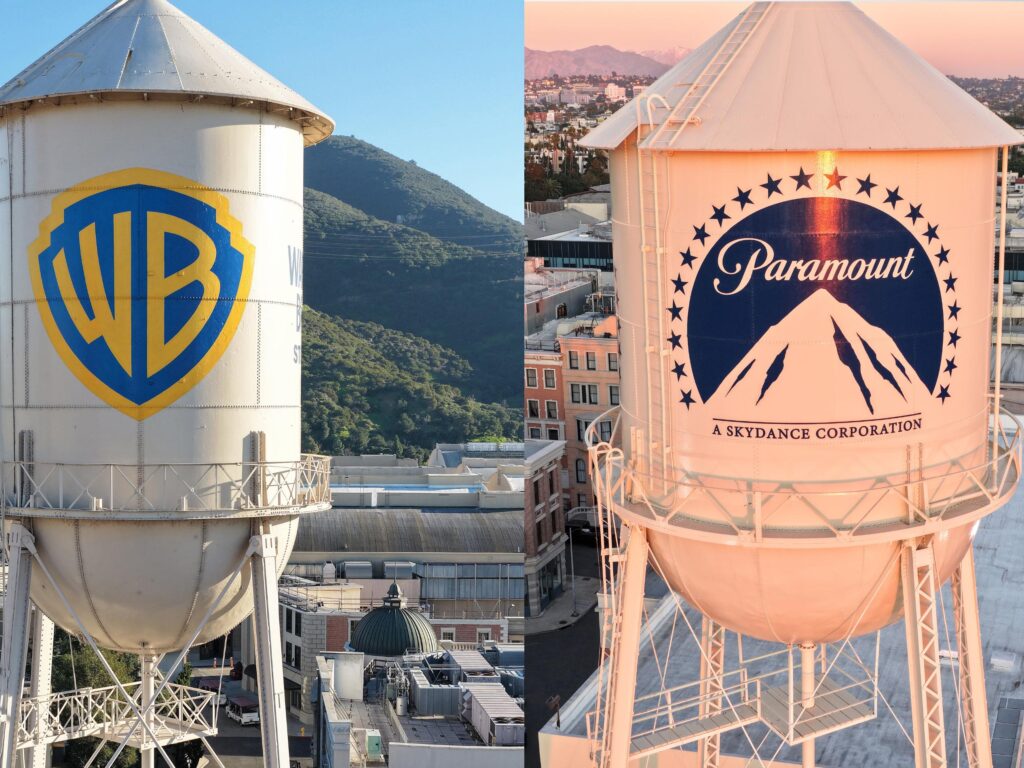
Variety’s account of the company’s first day described a strategy in which the Paramount and Warner Bros creative identities would continue to operate, while the wider company coordinates the businesses at corporate level. The studios are expected to retain their brands, with the Warner Bros and Paramount logos continuing alongside the designation that they are part of Skydance. Pasted text
The strategy suggests that Skydance does not intend to immediately erase the identities of the businesses it has brought together.
That may prove important.
Hollywood studios are not simply factories producing interchangeable products. Their value is closely tied to creative talent, established brands, audiences and relationships with filmmakers and performers.
A merger that achieves financial efficiencies but weakens those creative advantages could ultimately undermine the value of the acquisition.

How the Paramount-Warner Bros Merger Came Together
The path to the merger was not straightforward.
The transaction emerged from a highly competitive process involving negotiations, competing interests and regulatory scrutiny. The supplied source material notes that Netflix had also been involved in bidding, while lawsuits were filed in roughly a dozen US states before a settlement helped clear the way for the transaction.
That history matters because it demonstrates how strategically valuable the assets had become.
Warner Bros Discovery controls a collection of brands with enormous cultural and commercial significance. Paramount brings another substantial portfolio of entertainment properties and production capabilities.
The resulting competition around the assets reflected the broader transformation of the media industry.
Traditional media companies are under pressure from streaming platforms, changing consumer behaviour, declining traditional television audiences and escalating production costs.
Owning valuable content has therefore become increasingly important.
The merger represents one answer to that pressure: create greater scale, consolidate resources and attempt to compete more effectively in a global entertainment market dominated by powerful technology and media companies.
But the same strategy creates another question.
How much consolidation is too much?
That question followed the deal through its regulatory process and remains relevant after completion.

The $111 Billion Question
The headline value attached to the transaction underscores its extraordinary scale.
The supplied primary source describes the deal as a $111 billion Paramount-Warner Bros merger, while another source within the material refers to it as approximately $110 billion.
That discrepancy is worth noting rather than silently presenting the figures as identical.
Either way, the transaction represents a huge financial commitment at a time when the entertainment industry is already dealing with significant structural pressure.
And that leads to the most important question surrounding the new company:
Can Skydance generate enough value from this enormous portfolio to justify the financial and operational burden of combining it?
The challenge is not simply acquiring content.
It is monetising that content efficiently.
The company needs to manage film production, television operations, streaming strategies, advertising, licensing and global distribution while controlling costs.
According to the supplied material, management plans to cut approximately $6 billion in costs over three years. Analysts have identified integration, debt management and operational execution as significant risks. Skydance shares reportedly fell 8% to $8.79 on the second trading day, reflecting investor concern about the road ahead.
Cost reduction can strengthen a company when it eliminates duplication and inefficiency.
But entertainment presents a particular problem.
Cut too deeply into production, development or talent and the savings could come at the expense of the very content that attracts audiences.
Debt and the Cost of Becoming Bigger
The financial challenge facing Skydance is therefore more complicated than the headline value of the merger.
A larger company has more assets.
It also has more obligations.
The supplied material cites concerns about the combined company’s debt burden and the need to increase profits. AJ Bell’s Dan Coatsworth warned that the new entity would have to manage its debt while finding ways to reduce costs and improve profitability.
This creates a delicate balancing act.
Skydance needs to demonstrate that the merger produces efficiencies.
At the same time, it cannot afford to weaken the creative pipeline.
The company therefore has to answer three questions simultaneously:
Where can costs be eliminated?
Where must investment increase?
Which assets should receive priority?
Those decisions could determine the company’s future more than the merger itself.
Streaming Changes the Equation
Perhaps the biggest strategic challenge is streaming.
The entertainment industry has spent years moving away from the traditional model in which audiences primarily consumed films in cinemas and television programmes through scheduled broadcast or cable channels.
Streaming has transformed that relationship.
Audiences increasingly expect entertainment to be available when and where they want it.
That has created enormous opportunities but also enormous costs.
Streaming platforms require constant investment in content. Companies must compete for subscribers while controlling production expenditure and maintaining enough exclusive programming to keep audiences from cancelling.
The new Skydance company therefore inherits a substantial content advantage.
It also inherits the cost associated with maintaining that advantage.
Forrester’s Mike Proulx said HBO leadership would take a leading role in the combined streaming operation, according to the supplied source material. Proulx also warned that efforts to achieve cost efficiencies could potentially affect content quality.
That is one of the central contradictions of the merger.
Skydance wants efficiency.
But premium entertainment depends on investment.
The company will need to determine whether greater scale can reduce unnecessary duplication without reducing the quality that audiences expect from HBO, Warner Bros, Paramount and their associated brands.
An Extraordinary Library of Intellectual Property
One of Skydance’s greatest advantages is the intellectual property it now controls.
The combined portfolio includes some of the world’s best-known entertainment franchises.
Harry Potter, Game of Thrones, The Lord of the Rings, Indiana Jones, Mission: Impossible, Shrek, Batman and other major properties give the company something that cannot easily be created overnight: decades of audience recognition. Pasted text Pasted text
Intellectual property can be reused across different formats.
A successful film can generate television adaptations, streaming series, merchandise, licensing agreements and international distribution opportunities.
The value therefore extends beyond the original production.
This gives Skydance a powerful foundation.
But it also creates pressure to exploit the franchises carefully.
Audiences can become fatigued when familiar properties are repeatedly recycled.
The company’s future strategy will therefore require a balance between exploiting established franchises and developing new intellectual property.
That may be one of the most important creative tests facing its leadership.
David Ellison’s New Role
The new company will be led by Skydance founder David Ellison, who becomes chairman and chief executive, while Ynon Kreiz takes on a major operational role as co-CEO. The supplied material says Kreiz will focus on day-to-day operations and integration, while Ellison concentrates more heavily on strategy and technology.
That division of responsibility reflects the complexity of the new organisation.
Integration alone will be an enormous task.
The combined group includes different corporate cultures, production operations, management structures and distribution systems.
The leadership team will need to decide where duplication can be removed and where separate identities should remain.
The first-year film slate is expected to include 35 movies, according to the supplied Variety material, while the company intends to coordinate release schedules without eliminating the creative identities of the individual studios. Pasted text
That approach suggests that management understands one of the central risks of consolidation: making a creative company too bureaucratic.
CNN and CBS Create a Different Kind of Risk
The Paramount-Warner Bros merger is also significant because it is not only an entertainment story.
It is a media and journalism story.
The new company controls CNN and CBS News, two major news organisations with substantial political and cultural influence.
The supplied material says Paramount agreed to establish a news editorial independence board for CNN and CBS. The issue became particularly sensitive because of political questions surrounding the transaction and Skydance leadership. Pasted text
Mark Thompson remains chairman and editor-in-chief of CNN Worldwide, while Bari Weiss becomes editor-in-chief of CBS News, according to the supplied Variety material. Pasted text
David Ellison has also stressed editorial independence.
The significance of those commitments goes beyond corporate communications.
When a single entertainment company owns major news organisations, questions about ownership, political influence and editorial independence naturally become part of the public debate.
The company will therefore have to demonstrate through its actions — not simply statements — that newsroom independence remains protected.
That will be especially important during politically sensitive periods.
Regulation Did Not End With the Merger
The transaction also comes with regulatory conditions.
The supplied material says the agreement requires at least 30 films per year and imposes US production requirements over the initial years following the transaction. It also includes provisions concerning a stake in Miramax and guardrails around the use of AI-generated films.
These conditions illustrate the wider concern surrounding media consolidation.
Regulators are not simply asking whether two companies can legally combine.
They are also considering what happens afterward.
Will enough films continue to be produced?
Will US production remain substantial?
Will the company maintain competition?
Will artificial intelligence reduce human creative employment?
The regulatory conditions reflect a recognition that the consequences of a large media merger can extend into culture, employment, competition and creative production.
What the Merger Could Mean for Global Entertainment
The Paramount-Warner Bros merger is fundamentally an American corporate transaction.
Its consequences, however, are global.
Hollywood remains one of the world’s most powerful entertainment exporters. Its films and television programmes influence audiences across Africa, Europe, Asia and Latin America.
When ownership changes at this scale, distribution strategies can change with it.
A new management team may reassess which markets receive priority, how content is licensed, how streaming services are positioned and which productions receive international investment.
That is why the merger deserves attention in Africa.
The question is not whether African audiences will suddenly stop watching Hollywood.
It is how the changing structure of Hollywood may influence the choices available to them.
Why Nigeria and Nollywood Should Be Watching
For Nigeria, the most immediate relevance lies in Nollywood and the country’s rapidly evolving digital entertainment market.
Nollywood has developed into one of the world’s most significant film industries, with enormous production output and a growing international audience.
Its relationship with global streaming platforms has already changed the economics of Nigerian storytelling.
Global companies can provide financing, distribution and international visibility.
But they can also become powerful gatekeepers.
A larger Hollywood entertainment company could therefore create both opportunities and competition.
On one side, a company with a huge global distribution network could seek partnerships with African producers and expand its appetite for locally produced stories.
On the other, greater concentration among international entertainment companies could make it harder for smaller producers to negotiate favourable terms.
The outcome will depend on how Skydance approaches international content.
If the company views Africa simply as a market for American entertainment, the benefits may be limited.
If it views Africa as a source of stories, talent, production partnerships and intellectual property, the opportunities could be much greater.
The African Streaming Opportunity
The African streaming market presents another important possibility.
Nigeria, South Africa, Kenya and other African markets have young populations with rapidly changing media consumption habits.
Mobile devices and internet access have transformed the way audiences discover films and television programmes.
That creates an increasingly important market for international streaming companies.
Skydance will have to decide how aggressively it wants to compete in those markets.
Will it rely primarily on existing Hollywood content?
Will it invest in African productions?
Will it license content to established African platforms?
Or will it develop partnerships with local creators?
Those choices could determine whether the merger becomes relevant to African producers beyond the consumption of Hollywood films.
For Nollywood, the central issue is therefore not simply competition.
It is access.
Who controls the platforms?
Who controls distribution?
Who finances production?
And who owns the intellectual property after a successful African story becomes an international hit?
A Bigger Hollywood Does Not Automatically Mean a Better Hollywood
The fundamental argument behind a merger of this scale is straightforward: greater scale should produce greater efficiency and stronger competitiveness.
But entertainment does not always behave like a conventional manufacturing industry.
A film can cost hundreds of millions of dollars and fail.
A relatively inexpensive production can become a global phenomenon.
A television series can take years to build an audience.
A single franchise can generate billions in value over decades.
This makes creative judgment extremely difficult to reduce to a corporate formula.
The danger for Skydance is that financial pressure could encourage management to prioritise predictable franchises at the expense of experimentation.
The opposite danger is equally serious.
Spending aggressively without controlling costs could deepen the company’s financial pressures.
The successful strategy will probably lie somewhere between those extremes.
The Real Test Begins Now
The completion of the Paramount-Warner Bros merger is therefore not the end of the story.
It is the beginning of a much harder phase.
Skydance must now integrate two enormous organisations while preserving the creative strengths that made them valuable.
It must manage debt.
It must deliver the promised cost savings.
It must compete in streaming.
It must maintain an attractive film and television pipeline.
It must navigate regulatory obligations.
And it must convince audiences, investors, employees and regulators that the new company’s enormous scale will not come at the expense of quality or independence.
Those are difficult objectives even individually.
Together, they represent one of the most ambitious corporate challenges in modern entertainment.
What Happens Next?
The next few years will reveal whether the Paramount-Warner Bros merger becomes a model for the future of global entertainment or an example of the risks of becoming too large.
Investors will watch the company’s financial performance and debt.
Employees will watch restructuring and job decisions.
Filmmakers will watch whether creative freedom survives corporate integration.
Audiences will watch the quality of movies and television programmes.
News consumers will watch CNN and CBS for evidence that editorial independence remains intact.
And competitors will watch for opportunities created by any mistakes.
For Africa, particularly Nigeria, the watchlist is broader.
Nollywood producers should pay attention to licensing, international partnerships, streaming strategies and the appetite for African stories.
The merger could eventually create new routes into global entertainment.
It could also strengthen the negotiating power of one of the industry’s largest media companies.
The Bigger Picture
The Paramount-Warner Bros merger is ultimately a story about power.
It is about who owns the world’s most valuable entertainment brands, who controls distribution and who has the financial capacity to determine which stories reach global audiences.
Skydance now sits at the centre of that conversation.
Its new empire contains extraordinary creative assets and decades of Hollywood history.
But it also carries financial obligations and operational risks that cannot be solved simply by owning more content.
The $111 billion headline may capture the scale of the transaction.
It does not capture the difficulty of making the new company work.
The real measure of success will come later.
If Skydance can combine the strengths of Paramount and Warner Bros without destroying their creative identities, control costs without weakening content, expand globally without ignoring local creators and protect the independence of its news organisations, the merger could become one of the defining transformations of modern entertainment.
If it cannot, the same scale that makes the new company powerful could become its greatest weakness.
For Hollywood, the merger has created a new giant.
For Skydance, however, the harder question is just beginning:
Can the giant actually work?
About the Author