Microsoft’s AI PC Push Could Change How Nigerians Use AI
Microsoft is pushing artificial intelligence beyond the cloud and onto personal computers, unveiling new AI capabilities for Windows PCs that could allow sophisticated models to run directly on high-powered machines. The move, announced at a Microsoft event in San Francisco on October 7, could reshape how users and businesses access AI, while raising a critical question for Nigeria: who will be able to afford the hardware required to run it?
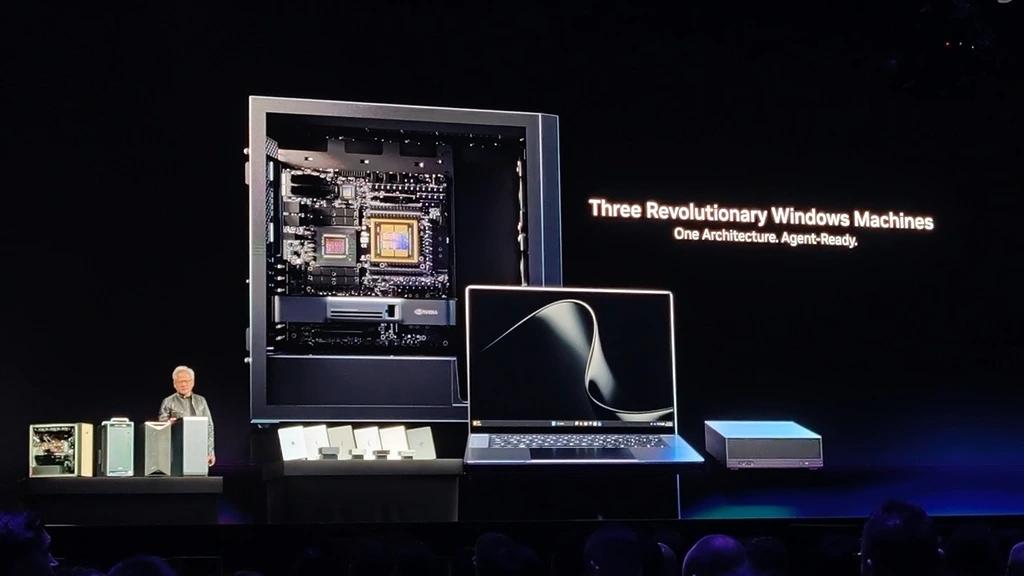
Microsoft presented a high-powered Surface Laptop Ultra using Nvidia’s RTX Spark chips and introduced AI models that can run locally rather than depending entirely on cloud servers. The company also unveiled Microsoft Execution Containers, a security technology designed to limit what increasingly autonomous AI agents can access and do on a computer.
For Microsoft, the strategy represents a broader attempt to turn Windows into a platform where AI agents can perform demanding tasks such as writing computer code and handling complex business projects directly on desktops and laptops.
But the significance extends beyond Microsoft’s hardware portfolio. The company is effectively betting that some AI workloads currently processed in cloud data centres can increasingly move onto users’ own machines.
For Nigerian users, that shift could eventually change the relationship between artificial intelligence, internet connectivity, cloud computing and personal computers.
Microsoft AI PCs Signal a Shift From Cloud to Local Computing
For much of the recent AI boom, sophisticated artificial intelligence has depended heavily on powerful cloud infrastructure.
Users interact with an AI service through a computer or smartphone, but much of the demanding computation takes place in large data centres operated by technology companies.
Microsoft’s new approach seeks to distribute more of that computing power.
The company unveiled AI models that previously required cloud access but can now run locally on high-powered Windows desktops and laptops. Among them is Nvidia’s open-source Nemotron model. Microsoft executive vice president Pavan Davuluri also said a version of Chinese AI company DeepSeek’s V4 model can run on machines with at least 60 gigabytes of memory. Pasted text
Microsoft’s Copilot strategy follows the same hybrid principle.
Rather than moving everything away from the cloud, Microsoft plans to divide workloads between cloud-based systems and local models. According to Copilot chief Jacob Andreou, the cloud will continue handling the hardest tasks, while some work can be delegated to models running directly on a user’s computer when cost or privacy considerations make local processing preferable. Pasted text
That distinction is important.
Microsoft is not announcing the end of cloud AI. It is proposing a more flexible computing model in which the cloud and the personal computer share the workload.
Why Local AI Could Matter in Nigeria
The potential Nigerian relevance begins with one simple difference between cloud AI and local AI.
Cloud-based AI requires a connection between the user’s device and the remote computing infrastructure handling the workload. Local AI moves at least some of that processing onto the device itself.
That could become significant for users who need AI for professional work but operate in environments where connectivity, cloud costs or data privacy are important considerations.
A Nigerian developer, for example, could potentially use a sufficiently powerful computer to run certain AI models without sending every task to a remote service.
The same principle could matter to businesses processing sensitive information, creative professionals working with large files, researchers handling specialised datasets and other users whose AI workloads do not always need to be performed in the cloud.
However, the technology should not be presented as a solution to Nigeria’s connectivity challenges by itself.
A powerful local-AI computer still needs electricity, software and the appropriate hardware. And Microsoft‘s announcement does not mean that every AI workload can suddenly be performed offline.
The company’s own strategy demonstrates this limitation: Copilot will continue using cloud computing for its most demanding tasks.
The opportunity, therefore, is not the disappearance of the cloud.
It is the possibility of having more choice over where AI processing happens.
The Privacy Question Is Becoming More Important
As AI systems become more capable, the question is no longer simply how intelligent an AI model is.
It is also what that AI is allowed to do.
Microsoft’s introduction of Execution Containers reflects this emerging concern.
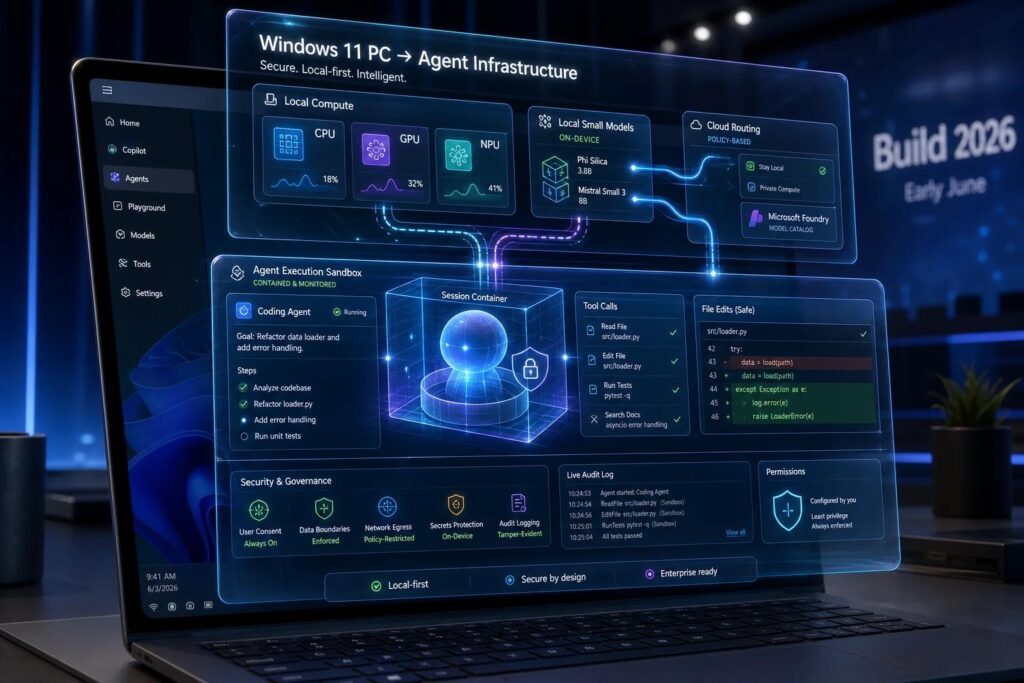
The company said Microsoft Execution Containers, or MXC, are designed to prevent AI agents running on computers from accessing data or carrying out tasks without permission. Microsoft said IT departments would be able to establish rules for AI agents, with Windows enforcing those rules on individual machines.
That matters because the next generation of AI systems is increasingly being designed to act rather than merely respond.
An AI assistant that writes an email is one thing.
An AI agent that can access files, execute code, interact with applications and perform tasks on a computer introduces an entirely different security challenge.
Microsoft CEO Satya Nadella said the company wanted to make the desktop a secure environment for AI agents to operate.
Nvidia‘s CEO Jensen Huang , who appeared alongside Nadella at the event, described Microsoft’s execution-container technology as potentially transformative for how AI agents are built and deployed.
Microsoft’s security move also places the company within a wider technology race.
Nvidia is working on measures to reduce AI security risks, while Apple is also tightening controls around AI agents accessing information stored on Macs.
The implication is clear: as AI becomes more autonomous, controlling its access becomes as important as increasing its intelligence.
Microsoft AI PCs Face a Major Nigerian Problem: Price
Microsoft‘s new Surface Laptop Ultra starts at $2,599 and rises to $5,899 for a configuration with a 20-core processor, 128 gigabytes of memory and one terabyte of storage.
That places the technology firmly in the premium computing market.
For Nigerian users, where the cost of imported technology can become significantly more burdensome after currency conversion and other market costs, the price of the hardware is particularly relevant.
The source material does not establish a Nigerian retail price for the Surface Laptop Ultra, so no precise local price should be assumed.
But the international price alone demonstrates the challenge.
The central issue is therefore not whether local AI is technically possible.
It is whether the machines capable of running powerful models locally can become affordable enough to achieve meaningful adoption.
That concern is not unique to Nigeria.
Reuters reported that a memory-chip crunch has contributed to higher prices for AI-capable computers. Nvidia’s DGX Spark AI desktop, for example, has risen by about 75% since launch to $6,950.
Analyst Anshel Sag of Moor Insights & Strategy captured the tension by arguing that the software is now ready while the hardware has become too expensive for many users to run AI locally.
That tension could shape the next stage of the AI race.
The Local AI Opportunity for Nigerian Businesses
If prices eventually fall, local AI could become more relevant to a broader range of businesses.
The most immediate opportunities are likely to come from organisations and professionals whose work depends heavily on computing power and AI-assisted productivity.
That could include:
- Software developers
- Graphic designers
- Video editors
- Researchers
- Digital media companies
- Financial and professional services
- Technology startups
- Corporate IT departments
For such users, the attraction is not simply having an AI computer.
It is having the ability to decide which workloads should remain local and which should be handled through cloud infrastructure.
That hybrid approach could become particularly important as businesses attempt to balance performance, cost, privacy and security.
Microsoft is clearly positioning Windows around this future.
The company said its new platform is intended to support AI agents capable of tasks ranging from software development to complex business projects. Pasted text
That suggests the AI PC is being conceived not merely as a faster laptop but as a new type of workplace computer.
AI Could Become More Personal — But Not Necessarily Cheaper
There is an important contradiction at the heart of Microsoft’s strategy.
Local AI is partly being promoted because some workloads can be handled without relying entirely on expensive cloud infrastructure.
But the computers capable of running sophisticated models locally can themselves be extremely expensive.
That creates a difficult economic equation.
If businesses save money by reducing some cloud workloads but have to spend thousands of dollars on high-performance machines, the economics will depend heavily on the type and volume of AI tasks being performed.
Microsoft therefore has to make the local-AI proposition compelling enough for customers to justify the hardware investment.
This is particularly important in emerging markets.
The success of local AI in Nigeria will not depend only on whether the technology works. It will also depend on whether businesses and professionals can obtain sufficiently powerful machines at prices that make economic sense.
Microsoft, Apple and Nvidia Are Fighting Over the Next PC
Microsoft’s announcement is also part of a much larger battle.
Apple is pursuing its own strategy to bring more AI capabilities onto personal devices, while Nvidia is seeking to expand its influence in the PC market.
For Nvidia, the Windows PC market represents an opportunity to challenge a space long dominated by Intel and AMD. Pasted text
That makes the AI PC more than another product category.
It is becoming a battleground involving operating systems, processors, graphics hardware, AI models, security architecture and cloud services.
Microsoft has an important advantage: Windows already sits on a vast installed base of personal and business computers.
The company’s challenge is to persuade users that the next computer they buy should not simply be a machine that runs applications.
It should also be a machine capable of running AI.
The Security Challenge Will Grow With AI Agents
The rise of local AI also introduces a different kind of risk.
An AI model operating on a computer is potentially closer to the user’s files, applications and system resources than a conventional cloud-based chatbot.
That makes security controls increasingly important.
Microsoft’s Execution Containers are designed around precisely this issue.
The system would allow organisations to establish boundaries for AI agents and have Windows enforce those rules on individual machines. Pasted text
For Nigerian businesses considering greater use of AI, this could eventually become an important part of technology procurement decisions.
The question will not simply be:
How powerful is the AI?
It will also be:
What can the AI access?
That distinction could become increasingly important as businesses allow AI systems to interact with internal documents, software applications and other sensitive resources.
What Microsoft’s AI PC Push Could Mean for Nigeria
The immediate impact of Microsoft‘s announcement in Nigeria is likely to be limited by hardware costs.
But the direction of travel is significant.
If local AI becomes more capable and hardware becomes more affordable, Nigerian users could gain greater flexibility in deciding how they use artificial intelligence.
Developers could run certain models directly on their machines.
Businesses could explore local processing for selected workloads.
Creative professionals could incorporate AI tools into production workflows without sending every task to a remote service.
Researchers could potentially experiment with increasingly capable models on local hardware.
And users could have greater control over where certain AI processing occurs.
At the same time, the technology could deepen the digital divide if powerful AI hardware remains concentrated among wealthy companies and individuals.
That is why affordability matters as much as technical capability.
The Bigger Question for Nigeria’s AI Future
Microsoft‘s move points toward a future in which artificial intelligence is no longer confined to giant cloud data centres.
Some of the processing could increasingly happen on computers sitting in offices, studios, homes and classrooms.
That could make AI more responsive, potentially improve control over sensitive workloads and reduce dependence on cloud processing for selected tasks.
But it does not automatically make AI more accessible.
The current price of the hardware demonstrates the gap between what technology can do and what most users can afford.
For Nigeria, that distinction may prove decisive.
The country has a growing community of developers, entrepreneurs, media professionals, researchers and businesses experimenting with artificial intelligence. But access to advanced computing remains a practical consideration.
Microsoft’s AI PC strategy therefore represents both an opportunity and a warning.
The opportunity is a computing environment in which powerful AI becomes increasingly available directly on the user’s machine.
The warning is that technological progress does not necessarily produce equal access.
From Cloud AI to Local AI
Microsoft‘s announcement marks an important stage in the evolution of personal computing.
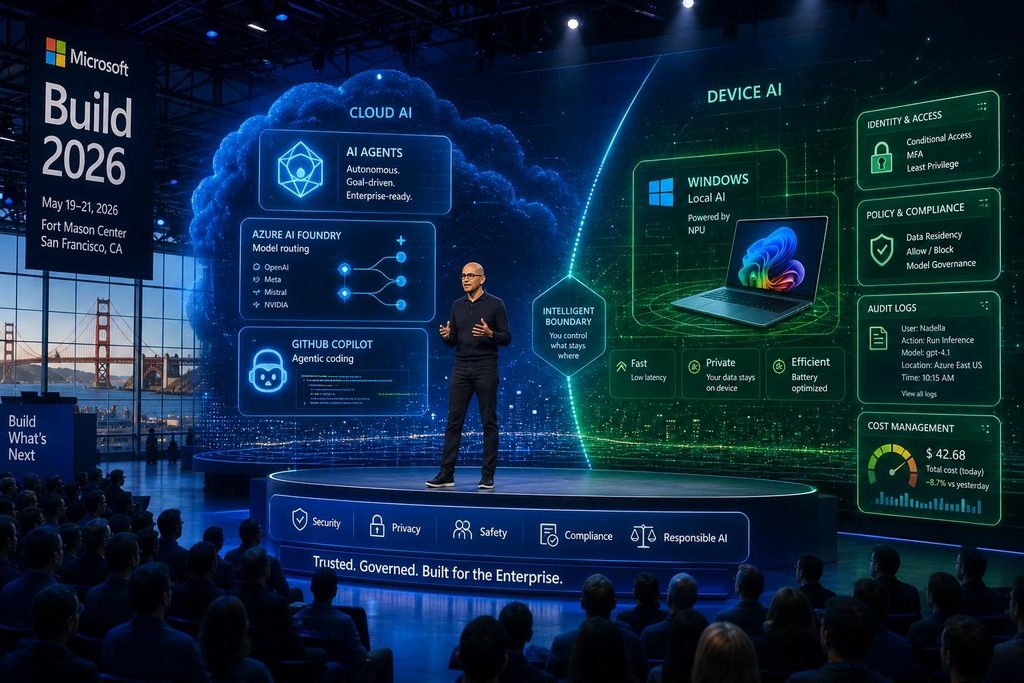
The company is not abandoning the cloud. Instead, it is moving toward a hybrid model in which the cloud handles the most demanding workloads while local machines increasingly handle tasks that can be processed on-device.
That could change how people think about personal computers.
The PC may no longer simply be the place where people access AI services.
It could increasingly become part of the AI infrastructure itself.
For Nigerian users, however, the next stage will depend on more than Microsoft’s software ambitions.
The real test will be whether powerful AI hardware becomes affordable enough, secure enough and practical enough for local users to take advantage of it.
Microsoft may be helping move AI closer to the individual computer.
The bigger question is whether that future will be close enough — and affordable enough — for Nigerians to participate.
Investment in Energy, AI, and Supply Chains to Boost Nigeria:
Global News Roundup: A Week of War, Energy, AI and Shifting Economic Power:
About the Author