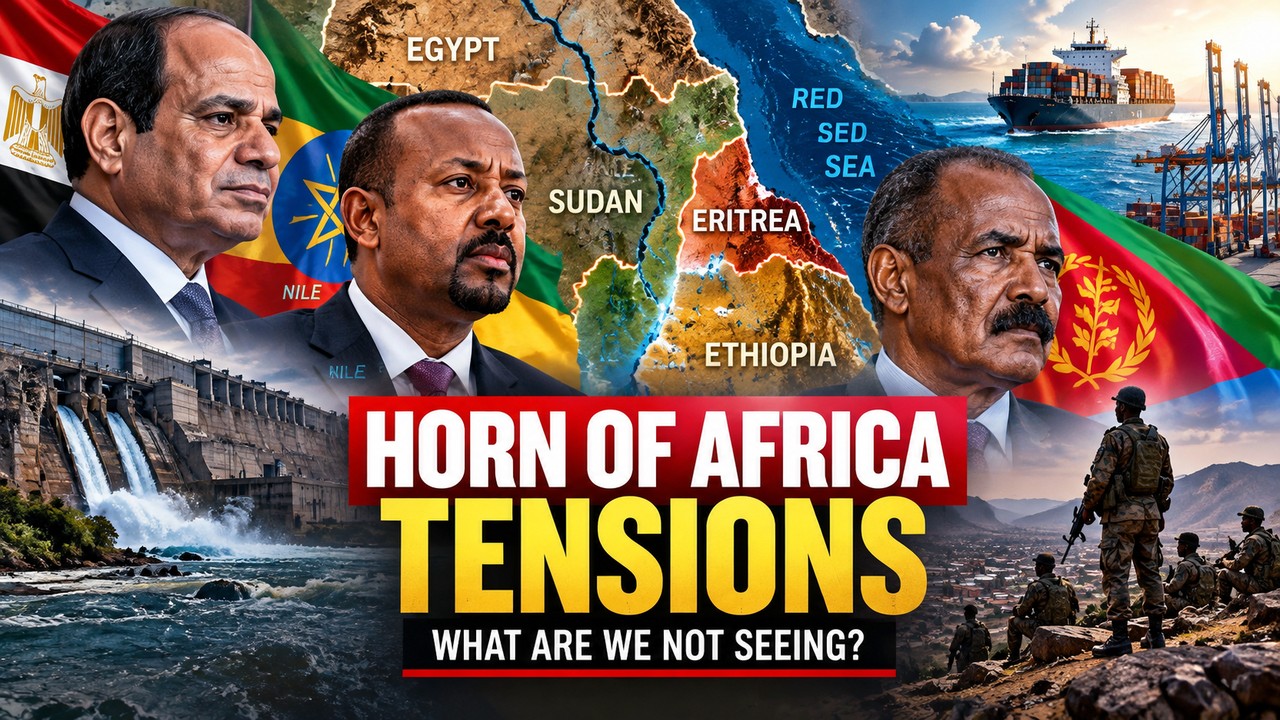
The Horn of Africa tensions have entered a more dangerous phase as Ethiopia, Eritrea and Egypt find themselves increasingly connected by disputes over security, water, territory and access to the Red Sea. Renewed fighting in northern Ethiopia, a sharp deterioration in Ethiopia-Eritrea relations and an African Union appeal for restraint have brought the wider regional equation into focus.
The immediate crisis began with renewed fighting in Ethiopia’s northern regions and accusations by Ethiopian Army Chief Field Marshal Birhanu Jula that Eritrea, Egypt and Sudan were backing armed opposition groups. The three countries rejected the allegations, and Ethiopia did not provide evidence to substantiate the claims in the material supplied for this report.
The diplomatic consequences have since become more serious. Ethiopia closed its embassy in Asmara and expelled 10 Eritrean diplomats, while Eritrea responded by severing diplomatic ties with Ethiopia. Ethiopia also expelled an Egyptian diplomat, with Egypt responding by expelling an Ethiopian embassy official. The African Union Commission has urged the three countries to exercise maximum restraint and resolve their differences through established diplomatic channels and peaceful dialogue.
But the current confrontation cannot be understood through the latest diplomatic exchanges alone.
The deeper story stretches from the **Grand Ethiopian Renaissance Dam and the Nile** to Ethiopia’s interest in Red Sea access, the unresolved consequences of the Tigray war and Sudan’s continuing civil war. These are separate disputes with their own histories, but their geography increasingly overlaps.
Here are five questions that explain the growing regional tensions.
1. Why Is Ethiopia and Egypt’s Nile Dispute So Important?
At the heart of the Ethiopia-Egypt relationship is the **Grand Ethiopian Renaissance Dam**, or GERD, built by Ethiopia on the Blue Nile.
For Ethiopia, the dam is closely connected to development and electricity generation. For Egypt, the Nile is fundamental to its water security, making the operation and filling of the dam a matter of major national concern.
The disagreement has lasted for years and has increasingly become part of a wider geopolitical competition.
The supplied source describes the GERD dispute as a longstanding disagreement in which Egypt fears that the dam could affect its water security, while Ethiopia considers the project vital to its economic development.
The significance of the Nile therefore goes beyond the physical river.
It is also about how two major African states understand their national interests.
Ethiopia sits upstream of Egypt on the Blue Nile. Egypt is downstream and has historically depended heavily on the river. That geographical relationship means decisions taken in Ethiopia can have strategic implications in Egypt.
The dam dispute has consequently become one of the central pillars of **Nile geopolitics**.
It has also increasingly intersected with other regional questions.
The Reuters account of the current crisis describes the dispute over Ethiopia’s hydroelectric dam as one factor contributing to the wider tensions surrounding renewed fighting in Tigray.
That does not mean the GERD dispute alone explains the current conflict. It does not.
Rather, it is one part of a much larger system in which water, security, diplomacy and regional alliances overlap.
That distinction matters.
The present allegations of external support for Ethiopian opposition groups remain allegations. Egypt has rejected them, saying its foreign policy is based on respect for the sovereignty and territorial integrity of other states. Sudan has also rejected Ethiopia’s accusations, while making its own allegations against Addis Ababa. Ethiopia has denied those allegations in turn.
The Nile dispute therefore provides important context, but it should not automatically be treated as proof of military involvement by any of the countries now being accused.
2. Why Has Red Sea Access Become So Important?
If the Nile explains much of the Ethiopia-Egypt relationship, the **Red Sea helps explain Ethiopia’s increasingly complicated relationship with Eritrea**.
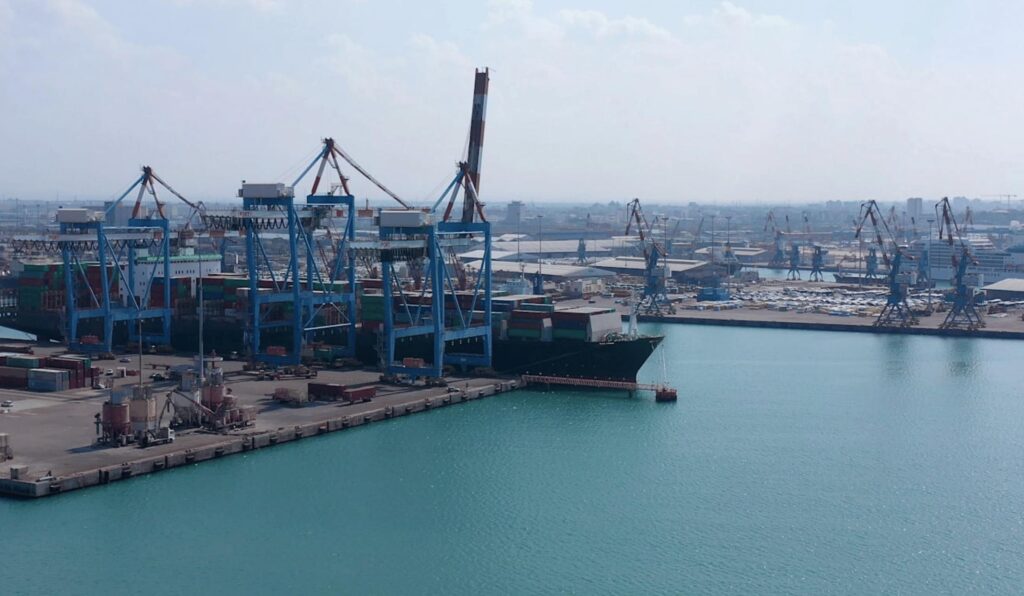
Ethiopia is landlocked, while Eritrea controls a coastline on the Red Sea.
That geography gives the Eritrean coast strategic importance in any discussion about Ethiopia’s access to international maritime trade.
The supplied material identifies Ethiopia’s pursuit of sovereign Red Sea maritime access as a major source of concern for Eritrea. It also says Eritrea views Ethiopian naval ambitions and rhetoric surrounding regional ports as a threat to its territorial sovereignty.
Recent Reuters reporting likewise identifies Ethiopia’s assertion that access to the sea is vital as a factor worsening relations with Eritrea, with Asmara concerned about the possibility of Ethiopian attempts to obtain access to Eritrean ports.
This is one of the most important pieces of geography behind the crisis.
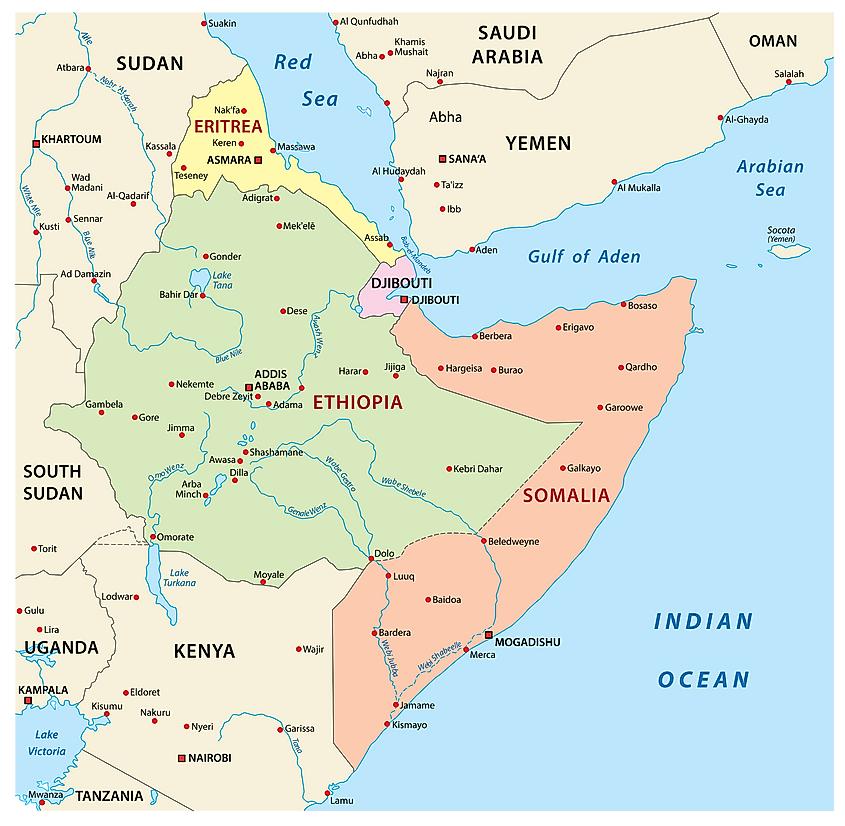
A map of the Horn of Africa makes the relationship easier to understand.
Ethiopia is a large, landlocked country. Eritrea lies directly to its northeast and has a coastline facing the Red Sea. The Red Sea itself connects the region to one of the world’s major maritime corridors and to the Bab al-Mandeb, the strategic passage linking the Red Sea with the Gulf of Aden.
As a result, Ethiopia’s search for maritime access is not simply an economic question.
It has security and geopolitical dimensions.
For Eritrea, meanwhile, questions involving its coastline and sovereignty are especially sensitive.
The two countries were once military partners.
During the 2020–2022 Tigray conflict, Eritrean forces fought alongside Ethiopian federal forces against the Tigray People’s Liberation Front, or TPLF. But the relationship deteriorated after the war, with Eritrea becoming increasingly concerned about Ethiopia’s regional ambitions and interest in Red Sea access.
That history helps explain why today’s diplomatic rupture is significant.
On October 1, Eritrea announced that it was severing all diplomatic ties with Ethiopia after Addis Ababa closed its embassy in Asmara and expelled Eritrean diplomats.
The breakdown of diplomatic channels comes at precisely the moment when fighting has again intensified in northern Ethiopia.
That combination makes the situation more difficult to manage through ordinary diplomacy.
3. How Did Tigray Become Part of the Regional Equation?
The third question is Ethiopia’s internal conflict.
The current crisis is unfolding against the background of the devastating **2020–2022 Tigray war**, but the renewed fighting is not simply a continuation of that conflict.
The supplied material says fighting has intensified across Tigray, Amhara and Afar following renewed clashes involving federal forces, the TPLF and allied groups.
Reuters reported on October 2 that Ethiopian federal forces and allied militias were advancing toward Mekelle, Tigray’s capital, while the Tigray People’s Liberation Front-led opposition alliance claimed territorial gains of its own.
The renewed fighting has therefore transformed Ethiopia’s internal political and military crisis into a major regional concern.
Why?
Because northern Ethiopia borders countries whose relationships with Addis Ababa are already strained.
The fighting is occurring close to Eritrea and within a broader regional environment shaped by the war in Sudan and strategic competition around the Red Sea.
That is why analysts and officials are watching the conflict beyond Ethiopia’s borders.
Ethiopia has accused Eritrea, Egypt and Sudan of supporting armed opposition groups. The accusations have been rejected by the countries named. The Ethiopian army chief did not provide evidence to substantiate the allegations described in the supplied report.
That caveat is crucial.
An allegation can become politically significant without being independently established as fact.
The current diplomatic fallout demonstrates the distinction.
Ethiopia’s accusations have been followed by diplomatic expulsions and the closure of its embassy in Eritrea. Eritrea then severed diplomatic ties with Ethiopia. Egypt also became involved in a diplomatic exchange of expulsions.
At the same time, analysts cited by Al Jazeera offered another interpretation of the accusations.
Some argued that Ethiopia’s government could be using the threat of foreign interference to redirect attention towards an external enemy and strengthen domestic support. Those are analysts’ interpretations, not established facts, and they should be treated as such.
The important point is that Ethiopia’s domestic conflict now sits inside a much larger regional security environment.
4. Why Does Eritrea Matter So Much?
Eritrea matters because it sits at the intersection of **Ethiopia’s northern security environment and the Red Sea**.
The relationship between the two countries has changed dramatically over the past decade.
Ethiopia and Eritrea fought a major border war before eventually reaching a peace agreement in 2018. During Ethiopia’s later Tigray conflict, however, Eritrean forces supported Ethiopian federal troops against the TPLF.
That cooperation did not produce a lasting strategic partnership.
Relations subsequently deteriorated.
The supplied material says Eritrea became increasingly alarmed by Ethiopia’s efforts to gain Red Sea access.
The latest diplomatic rupture represents another major turning point.
According to Reuters, Ethiopia closed its embassy in Asmara and expelled 10 Eritrean diplomats. Eritrea responded by severing diplomatic relations and closing its own embassy in Addis Ababa.
The timing is significant.
The diplomatic breakdown comes while fighting in northern Ethiopia is intensifying.
The African Union has responded by calling on Ethiopia, Eritrea and Egypt to exercise maximum restraint and avoid actions or statements that could further escalate the situation. The AU has also stressed the importance of maintaining communication channels and resolving disputes through diplomacy and peaceful dialogue.
This makes Eritrea central to understanding the current **Horn of Africa tensions**.
The country is not simply another neighbour of Ethiopia.
It occupies a strategically important position along the Red Sea, shares a border with northern Ethiopia and has a direct historical relationship with the Tigray conflict.
Those factors mean that developments along the Ethiopia-Eritrea border can quickly acquire regional significance.
5. Where Does Sudan Fit Into the Crisis?
Sudan adds another layer to an already complicated regional system.
The country has been fighting a devastating civil war since 2023 between the Sudanese Armed Forces and the paramilitary Rapid Support Forces.
The supplied material says Sudan’s military has accused Ethiopia of supporting the RSF, while Ethiopia has denied the allegation. Ethiopia has, in turn, accused Sudan of supporting armed opposition groups inside Ethiopia.
These competing accusations illustrate the broader problem.
The region contains several conflicts occurring simultaneously, and the countries involved do not necessarily see them through the same lens.
Sudan’s war has also created a wider security environment around Ethiopia’s western border.
That means Ethiopia’s relations with Sudan cannot be separated completely from its relationships with Eritrea and Egypt.
The result is a regional network rather than a single bilateral dispute.
The Nile connects Ethiopia, Sudan and Egypt geographically.
The Red Sea connects Ethiopia’s maritime ambitions with Eritrea and the wider maritime environment.
The Tigray conflict connects Ethiopia’s internal politics to Eritrea’s security concerns.
Sudan’s war adds another active conflict to the system.
And the result is what makes the current situation so difficult to interpret.
The Five Issues Are Connected — But They Are Not the Same Conflict
It is tempting to describe the situation as one large confrontation between opposing regional blocs.
The evidence is more complicated.
There are **different disputes with different histories**.
The GERD dispute is primarily a water-security and development dispute between Ethiopia and Egypt.
The Ethiopia-Eritrea relationship is shaped by war, borders, security concerns and Red Sea access.
The Tigray fighting is fundamentally an Ethiopian internal conflict, although its consequences can cross borders.
Sudan’s civil war is a separate conflict involving Sudanese armed factions, even though it has important regional dimensions.
The current danger lies in their **overlap**.
When several disputes occur in the same geographical area, decisions made in one conflict can influence another.
A diplomatic confrontation can affect military calculations.
A military development can alter regional alliances.
A dispute over maritime access can influence relations between neighbouring states.
And an internal conflict can become a regional security concern if neighbouring countries become involved.
That is the basic logic behind the growing concern over the Horn of Africa.
Why the African Union Is Calling for Restraint
The African Union‘s intervention is significant because the organisation is explicitly treating the tensions between Ethiopia, Eritrea and Egypt as a regional stability issue.
In its October 1 statement, the AU Commission said it was following the heightened tensions with concern. It called for maximum restraint, warned against actions or statements that could undermine regional peace and stability, and urged the countries to use established diplomatic channels and peaceful dialogue.
The AU also said it was ready to support de-escalation, dialogue and peaceful resolution efforts.
That response reflects the central problem.
The immediate disputes may be bilateral or domestic, but their geographical proximity means the consequences could extend beyond the countries directly involved.
The African Union therefore faces a familiar continental challenge: preventing an internal or bilateral conflict from becoming a broader regional confrontation.
What Does This Mean for the Horn of Africa?
The immediate question is not whether all the countries involved are already in a regional war.
They are not.
The more important question is whether the separate disputes can continue without becoming increasingly interconnected.
Current developments show why that question matters.
Fighting has resumed in northern Ethiopia.
Ethiopia has accused neighbouring and regional powers of supporting armed opposition groups.
Those governments reject the allegations.
Diplomatic relations between Ethiopia and Eritrea have now been severed.
Ethiopia and Egypt have also experienced diplomatic expulsions amid the wider escalation.
And the African Union is publicly calling for restraint.
At the same time, the longstanding GERD dispute remains unresolved in the supplied material, while questions surrounding Ethiopia’s Red Sea ambitions continue to influence its relationship with Eritrea.
The danger, therefore, lies less in any single disagreement than in the possibility that several disputes begin reinforcing one another.
Why This Matters Beyond Africa
The Horn of Africa occupies a strategically important position between Africa, the Middle East and major maritime routes.
The Red Sea and Bab al-Mandeb connect the region to international shipping routes. Instability in the surrounding countries therefore has implications that extend beyond their immediate borders.
For Africa, the consequences are more direct.
A wider regional conflict could affect trade, border security, humanitarian operations, migration and diplomatic relations among neighbouring states.
It could also complicate efforts to resolve existing conflicts in Ethiopia and Sudan.
For Nigeria and other African countries, the wider lesson is equally important.
The Horn of Africa demonstrates how modern regional security crises rarely fit neatly into one category.
Water security can become foreign policy.
Foreign policy can become military strategy.
A domestic conflict can become a regional issue.
And control of or access to a strategic maritime corridor can become part of a much wider geopolitical competition.
The Question Now Is Whether the Conflicts Stay Separate
The current **Horn of Africa tensions** are built from several different disputes.
The Nile and the GERD explain one major part of the Ethiopia-Egypt relationship.
Red Sea access helps explain Ethiopia’s increasingly difficult relationship with Eritrea.
The Tigray conflict explains the immediate internal security crisis.
Sudan’s civil war adds another active conflict to the regional environment.
None of these issues should automatically be treated as one conflict.
But they are increasingly occupying the same strategic space.
That is what makes the situation difficult.
The African Union‘s call for restraint reflects the concern that diplomatic language, military movements and competing allegations could push the region further away from dialogue.
For now, the most important task is understanding the connections without confusing allegations with established facts.
The Horn of Africa is not facing one simple dispute.
It is facing a collection of disputes whose geography increasingly overlaps.
And the central question for the region is whether diplomacy can keep those disputes from becoming one larger crisis.
For further DSG Herald News coverage, this feature can be internally connected to future reporting on the GERD/Nile dispute, the Tigray conflict, Sudan’s civil war and Red Sea geopolitics.
Related DSG Herald News Coverage
About the Author



