A Humanoid
China’s Humanoid Robot Race: What Happens to Human Jobs?
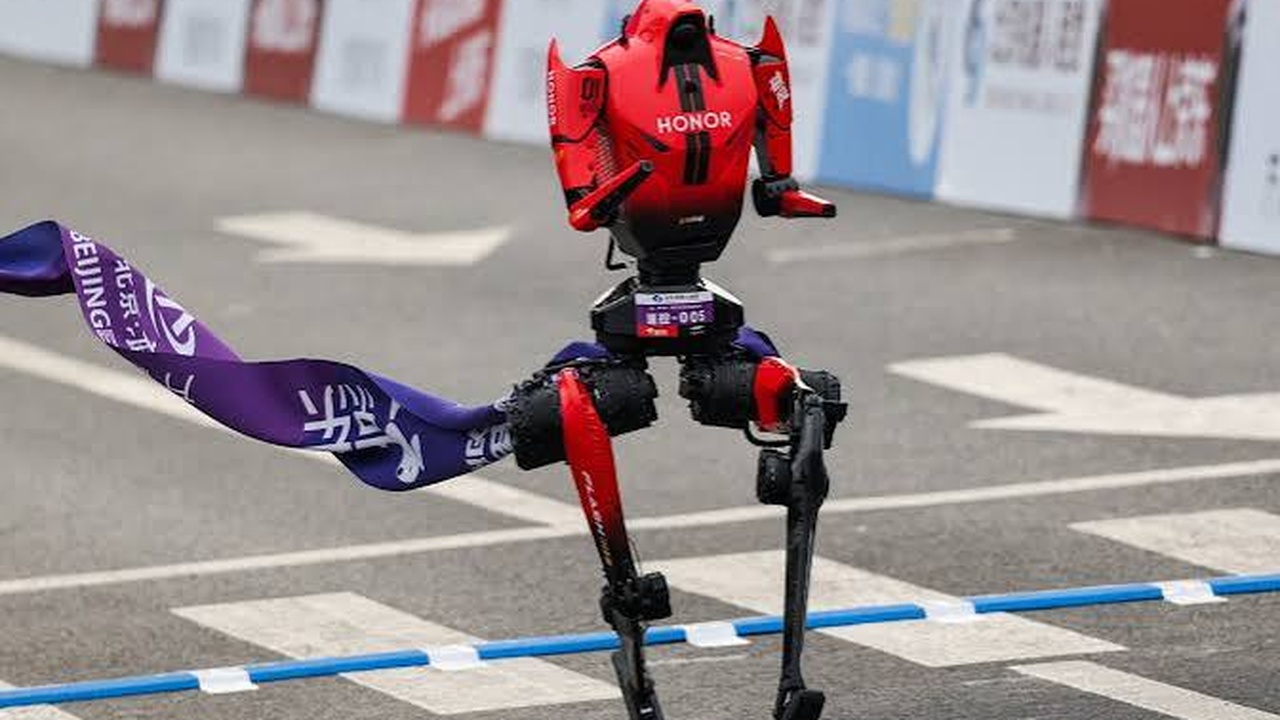
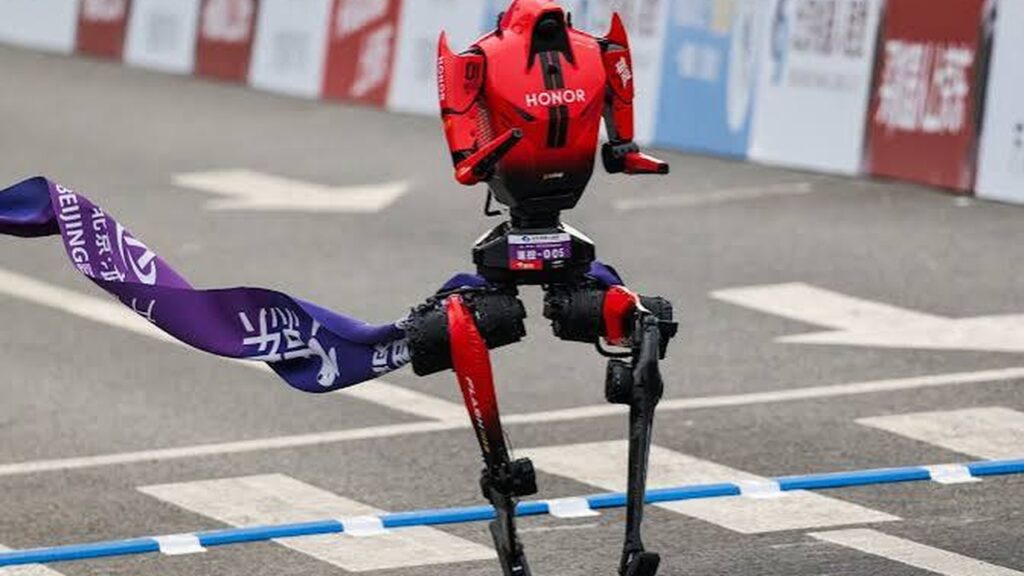
China’s humanoid robots are moving rapidly from spectacular demonstrations towards the more difficult test of practical work, with machines now being assessed in factories, warehouses, restaurants, offices and other real-world settings. At the World Humanoid Robot Games in Beijing, one Chinese humanoid robot ran 100 metres in 9.39 seconds, beating the 9.58-second human world record set by Jamaican sprinter Usain Bolt in 2009. The achievement was a striking demonstration of the speed at which the technology is developing, but the more consequential test is taking place away from the athletics track: whether these machines can perform useful tasks reliably, autonomously and at a cost that makes commercial sense.
The distinction is becoming increasingly important as China builds one of the world’s most active humanoid robotics industries. The country is no longer treating robots simply as laboratory experiments or exhibition pieces. Chinese companies are developing machines for industrial production, logistics, public services and other applications, while investors and manufacturers are committing increasing amounts of capital to the sector. The developments are beginning to raise broader questions about manufacturing, employment and the future structure of the global workforce.
From Robot Races to Real-World Work
The second edition of the World Humanoid Robot Games in Beijing illustrates the changing priorities of the industry. More than 2,000 robots from 666 teams are taking part, with competitions covering athletics and other sports alongside scenario-based events designed around practical environments. The 51-event programme includes simulated factories, restaurants, offices and emergency situations, while more than 40% of the competitions require robots to operate fully autonomously.
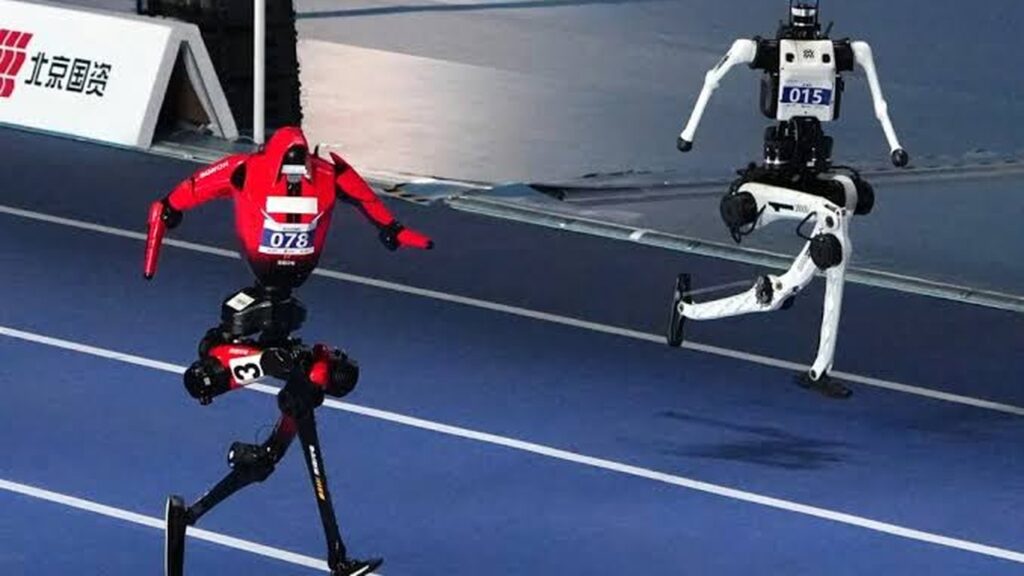
The sporting events have produced some remarkable results. Tiangong Ultra, developed by the Beijing Humanoid Robot Innovation Center, completed its 100-metre heat in 9.39 seconds, while Honor’s Lightning finished in 9.47 seconds. Both times were faster than Bolt’s human record. The improvement from the previous year’s competition was particularly notable: Tiangong Ultra had won the 100-metre event in 21.50 seconds at the inaugural games.
Yet athletic performance represents only one measure of progress. A robot can be exceptionally fast in a controlled race and still struggle with the ordinary physical interactions that define most human work.
Connecting a cable, identifying an object, positioning a component accurately or recovering from a small mistake can require a level of perception and coordination that is considerably more difficult than running along a marked track. Reuters’ reporting from the Beijing competition highlighted these practical tasks as a more revealing measure of whether humanoid robots are approaching commercial usefulness.
That gap between physical performance and practical usefulness has become one of the central challenges facing the industry.
The Commercial Test
Humanoid robotics has attracted considerable attention because the machines are designed to operate in environments already built for people. Unlike many conventional industrial robots, which perform highly specialised tasks within controlled production lines, humanoid machines are being developed with the expectation that they could eventually move through existing workplaces and perform a wider variety of activities.
The commercial challenge is therefore considerably broader than demonstrating that a robot can complete a particular task. Manufacturers need machines that can repeat those tasks consistently, operate safely, respond to changes in their surroundings and remain economically competitive.
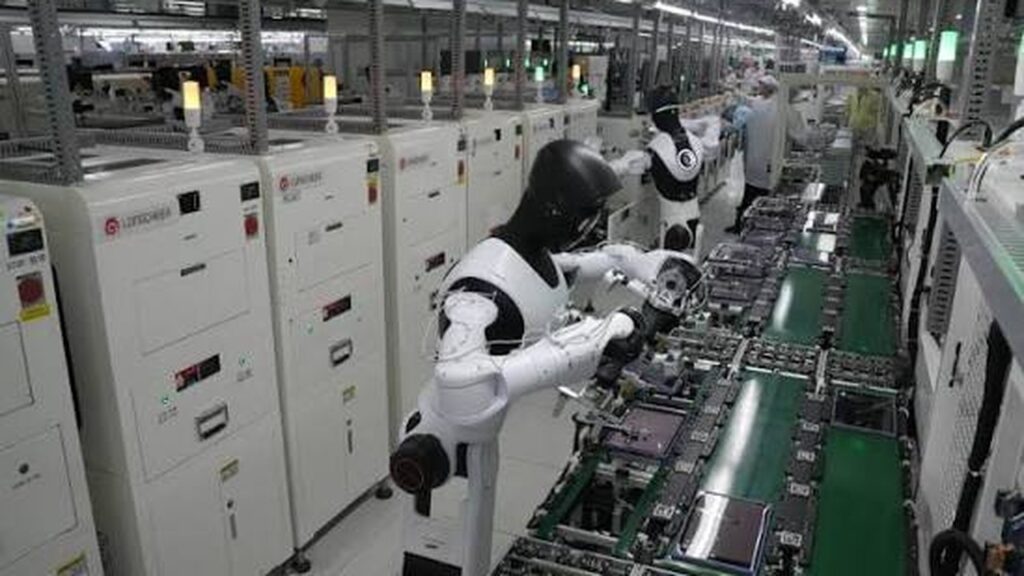
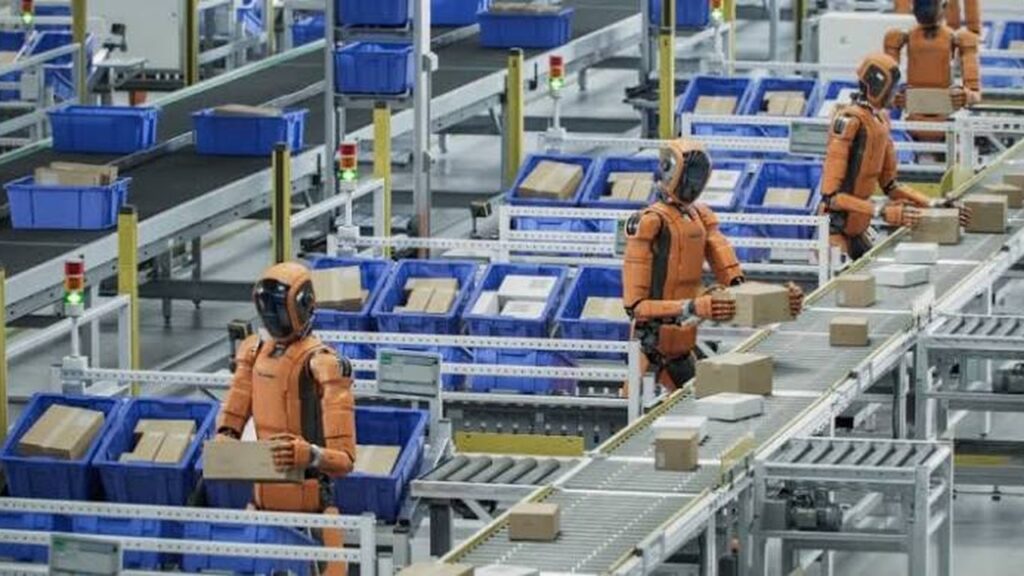
Chinese robotics companies are increasingly demonstrating machines in precisely these settings. At the World Robot Conference in Beijing, companies displayed humanoid robots sorting parcels, packing mobile phones and performing household tasks. More than 300 companies, mostly Chinese, exhibited products at the event, according to organisers, with more than 150 products being launched.
The development reflects a broader shift in China’s robotics industry from demonstration towards deployment. Companies are looking for factories, warehouses, shops and public spaces where robots can perform useful work rather than simply attract attention.
China’s Growing Robotics Industry
China’s interest in humanoid robots forms part of a much larger industrial push. The country already has extensive manufacturing capabilities across electronics, batteries, vehicles and industrial equipment, giving robotics companies access to a large domestic supply chain and manufacturing base.
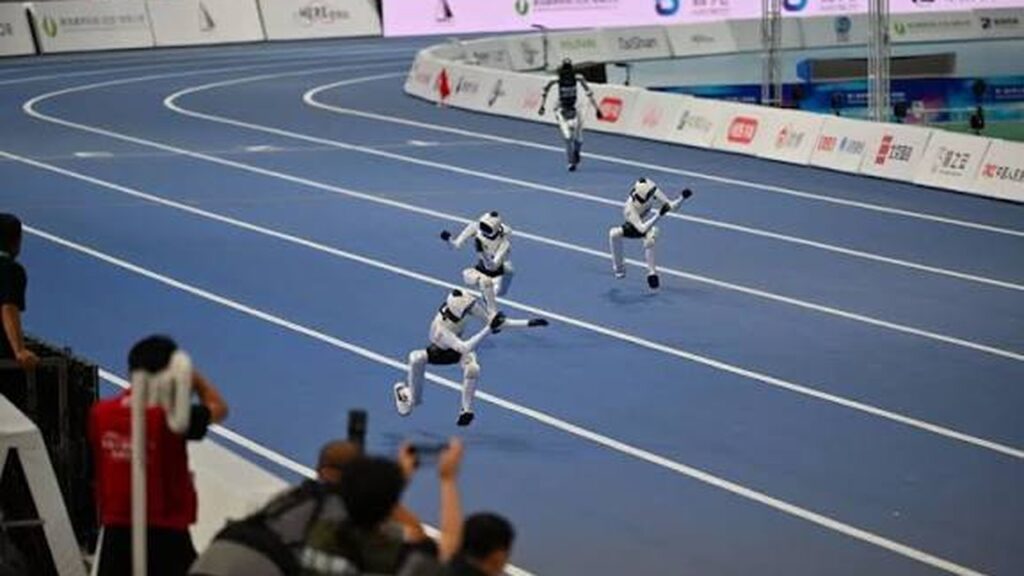
The country’s robot competitions have also changed in character. Reuters reported that China’s robot games, which began about a decade ago in a format resembling science fairs, have evolved into strategic showcases for an expanding robotics industry.
The growth is also attracting major financial investment. On August 24, Chinese electric vehicle maker Xpeng announced that its robotics unit had raised more than $900 million in its first funding round, giving the business a valuation of more than $6.3 billion. The company said the money would support robotics hardware and software development, physical-AI models, data collection, mass-production facilities and international expansion. Xpeng is targeting production of 1,000 humanoid robots a month by the end of 2026, with initial deployments planned for retail and industrial environments.
Another Chinese manufacturer, Chery’s robotics subsidiary AiMOGA, is also preparing for further expansion. The company has deployed more than 3,000 robots, including 2,000 overseas, and is targeting 10,000 global deliveries over the coming year, according to Reuters. Its applications include service robots and humanoid machines being used in public-safety and traffic-management roles.
These developments suggest that China’s humanoid robot industry is increasingly being treated as a commercial sector rather than a collection of experimental projects.
Where Human Jobs Could Face the Greatest Pressure
The potential effect on employment is likely to vary significantly by occupation. Jobs involving repetitive movements, predictable environments and physically demanding tasks are among the areas where automation has historically made the greatest progress.
Manufacturing is an obvious example. Assembly, packaging, sorting and material handling are activities in which machines can potentially repeat the same movements for long periods. Warehouses present similar opportunities, particularly in the movement and organisation of goods.
Logistics could also see greater automation as machines become better at handling packages and materials. Agriculture presents another potential area, although outdoor environments are considerably less predictable than factories and warehouses. Tasks involving harvesting, carrying, sorting and monitoring crops could eventually become more suitable for robotic assistance as the technology develops.
Construction is more complicated. Building sites change constantly, surfaces can be uneven and materials are often irregular. Nevertheless, individual repetitive or dangerous tasks could become increasingly automated without requiring the complete replacement of construction workers.
Cleaning and certain service activities could also become candidates for robotic assistance, particularly where the work is repetitive and takes place in predictable environments.
The transition would not necessarily mean that entire occupations disappear. In many cases, automation is more likely to alter the composition of a job, with workers spending less time on repetitive physical tasks and more time supervising machinery, maintaining systems or handling situations that require human judgement.
The Importance of Artificial Intelligence
The development of humanoid robots is closely linked to advances in artificial intelligence. The hardware provides the physical capability, while increasingly sophisticated AI systems are being developed to help machines interpret their surroundings, understand instructions and decide how to respond.
This is one of the major differences between traditional industrial automation and the emerging field of embodied AI. A conventional industrial robot may be highly effective at performing a specific programmed movement, but a humanoid robot intended for general-purpose work must cope with changing environments and tasks.
Chinese robotics executives have increasingly predicted major advances in this area. Unitree CEO Wang Xingxing said the industry could approach a breakthrough comparable to the arrival of ChatGPT, although he estimated that such progress in robot software could still be two to ten years away. Reuters reported that China delivered more than 40,000 humanoid robots in the first half of 2026 and accounted for 97% of the global market, although current humanoids remain less efficient than human labour.
Those figures underline both the scale of China’s investment and the gap that remains between technological progress and economic maturity.
A robot that can understand an instruction, identify an object and physically manipulate it in an unfamiliar environment would represent a significant step beyond today’s specialised automation. But achieving that consistently remains a substantial engineering challenge.
The Economics Behind the Robot Race
The long-term impact of humanoid robots will depend heavily on economics.
Companies do not adopt technology simply because it is technically impressive. They adopt it when the technology can deliver sufficient value relative to its cost.
For humanoid robots, that calculation includes the purchase price of the machine, energy consumption, maintenance, software, supervision, downtime and the reliability of its performance. A robot that can perform a task but frequently requires human intervention may offer little advantage over an existing workforce.
The economics could change as manufacturing volumes increase.
Large-scale production can reduce costs, while greater deployment provides companies with more data that can be used to improve robotic systems. Advances in batteries, sensors, processors and AI could also improve performance and reduce operating costs.
This is one reason China’s manufacturing capacity could be significant to the development of the sector. The country has experience producing complex hardware at large scale, and its robotics companies are operating within an industrial ecosystem that includes electronics, vehicles, batteries and automated manufacturing.
The transition from prototype to mass-produced machine, however, remains a major hurdle.
A New Phase of the Global Technology Race
The competition is not limited to China. Companies in the United States, Europe, Japan and South Korea are also pursuing humanoid robotics and related forms of embodied artificial intelligence.
The strategic importance of the technology extends beyond consumer applications. Advanced robots could eventually influence manufacturing, logistics, healthcare, infrastructure and other industries in which physical work represents a substantial part of operating costs.
Europe is already responding to the shift. Germany’s VDMA engineering association has called for humanoid robotics to receive greater political attention and for Europe to strengthen domestic supply chains for critical components.
The United States and China are also competing over the broader robotics ecosystem, including artificial intelligence, manufacturing capacity, advanced components and access to international markets.
The competition therefore resembles other technology races in which the eventual advantage depends not on a single invention but on the ability to combine research, capital, manufacturing and distribution.
What the Shift Could Mean for Africa
The implications become more complicated when the robotics race is viewed from Africa.
Many African economies have large working-age populations and rely heavily on labour-intensive industries. Manufacturing, agriculture, construction, logistics and services provide employment for millions of people, while comparatively low labour costs have often been considered an important factor in attracting investment.
Greater automation could alter that calculation in some industries.
If robots become capable of performing a growing range of physical tasks at competitive costs, businesses could place less emphasis on access to large pools of inexpensive labour when deciding where to locate certain operations.
That would not affect every industry equally. Human labour would remain important in occupations requiring judgement, interpersonal interaction, creativity and complex decision-making, while many physical environments would continue to be difficult to automate.
But the possibility represents a significant consideration for African economies seeking to industrialise through manufacturing.
At the same time, robotics could provide opportunities for African countries facing their own productivity and labour challenges. Machines could potentially perform dangerous tasks in mines and construction sites, support agricultural production, improve warehouse operations and assist healthcare workers.
The technology could therefore create both competitive pressures and productivity opportunities.
Nigeria’s Workforce in an Automated World
Nigeria presents a particularly important case because of the size and age of its population and the country’s long-standing ambitions to expand productive employment through manufacturing, agriculture, technology and other sectors.
A manufacturing model based primarily on abundant low-cost labour could face greater competition if automation reduces the labour component of production elsewhere.
But automation could also strengthen Nigerian industries if businesses use technology to increase output, improve quality and reduce the risks associated with dangerous or repetitive work.
Agriculture could provide one example. Robotic and autonomous systems could eventually assist with monitoring, harvesting, transportation and other tasks. In manufacturing, automated equipment could support assembly and quality control. Logistics companies could use increasingly sophisticated machines for sorting and warehouse operations.
The effect on employment would depend partly on how quickly businesses adopt such technologies and which tasks they automate.
For workers, the skills associated with robotics, artificial intelligence, engineering, maintenance, data and systems management could become increasingly valuable as workplaces become more automated.
The Jobs That May Change Rather Than Disappear
The history of automation suggests that technological change does not always produce a simple replacement of one worker by one machine.
Industrial machinery transformed agriculture without eliminating the need for food production. Computers removed some clerical tasks while creating entirely new professions. Industrial robots reduced the need for certain forms of manual production while creating demand for technicians, engineers and operators.
Humanoid robotics could follow a similar pattern.
A warehouse worker could increasingly supervise automated systems rather than manually move every package. A factory technician could spend more time maintaining robotic equipment. An agricultural worker could operate autonomous machinery across a larger area. A construction worker could use robots for dangerous or physically demanding activities.
The resulting labour market could therefore contain fewer people performing some repetitive tasks and more people managing increasingly sophisticated systems.
The transition could nevertheless be disruptive, particularly where workers lack access to retraining or where new occupations require skills that are difficult to acquire quickly.
The Test China Has Yet to Pass
For all the progress on display in Beijing, humanoid robots have not yet demonstrated that they can broadly replace human workers.
The 9.39-second sprint is an extraordinary engineering achievement, but speed is only one component of useful physical intelligence. The more difficult problems involve manipulating unfamiliar objects, responding to unexpected conditions, maintaining balance, correcting errors and completing tasks repeatedly without human intervention.
Those challenges explain why the industry’s attention is shifting from demonstrations towards practical applications.
The decisive evidence will come from workplaces rather than sporting arenas.
A robot that can work reliably for long periods, perform multiple tasks, recover from mistakes and operate at a competitive cost would have far greater economic significance than one that simply wins a race.
That threshold has not yet been universally reached.
But the investment flowing into the sector suggests that companies believe the technology is moving closer.
The Beginning of a New Industrial Era?
China’s humanoid robot programme is developing at the intersection of several major technological trends: artificial intelligence, advanced manufacturing, automation and increasingly sophisticated sensors and computing systems.
The country’s companies are testing robots in environments that resemble ordinary workplaces, while investors are placing increasingly large bets on the possibility of mass commercial adoption.
The outcome remains uncertain.
Some applications will succeed. Others will prove too expensive, unreliable or technically difficult. Some occupations will change faster than others, and many jobs will continue to require human judgement and interaction.
But the direction of development is becoming harder to ignore.
The most significant change may not come when a robot performs an extraordinary feat that attracts millions of views. It may come when a machine quietly enters a factory, warehouse, farm or service business and begins performing a task that previously required a human worker.
That would mark a different kind of milestone.
It would mean the humanoid robot had moved from demonstration to production.
And once that transition occurs at scale, the consequences will extend far beyond China’s technology industry.
They will reach factories, labour markets, education systems and economies around the world.
For Africa and Nigeria, the emerging robotics race therefore represents more than another chapter in China’s technological rise. It is an early indication of how the value of human labour could change as artificial intelligence begins to operate not only through computers and software, but through machines capable of moving and working in the physical world.
China’s robots may still have a long way to go before they can match humans across the workplace.
RECOMMENDED ARTICLE
About the Author